
How Much Does Food Truck Business Insurance Cost?

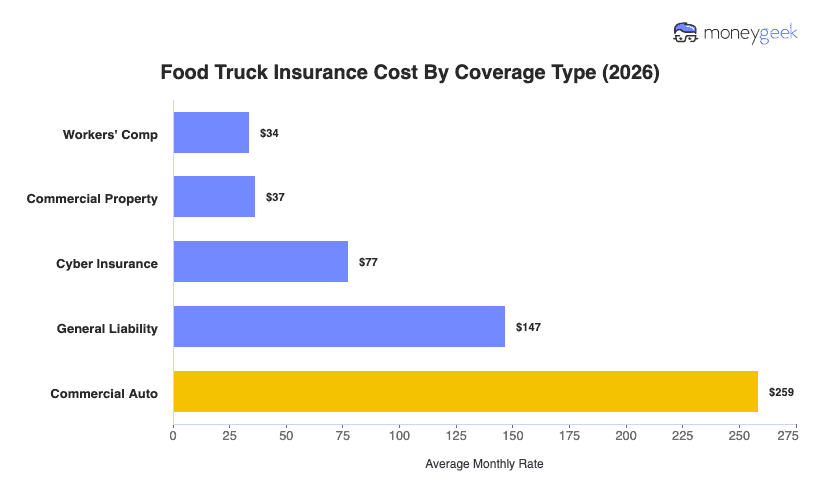
Most food trucks pay about $443 per month for business insurance. That's how much my recommended bundle costs, which includes commercial auto, general liability, and commercial property. It covers the everyday risks nearly every truck faces, like a customer who slips at your window or gets sick from your food, or an accident on the road. While this is what I'd recommend for most trucks, the total cost of food insurance for food trucks still depends on the coverages you include.

You don't have to carry all of it at once, though. If my recommended bundle feels like too much, consider the starting bundle instead. It covers the basics to get you on the road, and you can add coverage as your business grows.

Starting

Commercial auto + general liability

$406
A solo operator getting on the road with a simple menu and no employees.
Recommended

Starting + commercial property

$443
An owner with a built-out truck and equipment worth protecting.
Growing

Recommended + cyber insurance

$520
Any truck taking card payments, which is nearly everyone.
Comprehensive

Growing + workers' compensation + equipment breakdown

$592

A truck with employees on the payroll.

We analyzed quote data from 10 major U.S. commercial insurance providers, modeled standardized premium estimates for food truck business profiles across all states (including D.C.), and employee counts from sole proprietorships to 49-employee operations.

Our published averages represent modeled premiums for standardized business profiles and were aggregated in three ways.

  • National benchmark average: The national average cost reflects the modeled premium for a standardized one-to-four-employee food truck business across all 50 states and D.C. at standard industry-recommended policy limits.
  • State averages: To show how costs vary, we calculated average modeled premiums for our national base profile and isolated them for each state and D.C.
  • Bundle averages: We added the individual policy premiums together, before any discounts, to get each bundle total. This matches how the per-state bundle totals in the state table were computed.

Other coverage costs, including food spoilage, equipment breakdown, inland marine, and liquor liability insurance, were gathered externally, and minimum, maximum, and national average rates for most small food truck companies were presented.

See our full business insurance methodology.

Get Food Truck Business Insurance Cost Estimates

The food truck business insurance cost calculator below gives you a more personalized estimate so you can compare rates. Once you have a baseline, you can pull a quote from your top provider based on the details you enter.

Get Food Truck Insurance Cost Estimates
Select Coverage Type
Select State
Select Employee Count
Select vehicle_type
Monthly Rate Estimate

Factors Affecting Food Truck Business Insurance Costs

A food truck is a vehicle, a kitchen, and a customer-facing business all at once, so more factors affect your rate than they would for a typical small business. Which ones matter most depends on your setup. The standard factors that affect any business also apply, like your revenue, employee count, claims history, and location.

  • fryingPan icon

    Cooking equipment and heat sources

    If your truck runs propane systems, deep fryers or commercial grills, those heat sources affect how insurers price your policy. Operating that equipment inside a moving vehicle adds fire exposure a fixed kitchen doesn't carry. A cold-prep or pre-packaged menu places your truck in a lower fire-risk tier.

  • rideshare icon

    Operating model and territory

    A food truck parked at the same office pitch every weekday carries more predictable exposure than one covering farmers markets, food festivals and private catering across multiple locations. Running a multi-county circuit, adding alcohol service or stacking event weekends each shifts your risk profile in ways a fixed pitch doesn't.

  • money2 icon

    Annual revenue

    Food trucks can swing between a quiet Tuesday lunch doing a few hundred dollars and a festival weekend clearing several thousand. Underwriters use annual revenue to assess how much liability exposure your customer volume creates, since more service means more food handling and more potential claims from a foodborne illness or customer injury.

  • pickupTruck icon

    Truck age and build

    Many food trucks are converted vehicles, and your build's age and condition affect how underwriters approach replacement value and mechanical risk. A 20-year-old converted step van sits in a different risk tier than a purpose-built commercial unit. Generator mounts, cold-side additions and service window extensions can each shift your classification.

  • smallBusiness icon

    Off-truck operations

    If you prep at a commissary kitchen, serve at client sites or run indoor pop-ups, your liability exposure extends beyond the truck. A slip-and-fall at the commissary or property damage at a catered event may fall outside your standard policy unless those locations are specifically addressed in your coverage.

How to Lower Food Truck Business Insurance Costs

Getting cheap food truck business insurance starts with knowing which levers actually move the needle for your operation. Some, like comparing quotes across the smaller pool of insurers that understand mobile food operations, can immediately lower your renewal rate. Others, like adjusting your route or investing in safety practices, reduce your risk profile over time and strengthen your position at renewal. Below, I go over the most common methods that can help you save the most.

  • vsDocuments icon

    Compare quotes using the same coverage limits

    The pool of insurers who understand mobile food operations is smaller than the general market, and prices vary a lot between them. Ask each one to quote the same coverages, limits, and deductibles before comparing business insurance quotes. Otherwise a cheap quote might just mean less protection, not a better deal.

  • uninsured icon

    Right-size your coverage

    Review your limits and your truck's value at each renewal. If your truck is an older converted vehicle, insuring it at actual cash value instead of replacement cost saves money. If you work mostly low-volume markets, your liability limits may be set higher than you need.

  • shoppingBag icon

    Bundle policies with the same provider

    When your commercial auto and general liability sit with different insurers, a single incident can turn into a fight over which policy pays first. Specialty insurers often package auto, general liability, workers' comp, and property together at a lower combined rate, and bundling saves you the hassle of juggling providers.

  • insurance2 icon

    Lower your risk profile

    Insurers re-check your operation at every renewal, so improvements show up in next year's quote. Switching from propane to electric equipment, moving from a festival circuit to a steady fixed spot, earning a food safety certification, or adding a fire suppression system all signal lower risk.

  • stackOfBooks icon

    Invest in risk management practices

    The claims that raise food truck rates are usually kitchen fires, foodborne illness, customer injuries at the window, and road incidents. Handling these before they happen builds the claim-free record that keeps your rate down. A few worth doing:

    • Install a fire suppression system in your cooking area, especially if you run open flames.
    • Make sure anyone handling food holds a current food handler certification.
    • Fit a dashcam and keep a service log so you have proof if a road incident becomes a dispute.
    • Keep records of commissary inspections and off-truck prep so claims at those sites have documentation behind them.

Food Truck Business Insurance Cost: Bottom Line

A recommended food truck bundle costs an average of $443 per month, but your actual cost depends on the coverages your truck needs. A solo cold-prep operator without employees usually needs less than a staffed festival truck with a full propane kitchen. Use these three questions to review your quote and put it in context:

  1. Does the bundle include the right coverages? Check whether it covers the way you run. A lower price may leave out commercial property, cyber, or another coverage your truck actually needs.
  2. Which coverage is adding the most to the total? Look at each coverage's price instead of just the bundle total. That shows whether one coverage (usually commercial auto), your state, or part of your operation is driving the quote up.
  3. Are you comparing quotes with the same details? Make sure each insurer is pricing the same coverages, limits, and deductibles. One quote may look cheaper only because it covers less.

The goal isn't to match the estimates on this page. Focus on choosing or building a bundle that fits your truck without paying for coverage you don't need.

Food Truck Insurance Cost Chart

About Angelique Palenzuela-Cruz


Angelique Palenzuela-Cruz, Business Insurance Writer, MoneyGeek

Angelique Palenzuela-Cruz is a Business Insurance Content Writer at MoneyGeek, where she specializes in general liability, workers’ compensation and professional liability insurance. Her work helps small business owners understand how these policies apply to coverage, including risks like customer injuries, employee injuries, professional mistakes, client contract terms and industry-specific coverage requirements.
She primarily covers service-based businesses where liability and employee coverage decisions are especially important, including cleaning, consulting, beauty and wellness, childcare, education, fitness, food service, pet care, repair and maintenance, and other professional services.
Before joining MoneyGeek, Angelique spent nearly 12 years at Guthrie-Jensen Consultants, one of Southeast Asia’s largest management training firms, where she advanced from Training Consultant to Managing Consultant. In that role, she worked with business clients to assess operational needs, develop training programs and present performance analyses to executive decision-makers. She also helped establish Gladwin Training Consultancy, where she served in learning solutions and client service roles.
Her background gives her practical context for writing about how businesses operate, manage client expectations, structure teams and make risk decisions. At MoneyGeek, she applies that experience to business insurance content, connecting coverage to actual business needs.

LinkedIn: linkedin.com/in/ma-angela-cruz

Email Contact: angelique.palenzuela@moneygeek.com