

How Much Does Electrical Contractor Insurance Cost?

The monthly cost for electrical contractor insurance ranges from an average of $579 on average for a starting bundle to $1,258 for a bundle for expanded operations. The bundle your operations need depends on your services and business size. The more complex your business becomes, the more coverages you'll likely need, which affect your total cost. For example, you'll need professional liability only if design electrical systems your clients, and cyber insurance if you accept digital or online payments and store customer information electronically.

The bundle costs use national averages, so don't expect the exact figure when you request quotes. I've put the table below so you can see which one fits your business best:

Starting Bundle
General liability, commercial auto
$579
$6,948
Solo electricians or start up electrical operations using a business-owned vehicle
Recommended Bundle
General liability, commercial auto, tools and equipment
$606
$7,272
Independent electricians with higher-value tools
Growing Business Bundle
General liability, commercial auto, tools and equipment, workers' compensation
$881
$10,565
Electrical contractors with employees or apprentices
Expanded Operations Bundle
General liability, commercial auto, tools and equipment, workers' compensation, commercial property, umbrella liability, professional liability, cyber liability
$1,258
$15,101
Established electrical contractors with larger operations

Note: Our estimates were from quotes for electrical contractor companies with less than five employees across all states and the District of Columbia. Commercial auto insurance only assumes a single vehicle, while workers' comp assumes one employee. We completed external research to determine the estimates for specialized coverages such as tools and equipment insurance and installation floater coverage. Their rates are separate from our dataset.

Average Electrical Contractor Insurance Cost Overview By Coverage Type

The complexity of your operations and your business size determine the coverage types you should include in your policy. Individually, coverage range from an average of $9 per month for surety bonds to $379 per month for general liability. I've put the table below together so you can see what your insurance plan can include, but it's unlikely that you'll need everything in it.

$9
$108
Your license, permit, bid or contract requires a bond.
$27
$324
Replacing your testers, drills, ladders or specialty tools would cost $1,000 to $2,500+.
$61*
$733
You buy or store wire, panels, generators, EV chargers or other materials before the customer pays for the finished job.
$87
$1,041
Your business runs through digital records, online payments, cloud software or connected electrical systems.
$92
$1,104
Your contract requires higher liability limits than your general liability or auto policy provides.
$99
$1,193
You keep inventory, panels, wire, spare tools or business equipment at a shop, warehouse or storage unit.
$100
$1,198
You design electrical systems, write specs or give paid recommendations that clients rely on.
$200
$2,395
A van, truck or trailer is part of how you get workers, tools or materials to jobs.
$274
$3,293
Someone other than you works in the business, even as an apprentice or helper.
$379
$4,553
You enter homes, buildings or job sites to perform electrical work.

Note: The estimates for installation floater is based on approximately $100,000 in covered installation materials with a $1,000 deductible.

How Much Does General Liability Insurance Cost for Electrical Contractors?

General liability insurance covers third-party injury, property damage and completed-work claims tied to electrical work. For example, a customer who tripped over job-site materials or faulty wiring damaging property can sue after the job is done. For a standard $1 million per occurrence / $2 million aggregate policy, you'll pay an average of $379 per month. Clients, landlords, general contractors or permit offices usually require you to carry GL insurance before can start work.

At the state level, average general liability costs vary by 191%. You'll pay an average of $230 per month in West Virginia, which reflects lower repair costs and a less expensive claims environment. If you're in California, you're more likely to work on multifamily buildings and commercial projects. Add a more expensive legal environment and you'll see GL rates averaging $671 per month.

Alabama$277$3,324
Alaska$504$6,051
Arizona$381$4,559
Arkansas$256$3,075
California$671$8,057
Colorado$467$5,601
Connecticut$523$6,277
Delaware$406$4,869
District of Columbia$646$7,751
Florida$474$5,693
Georgia$360$4,320
Hawaii$506$6,068
Idaho$265$3,182
Illinois$453$5,442
Indiana$317$3,806
Iowa$268$3,221
Kansas$295$3,545
Kentucky$293$3,517
Louisiana$333$4,000
Maine$326$3,903
Maryland$501$6,012
Massachusetts$585$7,025
Michigan$346$4,148
Minnesota$410$4,916
Mississippi$236$2,829
Missouri$314$3,765
Montana$266$3,193
Nebraska$300$3,601
Nevada$409$4,912
New Hampshire$417$5,010
New Jersey$543$6,520
New Mexico$280$3,361
New York$631$7,572
North Carolina$342$4,101
North Dakota$274$3,284
Ohio$331$3,975
Oklahoma$290$3,486
Oregon$438$5,251
Pennsylvania$394$4,730
Rhode Island$410$4,916
South Carolina$280$3,363
South Dakota$248$2,974
Tennessee$331$3,970
Texas$386$4,634
Utah$328$3,932
Vermont$375$4,501
Virginia$430$5,157
Washington$518$6,213
West Virginia$230$2,764
Wisconsin$328$3,933
Wyoming$266$3,188

How Much Does Commercial Auto Insurance Cost for Electrical Contractors?

If your business owns uses a van, truck or trailer to drive between jobs, pick up materials or move tools, you’ll likely need commercial auto insurance in your bundle. Your policy, which costs $200 per month on average, helps pay for accident-related costs, such as damage to your own vehicle, injuries to other people, legal claims and damage your work vehicle causes to someone else’s property. Commercial auto requirements vary by state, so check your state’s minimum coverage rules before choosing limits.

Electrical contractors pay an average of $381 per month in Michigan, which is more than double than what you'd spend in Iowa, where coverage costs around $117 per month. Michigan’s higher cost is partly tied to its no-fault insurance system, so auto claims can involve medical benefits for injured drivers or passengers. That leads to higher rates since insurers price policies for more than vehicle repairs.

Alabama$169$2,027
Alaska$331$3,975
Arizona$182$2,187
Arkansas$182$2,184
California$251$3,014
Colorado$201$2,412
Connecticut$234$2,805
Delaware$165$1,983
Florida$284$3,409
Georgia$193$2,313
Hawaii$106$1,278
Idaho$127$1,519
Illinois$222$2,665
Indiana$188$2,257
Iowa$117$1,406
Kansas$175$2,106
Kentucky$192$2,298
Louisiana$220$2,645
Maine$224$2,690
Maryland$244$2,923
Massachusetts$243$2,915
Michigan$381$4,576
Minnesota$199$2,382
Mississippi$186$2,227
Missouri$229$2,752
Montana$161$1,929
Nebraska$165$1,983
Nevada$200$2,399
New Hampshire$142$1,705
New Jersey$250$3,006
New Mexico$157$1,878
New York$262$3,145
North Carolina$198$2,371
North Dakota$154$1,843
Ohio$192$2,309
Oklahoma$178$2,133
Oregon$192$2,308
Pennsylvania$100$1,197
Rhode Island$248$2,980
South Carolina$199$2,384
South Dakota$221$2,658
Tennessee$178$2,133
Texas$271$3,246
Utah$179$2,150
Vermont$110$1,317
Virginia$212$2,541
Washington$189$2,263
Washington DC$272$3,262
West Virginia$190$2,279
Wisconsin$146$1,748
Wyoming$171$2,053

How Much Does Workers’ Comp Insurance Cost for Electrical Contractors?

Once you hire someone, workers’ compensation becomes one of the bigger costs in your insurance plan as it costs an average of $274 per month per employee, or $3,293 per year. It helps pay for work-related injuries, which include medical care and lost wages after shocks, burns, falls, cuts or lifting injuries. Most states require workers’ comp once you have employees, but the rules for owners, apprentices, part-time help and subcontractors vary by state.

In Indiana, workers’ comp costs average $150 per month per employee. In New York, the average is $639, which is more than triple than Indiana. How New York handles subcontractors affects WC premiums. If a contractor hires uninsured subcontractors, those workers can be counted when the insurer calculates the contractor’s workers’ comp cost. Indiana’s lower rate reflects better claims trends, including fewer serious lost-time injuries and lower average injury costs.

Alabama$174$2,087
Alaska$437$5,249
Arizona$216$2,591
Arkansas$156$1,877
California$639$7,667
Colorado$272$3,265
Connecticut$495$5,936
Delaware$331$3,970
District of Columbia$574$6,887
Florida$256$3,071
Georgia$239$2,874
Hawaii$338$4,062
Idaho$169$2,033
Illinois$347$4,160
Indiana$150$1,802
Iowa$164$1,964
Kansas$178$2,132
Kentucky$190$2,282
Louisiana$253$3,033
Maine$241$2,888
Maryland$289$3,464
Massachusetts$450$5,404
Michigan$281$3,376
Minnesota$275$3,299
Mississippi$169$2,033
Missouri$218$2,618
Montana$227$2,723
Nebraska$176$2,108
Nevada$235$2,819
New Hampshire$281$3,368
New Jersey$477$5,727
New Mexico$201$2,415
New York$630$7,559
North Carolina$212$2,549
Oklahoma$227$2,723
Oregon$252$3,022
Pennsylvania$346$4,147
Rhode Island$294$3,530
South Carolina$250$3,001
South Dakota$155$1,861
Tennessee$195$2,342
Texas$184$2,210
Utah$174$2,090
Vermont$259$3,106
Virginia$201$2,414
West Virginia$238$2,857
Wisconsin$229$2,747

How Much Does Commercial Property Insurance Cost for Electrical Contractors?

Commercial property insurance covers business property, such as wire, panels, testing equipment or office equipment kept in a shop, office or warehouse. A policy with a $100,000 business personal property coverage limit costs an average of $99 per month or $1,193 per year. While you generally aren’t required to carry commercial property, you’ll need it if your lease requires it or if you store enough tools, materials or inventory in one place that a fire, theft or break-in could stop you from accepting jobs. 

The cost difference between the cheapest and most expensive states is only $32 per month. Electrical contractors pay an average of $87 per month in North Dakota, while the cost of commercial property insurance in New York is around $119. New York’s higher average likely reflects the higher cost of property claims in the state. If a fire, theft or break-in damages an electrician’s shop, stored materials or business equipment, insurers may expect repairs and replacements to cost more in there than in lower-cost states.

Alabama$92$1,100
Alaska$110$1,324
Arizona$100$1,195
Arkansas$89$1,065
California$115$1,383
Colorado$104$1,242
Connecticut$111$1,332
Delaware$104$1,252
District of Columbia$116$1,391
Florida$111$1,329
Georgia$98$1,170
Hawaii$117$1,406
Idaho$95$1,137
Illinois$103$1,233
Indiana$92$1,104
Iowa$89$1,067
Kansas$89$1,069
Kentucky$91$1,087
Louisiana$102$1,223
Maine$95$1,137
Maryland$107$1,286
Massachusetts$113$1,356
Michigan$95$1,140
Minnesota$98$1,174
Mississippi$90$1,076
Missouri$91$1,091
Montana$92$1,106
Nebraska$88$1,059
Nevada$102$1,219
New Hampshire$98$1,181
New Jersey$115$1,385
New Mexico$93$1,113
New York$119$1,426
North Carolina$98$1,177
North Dakota$87$1,047
Ohio$95$1,139
Oklahoma$91$1,097
Oregon$105$1,254
Pennsylvania$105$1,262
Rhode Island$108$1,297
South Carolina$96$1,156
South Dakota$88$1,057
Tennessee$94$1,122
Texas$106$1,267
Utah$98$1,172
Vermont$95$1,145
Virginia$100$1,199
Washington$108$1,290
West Virginia$89$1,066
Wisconsin$94$1,126
Wyoming$90$1,083

How Much Does Professional Liability Insurance Cost for Electrical Contractors?

You'll spend an average of $100 per month or $1,198 per year for a professional liability policy with $1 million per-occurrence/$2 million aggregate limits. It covers claims tied to your electrical design advice or system recommendations. Not all electricians need it in their policy mix, but if you do design-build work, make load calculations or stamp plans or specs, check your contract for professional liability requirements.

Professional liability costs in North Dakota average $92 per month, where there's a smaller, lower-cost market for professional disputes tied to electrical design or consulting work. You’ll pay about 24% more in New York, where monthly rates average $114 per month. You'll likely have larger commercial projects in New York, and with rising verdict severity and higher litigation costs, that leads to more expensive premiums.

Alabama$1,140$95
Alaska$1,241$103
Arizona$1,213$101
Arkansas$1,129$94
California$1,361$113
Colorado$1,204$100
Connecticut$1,245$104
Delaware$1,208$101
Florida$1,297$108
Georgia$1,240$103
Hawaii$1,266$105
Idaho$1,126$94
Illinois$1,276$106
Indiana$1,156$96
Iowa$1,128$94
Kansas$1,111$93
Kentucky$1,150$96
Louisiana$1,263$105
Maine$1,141$95
Maryland$1,233$103
Massachusetts$1,259$105
Michigan$1,190$99
Minnesota$1,178$98
Mississippi$1,233$103
Missouri$1,167$97
Montana$1,127$94
Nebraska$1,132$94
Nevada$1,229$102
New Hampshire$1,150$96
New Jersey$1,323$110
New Mexico$1,154$96
New York$1,369$114
North Carolina$1,168$97
North Dakota$1,100$92
Ohio$1,174$98
Oklahoma$1,149$96
Oregon$1,213$101
Pennsylvania$1,292$108
Rhode Island$1,208$101
South Carolina$1,193$99
South Dakota$1,123$94
Tennessee$1,175$98
Texas$1,257$105
Utah$1,143$95
Vermont$1,134$94
Virginia$1,187$99
Washington$1,224$102
Washington DC$1,274$106
West Virginia$1,159$97
Wisconsin$1,166$97
Wyoming$1,118$93

How Much Does Cyber Insurance Cost for Electrical Contractors?

Cyber liability insurance, which costs an average of $87 per month or $1,041 per year, covers data breaches, ransomware, payment fraud and other cyber incidents. For electricians, the need for cyber coverage goes beyond basic office data. When you work with connected systems like smart panels, EV chargers or building controls you have extra exposure because a cyber incident could affect customer systems and building operations. Some D.C. government contracts also require you to carry cyber liability insurance with specified limits, which can push cyber coverage from optional into a contract requirement.

Four states share the lowest rate in our dataset. Electricians in Alaska, Montana, North Dakota and Wyoming spend an average of $74 per month, but if you're in D.C., cyber insurance costs 1.45x higher. There, you'll need to budget around $107 per month. Electrical contractors in D.C. are more likely serving commercial buildings, public-sector clients or organizations with stricter data and vendor-security requirements.

Alabama$84$1,007
Alaska$74$883
Arizona$88$1,056
Arkansas$79$953
California$102$1,224
Colorado$94$1,128
Connecticut$99$1,186
Delaware$96$1,158
District of Columbia$107$1,285
Florida$94$1,128
Georgia$92$1,106
Hawaii$78$935
Idaho$76$906
Illinois$98$1,184
Indiana$86$1,037
Iowa$78$935
Kansas$82$985
Kentucky$84$1,006
Louisiana$84$1,006
Maine$78$934
Maryland$99$1,188
Massachusetts$99$1,186
Michigan$88$1,056
Minnesota$88$1,057
Mississippi$79$957
Missouri$86$1,037
Montana$74$886
Nebraska$78$936
Nevada$96$1,154
New Hampshire$78$935
New Jersey$101$1,208
New Mexico$79$955
New York$105$1,258
North Carolina$90$1,084
North Dakota$74$885
Ohio$88$1,053
Oklahoma$82$985
Oregon$90$1,087
Pennsylvania$90$1,084
Rhode Island$78$934
South Carolina$84$1,006
South Dakota$76$906
Tennessee$86$1,035
Texas$94$1,126
Utah$82$986
Vermont$78$934
Virginia$96$1,154
Washington$96$1,154
West Virginia$76$906
Wisconsin$86$1,037
Wyoming$74$883

How Much Do Specialized Insurance Policies Cost For Electrical Contractors?

Beyond the common coverages, you might need specialized policies to build the right insurance bundle for your business. Consider an installation floater if you buy materials, from panels and wires to generators and EV chargers, before they’re installed and paid for. When you start working with commercial policies and your clients require you to carry higher limits, a commercial umbrella policy should be in your bundle.

Use the table below to see which extra coverages apply to your business. These estimates aren’t part of our dataset, but they are reliable benchmarks based on external research.

Pays the client or government agency if you don’t meet the terms of a license, permit, bid or contract.
$4 to $13
If you bid on bonded jobs, apply for certain electrical licenses or take contracts that require a bond.
Pays to repair or replace covered tools and equipment that are stolen or damaged.
$6 to $48
When you carry expensive testers, drills, ladders or portable equipment from one job site to another.
Installation Floater
Covers materials and equipment before they’re fully installed, including items in transit or stored at a job site.
Around $61 (based on approximately $100,000 in covered installation materials with a $1,000 deductible)
For electricians who buy transformers, circuit breakers or low-voltage cabling to install later.
Adds extra liability coverage when a large claim goes beyond your general liability or auto policy limits.
$40 to $143
When you bid on larger commercial jobs or contracts that require higher liability limits.

Factors Affecting Electrical Contractor Insurance Costs

How much you pay for electrical contractor insurance depends on several factors. Some are specific to electrical work, like the complexity of your job you take and your jobsite. Others, like claims history or business size affect all industries.

I've explained both categories below:

Electrical Contractor-Specific Insurance Cost Factors

Electricians in the same state can pay different premiums if their work, job sites and crew setup create different levels of risk. These factors are most likely to affect your rate:

  • lightSwitch icon
    Type of electrical jobs you take

    Insurers look at how much damage a mistake could create, so electricians doing outlet repairs and fixture installs usually pays less because the work is limited to a smaller part of the electrical system. If you’re wiring new construction or replacing service panels, you’ll spend more in coverage since faulty work can damage larger systems or delay an entire project.

  • signupBonus icon
    Project size and contract value

    A solo electrician handling small repair tickets pays less than a contractor taking a $75,000 commercial buildout since one electrical issue can lead to delays or contract disputes. A larger contract usually gives the insurer more to price for because it involves more materials, labor hours and coordination. It could also lead to bigger financial loss if the work has to be redone.

  • business icon
    Worksite environment

    Some jobsites open you to exposure more than others. Residential service work is easier to insure because the job usually happens in one home, with fewer workers. But if you work in restaurants, factories or rooftops, expect a higher premium because an accident typically involves employees, customers, machinery, inventory or harder-to-access work areas.

  • rentPapers icon
    System complexity

    If you usually install switches, outlets and light fixtures, coverage is more affordable. Even if you make mistakes, these are usually limited to a smaller part of the property. An electrical contractor working on generators, fire alarm systems, control panels or smart building controls see higher rates because errors can disrupt business operations or multiple connected components.

  • contractor icon
    Crew size and supervision setup

    Insurance premiums increase when your business depends on more people to get the job done. If you’re licensed but work alone, your risk is mostly tied to your own electrical work, driving, tools and completed jobs. Once you hire apprentices or subcontractors and send them to different job sites, you aren’t there with them all the time. Insurers quote higher rates because they also have to account for employee or customer injuries, property damage and workmanship issues.

General Factors That Affect Any Business Premium

These factors are more general. They affect insurance rates of all businesses, not just those of electricians.

How to Lower Electrical Contractor Insurance Costs

Electricians pay higher premiums on average than almost half of the professions in our contractor study. More affordable rates involve applying methods that affect your rates within the same policy cycle and putting practices in place that lower your premiums in the long-term. I listed strategies that cover both timelines.

  • vsDocuments icon
    Compare quotes using the same coverage limits

    Make sure every quote uses the information. These include your revenue, payroll, job types, vehicles, tool values, coverage limits and deductibles. This keeps the comparison fair. A quote may look cheaper only because it uses lower limits, excludes a coverage you need or leaves out risks tied to your electrical work.

  • insurance2 icon
    Right-size your coverage

    Match your coverage to the work you actually do. A solo electrician handling residential repairs may not need the same policy mix as a contractor wiring commercial buildouts, storing materials or offering design-build services. Removing coverage you do not need can lower costs, but don't let go of those tied to your core jobs.

  • shoppingBag icon
    Bundle policies with the same provider

    Most insurers offer a discount if you buy multiple policies from them. Bundling can also make your coverage easier to manage because you have one provider for certificates, renewals, billing and policy updates as your business changes.

  • barChart icon
    Lower your risk profile

    Your insurance costs tend to increase as your business becomes more complex, but you don’t have to avoid larger jobs to keep your rates manageable. Instead, make higher-value work easier to insure. A contractor moving into commercial projects will still pay more than a solo residential electrician, but clean contracts, insured subcontractors and documented inspections can help prevent disputes and avoid claims that raise future premiums.

  • stackOfBooks icon
    Invest in risk management practices

    Stronger safety and documentation habits can reduce claims. Over time, fewer losses can help your business look cleaner to insurers at renewal. Look at these safety measures for your operations:

    • Keep permits, inspection records and change orders in one place so you can back up your work if a client questions the completed job.
    • Use lockout/tagout before panel work or equipment repairs so your crew is less likely to face shock or burn injuries.
    • Lock up testers and specialty tools between jobs to reduce theft from vans, trailers and job sites.
    • Check your employees' work before closeout so mistakes are caught before the customer signs off.

Electrical Contractor Insurance Cost: Bottom Line

Our recommended electrical contractor insurance bundle costs an average of $606 per month. Treat that figure as a reference point, not a target, since your actual premium can change based on your job mix, crew size, location and coverage needs.

The questions below can help you put your electrical contractor insurance quote in context.

  1. Where do you fall in the distribution? Compare your quote with the benchmarks that match your trade, state and employee count. A solo residential electrician and a larger contractor with crews may sit in different parts of the range for valid reasons.
  2. Is your quote consistent with your risk profile? A quote far above or below the benchmarks deserves a closer look. The gap may reflect limits, exclusions, payroll assumptions, job types or missing coverages rather than a true price difference.
  3. Which cost drivers apply to your business? Not every factor carries the same weight. A service electrician may be shaped more by vehicles and tools, while a design-build contractor may see more pressure from professional liability and contract requirements.

It helps you see whether the policies inside the bundle match what your business actually needs, not just whether the rates are above or below the average. Use the benchmark to understand what's driving the total cost, which coverages belong in your bundle and whether the quote reflects the business being insured.
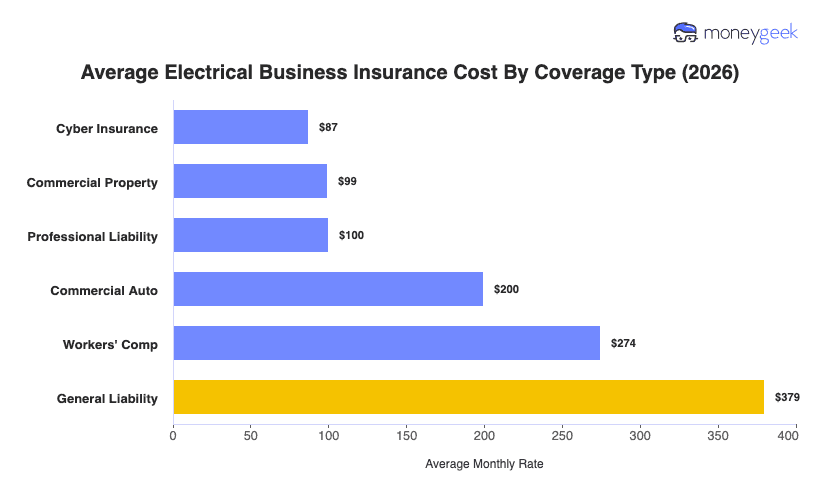
Electrical Business Insurance Cost Chart

How We Determined Electrical Insurance Costs

To estimate electrical contractor insurance costs, we modeled premiums using quotes from 10 major U.S. commercial insurance providers. The profiles reflect how electrical businesses commonly operate, from solo electricians doing service work to contractors with employees, apprentices, work vehicles, tools and job-site exposure.

The figures are modeled estimates, not live quotes. We used the data to create three cost views:

  • National benchmark average: This gives readers a broad cost reference for electrical contractor insurance. It is based on standardized electrical contractor profiles with one to four employees, industry-recommended policy limits and modeled premiums from all 50 states and Washington, D.C.
  • State averages: We compared the same base electrical contractor profile across every state and Washington, D.C. Keeping the business profile consistent helps isolate the effect of location, instead of mixing state differences with changes in crew size, job type, vehicle use, tools or project scope.
  • Bundle averages: We built bundle costs from the modeled prices of individual policies and added external estimates for specialized coverages not included in our core dataset. The bundles reflect how coverage often builds as an electrical business grows: liability for job-site and completed-work claims, vehicles, tools, employees, stored property, larger contracts and design-related work.

Some coverages fall outside the modeled dataset because they depend on specific parts of an electrical business. Installation floaters may apply when materials are purchased or staged before installation. Surety bonds may be needed for licenses, permits, bids or contracts. Umbrella liability may matter when larger projects require higher limits, while tools and equipment coverage depends on the value of portable gear carried between jobs. For those coverages, we used external research to give readers a practical cost estimate when the coverage applies.

See our full business insurance methodology.

Electrical Contractor Insurance Cost: Next Steps

If you’re still sorting out what applies to your business, start with the coverage question first. Look at whether the work you do or the jobs you accept create a need for each policy. Once that’s clear, the right amount of coverage is easier to judge. 

If you’re ready to shop, the next question is value. That means comparing providers for the same coverage mix and checking which ones fit your electrical work. But look beyond price and consider how providers support you if a claim arises.

Get Electrical Contractor Insurance Estimates and Quotes

Use our business insurance cost calculator below for more personalized estimates. Once you have a figure, click on get quotes and MoneyGeek connects you to the insurers that matches your coverage needs. You can then request for quotes from their website.

Calculate Electrical Insurance Costs

Plug in your coverage type, state, employee count and vehicle type (if you need commercial auto coverage) to get a cost estimate built around your operation. No personal information is required, and workers' comp estimates are calculated per employee. Once you have a good basis, click Get Quotes to be directed to your top electrician insurer for pricing.

Select Coverage Type
Select State
Select Employee Count
Select vehicle_type
Monthly Rate Estimate

About Angelique Palenzuela-Cruz


Angelique Palenzuela-Cruz, Business Insurance Writer, MoneyGeek

Angelique Palenzuela-Cruz is a Business Insurance Content Writer at MoneyGeek, where she specializes in general liability, workers’ compensation and professional liability insurance. Her work helps small business owners understand how these policies apply to coverage, including risks like customer injuries, employee injuries, professional mistakes, client contract terms and industry-specific coverage requirements.
She primarily covers service-based businesses where liability and employee coverage decisions are especially important, including cleaning, consulting, beauty and wellness, childcare, education, fitness, food service, pet care, repair and maintenance, and other professional services.
Before joining MoneyGeek, Angelique spent nearly 12 years at Guthrie-Jensen Consultants, one of Southeast Asia’s largest management training firms, where she advanced from Training Consultant to Managing Consultant. In that role, she worked with business clients to assess operational needs, develop training programs and present performance analyses to executive decision-makers. She also helped establish Gladwin Training Consultancy, where she served in learning solutions and client service roles.
Her background gives her practical context for writing about how businesses operate, manage client expectations, structure teams and make risk decisions. At MoneyGeek, she applies that experience to business insurance content, connecting coverage to actual business needs.

LinkedIn: linkedin.com/in/ma-angela-cruz

Email Contact: angelique.palenzuela@moneygeek.com