
Key Takeaways
blueCheck icon

ERGO NEXT, Thimble and The Hartford rank as the top three handyman insurance companies, having the most consistent performance across affordability, coverage breadth and customer experience. (Jump to Top Providers)

blueCheck icon

At $172 per month, ERGO NEXT has the most affordable rates on average, which saves you around $68 monthly or 29%. (Jump to Cheapest Providers)

blueCheck icon

Your most essential coverages are general liability for property damage at client sites, commercial auto for the vehicle you drive to every job and workers' comp if you have employees. (Jump to Types You Need)

blueCheck icon

Handyman business insurance costs range from $77 to $591 per month depending on which coverage types you carry. (Jump to Costs)

blueCheck icon

Choosing the right coverage means matching policies to the risks your work creates, setting limits that reflect your clients and job values and confirming your provider can grow with your business. (Jump to Choosing Process)

Best Handyman Business Insurance Companies

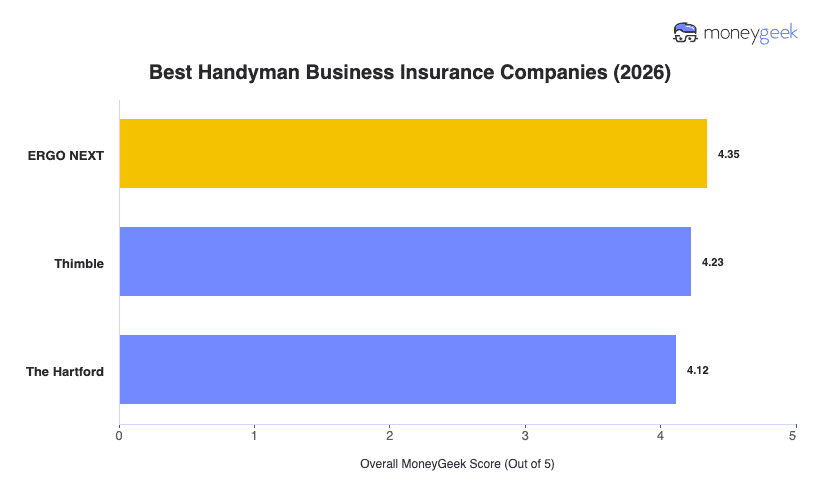
ERGO NEXT ranks first overall and leads on both affordability at $171 per month and customer experience, making it the strongest option if you want reliable coverage at the lowest available rate. Thimble ranks second and stands out for flexible coverage you can buy by the day, week or month, which suits handymen who take on jobs seasonally or want to cover a single project without an annual commitment. We found that the right carrier comes down to where your business sits on cost, service and coverage needs, not just who ranks first.

The breakdown below shows how each provider scores across all three pillars so you can match the right carrier for how your business runs.

ERGO NEXT4.35113
Thimble4.23227
The Hartford4.12761
Nationwide3.98372
Hiscox3.96445
biBERK3.96656
Progressive Commercial3.95534

For our overall best handyman business insurance ratings, we analyzed pricing, coverage options, and customer experience across all 50 states and Washington, D.C. Our analysis focuses on 1-to-4-person handyman businesses, while weighting results to ensure broader industry and location representation. To do this, we evaluated over six million business profiles, more than 100,000 customer experience data points and performed in-depth analysis of coverage contracts and endorsements to compare insurers consistently across industries and regions. We then rated each company across categories of affordability (50% of overall score), customer experience (30% of overall score) and coverage options and terms (20% of overall score) to form an overall rating.

See our full business insurance methodology.

The table rankings are a starting point, not a universal answer. For solo handymen working one-off residential repairs, ERGO NEXT's combination of low rates and responsive service aligns with how most owner-operators buy and use coverage. Handymen running small crews on commercial maintenance contracts, where client agreements set the limit and endorsement requirements, are likely better served by Thimble's project-level flexibility.

Each provider profile below breaks down exactly who that carrier fits and where it falls short.

ERGO NEXT
Best Overall for Handyman Businesses

ERGO NEXT

On ERGO NEXT's site

ERGO NEXT ranks first overall for handyman businesses, driven by first-place scores in both affordability and customer experience. You'll pay around 29% less than the average handyman business pays for the same coverage, and the fully digital platform means you can get a certificate of insurance in your hands within minutes of buying a policy, no phone call needed. Coverage is solid for most standard handyman work but narrows at the specialty level, so if your jobs push into higher-risk territory, check the policy terms before you buy.

Learn More: ERGO NEXT Business Insurance Review

Thimble
Best for Flexible, On-Demand Handyman Coverage

Thimble

For handyman businesses, Thimble comes in second overall, with second-place scores in affordability and customer experience. No other major digital insurer lets you buy by the hour, day or month, so your premium runs only when you're working. You save around 19% compared to what similar handyman businesses pay. Coverage ranks seventh, so check that the policy terms match what your clients require.

Learn More: Thimble Business Insurance Review

Cheapest Handyman Business Insurance

The cheapest handyman insurance companies we analyzed are ERGO NEXT at $172 per month, Thimble at $194 per month and Nationwide at $239 per month. ERGO NEXT sits 29% below the sub-industry average, a difference of $68 per month that adds up to over $800 in annual savings for your business. We find that cheap handyman insurance and the right handyman insurance aren't always the same thing: a low-cost policy that excludes completed operations coverage or caps your GL limit below what your commercial clients require can cost far more at claim time than the premium difference ever saved you.

How each of the three providers stacks up on price, and how far each sits from what handyman businesses typically pay, is worth seeing side by side.

ERGO NEXT$172$2,059
Thimble$194$2,322
Nationwide$239$2,863
Hiscox$248$2,979
Progressive Commercial$250$3,002
biBERK$251$3,010
The Hartford$269$3,224

What Types of Insurance Do Handymen Need?

Every job you take puts you inside someone else's property with tools, a vehicle and responsibility for the outcome. That combination of physical work, client premises and work that can fail after you leave creates exposure across multiple coverage types that a single policy rarely covers. The coverages most handyman businesses need include:

  • General liability (since you work inside client homes and properties on every job)
  • Commercial auto (since your vehicle is how you get to work, carry tools and transport materials)
  • Workers' comp (if you have any employees, even part-time)
  • Commercial property (if you operate out of a fixed location or store equipment there)
  • Cyber insurance (if you hold client home access codes, payment data or digital records)

We find that most handymen start with general liability and commercial auto, then add coverage as their operation grows. Adding employees doesn't just expand the number of policies you need, it changes the nature of your exposure. A solo handyman absorbs personal risk on every job, but once you have a crew, every person working under your name extends that risk in ways a solo policy isn't built to handle. The profiles below reflect those differences directly:

How Much Does Handyman Business Insurance Cost?

Handyman business insurance costs an average of $238 per month or $2,856 per year, though what you pay depends heavily on which coverage types you carry and how many employees you have. Workers' comp drives the highest individual coverage cost because handyman work puts employees on ladders, in crawl spaces and handling power tools at client properties every day. General liability is often the first policy handymen buy, but if you drive to every job and carry your tools in a vehicle, commercial auto is just as foundational. 

We find that two handyman businesses can look nearly identical on the surface but carry very different total costs: a solo operator running general liability and commercial auto pays around $409 per month, while a handyman with even one employee adds workers' comp to that stack and jumps to roughly $1,000 per month. The coverage types you carry, not just the size of your business, drive the biggest cost differences, and the spread is wider than most handymen expect:

How did we determine business insurance rates for handymen?

What your handyman business pays depends on more than which coverages you carry. Running jobs at commercial properties rather than residential homes shifts your GL cost, since commercial accounts typically require higher limits. The total value of tools and equipment you move between sites affects your inland marine premium directly. If you added an employee this year, your workers' comp cost adjusts to reflect it immediately. The handyman business insurance calculator builds an estimate around how your operation runs.

Estimate Your Monthly Handyman Insurance Cost

Enter your coverage type, state, number of employees and type of vehicle (if you need commercial auto coverage) to get a pricing estimate that fits your business.

We do not collect any personal information, and all rates are aggregated for all 50 states and Washington D.C. Workers' comp rate estimates are provided on a per employee basis and all coverage types assume standard industry limit recommendations for most businesses.

Select Coverage Type
Select State
Select Employee Cand
Select Vehicle Type
Average Monthly Cost—

How to Choose the Right Handyman Business Insurance

Getting business insurance as a handyman isn't a single purchase you make and forget. It starts with understanding what your work exposes you to, runs through finding the right coverage at the right limits and ends with a policy that holds up when something goes wrong on a job. We find that skipping steps in this process tends to surface gaps at claim time, not before. These five steps walk you through it.

  1. 1
    Understand your risk profile and what coverage it requires

    Your risk profile as a handyman is shaped by where you work, who you work for and how many people work with you. Map what you do, such as the job types, the client types, your vehicle situation and whether you have employees. Workers' comp is legally required in most states from your first hire. General liability isn't mandated in most states, but commercial clients and property managers require it as a condition of booking you.

  2. 2
    Choose the right coverage limits

    Minimum limits get you compliant but don't necessarily protect your business. If you work commercial accounts, a single flooring replacement you're held responsible for, legal fees from a disputed repair or a vehicle accident involving a client's car can each push into six figures. Set your GL at $1,000,000 per occurrence as a floor and move to $2,000,000 if you work commercial accounts. Match your commercial auto limit to the vehicles and cargo you're covering.

  3. 3
    Evaluate providers who understand handymen

    The providers you choose should have experience in contractor-class businesses, as they're more likely to cover completed operations exposure, subcontractor work and tools in transit. When you're comparing options, a low-cost provider that's hard to reach when you file a claim will cost you more in the long run than a moderately priced one with strong service.

  4. 4
    Get compliance-ready

    Once you have your policy, your next move is making sure your paperwork is ready to work as hard as your coverage does. Commercial clients and property managers will ask for your certificate of insurance before they book you, so have it ready to send before you show up to a job. If your state requires a handyman license or contractor registration, confirm your coverage aligns with what your license permits, since work performed outside that scope can void a GL claim. Before any subcontractor touches one of your jobs, get their certificate of insurance on file.

  5. 5
    Revisit your coverage as your handyman business grows

    Your coverage needs change when your business does, and for handymen the triggers are predictable. When you bring on your first employee, you activate workers' comp obligations and may push past your current GL limits at the same time. If you land a commercial maintenance contract, that client's agreement may require higher limits or an additional insured endorsement your current policy doesn't include. A second vehicle changes your auto exposure in ways a single commercial policy may not cover. Review your full coverage stack at least once a year and before you sign any new commercial contract, because what fit your business last year may not fit the version you're running now.

Get Handyman Business Insurance Quotes

What you pay for handyman business insurance depends on which insurer you choose, and the provider that works for a solo operator running residential repairs won't necessarily fit a handyman managing a crew on commercial maintenance contracts. Insurers weigh your job types, employee count and claims history differently, so the only way to know what you'll pay is to compare across providers that write contractor-class businesses. Request business insurance quotes below to get matched with providers that fit how your business runs.

About Connor Bolton


Connor Bolton, Senior SEO and Content Manager (Business & Pet), MoneyGeek

Connor Bolton is Senior SEO and Content Manager at MoneyGeek, where he leads the business and pet insurance editorial teams. He sets the research framework, data standards and content structure his writers work from, and reviews all team content for accuracy before it goes live. Connor also authors in-depth guides himself and has spent over four years covering insurance products across personal, commercial and specialty lines.

The research infrastructure Connor built covers auto, home, renters, life, health, business and pet insurance, from pricing analysis and carrier research to customer experience and coverage evaluation. It includes over 6 million data points for business insurance across 408 industry areas, all 50 states and 16 vehicle types, and over 5 million pet insurance profiles across 18 major providers, 100+ breeds and pet ages up to 20 years. Connor’s insurance research and his team's work has been cited by the U.S. Chamber of Commerce, Allstate, Liberty Mutual, CBS News, Forbes and LegalZoom.

Connor also talks directly with underwriters and carrier liaisons at Ethos, The Hartford, ERGO NEXT, Nationwide and State Farm, and monitors business and pet owner communities on Reddit. Both keep him current on how the market operates and what buyers need.

For questions about MoneyGeek's business and pet insurance content, contact him at connor@moneygeek.com or on LinkedIn.