
Best Business Insurance Companies For HR Consultants

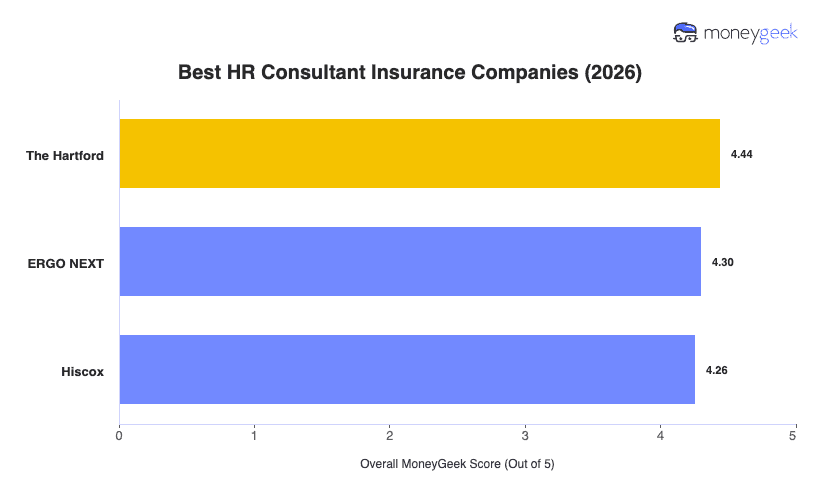
If you're looking for the best business insurance companies for HR consultants, I recommend:

  • Choose if you need higher liability limits and want lower rates on average: The Hartford
  • Choose if you prefer managing your policy yourself and have straightforward coverage needs: ERGO NEXT
  • Choose if you want a dedicated claims representative and work with international clients: Hiscox

HR consultants often sell expertise rather than physical products, so I didn't judge insurers by how many policies they have. I focused more on whether the price makes sense for a small consulting business and whether the insurer can keep supporting you when client requirements or your work's complexity increases.

  • Affordability (50%): Cost gets the largest share of the score. Many HR consultants run lean businesses, so an unnecessarily expensive policy can be difficult to justify. I used the same HR consultant profile for every insurer to keep the comparison focused on provider pricing rather than different assumptions.
  • Customer Experience (30%): Client work can create insurance tasks long after you buy the policy. I considered how easily you can obtain COIs, make changes, handle additional insured requests or get help when a claim needs attention.
  • Coverage Options (20%): I looked beyond whether an insurer sells professional liability. Higher contract limits, a growing team or work with larger and international clients can change what you need from a carrier. Providers get more credit when they can accommodate those shifts without leaving obvious gaps.

Though I used AI to support parts of the research, I made the final calls on which providers fit HR consultants best.

See our full methodology.

The Hartford

The Hartford: Best for Higher Liability Limits and Lower Rates

On The Hartford's site
checkmarkpros
  • Low rates for solo HR consultants

  • Up to $5 million professional liability limits

  • Industry specialists and risk-management support

closecons
  • Less suited to fully self-service buyers

  • Standard professional liability unavailable in AL, HI and LA

COMPANY HIGHLIGHTS

I’d recommend The Hartford for established HR consultants who work with larger clients or give advice that could carry bigger financial consequences, such as terminations or workforce restructuring. Its miscellaneous professional liability (MPL) coverage can offer limits up to $5 million for eligible businesses, which gives you more protection if a client claims your advice contributed to an expensive employment dispute. The Hartford is also the cheapest insurer in my analysis, with rates 16% below the industry average and about $81 in annual savings. Its lower price doesn’t mean you have to give up human support. The Hartford's dedicated industry specialists help you work through client insurance requirements or decide how much liability coverage you need.

Learn More: The Hartford Business Insurance Review

ERGO NEXT

ERGO NEXT:Best for Self-Service Policy Management and Straightforward Coverage Needs

On ERGO NEXT's site
checkmarkpros
  • Strong self-service policy management

  • Unlimited COIs at no extra cost

  • Competitive rates in select states

closecons
  • Professional liability limits top out at $1 million

  • Rates rise above average as firms add employees

COMPANY HIGHLIGHTS

If you want a fully online buying process, ERGO NEXT is an excellent fit. You can quote and buy a policy online in about 10 minutes, which works well for solo HR consultants and small firms that prefer to move without waiting on an agent. Licensed insurance professionals are still available if you need help, but most of the process stays in your hands.

That self-service setup continues after purchase. You can manage your policy 24/7 through the website or app. Additional insureds and unlimited COIs are available at no extra cost. For consultants juggling client requirements, that means less back-and-forth when someone suddenly asks for proof of insurance or an updated certificate.

Learn More: ERGO NEXT Business Insurance Review

Hiscox

Hiscox: Best for Dedicated Claims Support and International Clients

checkmarkpros
  • Worldwide coverage for international client work

  • Retroactive coverage for past consulting work

closecons
  • Some coverage goes through partner Tivly

  • Expensive for solo and small HR firms

COMPANY HIGHLIGHTS

Hiscox is my top choice if you have a global clientele. Its professional liability coverage follows your work anywhere in the world, from London to Mexico City, as long as any legal action is filed in the U.S., its territories or Canada. It can also cover claims tied to work you completed years earlier, with retroactive coverage back to your business’s start date in most cases. That matters if a former client comes back later and says your advice caused a loss.

You also get a dedicated claims representative once you file. That makes Hiscox a stronger fit if you’d rather have one person guiding the process than figure out a potentially complicated professional liability claim on your own.

Learn More: Hiscox Business Insurance Review

What Types of Insurance Do HR Consultants Need?

When choosing your coverage, professional liability typically comes first because bad advice is one of the most common reasons consultants get sued. For you, that could be a client who says your termination guidance led to an expensive employment dispute. Next comes general liability, which covers a different kind of exposure. If you meet clients in person or work onsite, it can help with claims involving someone getting hurt during a training session. It also matters when your job puts you in the middle of sensitive conversations. If someone says a statement you made damaged their reputation, personal and advertising injury coverage can help with the claim, depending on the policy.

The best HR consultant insurance bundle will include other coverages. Make sure to choose policies based on how you run your business.

Claims that your HR advice or services caused a client financial loss, including disputes tied to termination guidance or policy recommendations.
From your first client engagement.
HR advice is often tied to employment disputes. The EEOC received 88,531 discrimination charges in FY2024, up 9.2% from the year before. That shows how much risk surrounds decisions you may help clients make.
Third-party injury and property-damage claims that can come up during training sessions or client-site work.
Once you meet clients in person.
A routine client interaction can turn into an expensive accident. The Hartford says slip-and-fall settlements average $10,000 to $50,000.
Costs from breaches or cyberattacks involving sensitive information you handle, such as employee records.
Once you handle sensitive client data.
HR work can put employee information in your inbox or laptop. Verizon’s 2025 research found 32% of breaches involved stolen credentials. That makes compromised logins a practical risk even for a small consulting practice.
Medical costs and lost wages when an employee gets hurt or becomes ill because of work.
When you hire employees.
Even in a low-risk consulting business, an employee can still get hurt at the office or while visiting a client. Workers’ comp helps cover medical bills and lost wages.
Damage or loss involving the laptops and other business property you rely on to run your practice.
When equipment losses would hurt.
Replacing stolen laptops or repairing damaged office equipment can come straight out of your business cash flow. Commercial property helps pay for those losses instead of leaving you to fund the replacement yourself.
Liability and vehicle-damage claims involving business-owned cars used for client travel.
When the business owns vehicles.
A crash during business driving can leave your firm responsible for injuries, vehicle damage or both. Commercial auto helps cover those costs when a vehicle is being used for the business.

How Much Does HR Consultant Insurance Cost?

The average cost of insurance for HR consultants is $56 per month or $672 per year, though individual policies range from $7 to $126 per month. The actual rate on your quote will vary depending on the type of work you do, with advising on termination or compliance resulting in higher premiums. When and how you work also affect your costs. If you regularly do client visits, you're likely to spend more for coverage than if you're home-based.

Estimates at the policy level are:

What Are These Costs Based On?

Your rate depends on what your HR practice actually looks like, from the advice you give to whether you handle sensitive employee data or have a team. Our business insurance calculator can give you a more tailored estimate. If you’re ready to shop, click “Get Quote” to connect with the insurer that best matches your coverage needs.

HR Consultant Insurance Cost Calculator
Select Coverage Type
Select State
Select Employee Cand
Select Vehicle Type
Average Monthly Cost—

How To Buy The Best HR Consultant Insurance

The way to get the best HR consultant insurance involves decisions that don't come up in most small business purchases. Claims-made policy timing, EPLI requirements, bilateral dispute exposure and data handling obligations all affect what you need to buy and in what order. I've broken these down in seven steps and included a downloadable companion checklist that walks you through the decisions you need to make.

  1. 1

    Identify What You’re Required to Carry

    Before deciding what coverage you want, figure out what you have to carry. Hiring employees can trigger workers’ comp requirements, while a business-owned vehicle brings its own commercial auto insurance rules. Your client contracts could also add to these. Check each agreement to see if they require general liability and specifies minimum limits before you quote coverage. If a client asks for a certificate of insurance (COI), confirm whether they only need proof of coverage or also want to be added as an additional insured, since those aren’t the same thing.

    Read More: Business Insurance Requirements

  2. 2

    Match Uncovered Risks to the Right Coverage

    Once you’ve handled what the law or your contracts require, look at the risks you’re still exposed to. If you spend months embedded with a client, for example, you’re more likely handling sensitive employee information than someone hired for a short training engagement. Investigation work creates a different kind of exposure because you’re  dealing with confidential allegations or statements. The goal here is simple: only add coverage when you can point to a real gap in how your practice operates.

  3. 3

    Set Limits Based on Your Real Exposure

    Client contracts are a great starting point when you’re deciding on limits, but they don’t always tell you how much financial protection your business should carry. If a client only requires $1 million in professional liability, that may be enough for lower-risk advisory work. If you’re helping with decisions that could end in a major employment dispute, like layoffs or terminations, you may feel more comfortable at $2 million.

    Read More: How Much Business Insurance Do I Need?

  4. 4

    Research Providers Before You Quote

    Don’t start collecting quotes from every provider you can find. First, narrow the field based on how you want to manage your insurance. If you prefer handling routine tasks yourself, look for strong online policy tools and easy COI access. If you’d rather have someone guide you through higher limits or unusual client requirements, a carrier with specialist support may suit you better.

    Research on an insurer’s claims support too. Find out whether you get a dedicated representative or have to manage the process largely on your own. You should also know how updates are handled once a claim is underway. Finally, make sure the insurer can keep supporting you as your practice changes so you’re not forced to rebuild your insurance setup every time your needs shift.

  5. 5

    Compare Quotes on the Same Terms

    What genuinely makes a lower premium a great deal is if quotes are built on the same assumptions. Match the coverage limits first, then check the deductible and any major policy features that affect how the coverage works. If one quote includes broader protection or a lower deductible, the higher price makes sense.

    I’d also compare the annual cost, not just the monthly payment. That makes fees or installment charges easier to spot. When you compare business insurance quotes, keep the business details consistent so you’re judging the insurer rather than a different version of your HR practice.

  6. 6

    Read the Policy, Not Just the Quote

    Before you buy, look for the details that can quietly narrow your protection. With professional liability, check the retroactive date first because work performed before that date may not be covered if a claim surfaces later. Then read the exclusions and make sure the policy’s definition of professional services actually reflects the HR work you do. 

    I’d also check how the policy handles settlements. A hammer clause, for example, can shift some of the extra cost to you if you reject a settlement the insurer recommends and the claim later ends up costing more. Look at whether defense costs reduce your liability limit, since that leaves less money available for a settlement or judgment.

  7. 7

    Revisit Your Coverage When the Business Changes

    Your insurance must keep pace with how your HR practice operates. Hiring employees or taking on more sensitive client work creates risks you didn’t have when you first bought coverage. Scaling back changes the picture too. If you stop using a business vehicle or no longer offer a particular service, some policies or limits may no longer make sense. Review your coverage whenever you make a real operational change, not just when renewal comes around.

HR Consultant Insurance: FAQ

Choosing a provider and building the right coverage mix gets you started, but a lot of questions only come up once you’re working with clients. My answers to these questions fill in the gaps so you know what to consider as you build your insurance bundle.

Best HR Consultant Business Insurance: Bottom Line

Professional liability and general liability should anchor your coverage because they protect the work you do and the everyday risks around it. From there, let your practice dictate what comes next. Handling more sensitive data pushes cyber higher on your list, while hiring changes prioritizes a different coverage. I’d weigh cost against what the policy actually gives you since that's a better approach than automatically going for the lowest premium.

Your insurer should also match how you prefer to work. The Hartford makes more sense when you want higher limits and hands-on support. ERGO NEXT suits a self-service setup, while Hiscox can fit international HR consulting. Compare two or three quotes using the same coverage setup so you can see what each insurer is really charging and what you’re getting for the price.

Best HR Consultant Insurance Chart

Get HR Consulting Insurance Quotes

Compare HR consultant insurance quotes using the same coverage setup so you can see how providers differ on price and fit. Start with the options our tool provide.

About Angelique Palenzuela-Cruz


Angelique Palenzuela-Cruz, Business Insurance Writer, MoneyGeek

Angelique Palenzuela-Cruz is a Business Insurance Content Writer at MoneyGeek, where she specializes in general liability, workers’ compensation and professional liability insurance. Her work helps small business owners understand how these policies apply to coverage, including risks like customer injuries, employee injuries, professional mistakes, client contract terms and industry-specific coverage requirements.
She primarily covers service-based businesses where liability and employee coverage decisions are especially important, including cleaning, consulting, beauty and wellness, childcare, education, fitness, food service, pet care, repair and maintenance, and other professional services.
Before joining MoneyGeek, Angelique spent nearly 12 years at Guthrie-Jensen Consultants, one of Southeast Asia’s largest management training firms, where she advanced from Training Consultant to Managing Consultant. In that role, she worked with business clients to assess operational needs, develop training programs and present performance analyses to executive decision-makers. She also helped establish Gladwin Training Consultancy, where she served in learning solutions and client service roles.
Her background gives her practical context for writing about how businesses operate, manage client expectations, structure teams and make risk decisions. At MoneyGeek, she applies that experience to business insurance content, connecting coverage to actual business needs.

LinkedIn: linkedin.com/in/ma-angela-cruz

Email Contact: angelique.palenzuela@moneygeek.com


Sources