
How We Built These Best Small Business Insurer Rankings

Our Georgia commercial auto rankings are built on three things: what businesses in Georgia actually pay for coverage, what happens when they need support and whether the policy holds up when a claim is filed. Each provider was rated across affordability (50%), customer experience (30%) and coverage options (20%), weighted that way because price is where most Georgia businesses start the search, but it's rarely where the decision should end. For a full breakdown, see the full methodology.

Top Picks: Best Commercial Auto Insurance Companies in Georgia

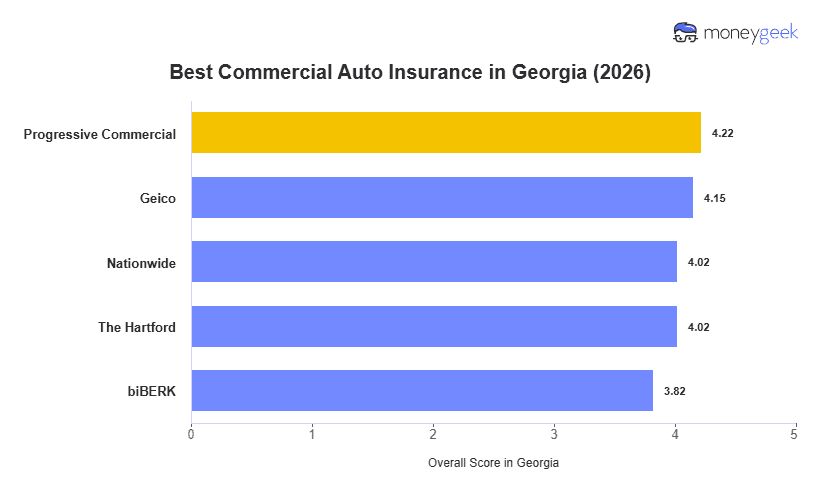
No single insurer is the right best commercial auto insurance option for every Georgia business, and the data bears that out. Progressive ranks first overall, but the right carrier depends on three things specific to the operation: what vehicles the business operates, what a serious claim would cost the business and how much support it needs when something goes wrong. A landscaping contractor running a single pickup truck in rural Georgia will reach a very different conclusion than a logistics company managing a mixed fleet out of Atlanta.

Each provider below earned its spot for a specific reason, and that reason matters more than the overall ranking when a business has a particular vehicle profile, risk level or set of priorities:

  1. Progressive: Best Overall, Best for Fleet Operations
  2. GEICO: Best for Low-Risk Business Areas
  3. Nationwide: Best for Agricultural and Specialty Fleets
  4. The Hartford: Best for Coverage Depth
  5. biBerk: Best for Simple Coverage Needs

The table below shows how these providers ranked across affordability, customer experience and coverage in this Georgia analysis for a side-by-side view to ground the comparison.

Progressive Commercial4.22214
Geico4.15123
Nationwide4.02352
The Hartford4.02521
biBERK3.82445

The summaries below lay out exactly who each provider fits best and who should look elsewhere, because overall rankings mean nothing if a provider doesn't match the specific vehicle type, industry or operational need.

Progressive
Best Overall, Best for Fleet Operations

Progressive

Progressive is the default starting point for most Georgia businesses, and the data backs that up. It's the largest commercial auto insurer in the country, which means its pricing model has been stress-tested across more vehicle types, industries and claim scenarios than any of the other four providers in this analysis. For Georgia businesses, that translates to rates that run 11% below the state average overall, with the biggest gaps on high-exposure categories like taxis, limousines and food trucks. It also leads the group on customer experience, with 24/7 claims access and a digital platform that handles fleet changes mid-policy without the paperwork headache. The one honest caveat is coverage depth: it ranks fourth out of five on endorsements, so if your operation has specialized needs, The Hartford deserves a look before you commit.

Learn More: Progressive Business Insurance Review

GEICO
Best for Low-Risk Business Areas

GEICO

GEICO leads all five Georgia providers on affordability, posting rates 15% below the state average, and that pricing edge is sharpest for low-exposure, office-based operations where vehicle risk is minimal and premium dollars matter more than coverage complexity. Consulting firms, financial services businesses, fitness operations and tech companies all rank GEICO first in Georgia, largely because its pricing model favors operations with clean driver records, standard light vehicles and limited time on the road. It ranks second overall on customer experience, which means the service quality holds up even as the price comes down. Where it falls short is coverage depth, ranking third among the five providers, so businesses that need a wide endorsement menu or operate in higher-risk categories will hit its limits quickly. For Georgia businesses that fit the low-risk profile, GEICO delivers strong value that the other four providers don't match on price.

Nationwide
Best for Agricultural and Specialty Fleets

Nationwide

Nationwide's strongest card in Georgia is its coverage structure, which ranks second among the five providers and gives it an edge for operations that need more than a standard commercial auto policy. It prices competitively for limousines, food trucks and farm-related operations, and its policy terms accommodate the kind of specialty vehicle coverage that generalist carriers often handle poorly. The tradeoff is customer experience, where it ranks last among the five Georgia providers, a gap that shows up most in claims handling and post-purchase service. Georgia businesses that prioritize coverage fit over service convenience and run agricultural equipment, specialty vehicles or mid-size fleets will find Nationwide worth a serious look, but those that expect hands-on support throughout the policy lifecycle should weigh that ranking carefully.

Learn More: Nationwide Commercial Auto Insurance Review

The Hartford
Best for Coverage Depth

The Hartford

On The Hartford's site

With over 200 years in commercial insurance, The Hartford brings a policy depth that none of the other four Georgia providers match. It leads all five on coverage options, ranking first on that dimension across every vehicle type in this analysis, which makes it the go-to for Georgia businesses whose risk profile has outgrown what standard carriers offer. The tradeoff is price: it ranks last on affordability in Georgia, with rates running 24% above the state average overall, and that gap widens considerably for high-exposure categories like farm tractors and pickup trucks. Its customer experience ranks second among the five providers, so the service quality justifies some of that premium for businesses that need it. The Hartford is worth the price for Georgia operations with complex coverage needs, but businesses running standard fleets on tight margins will find better value elsewhere.

Learn More: The Hartford Business Insurance Review

biBerk
Best for Simple Coverage Needs

biBerk

biBerk is a Berkshire Hathaway company built around one idea: selling commercial insurance directly to small businesses without agents or middlemen. That model keeps its process simple and its overhead low, but the tradeoff shows up in the data. It ranks fifth overall in Georgia across all three dimensions, last on coverage depth and fourth on both affordability and customer experience. Where it finds its footing is with very small, low-exposure operations running standard vehicles like sedans and SUVs, where its rates are competitive and the stripped-down policy structure is actually a fit rather than a limitation. Georgia sole proprietors or micro-businesses that know exactly what coverage they need and want to buy it quickly online without agent involvement will get the most out of what biBerk offers.

Learn More: biBerk Business Insurance Review

Best Georgia Commercial Auto Insurance by Vehicle Type

Progressive ranks first across all eight vehicle types in Georgia, leading on overall value for everything from pickup trucks and vans to food trucks, taxis and limousines. Its strongest rate advantages come on taxi and limousine fleets, where its rates run 31% below the Georgia average, and on food trucks, where the gap is 22%. For farm tractors and standard sedans, GEICO and Nationwide offer more competitive affordability and are worth comparing before committing to a single carrier.

Farm TractorProgressive Commercial214
Food TruckProgressive Commercial114
LimousineProgressive Commercial114
Pickup TruckProgressive Commercial214
SUVProgressive Commercial214
SedanProgressive Commercial314
TaxiProgressive Commercial114
VanProgressive Commercial114

Vehicle type is one of the biggest variables in Georgia commercial auto, and the gap between providers widens significantly depending on what your fleet runs.

Best Commercial Auto Insurance in Georgia by Industry

Progressive ranks first in 17 of 25 industries in Georgia, leading across construction, manufacturing, transportation and logistics, food and beverage, healthcare, retail and wholesale distribution, among others. GEICO leads in the remaining 8 industries, including agriculture, consulting, financial services, tech and marketing, and its affordability score tops all five Georgia providers across 15 of those categories.

Agriculture & Natural ResourcesGeico123
Arts, Media & EntertainmentGeico123
Beauty, Body & Wellness ServicesGeico223
Childcare ServicesProgressive Commercial114
Cleaning ServicesProgressive Commercial114
Construction & ContractingProgressive Commercial114
Consulting ServicesGeico123
EducationProgressive Commercial214
Financial ServicesGeico123
Fitness ServicesGeico123
Food & BeverageProgressive Commercial114
Healthcare & MedicalProgressive Commercial214
Hospitality, Travel & TourismProgressive Commercial214
ManufacturingProgressive Commercial114
Marketing & CommunicationsGeico123
Nonprofit & AssociationsProgressive Commercial114
Other Professional ServicesProgressive Commercial114
Pet Care ServicesProgressive Commercial214
Real Estate & Property ServicesProgressive Commercial314
Recreation & SportsProgressive Commercial214
Repair & MaintenanceProgressive Commercial214
Retail & Product RentalProgressive Commercial114
Tech/ITGeico123
Transportation & LogisticsProgressive Commercial114
Wholesale & DistributionProgressive Commercial214

Finding the best commercial auto insurance in Georgia depends partly on what industry your business operates in.

What Determines the Best Commercial Auto Insurance in Georgia for You

Georgia's commercial auto market doesn't have a one-size answer. The provider that works best for a Savannah logistics company hauling freight near the Port won't be the same one that fits an Atlanta consulting firm with two sedans on the road. Commercial auto insurance in Georgia breaks down across three dimensions, and where your business lands on each one shapes which provider deserves the most attention. Three areas matter most when evaluating which insurer fits your business.

    money2 icon
    Affordability Across Your Vehicle Type and Industry

    In Georgia, the provider you choose matters as much as the coverage level when it comes to what you actually pay. Taxi and limousine operators see rate spreads of up to 100% between the most and least competitive providers, meaning the wrong carrier choice can effectively double the premium. Pickup truck and farm tractor operators face gaps of nearly 70%. 

    On the industry side, agriculture, wholesale distribution and transportation and logistics show the widest spreads, with differences of 70% to 83% between the highest and lowest-priced providers for those categories. Georgia businesses in those industries have the most to gain from comparing providers rather than going with a default choice.

    insurance2 icon
    Coverage That Matches Your Fleet's Risks

    Georgia sets a baseline of 25/50/25 liability coverage for most commercial vehicles, but that minimum shifts depending on what your operation actually does. Vehicles over 10,001 pounds GVWR trigger federal FMCSA minimums that can reach $750,000 or more based on cargo type. GIMC-registered intrastate carriers must carry at least 100/300/50. Georgia transportation network companies must maintain $1 million in liability coverage while actively transporting passengers. Beyond those thresholds, the following coverage factors separate a policy that fits from one that leaves gaps:

    • Liability limits offered: Georgia's 25/50/25 floor is a legal minimum, not a business recommendation. For-hire carriers, construction contractors and fleet operators in Georgia typically need limits well above what the state requires.
    • Breadth of vehicles covered: Not every provider covers the full range of Georgia commercial vehicle types. Farm tractors, limousines and taxis require confirmed eligibility before comparing on price.
    • Standard vs. endorsement coverage: Roadside assistance, rental reimbursement and gap coverage are standard with some carriers and add-on costs with others, which affects the real total premium.
    • Hired and non-owned auto coverage: Georgia businesses in healthcare, real estate and professional services that send employees out in personal or rented vehicles need this confirmed before binding any policy.
    • Cargo and equipment protection: Georgia's construction, manufacturing and wholesale distribution businesses should verify whether tools and cargo coverage are built into the commercial auto policy or require a separate inland marine filing.
    • Exclusions and policy language: Georgia is not a no-fault state, so injury claims run through the at-fault driver's liability coverage. Driver eligibility rules and vehicle use restrictions vary between carriers and can affect claim outcomes.
    • Deductible flexibility: Diminishing deductibles and waived deductibles on total losses are carrier-specific features that can have a real financial impact when a Georgia commercial vehicle claim is filed.
    • Coverage for fleet growth: Georgia businesses that add vehicles during the policy period need to confirm how each carrier handles mid-term changes, since some require a full policy rewrite while others process additions digitally.
    talk icon
    Customer Experience and Claims Support

    For Georgia businesses, claims performance is the metric that matters most once a policy is bound. Check whether a provider offers 24/7 commercial claims reporting or limits access to business hours, whether commercial claims get a dedicated adjuster or go through a shared consumer line and whether the business will have a consistent point of contact over the life of the policy. Georgia's Port of Savannah activity and the state's high concentration of logistics and transportation operations mean commercial claims can be complex, making adjuster experience with business policies a meaningful differentiator. NAIC complaint ratios provide an objective baseline for comparing providers before making a final decision.

How to Choose the Best Commercial Auto Insurance in GA

Getting the best commercial auto insurance in Georgia takes more than pulling quotes from a few carriers. These steps give you a structured way to narrow your options before you spend time comparing prices.

  1. 1
    Define Your Risk Profile

    Before anything else, document every vehicle your business operates in Georgia, including owned, leased and employee-owned vehicles used for work. Record each vehicle's primary use, how often it's on the road and the driving history of every authorized driver. Georgia businesses in construction, transportation and logistics, food and beverage and agriculture should give particular attention to mileage and load type, since those factors directly affect both pricing and carrier eligibility across pickup trucks, vans, farm tractors and commercial box vehicles.

  2. 2
    Determine Your Coverage Requirements

    With your vehicle and driver inventory in hand, identify which coverage types your operations actually require beyond Georgia's base 25/50/25 liability minimum. A few specifics worth confirming for Georgia operations:

    • Georgia businesses hauling goods, including manufacturers, wholesalers and distributors operating near the Port of Savannah, need cargo coverage confirmed as part of the commercial auto policy or a separate inland marine filing.
    • Financed or leased commercial vehicles in Georgia require collision and comprehensive coverage to satisfy lender requirements.
    • Georgia businesses in healthcare, real estate and professional services that rely on employee-owned or rented vehicles for client work need hired and non-owned auto coverage in place before those vehicles hit the road.
    • Commercial vehicles over 10,001 pounds GVWR trigger federal FMCSA minimums, which can reach $750,000 or more depending on cargo type and route.
    • Georgia transportation network company drivers must carry $1 million in liability coverage while actively transporting passengers, separate from what standard commercial auto policies provide.

    Match coverage types to real operational needs in Georgia rather than assumptions.

  3. 3
    Research Providers by Industry and Vehicle Type

    Not every carrier prices Georgia commercial risks the same way, and the gaps are wide enough to matter. Carriers like Progressive and GEICO lead for different industries and vehicle categories in Georgia, so identifying which provider has a track record in your specific business category should come before price comparisons. Georgia businesses running high-exposure vehicles like taxis, limousines or heavy commercial trucks should focus on carriers with demonstrated commercial fleet experience rather than those built primarily around standard light vehicles.

  4. 4
    Evaluate Coverage Quality and Policy Terms

    A quote tells you what a policy costs. The policy terms tell you what you're actually getting for that price. For each provider you're seriously considering, check which coverages are standard versus available only as endorsements, what liability limits are available above Georgia's 25/50/25 minimum and which exclusions could affect a claim. Georgia is not a no-fault state, so injury claims run through the at-fault driver's liability coverage, making limit selection more consequential than it would be in a PIP state. Also confirm how each carrier handles mid-term fleet additions, since some Georgia policies require a full rewrite to add a vehicle while others process changes without interrupting existing coverage.

  5. 5
    Get Quotes to Confirm

    Request quotes only after you've identified the providers that fit your vehicle type, industry and coverage requirements. In Georgia, rates for the same vehicle category can vary by up to 100% between carriers, as is the case for taxis and limousines, so a quote from just one provider gives you no useful comparison point. Bring your vehicle list, driver records and coverage requirements to every quote request so the numbers reflect your actual operation rather than a generic business profile.

  6. 6
    Confirm Georgia Filing Requirements

    Before purchasing, verify whether your Georgia operation triggers any state or federal filing requirements beyond the base commercial auto policy. Vehicles over 10,001 pounds GVWR operating in interstate commerce fall under FMCSA authority and require minimum liability of $750,000 or more depending on cargo classification. GIMC-registered intrastate Georgia carriers must meet 100/300/50 minimums. Georgia passenger carriers, including taxis and limousines, are subject to separate operating authority requirements, and TNC drivers must confirm that their commercial coverage meets the $1 million active-transport threshold before accepting rides.

Best Commercial Auto Insurance in Georgia: Bottom Line

Three questions cut through most of the noise in Georgia commercial auto: What vehicles does your business operate? What industry are you in? And if a serious claim hit tomorrow, what would it actually cost you to be underinsured? Those three answers do more to narrow the right carrier than any rate comparison, because pricing and coverage depth in Georgia shift more by vehicle type and industry than most business owners realize before they start shopping.

A lower premium is only a good deal if the policy covers what your operation actually needs. Think about whether you prefer managing your policy digitally without agent involvement or whether you want someone you can call when a claim gets complicated, because that preference alone rules out certain carriers before you even look at price. From there, get at least two or three quotes with your full vehicle list and driver records in hand, so you're comparing policies that reflect your Georgia operation specifically rather than a generic business profile.

Best Commercial Auto Insurance: Next Steps

For most Georgia businesses, Progressive and GEICO are the right starting points. Progressive leads on customer experience and covers all eight vehicle types competitively, making it the stronger fit for mixed fleets and high-exposure operations across construction, transportation and logistics and food and beverage. GEICO is the better starting point for low-mileage, office-based Georgia businesses running standard light vehicles in industries like consulting, financial services and tech. If your operation involves regulated vehicles, specialized fleets or agricultural equipment, add Nationwide to your list given its stronger coverage structure for those categories.

Recommended: If You're Ready to Get Quotes Now

At this point you should have your vehicle inventory, driver records and coverage requirements ready. Request quotes from at least three providers and compare both policy terms and price before deciding. If a quote comes back higher than expected, check your vehicle classifications and driver history before ruling out a carrier that otherwise fits your Georgia operation well.

If You Want to Confirm Cost Before Deciding

If You're Unsure What Coverage Your Fleet Needs

If You Have Specialized Filing Requirements

How We Chose the Best Georgia Commercial Auto Insurance Companies

Our goal was to identify which providers deliver the most consistent overall value across the three dimensions that matter most to business owners: what they pay, how well they're covered and how the carrier performs when they need support. Five providers made the cut for our Georgia analysis: Progressive Commercial, GEICO, The Hartford, Nationwide and biBerk. We analyzed all five across all eight vehicle types and 25 general industry categories covering more than 400 specific industry areas.

Our Scoring Model

We scored each of the five providers across three weighted categories that combine into an overall score out of 5.

  • Affordability (50% of overall score): We measured how competitively and consistently each provider prices commercial auto coverage across vehicle types, industries and states, benchmarked against national average rates.
  • Customer Experience (30% of overall score): We evaluated how well each provider supports businesses across the full policy lifecycle — buying, policy management and claims handling.
  • Coverage Options (20% of overall score): We assessed how well each provider addresses common commercial fleet risks and how much flexibility it allows across coverage types and endorsements.

Learn more about our methodology.

About Connor Bolton


Connor Bolton headshot

Connor Bolton is Senior SEO and Content Manager at MoneyGeek, where he leads the business and pet insurance editorial teams. As editorial lead for both verticals, Connor sets the research framework, data standards, and content structure that his writers execute, directly authoring in-depth guides himself and reviewing all team content for accuracy and practical value before it goes live. With over four years evaluating insurance products across personal, commercial, and specialty lines, he brings cross-vertical knowledge to every guide the team produces.

Connor architected MoneyGeek's insurance research infrastructure across all major verticals including auto, home, renters, life, health, business, and pet, building systems for pricing analysis, provider-level research, customer experience evaluation, and coverage analysis with AI support. The infrastructure includes over 6 million data points for business insurance across 408 industry areas, all 50 states, and 16 vehicle types, and over 5 million pet insurance profiles across 18 major providers and hundreds of breed and age combinations. Connor's insurance cost research and his team's work has been cited by the U.S. Chamber of Commerce, Allstate, Liberty Mutual, CBS News, Forbes and LegalZoom.

Beyond the data, Connor stays connected to how the market actually operates, drawing on direct conversations with underwriters and carrier liaisons at Ethos, The Hartford, NEXT Insurance, Nationwide, and State Farm, and monitoring business and pet owner communities including Reddit, to inform how he interprets findings and frames guidance for real buyers.

He is the direct editorial contact for methodology questions at connor@moneygeek.com and can be found on LinkedIn.