CMS Expected Medicare Advantage Extras to Hold Steady. Plans With Full Extras Fell in 45 States and DC

Updated: October 28, 2026

Advertising & Editorial Disclosure

On Sept. 28, the Centers for Medicare & Medicaid Services (CMS) told seniors what to expect from Medicare Advantage in 2027. It projected lower premiums and wide plan choice, and it said "supplemental benefit offerings, including hearing, dental, and vision benefits, are expected to remain stable."

The plan filings CMS published a few days later show a different result for one benefit. For 2027, 58.0% of general-enrollment Medicare Advantage plans include an over-the-counter (OTC) allowance for every member, down from 66.3% in 2026. Among plans that set a separate OTC limit, the median allowance is $200 a year. CMS guidance lists items such as pain relievers and bandages as eligible, and fewer plans offer the allowance for 2027.

The broader package slipped too. Plans that include all four of the extras this study tracks (comprehensive dental, eyewear, hearing aids and OTC) fell from 59.5% of plans to 52.7%. The share fell in 45 states and Washington, D.C. Open enrollment runs through Dec. 7, and the benefit a retiree had in 2026 may not be in the plan's 2027 version.

mglogo icon
STUDY FINDINGS
  • Fewer plans include all four core extras. In 2027, 52.7% of general-enrollment Medicare Advantage plans include comprehensive dental, eyewear, hearing aids and an OTC allowance for every member, down from 59.5% in 2026. That is 1,856 plans, down from 2,217.
  • OTC allowances drove the decline. The share of plans with an OTC benefit fell 8.4 points, to 58.0%. Comprehensive dental, eyewear and hearing aids each fell about 1 to 2 points, closer to what CMS projected.
  • Existing plans cut OTC; exits played a smaller role. Of 2,925 plans offered in both years, 351 dropped OTC and 50 added it. Plans that left the market after 2026 had OTC at about the same rate (64.9%) as the market overall.
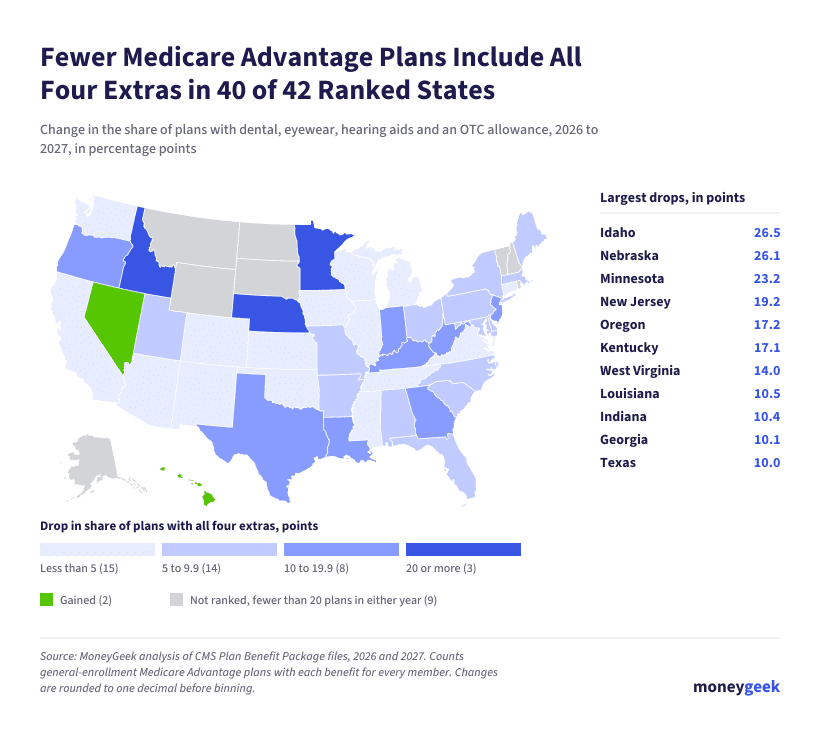
  • Idaho saw the largest drop. The share of Idaho plans with all four extras fell from 41.7% to 15.2%, a 26.5-point decline. Nebraska (26.1 points) and Minnesota (23.2 points) followed.
  • Nevada moved the other way. Nevada's share rose 3.5 points, to 70.7%, and Hawaii's rose 1.2 points. Arizona was nearly flat.
  • The Northeast and South declined everywhere. All nine Northeast states and all 17 Southern jurisdictions saw the all-four share fall. In the West, three of 12 states improved.

The Claim and the Filings

CMS made its projection in a press release on the 2027 Medicare Advantage and Part D programs. The release projected the average Medicare Advantage premium would fall from about $14 a month in 2026 to $12 in 2027. It named hearing, dental and vision among the benefits it expected to remain stable.

On those three, the filings largely agree with CMS. Preventive dental, which covers cleanings and exams, is in 97.9% of 2027 plans, up from 97.6%. Comprehensive dental, which covers fillings, crowns and extractions, slipped from 85.6% to 84.4%. Eyewear fell from 96.8% to 94.4%, and hearing aids fell from 95.6% to 93.8%.

OTC allowances weren't on CMS's list, and that's where the change is concentrated. The OTC share fell 8.4 points in one year. Eyewear had the next-largest decline, at 2.3 points.

OTC allowances fell from 66% to 58% of plans, more than any other extra.

The decline extends a trend. KFF, the health policy research group, reported that 79% of individual Medicare Advantage plans offered OTC benefits in 2025 and 68% did in 2026. KFF's counting method differs from ours, but its 2026 figure is close to the 66.3% we found. For 2027, the share is 58.0%, a second straight year of decline.

Where Medicare Advantage Extras Fell Most

The three largest declines, in Idaho, Nebraska and Minnesota, each topped 20 points. The table ranks 42 states by the change in the share of plans that include all four core extras. States with fewer than 20 plans in either year appear in the table but are not ranked, because a single plan can move their share by 5 points or more. Alaska has no general-enrollment Medicare Advantage plans and is not included. Ranking all 50 jurisdictions with no plan minimum leaves Idaho, Nebraska and Minnesota in the top three and moves Montana to fourth.

Map of 2027 Medicare Advantage extras losses by state, largest in Idaho.
1
Idaho
33
41.7%
15.2%
-26.5
47.2%
15.2%
2
Nebraska
30
72.7%
46.7%
-26.1
72.7%
56.7%
3
Minnesota
40
58.2%
35.0%
-23.2
60.0%
40.0%
4
New Jersey
56
51.4%
32.1%
-19.2
58.3%
35.7%
5
Oregon
69
59.3%
42.0%
-17.2
63.0%
43.5%
6
Kentucky
80
69.6%
52.5%
-17.1
74.7%
57.5%
7
West Virginia
51
70.9%
56.9%
-14.0
78.2%
60.8%
8
Louisiana
70
66.2%
55.7%
-10.5
67.6%
57.1%
9
Indiana
98
55.3%
44.9%
-10.4
57.4%
48.0%
10
Georgia
99
49.5%
39.4%
-10.1
60.7%
48.5%
11
Texas
228
64.3%
54.4%
-10.0
72.1%
60.1%
12
Utah
33
55.3%
45.5%
-9.8
63.2%
54.5%
13
New York
145
39.5%
29.7%
-9.8
44.9%
35.2%
14
Ohio
134
76.1%
67.2%
-9.0
79.4%
69.4%
15
Arkansas
54
69.6%
61.1%
-8.5
69.6%
61.1%
16
Delaware
24
58.3%
50.0%
-8.3
62.5%
50.0%
17
Alabama
65
65.1%
56.9%
-8.2
65.1%
56.9%
18
South Carolina
68
50.7%
42.6%
-8.1
55.1%
50.0%
19
Maine
32
38.9%
31.2%
-7.6
50.0%
40.6%
20
Maryland
30
50.0%
43.3%
-6.7
57.9%
50.0%
21
Florida
308
62.8%
56.8%
-6.0
65.5%
58.8%
22
Missouri
113
67.9%
61.9%
-5.9
71.6%
62.8%
23
Pennsylvania
267
72.9%
67.4%
-5.5
78.4%
71.2%
24
Massachusetts
79
34.5%
29.1%
-5.4
44.0%
31.6%
25
North Carolina
120
51.6%
46.7%
-5.0
57.4%
52.5%
26
Michigan
131
66.9%
62.6%
-4.3
73.0%
64.1%
27
Tennessee
105
73.1%
69.5%
-3.6
76.3%
71.4%
28
Connecticut
27
29.0%
25.9%
-3.1
51.6%
33.3%
29
New Mexico
39
62.0%
59.0%
-3.0
82.0%
64.1%
30
Mississippi
51
59.2%
56.9%
-2.3
61.2%
58.8%
31
Wisconsin
75
47.6%
45.3%
-2.2
59.8%
54.7%
32
Oklahoma
52
71.4%
69.2%
-2.2
78.6%
75.0%
33
Iowa
41
53.3%
51.2%
-2.1
64.4%
56.1%
34
Illinois
106
61.3%
59.4%
-1.9
66.9%
64.2%
35
Washington
71
33.7%
32.4%
-1.3
36.0%
32.4%
36
Kansas
60
66.2%
65.0%
-1.2
69.1%
65.0%
37
Colorado
65
59.2%
58.5%
-0.7
69.0%
63.1%
38
California
259
49.6%
49.0%
-0.6
72.1%
68.3%
39
Virginia
108
54.3%
53.7%
-0.6
61.0%
59.3%
40
Arizona
90
67.9%
67.8%
-0.1
75.0%
72.2%
41
Hawaii
37
28.6%
29.7%
+1.2
28.6%
32.4%
42
Nevada
58
67.2%
70.7%
+3.5
71.9%
79.3%
Not ranked
Montana
19
25.0%
5.3%
-19.7
32.1%
5.3%
Not ranked
South Dakota
15
69.2%
53.3%
-15.9
76.9%
73.3%
Not ranked
New Hampshire
15
41.2%
26.7%
-14.5
64.7%
33.3%
Not ranked
Vermont
5
33.3%
20.0%
-13.3
33.3%
20.0%
Not ranked
Rhode Island
13
71.4%
61.5%
-9.9
92.9%
69.2%
Not ranked
Washington, D.C.
11
75.0%
72.7%
-2.3
75.0%
72.7%
Not ranked
North Dakota
12
66.7%
66.7%
+0.0
73.3%
83.3%
Not ranked
Wyoming
8
30.8%
37.5%
+6.7
38.5%
37.5%

Eleven ranked states saw the all-four share fall about 10 points or more, from Idaho (26.5 points) to Texas (10.0 points).

Kentucky added a plan and still lost extras. Seniors there can choose from 80 general-enrollment plans in 2027, compared with 79 in 2026. The share with all four extras still fell from 69.6% to 52.5%, and the OTC share fell from 74.7% to 57.5%.

Florida, the largest market in this analysis with 308 plans, fell from 62.8% to 56.8%. Texas fell from 64.3% to 54.4%.

Two Ways a State Loses Extras

Nationally, cuts by plans that stayed in the market drove most of the decline. A state's share can also fall when plans with the extras leave, and the mix differs by state. MoneyGeek's analysis of Medicare Advantage plan exits found 67 counties will lose every general-enrollment plan in 2027.

New Jersey lost generous plans. Braven Health offered 10 general-enrollment plans in New Jersey in 2026, and all 10 included the four extras. None of those plans appear in the 2027 filings. New Jersey's all-four share fell from 51.4% to 32.1%.

Minnesota and Idaho lost both. In Minnesota, Blue Cross and Blue Shield of Minnesota went from 12 plans to seven, and the number with all four extras fell from six to one. HealthPartners went from four plans with all four extras to none. In Idaho, Saint Alphonsus Health Plan left the market with four plans that had all four extras, and PacificSource's two remaining plans have no OTC benefit for 2027.

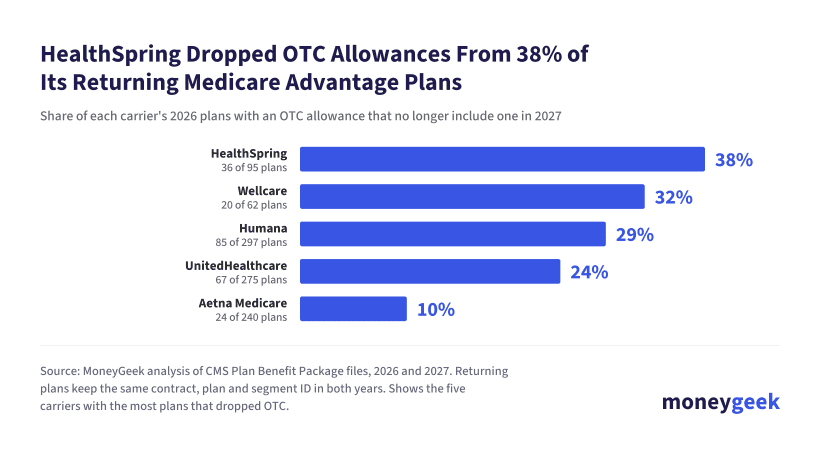
Five carriers made most of the OTC cuts. Among plans offered in both years:

Humana
85
28.6%
UnitedHealthcare
67
24.4%
HealthSpring
36
37.9%
Aetna Medicare
24
10.0%
Wellcare
20
32.3%
HealthSpring dropped OTC allowances from 38% of its returning plans.

We checked whether those plans moved OTC into a combined flex allowance or into benefits limited to chronically ill members. None of the 351 plans that dropped OTC list it in a 2027 combined-benefit group. Thirteen list benefits for chronically ill or other targeted members in 2027, which can include OTC items. For the other 338, the allowance is gone.

Why Some States Kept Their Extras

Nevada is the only ranked state where the all-four share rose by more than 2 points. For 2027, 70.7% of Nevada's 58 general-enrollment plans include all four extras, up from 67.2%. Nevada's OTC share rose from 71.9% to 79.3%, even though Senior Care Plus left the state with five plans.

The West as a whole held up better than other regions. The median Western state saw its all-four share fall 1 point, compared with 9.8 points in the Northeast and 8.1 points in the South. California, with 259 plans, was nearly flat at 49.0%.

Small markets show the widest range. Montana, which is not ranked because it has 19 plans, has the lowest all-four share in the country at 5.3%. Washington, D.C., has the highest at 72.7%, from 11 plans.

Dollar Limits Changed Little

Among plans that kept a benefit, the median dollar limit held. The median annual maximum for comprehensive dental stayed at $1,500 in both years. The average fell from $2,043 to $1,875. Plans with a dental maximum of $3,000 or more fell from 626 to 530, or from 22.5% to 20.5% of plans with a stated limit.

The median separate OTC allowance stayed at $200 a year. That figure covers plans that set a separate OTC limit. Many plans fold OTC into a combined flex card, and those allowances are not counted in the median.

What This Means for Your Coverage

Medicare Advantage extras are part of the insurance contract. They are written into each plan's benefit package and can change every January. A plan with the same name and premium can drop a benefit from one year to the next.

For a retiree who used a $200 OTC allowance, losing it adds $200 a year in out-of-pocket costs for the same items. For someone weighing Medicare Advantage against Original Medicare with a Medigap policy, extras are often part of the case for Medicare Advantage. Medicare.gov says Medigap policies usually don't cover vision, dental care or hearing aids.

Three steps help during open enrollment:

  1. 1
    Read the 2027 Annual Notice of Change

    Plans send it each September. It lists changes in coverage and costs that take effect in January.

  2. 2
    Compare Benefits Line By Line

    Medicare Plan Finder lists the extra benefits each 2027 plan includes. Check that the ones you use are still there. MoneyGeek's guide to the best Medicare Advantage plans by state can help narrow the list.

  3. 3
    Know the Deadlines

    You can switch plans through Dec. 7. If you are in Medicare Advantage on Jan. 1, the Medicare Advantage Open Enrollment Period lets you make one change from Jan. 1 to March 31.

THE BENEFIT CMS DIDN'T NAME

CMS told seniors to expect stable hearing, dental and vision benefits in 2027, and on those three the filings come close. The release didn't mention OTC allowances, which fell for a second straight year, mostly in plans that stayed on the market. A retiree reading only that release would have no reason to look for a missing OTC allowance. In 351 returning plans, it no longer comes standard.

Methodology

MoneyGeek analyzed the CMS Plan Benefit Package (PBP) files for contract years 2026 and 2027. The 2027 files are dated Oct. 1, 2026. The 2026 files are the latest quarterly version, downloaded Oct. 21, 2026. Both years' files were confirmed unchanged on Oct. 27, 2026. Each record is one plan benefit package (a contract, plan and segment). Every plan counts equally. Enrollment in 2027 plans is not yet available.

About Nathan Paulus


Nathan Paulus, Head of Content and SEO, MoneyGeek

Nathan Paulus is the Senior Director of Content and SEO at MoneyGeek, where he leads content strategy and conducts original data research across insurance, consumer costs, transportation safety, housing, public policy and personal finance. He reviews studies for methodology, source quality and factual accuracy.

Research and Analysis

In more than six years at MoneyGeek, Nathan has published more than 100 original studies and explanatory guides. His insurance research includes 50-state comparisons of health care outcomes, costs and access, and an analysis of how uninsured rates track with state Medicaid expansion decisions and electoral patterns. 

He has analyzed full-coverage auto rates across major insurers in all 50 states and tracked how premium trends relate to industry underwriting losses. That research draws on combined ratio data from Fitch Ratings and AM Best, plus the Bureau of Labor Statistics CPI figures. Beyond insurance, his work spans vehicle pricing trends across the U.S. new car market, summer traffic fatality rates by state, homeowner underinsurance ratios using mortgage and policy data, and housing affordability across all 50 states.

His research has been cited by Bloomberg, the Los Angeles Times, Forbes, Fast Company, the San Francisco Chronicle, USA Today and NBC Los Angeles. Harvard, MIT, Stanford and Yale have referenced his work.

Career

Nathan traces his interest in personal finance back to his grandmother, who ran her household on a simple rule: spend less than you make and save the difference before anything else. That rule shows up in his work today. His writing skips jargon and complex strategy in favor of the basics that help someone living paycheck to paycheck.

He joined MoneyGeek in July 2020 as Director of Content Marketing, where he led the content team and oversaw data journalism production across insurance and personal finance verticals. A promotion to Head of Marketing and Communications followed in December 2023. The new role added digital PR and communications strategy to his responsibilities. He was appointed Head of Content and SEO in January 2025.

Before MoneyGeek, Nathan served as Director of Content Marketing and SEO at Ventrix Advertising, where he helped build two content sites from scratch, contributed to link-building programs that generated more than 1,500 unique referring domains within a year and co-managed a marketing team of more than 20 people. Two and a half years at ABUV Media preceded that role. He advanced from Marketing Research Analyst to Senior Marketing Tactics Analyst, where he built expertise in audience research, content strategy and SEO.


Sources