67 Counties Will Lose All General-Enrollment Medicare Advantage Plans in 2027

Advertising & Editorial Disclosure

Sixty-seven U.S. counties, 63 of them rural, have no general-enrollment Medicare Advantage plans listed for 2027 after having at least one in 2026, MoneyGeek's analysis of Centers for Medicare & Medicaid Services (CMS) Medicare Advantage and Part D Landscape files found. General-enrollment plans are the individual Medicare Advantage plans that aren't limited to people with Medicaid, certain chronic conditions or institutional care.

Beyond those counties, MoneyGeek estimates that 2.83 million to 2.89 million general-enrollment members, or 13.2% to 13.6%, were in October 2026 plan-county combinations with neither their current plan nor an identified general-enrollment successor listed for 2027. The range reflects suppressed CMS enrollment counts and doesn't capture later file changes, continuation arrangements or individual eligibility.

If your plan is leaving, compare the 2027 plans in your county, including whether they cover your doctors and prescriptions, and check your right to buy a Medicare Supplement (Medigap) policy if you return to Original Medicare. For Medicare Advantage or Part D coverage starting Jan. 1, make sure the new plan receives your enrollment request by Dec. 31, 2026.

mglogo icon
MAIN FINDINGS
  • Counting the 67 counties that lose their last plan, 181 counties have no general-enrollment plan listed for 2027, up from 116 in 2026.
  • An estimated 2.83 million to 2.89 million members, or 13.2% to 13.6% of general-enrollment Medicare Advantage members, were in October 2026 plan-county combinations without their current plan or an identified successor listed for 2027.
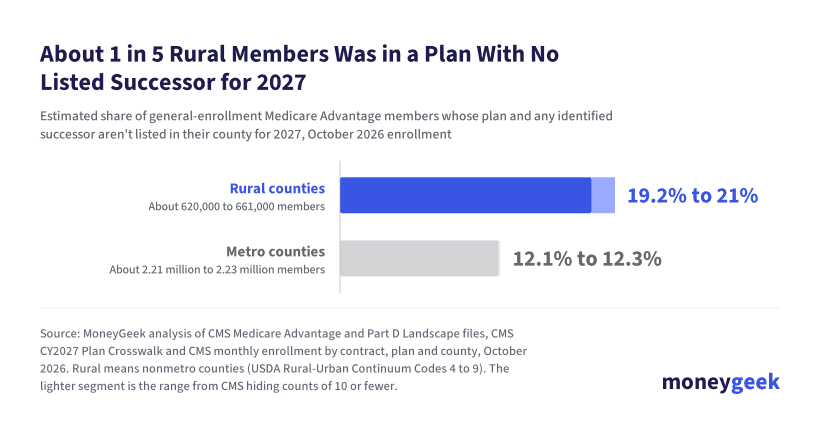
  • Rural members were more likely to be affected: an estimated 19.2% to 21% of nonmetro general-enrollment members, compared with 12.1% to 12.3% in metro counties.
  • Regional insurers, which offered general-enrollment plans in fewer than 10 states in 2026, had 27.4% of reported general-enrollment members but accounted for 46.3% of reported affected members.
  • Minnesota had the largest share affected, an estimated 68.2% of its general-enrollment members, or about 342,000 people.
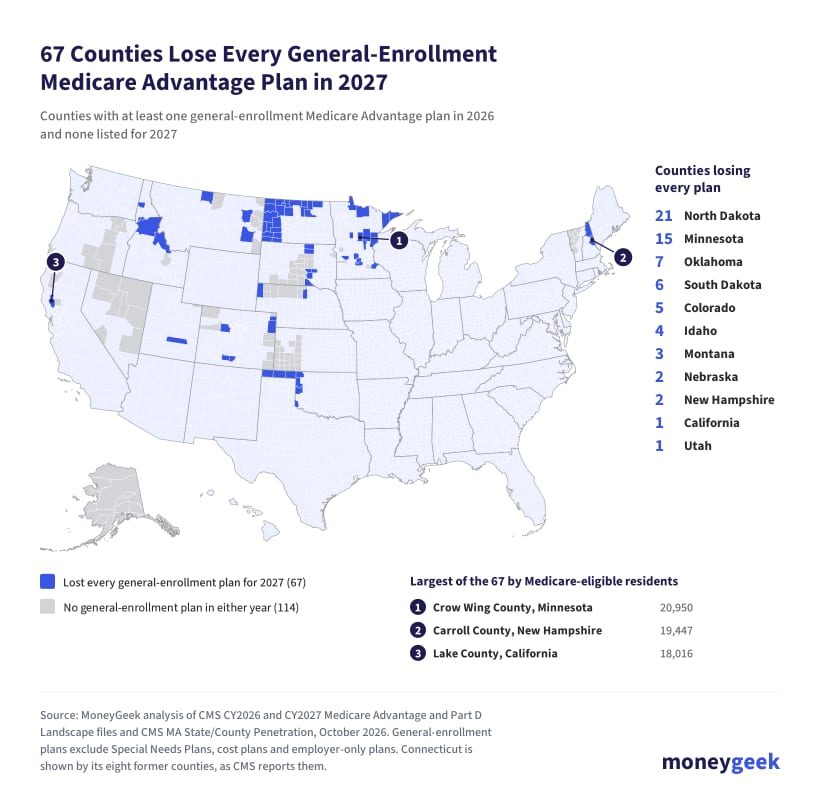
67 U.S. counties lose every general-enrollment Medicare Advantage plan for 2027, led by 21 in North Dakota and 15 in Minnesota.

Where Are Medicare Advantage Plans Leaving in 2027?

North Dakota has the most counties losing all general-enrollment Medicare Advantage plans for 2027, with 21. Minnesota follows with 15, then Oklahoma (seven), South Dakota (six) and Colorado (five). MoneyGeek's analysis of CMS files found 11 states with at least one county going from some general-enrollment plans in 2026 to none listed in 2027.

North Dakota
21
21
Minnesota
15
18
Oklahoma
7
7
South Dakota
6
21
Colorado
5
12
Idaho
4
5
Montana
3
9
Nebraska
2
8
New Hampshire
2
2
California
1
3
Utah
1
2

Crow Wing County, Minnesota, has the most Medicare-eligible residents among the 67 counties losing all general-enrollment plans, with 20,950 as of October 2026. Blue Cross and Blue Shield of Minnesota and Medica had nine general-enrollment plans there in 2026. Carroll County, New Hampshire, and Lake County, California, are next, each with more than 18,000 Medicare-eligible residents and only one general-enrollment plan in 2026.

Most of these 67 counties still list another private Medicare health plan for 2027. CMS lists a Medicare cost plan in 41 of them, all in North Dakota, Minnesota, South Dakota and Nebraska, and a Special Needs Plan (SNP) in 42, with some counties listing both. Cost plans are a separate Medicare plan type with their own rules, and SNPs only enroll people who qualify, such as those with both Medicare and Medicaid. Five of the 67 counties list neither option.

Nationally, general-enrollment Medicare Advantage plans fall from 3,350 in 2026 to 3,171 in 2027, with each contract and plan ID counted once. General-enrollment plan-county offerings drop 11.8%, and 2,236 counties have fewer general-enrollment plans to choose from. CMS says more than 99% of Medicare beneficiaries have access to at least one Medicare Advantage plan, a figure that includes plan types this study excludes. Among counties with October CMS eligibility data, which exclude Alaska and Connecticut, 0.7% of Medicare-eligible residents live in counties without a general-enrollment plan listed for 2027.

How Many Members Are in Plans Without a Listed Successor?

MoneyGeek estimates that 2,834,123 to 2,893,693 general-enrollment Medicare Advantage members were in October 2026 plan-county combinations with neither their current plan nor an identified general-enrollment successor listed for 2027. That's 13.2% to 13.6% of general-enrollment members. The estimate uses the CMS CY2027 Plan Crosswalk dated Oct. 1, 2026, and the range reflects suppressed enrollment counts of 10 or fewer. It doesn't capture later crosswalk changes, continuation arrangements a carrier may offer or individual eligibility, and 923 reported members with unresolved crosswalk results are excluded.

Plan disappearance alone overstates the disruption. About 3.76 million reported members were in plans whose ID isn't listed in their county for 2027, but about 925,000 of them are linked in the CMS crosswalk to a successor plan listed in their county. Those members can expect to move to the successor plan, though benefits, premiums and networks can change.

A different general-enrollment plan from the same parent company is listed in the county for about 71% of reported affected enrollment, or roughly 2 million members. That listing doesn't mean a member is moved automatically. The other plan may have different doctors, benefits or premiums.

SNPs are reported separately. MoneyGeek estimates that 310,860 to 348,700 SNP members were in plans without a listed SNP successor in their county. SNP eligibility depends on each member's circumstances, such as Medicaid status or a chronic condition.

A Johns Hopkins research letter in JAMA estimated that about 2.9 million Medicare Advantage enrollees in nonemployer HMO and PPO plans, including SNP members, were affected by plan exits for 2026. That study used March 2025 enrollment and a different plan population, and it isn't a direct comparison with MoneyGeek's 2027 estimate.

Are Rural Counties More Likely to Lose Medicare Advantage Plans?

Yes: nonmetro counties account for 63 of the 67 counties losing their last general-enrollment Medicare Advantage plan, or 3.4% of nonmetro counties that had such a plan in 2026. Only four metro counties lose their last general-enrollment plan, 0.3% of metro counties with plans.

Rural Medicare Advantage members were also more likely to be in plans without a listed successor in their county: 19.2% to 21% of nonmetro general-enrollment members, compared with 12.1% to 12.3% of metro members. Insurer exits were close to even, though: at least one insurer drops all of its general-enrollment plans in 54.8% of nonmetro counties and 52.4% of metro counties.

Counties losing all general-enrollment plans

63 of 1,848 (3.4%)

4 of 1,179 (0.3%)
Counties losing at least one insurer
1,012 of 1,848 (54.8%)
618 of 1,179 (52.4%)
Median change in general-enrollment plans per county
Down 12.2%
Down 9.7%
Counties with fewer general-enrollment plans
1,352 of 1,848 (73.2%)
884 of 1,179 (75%)
Estimated members affected
620,016–661,336
2,214,107–2,232,357
Estimated share of general-enrollment members affected
19.2–21%
12.1–12.3%
About 1 in 5 rural Medicare Advantage members had no listed 2027 successor plan, compared with 1 in 8 in metro counties.

North Dakota's county losses trace to one insurer. All 21 of its counties losing every general-enrollment plan lost NextBlue of North Dakota, a Medicare Advantage insurer CMS lists under Blue Cross Blue Shield of Michigan, and an estimated 42.8% to 45% of the state's general-enrollment members were in plans without a listed successor in their county. CMS lists Medica cost plans in all 21 of those counties for 2027.

Members of regional insurers, including health-system plans, were more than twice as likely to be affected. MoneyGeek classified CMS parent companies that offered general-enrollment plans in fewer than 10 states in 2026 as regional. They had 27.4% of reported general-enrollment members but 46.3% of reported affected members, about 1.31 million people. That's 22.5% of their reported members, compared with 9.9% of reported members in the eight national insurers' plans.
Regional insurer exits left a larger share of members affected in rural counties. Where at least one regional insurer dropped all of its general-enrollment plans in a rural county, 31.8% of reported members were affected, compared with 20.6% in rural counties where only national insurers exited and 14.6% in rural counties with no insurer exit. In metro counties, the shares were 14.4%, 12.1% and 10.1%. Wyoming is an exception to the regional pattern: about 2 in 5 of its members were affected, and all of its reported affected members were in national insurers' plans.

Which States Have the Most Medicare Advantage Members Affected?

Minnesota had the most general-enrollment Medicare Advantage members affected for 2027, an estimated 341,972 to 342,562, or 68.2% of its general-enrollment members. Florida had about 302,000 to 303,000 affected members, New York about 218,000 to 219,000 and Texas about 190,000 to 199,000, but those totals are smaller shares of much larger markets.

Minnesota
341,972–342,562
68.2%
Florida
302,379–303,279
16.8–16.9%
New York
217,563–218,933
20.9–21%
Texas
189,583–198,593
11.6–12.2%
California
143,349–143,539
6.4%
Washington
138,389–138,729
27.3%
Oregon
115,645–115,715
28.4%
Pennsylvania
96,336–98,646
8.6–8.9%
Michigan
91,124–92,154
11.7–11.9%
Connecticut
81,722–81,732
36.8%

More than 1 in 3 general-enrollment members were affected in nine states. After Minnesota, they're South Dakota (45.3% to 47%), Maine (44.6%), North Dakota (42.8% to 45%), Wyoming (40.4% to 40.9%), Nebraska (40% to 43.9%), Idaho (39.1% to 39.4%), New Mexico (37.6% to 37.9%) and Connecticut (36.8%).

minnesota icon
WHY IS MINNESOTA LOSING SO MANY MEDICARE ADVANTAGE PLANS?

Minnesota's numbers come largely from Blue Cross and Blue Shield of Minnesota, which ended eight of its nine individual Medicare Advantage PPO plans for 2027. Those eight plans had 250,821 reported members in October 2026. CMS's crosswalk doesn't link them to the insurer's new 2027 plans, so those members aren't moved automatically. Blue Cross and Blue Shield of Minnesota says impacted members are receiving personalized letters with their 2027 options.

Blue Cross and Blue Shield of Minnesota lists another 2027 general-enrollment plan in the counties where 84.2% of those 250,821 reported members live. The insurer separately says new options exist for more than 80% of its current Medicare Advantage members, a different denominator. HealthPartners, Medica, UnitedHealthcare, Humana and the Allina Health and Aetna joint venture also ended plans or left counties in Minnesota.

Which Insurers Are Leaving the Most Counties?

Health Care Service Corporation leaves the most counties. It drops general-enrollment Medicare Advantage plans in 498 of the 948 counties where it offered them in 2026. CMS lists Health Care Service Corporation as the parent of Blue Cross and Blue Shield plans in Illinois, Montana, New Mexico, Oklahoma and Texas, and of HealthSpring. Centene, which sells Wellcare plans, follows with 359 county exits. UnitedHealthcare leaves 148 counties and enters eight, so it still serves 2,457 in 2027.

Health Care Service Corporation
498
948
Centene Corporation
359
1,731
Blue Cross Blue Shield of Michigan Mutual Ins. Co.
194
299
CVS Health Corporation (Aetna)
186
2,083
UnitedHealth Group (UnitedHealthcare)
148
2,597
Group 1001 (Clear Spring Health)
138
138
Molina Healthcare
75
75
Elevance Health
66
952

County exits and affected members rank insurers differently. Humana leaves only 61 of its 2,655 counties, but an estimated 534,593 to 538,413 of its general-enrollment members were in plans without a listed successor, about 19% of all affected members and more than any other parent company. Another general-enrollment plan from the same parent is listed in the member's county for 93.6% of Humana's reported affected enrollment, compared with 74.4% for UnitedHealth Group and 50.8% for Centene.

Group 1001, which sells Medicare Advantage plans as Clear Spring Health, and Molina Healthcare are among 12 CMS parent organizations with no general-enrollment Medicare Advantage plans listed for 2027. Clear Spring Health listed plans in 138 counties in Colorado, Georgia and Illinois in 2026 but has no matching October enrollment records, so it has no affected-member count. Molina Healthcare, Horizon Mutual Holdings (Horizon Blue Cross Blue Shield of New Jersey), Presbyterian Healthcare Services and Elderplan still list SNPs, so these insurers' general-enrollment exits aren't complete Medicare Advantage withdrawals.

Seven health-system insurers have no individual Medicare Advantage plans of any kind listed for 2027. They're Aspirus, BMC Health System's WellSense, CHRISTUS Health, Memorial Hermann, Providence, Sharp HealthCare and UMass Memorial Health's Mass Advantage.

The seven health-system insurers' general-enrollment plans account for an estimated 108,126 to 108,686 affected members, or 112,113 to 112,693 including SNP members. Employer-only plans aren't in the CMS files used here, so this doesn't describe employer group coverage.

Blue Cross Blue Shield of Michigan Mutual Insurance Co. is the parent CMS lists for NextBlue of North Dakota and for Wellmark-branded Medicare Advantage plans in South Dakota. Its exits account for all 21 of North Dakota's counties losing every general-enrollment plan and three of South Dakota's six.

Affected members were more often in lower-rated contracts. Among reported affected enrollment, 13.9% was in contracts with a 2026 Medicare Part C summary star rating of 3 stars or lower, compared with 4.2% of reported enrollment in continuing plans. CMS star ratings apply to whole contracts, not individual plans, and this comparison doesn't show why any insurer left.

What Can You Do if Your Medicare Advantage Plan Is Leaving?

You can join another Medicare Advantage plan, return to Original Medicare or choose another option such as a cost plan, if one serves your county and you're eligible. Medicare annual open enrollment runs Oct. 15 to Dec. 7, 2026, for coverage starting Jan. 1, 2027. Members whose plans aren't renewing also get a special enrollment period from Dec. 8, 2026, through Feb. 28, 2027, Medicare.gov says.

Coverage start dates depend on when you act under that nonrenewal special enrollment period, CMS's 2027 enrollment guidance says. Requests received Dec. 8 to Dec. 31, 2026, take effect Jan. 1, 2027. A request received in January or February takes effect the first day of the next month. If you return to Original Medicare, eligible applicants have until March 4, 2027, to apply for certain Medigap policies without denial or higher premiums because of health, but applying by that date doesn't by itself provide coverage back to January.

Members of a nonrenewing Medicare Advantage plan who don't join another plan before it ends are enrolled in Original Medicare. Original Medicare doesn't include Part D prescription drug coverage, though Part B covers certain outpatient drugs. Arrange a separate Medicare Part D plan unless you have other creditable drug coverage or Medicare reassigns you to a drug plan through Extra Help, and check your notices for the effective date.

mglogo icon
MONEYGEEK EXPERT TIP
  1. Read your plan's letter. A Medicare Advantage plan that isn't renewing must mail members a notice at least 90 days before coverage ends, with information about other plan options.
  2. Compare 2027 plans in your county. Use Medicare's Plan Finder on Medicare.gov, including plans from your current insurer, and check that your doctors and prescriptions are covered.
  3. Compare Medicare Advantage with Original Medicare plus Medigap, including premiums, out-of-pocket costs and coverage.
  4. Choosing Original Medicare? Arrange drug coverage and apply for Medigap within your guaranteed-issue window.
  5. For Jan. 1, 2027, coverage, make sure the new Medicare Advantage or Part D plan receives your enrollment request by Dec. 31, 2026. If you choose Medigap, arrange its effective date separately with the insurer.
What Medigap Rights Apply When a Medicare Advantage Plan Leaves?

Federal law gives eligible people a guaranteed-issue right to buy certain Medigap policies when their Medicare Advantage plan leaves Medicare or stops serving their area and they return to Original Medicare. During this window, an insurer can't deny the policy, charge more because of health or exclude pre-existing conditions. Eligible applicants can apply as early as 60 days before their plan coverage ends and no later than 63 days after, so the window for plans ending Dec. 31, 2026, runs from Nov. 1, 2026, to March 4, 2027.

The Medigap plans covered by this right depend on when you first became eligible for Medicare. People first eligible on or after Jan. 1, 2020, can buy Plans A, B, D, G, K or L where sold. For people eligible earlier, the list is Plans A, B, C, F, K and L, CMS told state insurance regulators in November 2024. Plan N isn't part of this federal minimum. Massachusetts, Minnesota and Wisconsin standardize Medigap policies differently, so plan letters differ there.

Federal law doesn't require insurers to sell Medigap policies to people under 65, so some people with Medicare due to disability may not have this right unless state law provides it. Illinois, Mississippi and North Carolina give people under 65 a guaranteed-issue right when their Medicare Advantage or other managed care plan ends, KFF reports. In Texas, people under 65 who get Medicare because of a disability can buy at least Plan A when they have a guaranteed-issue right after losing coverage, the Texas Department of Insurance says.

To use the plan-exit protection, you must return to Original Medicare and apply within the window, and choosing another Medicare Advantage plan doesn't extend that deadline. Without another guaranteed-issue right, most states let insurers use medical underwriting.

Do Some States Give Medigap Protections Beyond Federal Law?

Some states do: every state follows the federal plan-exit guaranteed-issue right, and several add enrollment opportunities beyond it. People with Medicare can buy Connecticut Medigap policies and New York Medigap policies at any time of year. MoneyGeek checked the states below against state laws or insurance department guidance.

Connecticut
Year-round Medigap issue
Where permitted, a pre-existing condition waiting period can last up to 6 months; qualifying prior coverage can reduce or eliminate it
New York
Year-round Medigap issue, including people under 65
Waiting period of up to 6 months, reduced or waived for prior coverage
Massachusetts
Annual open enrollment, Feb. 1–March 31, by regulation
Most insurers listed by the state offered continuous enrollment in 2026; uses its own plan designs
Maine
Guaranteed issue for Plan A during at least one designated month each year
Each insurer picks its month
Rhode Island
Guaranteed issue during fall Medicare open enrollment for coverage starting Jan. 1, for people currently in Medicare Advantage or Medigap
Must have had Medigap, Medicare Advantage or other creditable coverage since their Medigap open enrollment period, with no break over 90 days (law amended June 2026); eligible enrollees under 65 with a disability can buy Plan A only
Delaware
Medicare Advantage enrollees can switch to Medigap during Medicare open enrollment periods
On this state route, insurer can rate individually and apply a pre-existing condition limit
Minnesota
Annual window for people ages 65–70 applying for the first time during Medicare open enrollment periods
Surcharge set by enrollment year (15% for 2026, 20% for 2027, up to 35% from 2030) continues while the policy is in force; qualifying plan-exit purchases are exempt

State Medigap rules beyond the federal minimum help most if you miss the federal window. A year-round Medigap rule doesn't let you leave Medicare Advantage at any time, but a New York or Connecticut resident who returns to Original Medicare during a later enrollment period can still buy a policy. In most other states, that person would need another guaranteed-issue right or would go through medical underwriting.

Outside the seven states in the table, no state law adds a year-round or annual Medigap window, KFF's 2026 review shows. Illinois has a voluntary version: Blue Cross Blue Shield of Illinois sells Medigap on a guaranteed-issue basis all year, KFF reports, though state law doesn't require it. At the other end, KFF lists 10 states and Washington, D.C., as following only the federal minimum for people 65 and older: Alabama, Arizona, Georgia, Hawaii, Mississippi, New Hampshire, North Carolina, North Dakota, South Carolina and South Dakota.

KFF classifies the other 32 states as adding guaranteed-issue rights tied to events such as a cut in retiree coverage or the loss of Medicaid. Some also expand options when a plan ends. Since July 1, 2026, for example, Maryland has let people who first became eligible for Medicare before 2020 and have a qualifying federal special enrollment period buy any Medigap policy open to new members, the Maryland Insurance Administration says.

Vermont and Washington sometimes appear on lists of states with extra Medigap protections, but neither offers year-round issue to people leaving Medicare Advantage. Vermont ties guaranteed issue to events such as a plan exit, and Washington's any-time switching rule covers only people who have Medigap Plan B through N.

What Happens if Your Plan Leaves? 2 Enrollee Scenarios

Each hypothetical enrollee below is 70 years old, first became eligible for Medicare in 2021 and has a general-enrollment Medicare Advantage plan ending Dec. 31, 2026. The scenarios use plan listings from the CMS 2027 files and the laws reviewed above. They don't replace advice from a State Health Insurance Assistance Program.

  • northDakota icon

    Scenario 1: A Rural North Dakota Enrollee Whose Insurer Leaves

    In Stark County, North Dakota, all three 2026 general-enrollment Medicare Advantage plans came from NextBlue of North Dakota, and none are listed for 2027. A Stark County member can return to Original Medicare, arrange drug coverage and use the federal right to buy Medigap Plan A, B, D, G, K or L, where sold, from Nov. 1, 2026, to March 4, 2027. CMS also lists Medica cost plans in Stark County for 2027.

    Without another guaranteed-issue right, an insurer may require medical underwriting for a Stark County applicant after March 4, 2027. Compare quotes from insurers selling Medigap in North Dakota before that date.

  • minnesota icon

    Scenario 2: A Minnesota Enrollee in a County Losing Every General-Enrollment Plan

    In Crow Wing County, Minnesota, Blue Cross and Blue Shield of Minnesota and Medica had nine general-enrollment plans in 2026, and CMS lists none for 2027. Among the medical plan types MoneyGeek reviewed, only SNPs are listed there for 2027. A Crow Wing County member who returns to Original Medicare can use the federal plan-exit right through March 4, 2027.

    Minnesota exempts qualifying plan-exit purchases from the surcharge on its newer age-65-to-70 enrollment route, so this member doesn't need that route. Minnesota uses its own basic and extended basic Medigap plans rather than the lettered plans used in most states.

Which Costs Should You Compare Before Switching?

Compare annual premiums and expected cost sharing for medical care and prescriptions under each option: a Medicare Advantage plan, or Original Medicare with a Medigap policy and a Part D plan. MoneyGeek’s 2026 quote analysis reports average Medigap Plan G premiums of $220 a month at age 65 and $279 at age 75. Get 2027 quotes before you decide. Extra benefits are part of that comparison, and fewer plans include them for 2027. MoneyGeek’s analysis of 2027 plan filings found that 52.7% of general-enrollment Medicare Advantage plans include comprehensive dental, eyewear, hearing aids and an over-the-counter allowance, down from 59.5% in 2026.

State Health Insurance Assistance Programs offer free help comparing 2027 options. Most people enrolled in Medicare Advantage can make one change during the Medicare Advantage open enrollment period, Jan. 1 to March 31, 2027. That period doesn’t apply to Medicare medical savings account plans.

Which Counties Lose All Medicare Advantage Plans in 2027?

These 67 counties had at least one general-enrollment Medicare Advantage plan in 2026 and have none listed for 2027. An estimated 31,191 to 32,151 general-enrollment members in these counties were in plans with no listed successor.

Lake County
California
UnitedHealthcare
1,063
Alamosa County
Colorado
Humana
689–699
Eagle County
Colorado
UnitedHealthcare
739
Phillips County
Colorado
UnitedHealthcare
56
Rio Grande County
Colorado
Humana
669
Yuma County
Colorado
UnitedHealthcare
67
Benewah County
Idaho
UnitedHealthcare
262
Idaho County
Idaho
UnitedHealthcare
617
Lemhi County
Idaho
UnitedHealthcare
156–166
Lewis County
Idaho
UnitedHealthcare
83
Aitkin County
Minnesota
Humana
521
Carlton County
Minnesota
Humana
394–404
Chippewa County
Minnesota
Blue Cross and Blue Shield of Minnesota and Medica
1,159–1,169
Cook County
Minnesota
UnitedHealthcare
83–93
Crow Wing County
Minnesota
Blue Cross and Blue Shield of Minnesota and Medica
10,861
Goodhue County
Minnesota
Humana
328
Koochiching County
Minnesota
UnitedHealthcare
259
Lake County
Minnesota
Humana and UnitedHealthcare
381
Lake of the Woods County
Minnesota
Blue Cross and Blue Shield of Minnesota, Medica and UnitedHealthcare
632–682
McLeod County
Minnesota
HealthPartners and Humana
887–897
Meeker County
Minnesota
HealthPartners and Humana
459–469
Mille Lacs County
Minnesota
Allina Health Aetna Medicare and Humana
745–765
Pine County
Minnesota
Humana
502
Sibley County
Minnesota
Allina Health Aetna Medicare and Humana
563
Wadena County
Minnesota
Blue Cross and Blue Shield of Minnesota and Medica
1,944
Custer County
Montana
Blue Cross and Blue Shield of Montana
347–367
Hill County
Montana
Blue Cross and Blue Shield of Montana
214–234
McCone County
Montana
UnitedHealthcare
12–42
Rock County
Nebraska
Aetna Medicare
0–50
Sioux County
Nebraska
Humana
12–32
Carroll County
New Hampshire
WellSense Health Plan
937
Coos County
New Hampshire
WellSense Health Plan and Humana
2,741
Adams County
North Dakota
NextBlue of North Dakota
16–36
Benson County
North Dakota
NextBlue of North Dakota and UnitedHealthcare
64–104
Billings County
North Dakota
NextBlue of North Dakota
0–30
Bottineau County
North Dakota
NextBlue of North Dakota
75–85
Bowman County
North Dakota
NextBlue of North Dakota
17–37
Burke County
North Dakota
NextBlue of North Dakota
20–40
Cavalier County
North Dakota
NextBlue of North Dakota
28–48
Divide County
North Dakota
NextBlue of North Dakota
12–32
Dunn County
North Dakota
NextBlue of North Dakota
30–40
Golden Valley County
North Dakota
NextBlue of North Dakota
16–36
Hettinger County
North Dakota
NextBlue of North Dakota
31–41
McKenzie County
North Dakota
NextBlue of North Dakota
56–66
Mountrail County
North Dakota
NextBlue of North Dakota and UnitedHealthcare
142–162
Pierce County
North Dakota
NextBlue of North Dakota
58–68
Renville County
North Dakota
NextBlue of North Dakota
47–57
Rolette County
North Dakota
NextBlue of North Dakota
47–57
Slope County
North Dakota
NextBlue of North Dakota
11–31
Stark County
North Dakota
NextBlue of North Dakota
200
Towner County
North Dakota
NextBlue of North Dakota
20–40
Ward County
North Dakota
NextBlue of North Dakota
608
Williams County
North Dakota
NextBlue of North Dakota
370
Beaver County
Oklahoma
UnitedHealthcare
93–123
Cimarron County
Oklahoma
UnitedHealthcare
43–83
Ellis County
Oklahoma
UnitedHealthcare
66–76
Harmon County
Oklahoma
Blue Cross and Blue Shield of Oklahoma and UnitedHealthcare
59–169
Harper County
Oklahoma
UnitedHealthcare
38–48
Roger Mills County
Oklahoma
UnitedHealthcare
76–106
Texas County
Oklahoma
UnitedHealthcare
311
Brule County
South Dakota
Aetna Medicare
12–32
Buffalo County
South Dakota
Aetna Medicare
0–30
Edmunds County
South Dakota
Wellmark Advantage Health Plan
45–55
Gregory County
South Dakota
Aetna Medicare
13–33
Jerauld County
South Dakota
Wellmark Advantage Health Plan and Aetna Medicare
13–53
McPherson County
South Dakota
Wellmark Advantage Health Plan
14–24
Wayne County
Utah
Select Health
158

Methodology

MoneyGeek compared the general-enrollment Medicare Advantage plans listed in each county in the CMS CY2026 Medicare Advantage and Part D Landscape file (version 202609, data updated Sept. 2, 2026) and the CY2027 file (version 202610, data updated Oct. 18, 2026). The CMS CY2027 Plan Crosswalk (dated Oct. 1, 2026) links each 2026 plan to any 2027 successor. General-enrollment plans are Medicare Advantage HMO, PPO, regional PPO, private fee-for-service and medical savings account plans that aren't SNPs. The analysis excludes cost plans, stand-alone drug plans, employer-only plans and U.S. territories.

About Myryah Irby


Myryah Irby, Writer and Data Journalist

Myryah Irby is a writer and data journalist at MoneyGeek. Her work spans original data studies and how-to guides covering auto, home and health insurance, consumer costs and transportation safety.

Research and Analysis

Since joining MoneyGeek in late 2025, Irby has produced data studies on insurance costs, consumer spending and transportation risk. Her published work includes a 50-state analysis of winter driving danger using fatality and weather severity data; research tracking the relationship between rhodium commodity prices and catalytic converter theft rates, including state-level theft trends and what those rates mean for insurance costs; a state-by-state comparison of winter home heating costs; and an analysis of the full cost of having a baby in America: hospital bills, insurance and out-of-pocket expenses.

Career

Irby has more than 20 years of editorial and writing experience. Since 2005, she has run Irby x Irby, her own editorial and copywriting practice, with clients including The New York Times, The San Francisco Chronicle, OpenAI and the National Park Service. From 2019 to 2023, she served as Senior Managing Editor and then Copywriting Manager at Callisto Media, a nonfiction publisher acquired by Penguin Random House in May 2023, where she led a team of writers and graphic designers.

Before that, she spent nearly 11 years at QuinStreet, a performance marketing company that runs content and comparison sites in insurance and personal finance. She rose from Managing Editor to Senior Managing Editor between 2010 and 2016. Earlier in her career, she edited at Collabrys for nearly four years and tutored doctoral candidates on dissertation writing at the University of San Francisco.


Sources