ACA Premiums at Age 59 in 2027: More Than $20,000 a Year in 23 States

Updated: November 10, 2026

Advertising & Editorial Disclosure

A 59-year-old buying an Affordable Care Act (ACA) Silver plan without a tax credit will pay an average of $1,662 a month in 2027, up 13.2% from $1,469 in 2026. The increase is $194 a month, or $2,324 over a full year of coverage.

The full-price bill tops $20,000 a year in 23 states, up from eight in 2026. In Wyoming, it's $31,922.

Most marketplace shoppers pay less than these prices. CMS data shows 87% of people who picked a 2026 marketplace plan had a tax credit applied. The full price falls on people who earn too much to qualify: for 2027, any single person with income above $63,840 in most states.

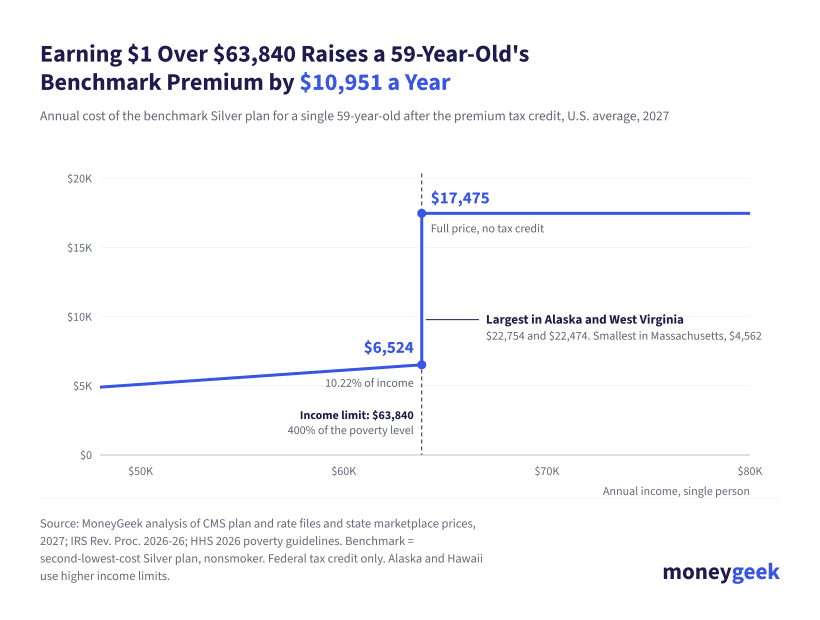
That line is where the cost jumps. At $63,840, a single 59-year-old pays no more than $6,524 a year for the benchmark Silver plan. One dollar more, and the same plan's full price averages $17,475.

The increase lands harder on older buyers. In 46 states, insurers charge a 59-year-old 2.04 times what a 40-year-old pays for the same plan. The same percentage increase adds about twice as many dollars at 59.

Adults 55 to 64 made up 5.2 million of the 23.1 million people who picked a 2026 marketplace plan, CMS open enrollment data shows. The premium figures come from MoneyGeek's study of 2027 ACA premiums, which priced Silver plans by hand on the marketplace websites of 20 states and D.C.

mglogo icon
STUDY FINDINGS
  • Full-price premiums at 59 rose 13.2% for 2027. A 59-year-old's average Silver plan costs $1,662 a month before tax credits, up from $1,469 in 2026 (50 states and D.C.).
  • A 59-year-old pays $19,947 a year for the average Silver plan. That's $9,670 more than a 40-year-old pays for the same coverage.
  • The $20,000 mark spread. A 59-year-old pays more than $20,000 a year in 23 states, up from eight in 2026.
  • $1 over the income limit costs $10,951 a year. A single 59-year-old earning $63,840 pays no more than $6,524 for the benchmark Silver plan in most states. Above that, the plan's full price averages $17,475.
  • Wyoming is the most expensive state at 59. The average Silver plan costs $2,660 a month, or $31,922 a year. New Hampshire is the cheapest at $1,179 a month.
  • Washington had the largest increase. A 59-year-old's average Silver premium rose $449 a month, adding $5,392 to a year of coverage.
  • Arkansas and Iowa got cheaper. Arkansas fell $51 a month for a 59-year-old, and Iowa fell $5.
  • Most states charge 59-year-olds 2.04 times the age-40 rate. New York and Vermont don't vary premiums by age, and Massachusetts, D.C. and Utah use their own age curves.

ACA Premiums at Age 59 by State

Wyoming charges a 59-year-old the most for 2027 at $2,660 a month, and New Hampshire charges the least at $1,179. Each row shows a state's 2027 and 2026 full-price Silver premium for a 59-year-old and the change between them.

1
Wyoming
$2,660
$31,922
$2,270
+$391
17.2%
2
West Virginia
$2,484
$29,807
$2,219
+$265
11.9%
3
Alaska
$2,466
$29,594
$2,116
+$350
16.6%
4
Illinois**
$2,113
$25,358
$1,927
+$186
9.6%
5
Florida
$2,045
$24,538
$1,795
+$250
13.9%
6
Nebraska
$2,016
$24,196
$1,901
+$115
6.0%
7
Washington*
$1,940
$23,278
$1,491
+$449
30.1%
8
Delaware
$1,934
$23,208
$1,545
+$389
25.2%
9
Utah†
$1,906
$22,877
$1,654
+$253
15.3%
10
Kansas
$1,858
$22,297
$1,574
+$284
18.0%
11
Arizona
$1,849
$22,188
$1,562
+$287
18.4%
12
Montana
$1,844
$22,133
$1,529
+$315
20.6%
13
Louisiana
$1,834
$22,006
$1,647
+$187
11.3%
14
Connecticut
$1,832
$21,985
$1,751
+$81
4.7%
15
Tennessee
$1,828
$21,934
$1,569
+$259
16.5%
16
Maine
$1,818
$21,821
$1,573
+$245
15.6%
17
Texas
$1,812
$21,748
$1,625
+$187
11.5%
18
New Mexico
$1,810
$21,714
$1,559
+$250
16.1%
19
Mississippi
$1,806
$21,669
$1,512
+$294
19.5%
20
Pennsylvania
$1,794
$21,524
$1,616
+$178
11.0%
21
North Carolina
$1,732
$20,784
$1,607
+$125
7.8%
22
Missouri
$1,707
$20,487
$1,500
+$208
13.9%
23
Wisconsin
$1,689
$20,265
$1,463
+$226
15.4%
24
New Jersey
$1,662
$19,941
$1,370
+$292
21.3%
25
Alabama
$1,653
$19,833
$1,421
+$232
16.3%
26
Georgia
$1,644
$19,731
$1,437
+$208
14.4%
27
California
$1,638
$19,655
$1,464
+$174
11.9%
28
Arkansas
$1,625
$19,505
$1,677
-$51
-3.1%
29
Nevada
$1,620
$19,446
$1,477
+$143
9.7%
30
Kentucky
$1,597
$19,160
$1,355
+$242
17.9%
31
South Carolina
$1,581
$18,969
$1,310
+$270
20.6%
32
Oklahoma
$1,569
$18,829
$1,466
+$103
7.0%
33
South Dakota
$1,556
$18,670
$1,411
+$145
10.3%
34
Michigan
$1,552
$18,622
$1,419
+$133
9.3%
35
Oregon
$1,551
$18,613
$1,283
+$268
20.9%
36
Colorado
$1,525
$18,300
$1,335
+$190
14.2%
37
Rhode Island
$1,471
$17,648
$1,175
+$296
25.2%
38
Ohio
$1,462
$17,548
$1,286
+$176
13.7%
39
North Dakota
$1,452
$17,423
$1,266
+$186
14.7%
40
Vermont***
$1,433
$17,192
$1,423
+$10
0.7%
41
D.C.†
$1,420
$17,040
$1,287
+$133
10.3%
42
Indiana
$1,332
$15,989
$1,147
+$185
16.2%
43
Massachusetts†
$1,326
$15,916
$1,188
+$139
11.7%
44
Hawaii
$1,289
$15,470
$1,187
+$102
8.6%
45
Minnesota
$1,280
$15,362
$1,188
+$92
7.8%
46
Idaho
$1,251
$15,014
$1,111
+$140
12.6%
47
Virginia
$1,227
$14,723
$1,059
+$168
15.8%
48
Iowa
$1,197
$14,359
$1,202
-$5
-0.5%
49
New York***
$1,195
$14,341
$1,091
+$104
9.5%
50
Maryland
$1,180
$14,165
$973
+$208
21.4%
51
New Hampshire
$1,179
$14,147
$981
+$198
20.2%

Where a 59-Year-Old Pays More Than $20,000 a Year

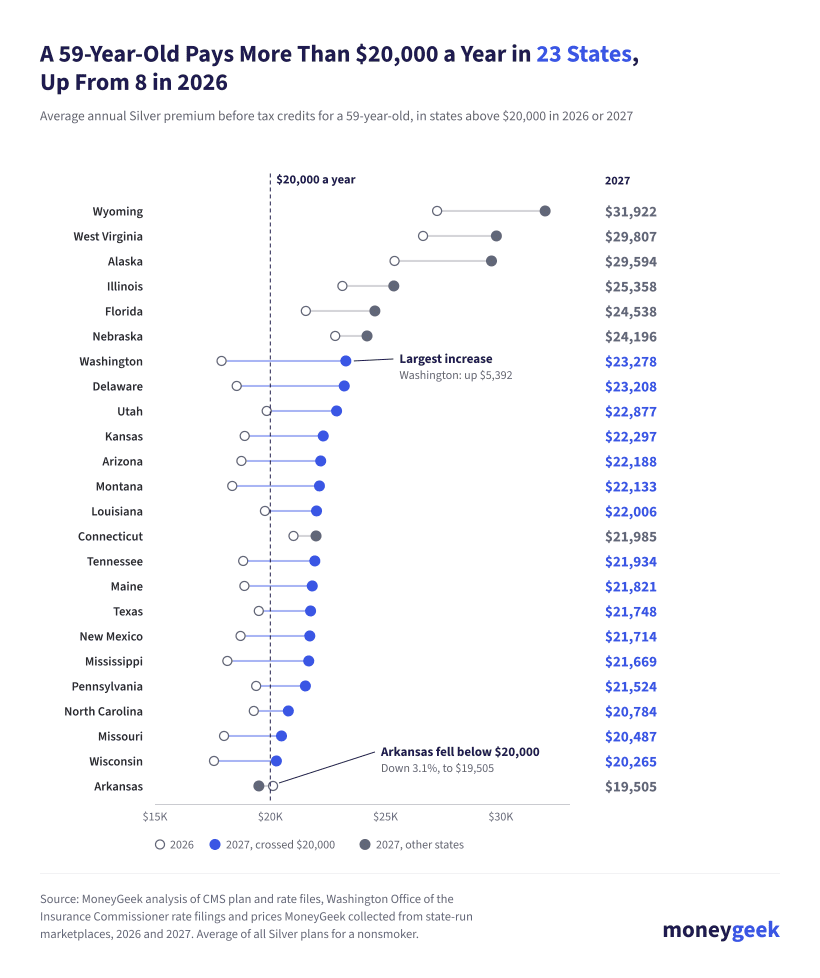
The average full-price Silver plan for a 59-year-old tops $20,000 a year in 23 states for 2027. In 2026, eight states crossed that line.

At 59, full-price Silver plans top $20,000 a year in 23 states

Sixteen states joined the group this year, including Texas and Pennsylvania. Arkansas left it: its premium for a 59-year-old fell 3.1%, to $19,505 a year.

Wyoming is the only state above $30,000, at $31,922. West Virginia ($29,807), Alaska ($29,594) and Illinois ($25,358) follow.

At the low end, five states keep the annual cost under $15,000: New Hampshire, Maryland, New York, Iowa and Virginia. New Hampshire's $14,147 is less than half of Wyoming's.

How Much More a 59-Year-Old Pays Than a 40-Year-Old

A 59-year-old pays $9,670 more a year than a 40-year-old for the same average Silver plan, before tax credits. ACA rules let insurers charge older adults up to three times what they charge a 21-year-old, and most states follow a federal age curve that sets each age's price.

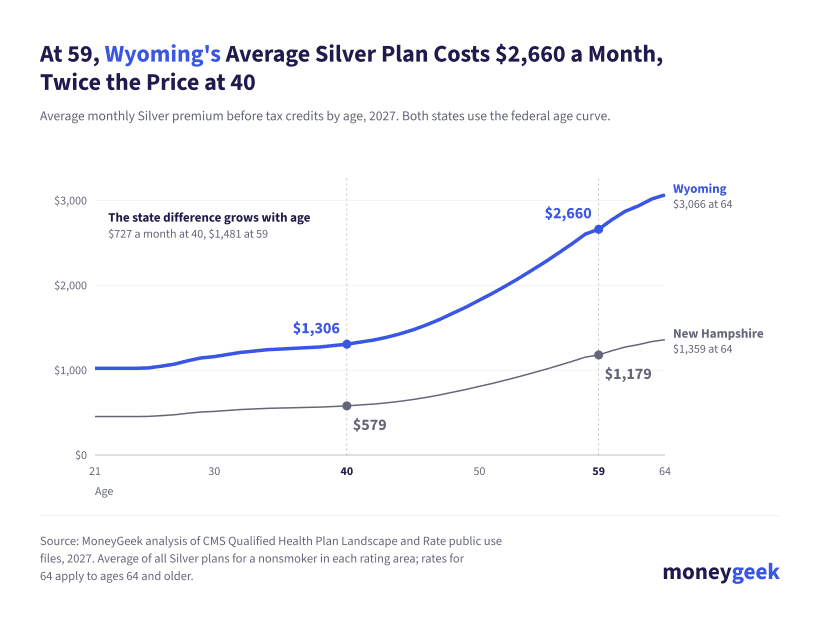
Under that curve, a 59-year-old pays 2.04 times the age-40 rate. Forty-six states use it. The dollar difference is largest where premiums are highest: in Wyoming, a 59-year-old pays $16,249 more a year than a 40-year-old.

Wyoming's Silver plan costs $2,660 a month at 59, double its $1,306 price at 40.

The multiplier also applies to each year's increase. Nationally, the average full-price premium rose $99 a month for a 40-year-old and $194 a month for a 59-year-old.

Five places price age differently:

D.C.
2.07x
$1,420
$8,815
Utah
2.03x
$1,906
$11,599
Massachusetts
1.64x
$1,326
$6,192
New York
1.00x
$1,195
$0
Vermont
1.00x
$1,433
$0

New York and Vermont don't let insurers vary premiums by age. A 59-year-old there pays the same as a 40-year-old. That's why New York, the fifth-most expensive state for a 40-year-old, ranks 49th at age 59.

What $1 Over the Income Limit Costs at 59

Earning one dollar more than $63,840 adds $10,951 to what a single 59-year-old pays for the benchmark Silver plan in 2027, on average. Premium tax credits stop at 400% of the federal poverty level: $63,840 for a single person in 48 states and D.C., $79,800 in Alaska and $73,440 in Hawaii.

Up to that line, a buyer pays no more than 10.22% of income for the benchmark plan, the second-lowest-cost Silver plan where they live, under IRS Rev. Proc. 2026-26. For a single 59-year-old earning $63,840, that's $6,524 a year. At $63,841, the credit is gone and the benchmark plan costs its full price, which averages $17,475 a year.

$1 over $63,840 raises a 59-year-old's benchmark premium $10,951 a year.

The jump is largest in Alaska ($22,754) and West Virginia ($22,474), where benchmark premiums are highest. It's smallest in Massachusetts ($4,562) and Maryland ($5,510).

These figures count the federal tax credit only. Some states offer their own premium help on top of it.

Who Buys Marketplace Coverage at This Age

Adults 55 to 64 made up 5.2 million of the 23.1 million people who picked a 2026 marketplace plan, or 22.4%, CMS open enrollment data shows. That's down from 5.5 million in 2025, a 5.9% drop, while total plan selections fell 4.9%.

The age group's share is highest in Wisconsin, at 36.9%. A 59-year-old there pays $20,265 a year for the average Silver plan at full price. Minnesota (35.4%), Maine (34.6%) and Oregon (33.7%) follow.

Florida has the most marketplace buyers ages 55 to 64, with 875,830 plan selections, followed by Texas with 709,598. A 59-year-old pays $24,538 a year at full price in Florida and $21,748 in Texas.

The share is lowest in Utah, at 12.0%.

How to Keep a Tax Credit and Lower Your Premium in Your Late 50s

For buyers in their late 50s, income decides whether a tax credit applies at all. Most of these steps work best before you enroll.

  1. 1
    Know where your income lands against the limit.

    For 2027 coverage, the tax credit limit is $63,840 for a single person and $86,560 for a couple in most states, based on the 2026 HHS poverty guidelines. Enter your expected 2027 income on HealthCare.gov or your state's marketplace before you compare plans. HealthCare.gov says to enroll by Dec. 15 for coverage that starts Jan. 1; state-run marketplaces set their own deadlines.

  2. 2
    If you're near the limit, look at what lowers your counted income.

    Pretax 401(k) contributions, deductible traditional IRA contributions and HSA contributions reduce the income the marketplace uses.

  3. 3
    Count every source of income in your estimate.

    HealthCare.gov tells shoppers to include most IRA and 401(k) withdrawals. Qualified Roth distributions don't count. Starting with tax year 2026, you must repay the full amount of any excess advance tax credit, the IRS says. Report income changes to the marketplace during the year.

  4. 4
    Compare a Bronze plan paired with a health savings account.

    Bronze plans available through a marketplace now work with an HSA, the IRS says. People 55 and older can add a $1,000 catch-up contribution each year.

  5. 5
    Plan the move to Medicare at 65.

    Medicare's first enrollment window starts three months before you turn 65 and ends three months after. Once your Medicare Part A coverage starts, you won't qualify for marketplace savings, HealthCare.gov says, and signing up late can bring penalties that rise the longer you wait.

Methodology

MoneyGeek measured the average monthly premium of every Silver marketplace plan for a 59-year-old nonsmoker in each of the 50 states and D.C. for the 2027 plan year. Premiums are full prices, before premium tax credits. Each H3 below is a collapsible section on the page.

About Nathan Paulus


Nathan Paulus, Head of Content and SEO, MoneyGeek

Nathan Paulus is the Head of Marketing and Brand Partnerships at MoneyGeek, where he leads content strategy and conducts original data research across insurance, consumer costs, transportation safety, housing, public policy and personal finance. He reviews studies for methodology, source quality and factual accuracy.

Research and Analysis

In more than six years at MoneyGeek, Nathan has published more than 100 original studies and explanatory guides. His insurance research includes 50-state comparisons of health care outcomes, costs and access, and an analysis of how uninsured rates track with state Medicaid expansion decisions and electoral patterns. 

He has analyzed full-coverage auto rates across major insurers in all 50 states and tracked how premium trends relate to industry underwriting losses. That research draws on combined ratio data from Fitch Ratings and AM Best, plus the Bureau of Labor Statistics CPI figures. Beyond insurance, his work spans vehicle pricing trends across the U.S. new car market, summer traffic fatality rates by state, homeowner underinsurance ratios using mortgage and policy data, and housing affordability across all 50 states.

His research has been cited by Bloomberg, the Los Angeles Times, Forbes, Fast Company, the San Francisco Chronicle, USA Today and NBC Los Angeles. Harvard, MIT, Stanford and Yale have referenced his work.

Career

Nathan traces his interest in personal finance back to his grandmother, who ran her household on a simple rule: spend less than you make and save the difference before anything else. That rule shows up in his work today. His writing skips jargon and complex strategy in favor of the basics that help someone living paycheck to paycheck.

He joined MoneyGeek in July 2020 as Director of Content Marketing, where he led the content team and oversaw data journalism production across insurance and personal finance verticals. A promotion to Head of Marketing and Communications followed in December 2023. The new role added digital PR and communications strategy to his responsibilities. He was appointed Head of Content and SEO in January 2025.

Before MoneyGeek, Nathan served as Director of Content Marketing and SEO at Ventrix Advertising, where he helped build two content sites from scratch, contributed to link-building programs that generated more than 1,500 unique referring domains within a year and co-managed a marketing team of more than 20 people. Two and a half years at ABUV Media preceded that role. He advanced from Marketing Research Analyst to Senior Marketing Tactics Analyst, where he built expertise in audience research, content strategy and SEO.


Sources