Full-Price ACA Premiums Rise 13% for 2027, Faster in Reinsurance States

Updated: November 10, 2026

Advertising & Editorial Disclosure

Full-price Silver premiums on Affordable Care Act (ACA) marketplaces rose 13.0% for 2027, from an average of $758 to $856 a month for a 40-year-old. That's $99 more each month, or $1,182 more over the year.

More people pay that full price than a year ago. The expanded premium tax credits that began in 2021 expired at the end of 2025, and 3.1 million people picked a 2026 marketplace plan without a tax credit, up from 1.9 million in 2025, CMS open enrollment data shows.

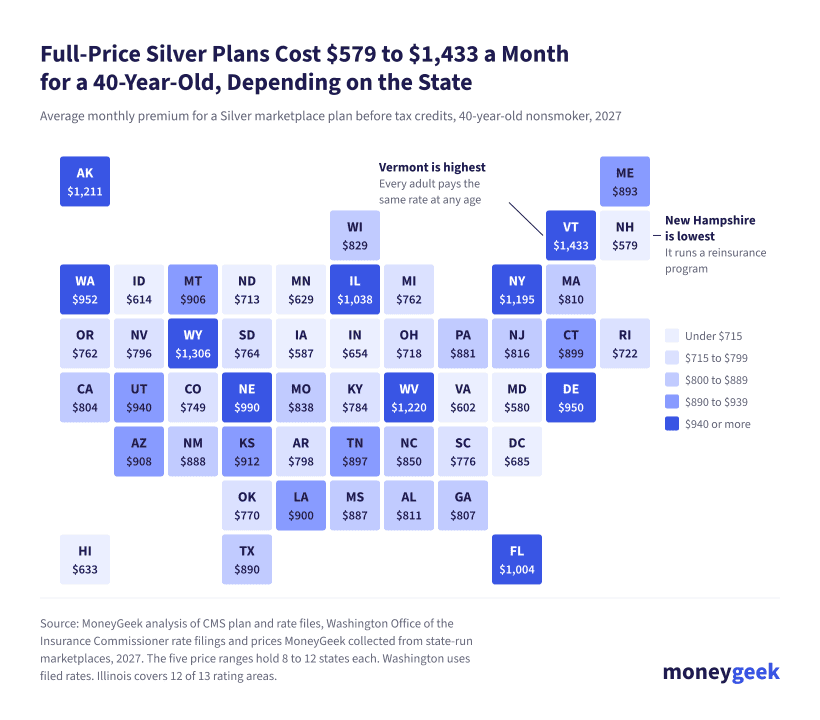
State prices differ by more than $850 a month: the same coverage averages $1,433 in Vermont and $579 in New Hampshire.

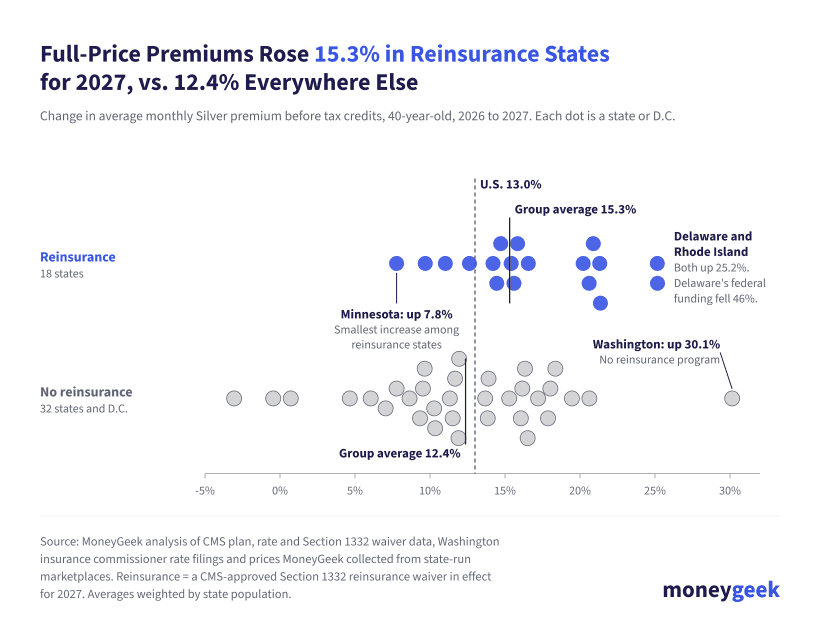
Some of the largest increases came in states with programs built to hold premiums down. Eighteen states run reinsurance programs, which pay part of insurers' highest claims. Those states still pay less on average ($761 a month vs. $888), yet their premiums rose 15.3% for 2027, compared with 12.4% everywhere else.

MoneyGeek priced 2027 Silver plans by hand on the marketplace websites of 20 states and D.C., the second year it has collected these prices directly. Federal plan files don't cover those state-run marketplaces until months after open enrollment. For the 29 states on HealthCare.gov, MoneyGeek used CMS plan and rate files.

For costs at other ages and coverage levels, see MoneyGeek's guide to how much health insurance costs.

mglogo icon
STUDY FINDINGS
  • Full-price Silver premiums rose 13.0% for 2027. A 40-year-old's average Silver plan costs $856 a month before tax credits, up from $758 in 2026 (50 states and D.C.).
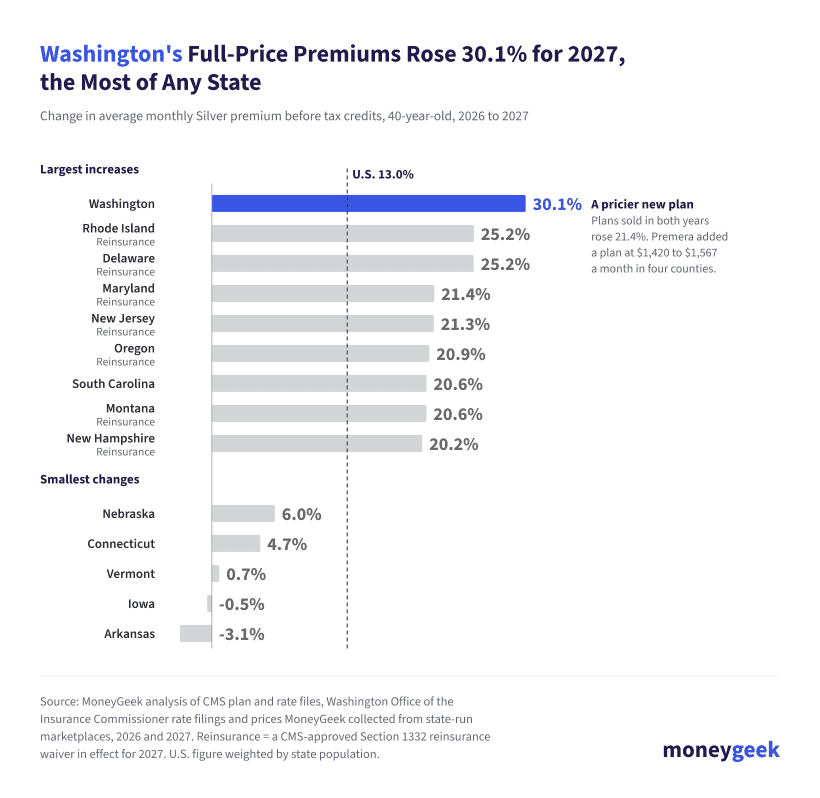
  • Washington had the largest increase at 30.1%. Its average Silver premium jumped from $732 to $952 a month. Silver plans sold in both years rose 21.4% on average. A new, higher-priced Premera plan and the exit of a lower-priced Ambetter plan added the rest.
  • States with reinsurance rose faster. Premiums climbed 15.3% in the 18 states with federally approved reinsurance programs and 12.4% in the rest. Seven of the nine states with increases above 20% run one.
  • Two states got cheaper. Arkansas fell 3.1%, to $798 a month, and Iowa fell 0.5%, to $587.
  • Vermont has the highest premium for a 40-year-old at $1,433 a month. Vermont insurers charge every adult the same rate regardless of age. Among states that price by age, Wyoming is highest at $1,306, and New Hampshire is lowest nationwide at $579.
  • Federal funding for reinsurance fell in 15 of 17 states for 2026. The median state's pass-through payment from CMS dropped 24%.

ACA Premiums by State in 2027

Twelve states and D.C. average less than $750 a month for a 40-year-old, and five states top $1,150.

Full-price Silver premiums run from $579 in New Hampshire to $1,433 in Vermont.

Highest and Lowest States for 2027 Premiums

A 40-year-old in Vermont pays about 2.5 times what the same Silver coverage costs in New Hampshire. The difference between the cheapest and most expensive states grows with age, reaching $1,481 a month at 59.

2027 monthly Silver premium, age 40
New Hampshire ($579)
Vermont ($1,433)
$854
Change from 2026
Arkansas (-3.1%)
Washington (30.1%)
33.2 percentage points
Monthly dollar change
Arkansas (-$25)
Washington (+$221)
$246
2027 monthly premium, age 59
New Hampshire ($1,179)
Wyoming ($2,660)
$1,481

All 50 States and DC

Wyoming, West Virginia and Alaska follow Vermont at the top of the 2027 ranking, and Iowa and Virginia rank just above Maryland and New Hampshire at the bottom. Each row shows a state's 2027 and 2026 premiums, the dollar and percent change, and whether the state runs a reinsurance program.

1
Vermont***
$1,433
$1,423
+$10
0.7%
No
2
Wyoming
$1,306
$1,114
+$192
17.2%
No
3
West Virginia
$1,220
$1,089
+$130
11.9%
No
4
Alaska
$1,211
$1,039
+$172
16.6%
Yes
5
New York***
$1,195
$1,091
+$104
9.5%
No
6
Illinois**
$1,038
$946
+$91
9.6%
No
7
Florida
$1,004
$881
+$123
13.9%
No
8
Nebraska
$990
$934
+$56
6.0%
No
9
Washington*
$952
$732
+$221
30.1%
No
10
Delaware
$950
$759
+$191
25.2%
Yes
11
Utah
$940
$815
+$125
15.3%
No
12
Kansas
$912
$773
+$139
18.0%
No
13
Arizona
$908
$767
+$141
18.4%
No
14
Montana
$906
$751
+$155
20.6%
Yes
15
Louisiana
$900
$809
+$92
11.3%
No
16
Connecticut
$899
$859
+$40
4.7%
No
17
Tennessee
$897
$770
+$127
16.5%
No
18
Maine
$893
$772
+$120
15.6%
Yes
19
Texas
$890
$798
+$92
11.5%
No
20
New Mexico
$888
$766
+$123
16.1%
No
21
Mississippi
$887
$742
+$144
19.5%
No
22
Pennsylvania
$881
$793
+$87
11.0%
Yes
23
North Carolina
$850
$789
+$61
7.8%
No
24
Missouri
$838
$736
+$102
13.9%
No
25
Wisconsin
$829
$718
+$111
15.4%
Yes
26
New Jersey
$816
$673
+$143
21.3%
Yes
27
Alabama
$811
$698
+$114
16.3%
No
28
Massachusetts
$810
$726
+$85
11.7%
No
29
Georgia
$807
$705
+$102
14.4%
Yes
30
California
$804
$719
+$86
11.9%
No
31
Arkansas
$798
$823
-$25
-3.1%
No
32
Nevada
$796
$725
+$70
9.7%
Yes
33
Kentucky
$784
$665
+$119
17.9%
No
34
South Carolina
$776
$643
+$133
20.6%
No
35
Oklahoma
$770
$720
+$51
7.0%
No
36
South Dakota
$764
$693
+$71
10.3%
No
37
Michigan
$762
$697
+$65
9.3%
No
38
Oregon
$762
$630
+$132
20.9%
Yes
39
Colorado
$749
$656
+$93
14.2%
Yes
40
Rhode Island
$722
$577
+$145
25.2%
Yes
41
Ohio
$718
$632
+$86
13.7%
No
42
North Dakota
$713
$621
+$91
14.7%
Yes
43
D.C.
$685
$621
+$64
10.3%
No
44
Indiana
$654
$563
+$91
16.2%
No
45
Hawaii
$633
$583
+$50
8.6%
No
46
Minnesota
$629
$583
+$45
7.8%
Yes
47
Idaho
$614
$545
+$69
12.6%
Yes
48
Virginia
$602
$520
+$82
15.8%
Yes
49
Iowa
$587
$590
-$3
-0.5%
No
50
Maryland
$580
$478
+$102
21.4%
Yes
51
New Hampshire
$579
$481
+$97
20.2%
Yes

Where 2027 Premiums Rose Most and Least

Washington had the largest increase in the country at 30.1%. The average Silver premium for a 40-year-old went from $732 to $952 a month, adding $2,647 to a year of coverage.

Silver plans sold in both years rose 21.4% on average. Changes in the plan lineup added the rest. Premera added a Silver plan in four of the nine counties MoneyGeek tracked, priced at $1,420 to $1,567 a month for a 40-year-old. Ambetter's Balanced Care 4 Silver plan, which cost $552 to $677 a month in 2026, left all nine counties.

That first-place rank depends on the lineup change. Measured only on plans sold in both years, Washington's 21.4% would fall below Rhode Island's and Delaware's 25.2%.

Rhode Island and Delaware followed at 25.2% each. In Rhode Island, the average went from $577 to $722 a month. Delaware's rose from $759 to $950, adding $2,290 to a year of coverage.

Nine states saw increases above 20%: Washington, Rhode Island, Delaware, Maryland, New Jersey, Oregon, Montana, South Carolina and New Hampshire. Washington and South Carolina are the only two without a reinsurance program.

Maryland and New Hampshire rose 21.4% and 20.2% and are still the two cheapest states in the country, at $580 and $579 a month.

Washington's full-price premiums rose 30.1%, the most; Arkansas and Iowa fell.

At the other end, two states got cheaper. Arkansas fell 3.1%, from $823 to $798 a month, and Iowa slipped 0.5%, to $587. Vermont rose 0.7%, Connecticut 4.7% and Nebraska 6.0%, the smallest increases among states that didn't fall.

Why Premiums Rose Faster in Reinsurance States

Reinsurance states still have lower prices, but the difference shrank for 2027: full-price premiums in the other states ran 19.7% higher in 2026 and 16.7% higher for 2027. A reinsurance program pays part of the cost of insurers' most expensive claims. That lets insurers charge everyone less. Eighteen states run one under a Section 1332 waiver, the part of the ACA that lets a state change its marketplace rules with federal approval.

In those 18 states, the average full-price Silver premium for a 40-year-old is $761 a month. In the other 32 states and D.C., it's $888.

The increases ran the other way. Premiums rose 15.3% in reinsurance states and 12.4% everywhere else, and the median state change was 15.7% vs. 11.9%. Fourteen of the 18 reinsurance states rose faster than the 13.0% national figure, compared with 15 of the other 33 jurisdictions.

That pattern is new. Using the same method on the 2025 and 2026 CMS plan files, premiums rose 21.5% in reinsurance states for 2026 and 23.5% in the rest, and the median state in each group rose about the same amount. For 2027, reinsurance states rose 2.9 percentage points faster.

Reinsurance states rose 15.3% for 2027 vs. 12.4% in states without.

Federal money for these programs shrank first. Under Section 1332, CMS pays each state the federal tax-credit savings its program produces.

Those pass-through payments fell in 15 of the 17 states with CMS letters for both 2025 and 2026, and the median drop was 24%. Payments to the 17 states fell 8.7% combined, from $4.09 billion to $3.73 billion. New Jersey and Wisconsin were the only states to receive more.

The size of a state's funding cut doesn't predict its 2027 increase. Delaware's payment fell 46%, the largest cut, and its premiums rose 25.2%. New Jersey's payment rose 21%, and its premiums rose 21.3% anyway. Insurer costs and changes to each program's design also feed into rates, and this analysis doesn't separate those effects.

Two reinsurance states came in well under the national figure. Minnesota rose 7.8%, and Nevada, whose waiver took effect in 2026, rose 9.7%.

2027 Premiums by Region and State Policy

Western states had the largest increases for 2027. Premiums there rose 15.4%, and nine of the 13 Western states topped the 13.0% national change. Washington, Oregon and Montana each rose more than 20%.

The Northeast has the highest prices, at $967 a month on average. Its premiums rose 11.6%, and the Midwest's rose 11.4%, the two smallest regional increases.

West
13
$831
15.4%
16.1%
9
South
17
$853
13.1%
14.4%
10
Northeast
9
$967
11.6%
11.7%
4
Midwest
12
$800
11.4%
12.0%
6
No Medicaid expansion
10
$897
14.2%
16.4%
9
Medicaid expansion
41
$840
12.5%
12.6%
20
State-run marketplace
22
$855
13.2%
13.4%
11
HealthCare.gov
29
$858
12.8%
14.7%
18

The 10 states that haven't expanded Medicaid saw faster increases. Premiums there rose 14.2%, compared with 12.5% in the 40 expansion states and D.C. Nine of the 10 topped the national change; Texas, at 11.5%, was the exception.

The type of marketplace made little difference: states that run their own marketplaces averaged $855 a month and rose 13.2%, compared with $858 and 12.8% in HealthCare.gov states.

Seven of the 10 non-expansion states are in the South, and the expansion and regional patterns overlap. These group averages describe where increases landed and can't establish that a policy caused them.

Who Pays the Full Price

The prices in this study are what a buyer pays with no premium tax credit. With the expanded credits gone, households earning more than 400% of the federal poverty level no longer qualify for one. CMS open enrollment data shows 3.1 million of the 23.1 million people who picked a 2026 marketplace plan, or 13.4%, enrolled without a premium tax credit.

Age raises the bill. ACA rules let insurers charge older adults up to three times what they charge a 21-year-old. In 46 states, a 59-year-old pays 2.04 times what a 40-year-old pays for the same plan.

The average Silver premium for a 59-year-old is $1,662 a month in 2027, or $19,947 for the year. In Wyoming, it's $2,660 a month, or $31,922 a year. A 59-year-old pays more than $20,000 a year for the average Silver plan in 23 states.

Wyoming
$2,660
$31,922
West Virginia
$2,484
$29,807
Alaska
$2,466
$29,594
Illinois
$2,113
$25,358
Florida
$2,045
$24,538

Adults 55 to 64 made up 5.2 million of 2026 marketplace plan selections, or 22.4%. Wisconsin had the highest share of any state at 36.9%, and a 59-year-old there pays $20,265 a year for the average Silver plan.

New York and Vermont don't vary premiums by age. A 59-year-old in New York pays the same $1,195 a month as a 40-year-old.

How to Lower Your 2027 Marketplace Premium

Most marketplace shoppers pay less than the full prices in this study. CMS data shows 87% of people who picked a 2026 marketplace plan had a premium tax credit applied. These five steps can help you lower your 2027 premium, with or without a tax credit.

  1. 1
    Check whether you qualify for a tax credit.

    The prices in this study are full prices. Enter your expected 2027 income on HealthCare.gov or your state's marketplace before you assume you'll pay them. Open enrollment for 2027 coverage began Nov. 1, and deadlines vary by state.

  2. 2
    Don't let automatic renewal pick your plan.

    If you do nothing, the marketplace may renew your current plan at its 2027 price or move you to a similar plan if yours left the market. In Washington, 24 Silver offerings in the counties MoneyGeek tracked weren't available for 2027.

  3. 3
    Compare Bronze and Gold plans with Silver.

    A Bronze plan usually costs less each month but has a higher deductible. If your income qualifies you for cost-sharing reductions, those savings come only with a Silver plan.

  4. 4
    Price the cheapest Silver plan in your county.

    This study averages every Silver plan, and the lowest-priced Silver plan in a county costs less than that average. Sort by premium and confirm your doctors and prescriptions are covered before you choose.

  5. 5
    Plan for age-based increases if you're in your 50s or early 60s.

    Premiums rise each year with age until 64. A 59-year-old pays about twice what a 40-year-old pays for the same plan in most states. Budget for a higher bill each birthday.

Methodology

MoneyGeek measured the average monthly premium of every Silver marketplace plan for a 40-year-old nonsmoker in each of the 50 states and D.C. for the 2027 plan year. Premiums are full prices, before premium tax credits.

About Nathan Paulus


Nathan Paulus, Head of Content and SEO, MoneyGeek

Nathan Paulus is the Head of Marketing and Brand Partnerships at MoneyGeek, where he leads content strategy and conducts original data research across insurance, consumer costs, transportation safety, housing, public policy and personal finance. He reviews studies for methodology, source quality and factual accuracy.

Research and Analysis

In more than six years at MoneyGeek, Nathan has published more than 100 original studies and explanatory guides. His insurance research includes 50-state comparisons of health care outcomes, costs and access, and an analysis of how uninsured rates track with state Medicaid expansion decisions and electoral patterns. 

He has analyzed full-coverage auto rates across major insurers in all 50 states and tracked how premium trends relate to industry underwriting losses. That research draws on combined ratio data from Fitch Ratings and AM Best, plus the Bureau of Labor Statistics CPI figures. Beyond insurance, his work spans vehicle pricing trends across the U.S. new car market, summer traffic fatality rates by state, homeowner underinsurance ratios using mortgage and policy data, and housing affordability across all 50 states.

His research has been cited by Bloomberg, the Los Angeles Times, Forbes, Fast Company, the San Francisco Chronicle, USA Today and NBC Los Angeles. Harvard, MIT, Stanford and Yale have referenced his work.

Career

Nathan traces his interest in personal finance back to his grandmother, who ran her household on a simple rule: spend less than you make and save the difference before anything else. That rule shows up in his work today. His writing skips jargon and complex strategy in favor of the basics that help someone living paycheck to paycheck.

He joined MoneyGeek in July 2020 as Director of Content Marketing, where he led the content team and oversaw data journalism production across insurance and personal finance verticals. A promotion to Head of Marketing and Communications followed in December 2023. The new role added digital PR and communications strategy to his responsibilities. He was appointed Head of Content and SEO in January 2025.

Before MoneyGeek, Nathan served as Director of Content Marketing and SEO at Ventrix Advertising, where he helped build two content sites from scratch, contributed to link-building programs that generated more than 1,500 unique referring domains within a year and co-managed a marketing team of more than 20 people. Two and a half years at ABUV Media preceded that role. He advanced from Marketing Research Analyst to Senior Marketing Tactics Analyst, where he built expertise in audience research, content strategy and SEO.


Sources