


Jump to the section that meets your needs best below:
Average Retail Business Insurance Cost (2026 Report)
Retail business insurance costs range from $33 to $293 per month, driven by factors like foot traffic volume, what the store sells and to whom, payroll size and whether the business makes deliveries.
If you're ready for quotes, MoneyGeek's matching tool can connect you to your best retail business insurer below.
Select state
Updated: September 15, 2026
Advertising & Editorial Disclosure
How Much Does Retail Business Insurance Cost?
Retail businesses typically pay $129 monthly, or $1,549 annually, across the five most common coverage types. That figure comes from MoneyGeek's analysis of quotes for businesses with one to four employees across 39 retail sub-industries, four vehicle types, all 50 states and Washington, D.C., with standardized limits.
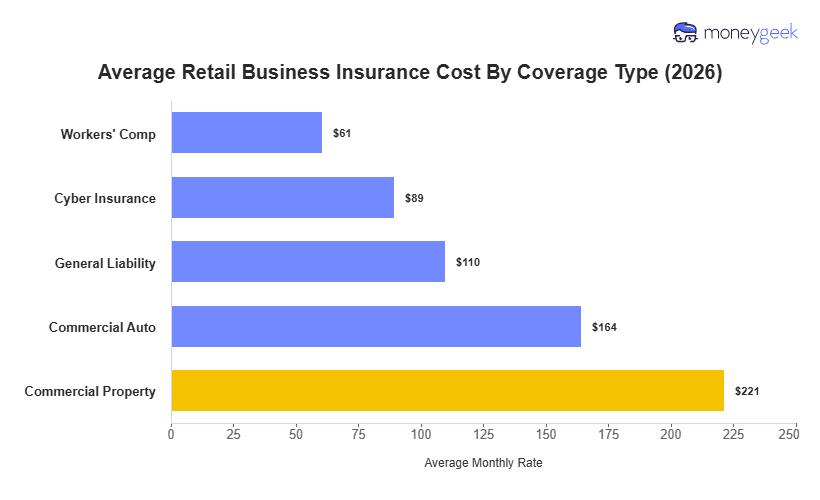
The average cost of business insurance varies by coverage type, running from $61 monthly per employee for workers' comp to $221 monthly for commercial property. Workers' comp tends to run low for retail because cashiering, stocking shelves and running a register carry lower injury exposure than physical trades, which keeps base rates modest for most store types. Commercial property is the most expensive because insurers price the inventory, fixtures and equipment inside the store. For auto parts shops, electronics retailers and stores carrying high-value stock, that exposure adds up quickly.
The table below shows average monthly and annual costs for each coverage type. These are estimates, not quotes as your actual premium will vary based on your store type, location and payroll.
| Workers' Comp | $61 | $726 | 46% | 12 |
| Cyber Insurance | $89 | $1,073 | -7% | 18 |
| General Liability | $110 | $1,320 | -10% | 21 |
| Commercial Auto | $164 | $1,969 | -1% | 16 |
| Commercial Property | $221 | $2,658 | -77% | 22 |
We analyzed quote data from major U.S. commercial insurance providers and modeled standardized premium estimates across business profiles representing around 95% of the market. Results are designed to provide a consistent national benchmark showing how premiums vary by key baseline factors including business size, cleaning profession type, location and vehicle type for operations that use commercial vehicles.
Dataset Scope and Assumptions
Our cost modeling uses standardized inputs for consistent comparisons across businesses.
- Total estimates modeled: just over 6 million standardized pricing estimates
- Providers analyzed: 10 major insurance providers
- Professions covered: 39 retail subindustries
- Geography: all U.S. states including Washington, D.C.
- Employee count bands: solo practitioners, one to four, five to nine, 10 to 19, and 20 to 49 employees
- Vehicle types studied: Sedans, SUVs, pickup trucks, vans, taxis, limousines, tractors, food trucks, semi-trucks (non-HAZMAT and HAZMAT), tanker trucks (non-HAZMAT and HAZMAT), buses, box trucks, dump trucks, flatbed trucks
- Policies studied: general liability, workers' comp, commercial auto, commercial property, and cyber insurance
- General liability: $1 million per occurrence and $2 million aggregate
- Workers' comp: state required coverage
- Commercial auto: minimum coverage
- Commercial property: personal property coverage limits personalized to industry, business size and state
- Cyber insurance: $1 million per occurrence and $1 million aggregate
How We Calculated Average Retail Business Insurance Costs
Our published averages represent modeled premiums for standardized business profiles and were aggregated in two ways.
- National benchmark average: The national average cost reflects the modeled premium for a standardized one to four employee business across all cleaning profession categories and states included in our dataset for a standard professional liability policy
- Segment averages: To show how costs vary, we calculated average modeled premiums for our national base profile and isolated for variables, including:
- Employee count (business size ranges)
- Profession / industry categories
- Vehicle types (for commercial auto)
- States (including Washington, D.C.)
Segment averages were produced by aggregating modeled pricing trends across the full dataset so readers can compare how premiums shift across profession types and regions.
See our full business insurance methodology.
If you want to see business insurance costs for specific retail establishments, these pages provide more detail:

Get Retail Business Insurance Cost Estimates
Get an estimate with the small business insurance calculator below built around your specific operation.
Get Retail Insurance Cost Estimates
Select Coverage Type
Select Employee Count
Select Vehicle Type
Average Monthly Estimate—
Select Coverage Type
Average Monthly Estimate—
Select Employee Count
Select Vehicle Type
Factors Affecting Retail Business Insurance Costs
Multiple factors influence the average cost of retail business insurance and the combination shifts depending on how the store operates, what it sells and whether it employs staff or makes deliveries.
 Business size
Larger retail operations pay more across nearly every coverage type because more employees, higher payroll and greater floor space all increase exposure. A solo online seller and a 20-person furniture showroom carry fundamentally different risk profiles, even when they sell the same type of merchandise.
 Location
State regulations, local court environments and regional weather patterns all affect what retail businesses pay. A storefront in California or Michigan will often price higher than a comparable operation in Indiana or Arkansas, reflecting both regulatory costs and claims frequency patterns in those markets.
 Type of merchandise sold
Retailers selling high-value, hazardous or regulated products pay more across multiple coverage lines. A liquor store, pawn shop or cannabis dispensary carries higher liability and property exposure than a gift shop or clothing boutique because the merchandise itself shapes the risk profile insurers evaluate.
 Customer foot traffic
High daily customer volume increases third-party injury and property damage exposure for retail businesses. Wet floors, cluttered aisles and crowded checkout areas create slip and fall conditions that generate liability claims, a risk that concentrates in grocery stores, convenience stores and any storefront with steady walk-in traffic throughout the day.
 Business model
How a retail business operates changes which coverage lines apply and what they cost. A furniture store making deliveries needs commercial auto coverage that an in-store boutique doesn't, while an e-commerce operation with warehouse stock carries property exposure that a weekend market vendor typically avoids altogether.
 Seasonal inventory fluctuations
Toy stores, garden centers and costume shops all see their stock levels spike at predictable times of year, and insurers price commercial property limits around those peaks rather than annual averages. For retailers with wide seasonal swings, the gap between average and peak inventory can push premiums higher than the day-to-day operation would imply.
How to Lower Retail Business Insurance Costs
Retail businesses have access to several approaches to get more affordable business insurance. Some methods take effect upon purchase or renewal, while others build over time.
 Compare quotes using the same coverage limits
Rate differences between insurers can be meaningful for retail businesses, but only when the quotes reflect identical limits, deductibles and endorsements. A pawn shop comparing business insurance quotes across three insurers needs all three to price the same liability limits and merchandise coverage terms. A lower number that reflects thinner coverage is not a better deal.
 Right-size your coverage
Not every retail business needs the same coverage mix. A home-based online seller may not need commercial property coverage for a storefront it doesn't have, and a gift shop with no delivery operations has no use for commercial auto insurance. Paying for coverage that doesn't match your actual operations inflates premiums without adding protection.
 Increase your deductible strategically
Choosing a higher deductible lowers the premium on commercial property and general liability policies, but works best for retailers with the cash reserves to absorb a larger out-of-pocket cost after a claim. A jewelry store with high-value inventory should weigh that tradeoff carefully before raising its property deductible.
- Bundle policies with the same provider
A business owner's policy combines general liability and commercial property under one insurer, and many providers extend it to cover cyber insurance as well. Retail businesses that bundle this way typically pay less than those buying each coverage separately, though the discount varies by insurer and business profile.
 Pay annually instead of monthly
Most insurers charge installment fees for monthly payment plans, and for retail businesses that generate stronger cash flow outside of seasonal peaks, paying annually at renewal removes those fees without touching the coverage. The savings are modest but require no underwriting changes.

Invest in risk management practices
Retail businesses that reduce claims frequency over multiple policy periods earn better renewal pricing across general liability, workers' comp and commercial property. Slips and falls, stocking injuries and theft are among the most common retail claim drivers, and each one responds to consistent operational controls.
- Train staff on wet floor protocols and aisle safety standards to reduce customer injury claims in high-traffic store environments
- Install security systems and maintain accurate stock records to lower shrinkage-related property claims for stores carrying high-value merchandise
- Implement proper lifting and stocking procedures to reduce back injury claims among warehouse and floor staff
- Use secure point-of-sale systems and limit cash on hand to reduce robbery-related liability exposure for liquor stores, pawn shops and convenience stores
Retail Business Insurance Cost: Bottom Line
Retail businesses spend an average of $1,549 per year across five common coverage types, but that figure reflects a standardized profile, consistent limits and a broad mix of sub-industries. Treat the average as a starting point for calibrating expectations, not as a prediction of what your operation will pay.
Three questions can help put the numbers in context for your specific situation:
- How does the operation compare against the distribution? Where a retail business sits depends heavily on what it sells and how it operates. A thrift store with two employees prices very differently from a pawn shop or a cannabis dispensary of the same size. Merchandise type and liability exposure account for more of the spread in retail than employee count alone.
- Is the quote in line with the risk profile? The benchmarks serve as a useful cross-check against what has been quoted for the sub-industry and state. A quote running well above the average may reflect claims history, higher limits or added endorsements, while one running well below may signal thinner coverage terms. The gap between the quote and the benchmark is more informative than either figure on its own.
- Which cost drivers are relevant to the operation? Not every factor carries the same weight for every retail operation. Seasonal inventory swings matter more for a garden center or toy store than for a shoe retailer with stable stock year-round. Delivery operations create commercial auto exposure that a pure storefront does not carry. The drivers most specific to the operation should be identified first, particularly those that distinguish the business profile from the industry average, and whether the quote reflects them should be confirmed.
Where the quote lands relative to the benchmark is a reference point, not a final answer. The more meaningful question is what is producing that result, whether it is the merchandise carried, how the store is staffed, the state of operation or some combination of those factors. A figure only becomes actionable when it can be traced back to the specific inputs behind it.
About Mark Flores

Mark Flores is a Business Insurance Content Writer at MoneyGeek, where he focuses on commercial auto, commercial property, cyber and specialty business insurance coverage. His work simplifies coverage terms, gives business owners a strong baseline for expected costs, and narrows down policies and providers tailored to your operation, regardless of complexity.
Before joining MoneyGeek’s business insurance team, Mark worked as a Senior Content Writer at Clutch.co, where he produced structured B2B reviews and provider analyses based on client interviews, company research and service evaluation. That experience shaped his approach to business insurance content, especially when comparing insurers, explaining coverage differences and translating complex policy features into practical guidance for small business owners.
Mark also spent nearly 4 years as a digital marketing specialist serving small-business clients across industries such as home services, manufacturing and education. That background gives him practical context for how businesses evaluate vendors, manage operational needs and make purchasing decisions.
At MoneyGeek, he applies this research and evaluation experience to build guides that help transportation sectors, those with complex property-related risks (such as hotels and retail stores), and those most at risk of a cyberattack get the coverage they need at a reasonable price.
Linkedin: https://www.linkedin.com/in/mark-jason-flores-7844634a/
Contact Email: mark.flores@moneygeek.com