Nuclear Verdicts Used to Be a Big-Company Problem. Not Anymore.

Advertising & Editorial Disclosure

A $10 million jury verdict used to be a problem for Fortune 500 companies and major insurers. In 2024, it's increasingly a problem for the small businesses next door.

Small businesses with $10 million or less in revenue now carry 48% of U.S. commercial tort costs, even though they generate just 20% of commercial revenue, according to a 2023 Institute for Legal Reform analysis of Brattle Group data covering 2021. That works out to about $35 in tort costs for every $1,000 of revenue, versus less than $5 per $1,000 for the largest companies.

Nuclear verdicts, defined as jury awards of $10 million or more, hit a record $31.3 billion in 2024 in the dataset tracked by Marathon Strategies, a 116% jump from the year before. A 2025 Swiss Re behavioral study found that in legal simulations, survey respondents awarded damages against small and midsize companies at nearly the same rate as against large corporations when injuries were serious. Yet general liability cost data shows the typical small business policy covers just $1 million per occurrence, meaning a single nuclear verdict could exceed that limit by $9 million or more before any umbrella coverage applies.


Small businesses earn 20% of U.S. commercial revenue but pay 48% of commercial lawsuit costs, or $35 per $1,000 earned versus under $5 for the largest businesses.
mglogo icon
KEY FINDINGS
  • Small businesses with $10 million or less in revenue carry 48% of commercial tort costs despite earning 20% of commercial revenue. (ILR/Brattle Group)
  • A $1 million general liability limit covers only 7% of Swiss Re's $13.8 million simulated small-business award.
  • Survey respondents issued nuclear-level awards against small and midsize businesses at a 25% rate, close to the 30% rate for large corporations. (Swiss Re)
  • Among verdicts tracked by Marathon Strategies, nuclear verdicts totaled $31.3 billion in 2024, up 116% from 2023.

What Is a Nuclear Verdict?

A nuclear verdict is a jury award of $10 million or more in a civil lawsuit. Legal professionals and groups like the Institute for Legal Reform use the term to describe awards that far exceed what defendants and their insurers expected. Awards above $100 million are sometimes called "thermonuclear" verdicts. Most civil cases settle before trial, but a nuclear verdict comes from a jury that has decided to send a message, sometimes in response to perceived corporate negligence or sympathy for a seriously injured plaintiff. Verdicts differ from settlements because juries, not negotiating parties, set the final award.

How Wide Is the Small Business Coverage Shortfall?

MoneyGeek analyzed how common small business liability limits compare to current nuclear verdict benchmarks. At every level, the standard $1 million per-occurrence limit equals only a small fraction of each benchmark.

A standard $1 million liability policy covers 10% of a $10 million nuclear verdict, 7% of a $13.8 million simulated small-business award, and 2% of the $51 million 2024 median verdict.
Nuclear verdict threshold
$10 million
10%
90%
Swiss Re simulated small-business award
$13.8 million
7%
93%
Median nuclear verdict (Marathon dataset), 2024
$51 million
2%
98%

Note: This analysis compares scale, not claim-specific coverage. Coverage depends on policy type, exclusions and whether the claim falls under general liability, commercial auto, professional liability or another policy. Amounts shown are before appeals, settlements, other insurance or coverage disputes. Methodology: MoneyGeek calculated each benchmark's uncovered share as (benchmark amount minus $1 million) divided by benchmark amount. The $1 million per-occurrence limit reflects the standard policy baseline used in MoneyGeek's general liability cost model. Post-trial payments may differ from initial jury awards.

Even a business carrying both a $1 million general liability policy and a $1 million commercial umbrella policy has $2 million in total coverage, which is less than 15% of the $13.8 million average simulated award against small and midsize businesses in Swiss Re's behavioral study. Verdicts can be reduced on appeal or through settlement, but the initial exposure far exceeds what most small businesses carry.

How Fast Are Nuclear Verdicts Growing?

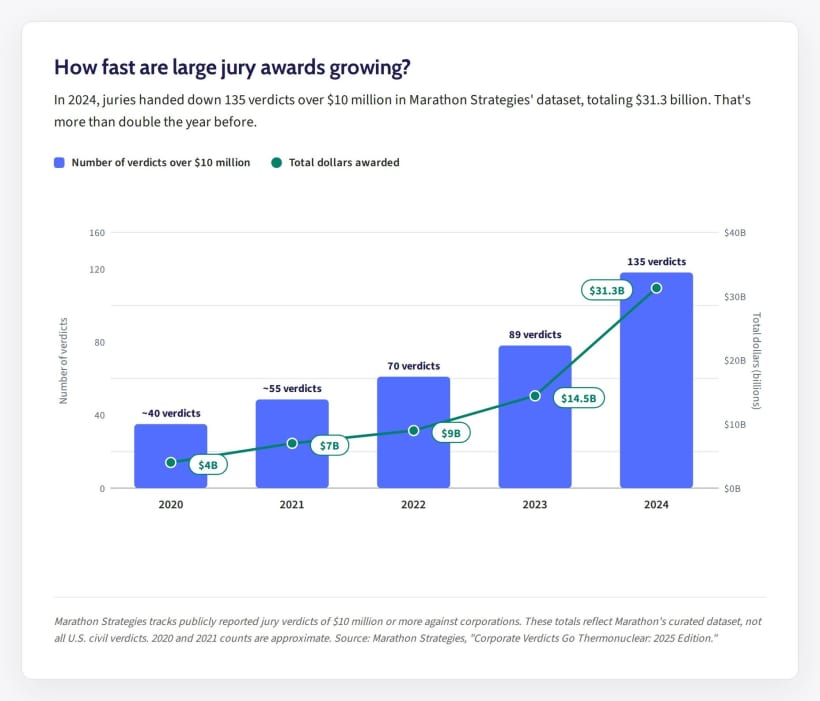
Marathon Strategies tracked 135 nuclear verdicts against corporations in 2024, up 52% from 89 in 2023. Total payouts in its dataset hit $31.3 billion, more than double the $14.5 billion the year before. Marathon reported a median of $51 million among the verdicts it tracked, up from $44 million in 2023 and $21 million in 2020. Five verdicts crossed the $1 billion mark, up from two in 2023.

Nuclear verdicts over $10 million grew from about 40 to 135 a year between 2020 and 2024, with total awards rising from $4 billion to $31.3 billion.

Thermonuclear verdicts (above $100 million) nearly doubled as well. Marathon Strategies tracked 49 thermonuclear verdicts in 2024, up from 27 in 2023 and just five in 2020. The growth rate for the largest awards has outpaced overall verdict growth every year since 2020.

The U.S. Chamber of Commerce's Institute for Legal Reform studied 1,288 nuclear verdicts from 2013 to 2022, finding an average payout of $89 million and a median of $21 million. That 10-year ILR median happens to match Marathon Strategies' $21 million single-year median for 2020, but the two figures describe different things: ILR's is a decade-long average, while Marathon's is a year-by-year snapshot that climbed to $51 million by 2024. Product liability verdicts grew fastest, with the median rising 50% from $24 million in 2013 to $36 million by 2022. The Institute for Legal Reform also found that noneconomic damages (money awarded for pain, suffering and emotional distress) exceeded economic and punitive damages combined in six of the 10 years it studied. Because noneconomic damages can exceed measurable financial losses, verdict size is harder for small businesses and insurers to predict. (Note: The ILR is affiliated with the U.S. Chamber of Commerce. No independent federal dataset currently tracks nuclear verdicts, so industry-affiliated research from the ILR, Marathon Strategies and Swiss Re represents the most comprehensive data available.)

Why Small Businesses Have More Exposure Than Owners Think

Swiss Re's 2025 Behavioral Social Inflation Study surveyed 1,150 U.S. adults and presented them with randomized legal scenarios involving slip-and-fall incidents, motor vehicle accidents and product liability claims. The study found that injury severity, not company size, was the primary factor in how much money participants awarded.

Jurors in Swiss Re's 2025 study awarded $10M-plus damages against small businesses at 25%, close to the 30% rate against large corporations.

When plaintiffs in Swiss Re's simulations suggested a $100 million award in a motor vehicle accident case, average simulated awards jumped to $20 million against large corporations and $13.8 million against small and midsize businesses. Without those suggested amounts, simulated awards stayed below $1 million for both groups. Swiss Re's researchers called the anchoring effect one of the strongest predictors of award size in the study.

The share of respondents who issued nuclear-level awards was 30% for large corporations and 25% for small and midsize businesses. That five-percentage-point spread is much narrower than most owners would expect. And 67% of respondents still supported punitive damages against small and midsize businesses, compared with 79% against large corporations.

The Institute for Legal Reform's tort cost study puts this in financial terms. Businesses earning under $10 million pay $35 in tort costs for every $1,000 in revenue. Businesses earning $50 million or more pay less than $5 per $1,000. That 7-to-1 ratio means small businesses bear a disproportionate share of the legal system's costs even before a nuclear verdict enters the picture.

Which States and Industries Carry the Most Risk?

Marathon Strategies' data shows nuclear verdicts landed in 34 states in 2024, up from 27 in 2023, across 77 courts, up from 65. Businesses in states that were once considered low-risk litigation markets now see multimillion-dollar awards, and small businesses in those markets may need to reassess their coverage.

These are the top five states for nuclear vertict dollars:

Nevada
$8.5 billion
4
Beverages
California
$6.9 billion
17
Movies and entertainment
Pennsylvania
$3.4 billion
12
Fertilizers and ag. chemicals
Texas
$3.0 billion
23
Tech hardware and storage
New York
$2.1 billion
7
Construction and engineering

Texas led all states in verdict count with 23 nuclear verdicts, even though Nevada led in total dollars with $8.5 billion across just four cases. Over the longer term, the Institute for Legal Reform found that California, Florida, New York and Texas produced roughly half of all nuclear verdicts between 2013 and 2022. But the trend is spreading: 55 industries in Marathon Strategies' dataset saw at least one nuclear verdict in 2024, up from 48 in 2023.

The Institute for Legal Reform's 10-year analysis showed three case types producing the most nuclear verdicts: product liability (23.3%), auto accidents (23.2%) and medical liability (20.3%). Small businesses that sell products, put vehicles on the road or provide health-related services are closest to the case types most often tied to nuclear verdicts.

How Jury Attitudes and Legal Tactics Are Changing

Public attitudes toward lawsuits have shifted. The Swiss Re study found that the share of Americans who believe there are too many lawsuits dropped to 56% in 2025, down from 90% in 2016. Swiss Re found that 76% of respondents now say damages awarded in lawsuits are either too low or about right, up from 58% eight years ago.

Age shaped award views in Swiss Re's study. Among respondents under 40, 83% said current damages are appropriate or too low. Among those over 60, only 41% agreed. Democrats in the Swiss Re study selected award amounts 25% to 65% higher than Republicans, with the gap widening when plaintiff attorneys requested larger sums.

Plaintiff attorneys often use a strategy called the "reptile theory," which aims to trigger a sense of danger in jurors' minds rather than focusing on the specific evidence. Another tactic, anchoring, involves suggesting a very high dollar amount early in trial to set a psychological baseline. The Swiss Re study showed anchoring works against small businesses nearly as well as against large ones. For small business defendants, that means jury attitudes, not just the facts of the case, can shape results.

Third-party litigation funding has also expanded, giving outside investors a larger role in financing lawsuits in exchange for a share of the eventual payout. That can prolong cases and push plaintiffs to hold out for larger awards. Swiss Re's Monica Ningen called litigation funding one of the forces inflating awards and contributing to growing loss ratios across commercial auto, medical malpractice and general liability lines.

How Nuclear Verdicts Affect Small Business Insurance Costs

Nuclear verdicts push small business insurance costs higher by feeding social inflation, the industry's term for claims costs rising faster than standard economic inflation. Swiss Re's sigma 4/2024 report found that social inflation contributed about 7 percentage points to U.S. liability claims growth in 2023. Marsh's Q3 2024 Global Insurance Market Index reported that U.S. casualty rates rose 10%, with excess and umbrella lines as primary contributors. The National Association of Insurance Commissioners has identified social inflation as one of the top issues affecting property and casualty pricing.

Georgia offers a concrete example. Nuclear verdicts in the state climbed steadily from 2013 to 2024. MoneyGeek's analysis of Georgia general liability costs estimates that verdict-related pressures may contribute roughly $1,370 per year to the average small business policy in the state, an amount roughly equal to 94% of Georgia's $1,452 average annual general liability premium. Georgia's insurance commissioner projects the state's 2025 tort reform will reduce premiums by 3% to 5%.

Social inflation's rate pressure is concentrated in specific insurance lines. Marsh's Q3 2024 data shows excess and umbrella policy rates rising fastest among U.S. casualty lines. General liability and commercial auto costs have also increased in many markets. For small businesses, that can mean higher premiums, larger deductibles and, in some cases, difficulty finding coverage.

Are States Taking Action?

Florida offers the clearest before-and-after comparison. After its 2023 tort reform took effect, several major auto insurers filed rate reductions of 6% to 10.5%, Risk & Insurance reported. Litigation fell nearly 30% from peak levels, the same report says. Marathon Strategies' data shows Florida dropped from second in the nation for nuclear verdicts (2009 to 2022) to 10th in 2024.

Georgia passed comprehensive reform through Senate Bills 68 and 69, which limit anchoring testimony and create new fault apportionment rules. West Virginia and Iowa each capped noneconomic damages at $5 million in commercial motor vehicle lawsuits. But reform doesn't always pass: Texas saw a major reform bill fail in its 2025 legislative session.

Tort reform is contested. Groups like the American Association for Justice argue that damage caps can deny seriously injured people fair compensation, and that the real problem is corporate conduct, not jury awards. Small business owners should follow reform debates in their state, because the results can affect their insurance costs and liability exposure.

What Types of Coverage Can Help?

MoneyGeek's coverage data shows that small businesses should review liability limits across multiple policies, not one at a time. A customer injury, vehicle crash or product-related lawsuit can move beyond standard limits quickly, and no single policy covers every type of claim.

General liability insurance covers many third-party bodily injury, property damage and advertising injury claims. It's the baseline policy for most small businesses, but it doesn't cover professional errors, employee injuries, vehicle crashes or cyber incidents, which require separate policies. Standard per-occurrence limits of $1 million also won't cover a nuclear verdict. MoneyGeek's general liability cost data shows that premiums vary widely by industry and state, so owners should benchmark their rates before renewal.

Commercial umbrella insurance adds liability limits above base general liability, commercial auto and employer's liability policies. A $5 million umbrella costs less per dollar of protection than raising each underlying policy separately, and most insurers offer it as an add-on to existing commercial coverage.

Commercial auto insurance pays for covered liabilities tied to business-owned or work-used vehicles. Marathon Strategies tracked eight nuclear verdicts in trucking alone in 2024. For businesses with delivery vehicles, service fleets or employee drivers on the road, commercial auto coverage is one of the most important lines to right-size.

Professional liability insurance (also called errors and omissions) covers legal costs and settlements when clients claim advice or services caused financial harm. Industries like consulting, accounting, architecture and technology carry the most professional liability insurance risk, with premiums varying widely by industry and business size.

Workers' compensation insurance covers job-related employee injuries and can reduce employer lawsuits tied to workplace incidents. Most states require workers' comp for businesses with employees, and workers' comp costs vary by industry, state and claims history.

What Should Small Business Owners Do Now?

Small business owners should start by reviewing their insurance limits and building a defense file before a claim ever arises. Swiss Re's study found that defense teams using counter-anchors (their own suggested award amounts) reduced average simulated verdicts by 40% to 50%. But 14% of jurors still issued nuclear verdicts despite those efforts, which means preparation before a lawsuit matters as much as strategy during one.

  1. 1
    Review your declarations pages.

    Pull the policy declarations pages for general liability, commercial auto, professional liability and umbrella policies. Check per-occurrence limits, aggregate limits and whether defense costs erode the amount left to pay damages. A $1 million policy where defense costs come out of the same pool can leave far less than $1 million to pay the verdict itself.

  2. 2
    Match limits to today's verdict environment.

    Many contracts and leases require $1 million to $2 million in liability limits, but those amounts reflect an older risk environment. Businesses with customer foot traffic, delivery vehicles, field work, product sales or high-value consulting contracts should ask an insurance agent whether higher umbrella limits fit their operations.

  3. 3
    Build your defense file now.

    Keep written safety records, incident reports, maintenance logs, employee training records and contract files. These records don't stop a lawsuit, but they support the defense and show a jury the business took safety seriously. A small business insurance calculator can help estimate appropriate coverage levels for your industry and revenue.

  4. 4
    Shop for coverage annually.

    Premium increases tied to nuclear verdict trends vary widely by insurer, region and industry. Carriers price small business risk differently, so getting business insurance quotes from multiple providers each year can help keep premiums competitive while preserving adequate limits.

Nuclear Verdicts and Small Business Insurance FAQ

Here are some common questions answered regarding nuclear verdicts and small business:

What Nuclear Verdict Trends to Watch

Nuclear verdict counts, total dollars and geographic reach have all increased year over year since 2020 in Marathon Strategies' dataset. Thermonuclear verdicts above $100 million are growing faster than any other category. Recent data shows continued growth, with no clear signs of slowing.

State-level tort reform will be one of the main policy factors shaping small business insurance costs over the next two to three years. Florida's results show that well-designed legislation can reduce both verdicts and premiums. But the failure of Texas' 2025 bill shows that reform support is uneven, and businesses in states without new caps should plan coverage accordingly.

Swiss Re's jury attitude data points to a longer-term shift. Younger Americans are more sympathetic to plaintiffs and less skeptical of large awards. As these age groups fill more jury seats, the risk of outsized verdicts will grow with them. For small business owners, the most actionable step is to review insurance coverage and liability limits now, before a claim reaches litigation.

About Myryah Irby


Myryah Irby headshot

Myryah Irby is a writer and data journalist at MoneyGeek. Her work spans original data studies and how-to guides covering auto, home and health insurance, consumer costs, and transportation safety.

Research and Analysis

Since joining MoneyGeek in late 2025, Irby has produced data studies on insurance costs, consumer spending and transportation risk. Her published work includes a 50-state analysis of winter driving danger using fatality and weather severity data; research tracking the relationship between rhodium commodity prices and catalytic converter theft rates, including state-level theft trends and what those rates mean for insurance costs; a state-by-state comparison of winter home heating costs; and an analysis of the full cost of having a baby in America: hospital bills, insurance and out-of-pocket expenses.

Career

Irby has more than 20 years of editorial and writing experience. Since 2005, she has run Irby x Irby, her own editorial and copywriting practice, with clients including The New York Times, The San Francisco Chronicle, OpenAI and the National Park Service. From 2019 to 2023, she served as Senior Managing Editor and then Copywriting Manager at Callisto Media, a nonfiction publisher acquired by Penguin Random House in May 2023, where she led a team of writers and graphic designers.

Before that, she spent nearly 11 years at QuinStreet, a performance marketing company that runs content and comparison sites in insurance and personal finance. She rose from Managing Editor to Senior Managing Editor between 2010 and 2016. Earlier in her career, she edited at Collabrys for nearly four years and tutored doctoral candidates on dissertation writing at the University of San Francisco.


Sources