



Jump to the section that meets your needs best below:
Average HVAC Contractor Insurance Cost (2026 Report)
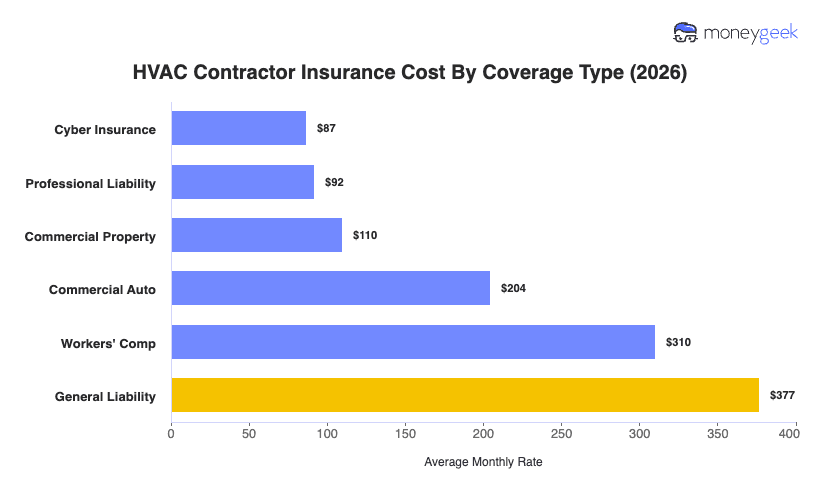
The average HVAC contractor insurance range from $352 to $1,143 per month, depending on your services, your vehicle and whether your have employees.
If you're ready to get a quote, use the tool below to get matched with the best business insurance provider for your HVAC operations.
Select state
Updated: September 11, 2026
Advertising & Editorial Disclosure
How Much Does HVAC Contractor Insurance Cost?
HVAC contractor insurance costs average $352 per month for a starting bundle, which is a group of policies that fit a solo service contractor. You likely drive a company-owned van to homes, small offices or shops and carry tools between jobs. The bundle pays for customer injuries or property damage caused by your work, accidents involving the van and certain theft or damage to your portable tools.
As your business takes on more complex work, the risks that come with each job can change. Installing complete HVAC systems adds equipment and materials that could be damaged before the job is finished, so you'll likely need broader property coverage and an installation floater. Hiring technicians also adds workers’ compensation to your coverage mix, which helps pay for work-related injuries. The bundles below show which combination best matches the way your business operates now.
Starting Bundle | General liability + commercial auto + tools and equipment | $352 | Solo service contractors with one work vehicle |
Recommended Bundle | Business owner’s policy (BOP) + commercial auto + tools and equipment + installation floater | $424 | Full-service owner-operators handling installations |
Growing Bundle | Recommended bundle + workers’ compensation | $1,073 | Staffed HVAC businesses mainly handling service and installations |
Expanded Bundle | Growing bundle + commercial umbrella | $1,143 | Multi-crew contractors managing simultaneous commercial jobs |
We treated the HVAC business itself as the starting point, then priced the insurance changes created by specific operational decisions. Moving from repair work to full-system installations adds materials and equipment at job sites. Buying a service vehicle creates road exposure. Hiring technicians adds payroll and workplace injuries. Pricing from 10 major U.S. commercial insurers was then matched to those changes.
- Bundle averages: We built the bundles first, using recognisable HVAC operations rather than coverage count. The starting profile handles service and repair work with one business vehicle and portable tools. The recommended profile also installs complete systems, so it adds protection for business property and customer-bound equipment. Workers’ compensation enters when the contractor hires employees, while commercial umbrella coverage appears only when larger jobs create a need for higher liability limits.
- National benchmark average: Once the profiles were set, we calculated national costs for HVAC businesses with fewer than five employees. Each average only includes the policies tied to that profile, so the figures do not assume every contractor buys every coverage on the page. This keeps a solo service contractor from being priced like a staffed installation company.
- State averages: We then moved the same contractor from state to state without changing the work performed, payroll, employee count, vehicles, equipment values or policy terms. That lets the comparison reflect location rather than a different business setup. Where specialised coverage lacked direct state data, we adjusted its national estimate using the state pattern of the closest comparable policy.
The results are designed to help you set a realistic insurance budget and identify the bundle closest to your operation. Your final quote may still change with the jobs you accept, where you work, how your technicians and subcontractors are used, the value of your equipment, your driving exposure and the policy terms you select.
See our full business insurance methodology.
Get HVAC Contractor Business Insurance Cost Estimates
Use our business insurance cost calculator to enter your state, the coverage you want to estimate, employee count and work vehicle type. You’ll get an estimate based on how your HVAC business operates, and you can select Get Quotes to compare insurers that may fit your needs.
Keep these points in mind:
- You can use the calculator without sharing personal details, and we do not collect or store them.
- Workers’ compensation estimates change with the number of employees entered.
- Commercial auto estimates change based on the work vehicle selected.
Get HVAC Contractor Insurance Cost Estimates
Select Coverage Type
Select State
Select Employee Count
Select vehicle_type
Monthly Rate Estimate—
Select Coverage Type
Monthly Rate Estimate—
Select State
Select Employee Count
Select vehicle_type
Factors Affecting HVAC Contractor Insurance Costs
Several factors can push your insurance costs above or below the average. Your state, claims history and business size affect costs in most industries, while the work you perform, where you perform it and who handles each job can change how likely a claim is and how expensive it could be.
 Type of HVAC work
You may pay more when you install full systems than when you mainly perform seasonal tune-ups. Installation involves heavier equipment, more changes to the building and a greater chance of damage or system failures appearing after you finish the job.
 Work setting
Where you work changes how costly one mistake becomes. A refrigerant leak in a restaurant could spoil food and interrupt service, while the same leak in an empty warehouse affects fewer people and causes a smaller loss.
 Employee duties
Insurers look at what your employees do, not just how many people you hire. You’ll generally pay more in workers’ compensation for four field technicians who climb ladders and handle equipment than for one technician supported by three office employees.
 Vehicle use
Running several service vans across a wide area puts your team on the road more often. That can raise your commercial auto costs compared with operating one van within a small local service area.
 Tools and equipment value
The more your equipment would cost to replace, the more you’ll pay to insure it. A business carrying advanced testing devices and refrigerant-recovery machines will usually need more coverage than one using a basic set of service tools.
 Use of subcontractors
Hiring outside workers can still affect your insurance costs, even though they aren’t on your payroll. You’ll pay more when subcontractors perform higher-risk work or can’t provide proof of their own insurance, and an audit could add charges based on what you paid them.
How to Lower HVAC Contractor Insurance Costs
You can lower your insurance costs without stripping out coverage your HVAC business relies on. Combining short- and long-term methods usually gives you the best value. I've combined both in list below:
 Compare quotes using the same coverage limits
Ask each insurer to price the same policies, limits, deductibles, vehicles, payroll and HVAC services when you compare quotes. That gives you a fair comparison and helps explain why one quote is lower. For example, one insurer may include refrigeration work, rooftop jobs and subcontractors, while another may leave them out or charge extra to add them later. Compare the policy details and exclusions alongside the premium so you can tell whether the lower price reflects a real saving or less protection.
 Right-size your coverage
Choose policies and limits based on the work you perform and the property you need to protect. This helps you avoid paying for risks you don't have without leaving gaps around your vehicles, tools or installation work. If don't handle refrigerants, you won't need pollution liability. But a contractor installing full systems needs an installation floater to protect customer-bound equipment and materials from covered theft or damage before the job is complete.
 Bundle policies with the same provider
A BOP combines general liability and commercial property and usually costs less than buying them separately. Some insurers might also discount commercial auto, tools coverage or workers’ compensation when you keep several policies with them. If you bundle policies with one carrier, make sure the package covers the HVAC work you perform without paying for multiple policies that address the same risk. Overlapping coverage increases your costs without adding financial protection.
 Lower your risk profile
Monthly payments makes insurance easier to manage, but insurers usually add installment or finance fees. Paying the full annual premium upfront removes those charges and reduces what you spend over the coverage year. Compare the full-year cost under both payment options rather than multiplying the monthly payment by 12. I’d also weigh the savings against your cash flow, especially during slower seasons or before buying equipment or funding a large installation job.
 Invest in risk management practices
Fewer fires, refrigerant leaks, employee injuries and vehicle accidents reduces how often you file claims and how expensive those claims become. Insurers usually take that stronger record into account when calculating your premium. I’d start with these practices to reduce your risks:
- Use written brazing and welding procedures to reduce fires, burns and damage to customers’ buildings during hot work.
- Train technicians to recover refrigerants and respond to leaks before they cause cleanup costs or interrupt a customer’s operations.
- Check ladders, rooftop access and fall protection before each job to reduce technician injuries and workers’ compensation claims.
- Screen drivers and maintain service vans to reduce accident risks that can push commercial auto costs higher.
HVAC Contractor Insurance Cost: Bottom Line
Your HVAC contractor insurance cost makes more sense when you compare it with a bundle built for a business like yours. A solo service contractor could pay between an average of $352 and $424 per month, while a company with employees or larger jobs may spend $1,073 to $1,143 as workers’ compensation, installation coverage and higher liability needs enter the picture.
Whenever you request quotes, use these questions to put it in context:
- Which bundle looks most like your business today? A solo contractor with one service vehicle needs a different mix from someone installing complete systems or managing a team of technicians. I’d start with the profile that most closely matches your current jobs, vehicles, equipment and staffing.
- Does your quote include the same policies? A lower price might not include commercial auto, tools coverage, an installation floater or workers’ compensation. See what coverages are really included in quote before deciding which one offers better value.
- What change in your business explains the cost difference? Hiring technicians, taking on full installations or moving into larger commercial work can push you into a higher-cost bundle. A quote above the starting estimate may still be reasonable when it covers risks your business now faces.
Use the bundle costs as reference points, not targets your quote needs to match. Remember, the goal is to make sure it covers the way you work now without charging you for protection you don't need.
About Connor Bolton

Connor Bolton is Senior SEO and Content Manager at MoneyGeek, where he leads the business and pet insurance editorial teams. He sets the research framework, data standards and content structure for his team. All content goes through his accuracy review before publication. Connor also writes in-depth guides and has spent more than four years covering insurance products across personal, commercial and specialty lines.
The research infrastructure Connor built covers auto, home, renters, life, health, business and pet insurance across pricing analysis, carrier research, customer experience and coverage evaluation. It includes over 6 million data points for business insurance across 408 industry areas, all 50 states and 16 vehicle types. The pet insurance side covers over 5 million profiles across 18 major providers, 100+ breeds and ages up to 20 years. Connor’s insurance research and his team's work have been cited by the U.S. Chamber of Commerce, Allstate, Liberty Mutual, CBS News, Forbes and LegalZoom.
Connor also talks with underwriters and carrier liaisons at Ethos, The Hartford, ERGO NEXT, Nationwide and State Farm, and monitors business and pet owner communities on Reddit. Those sources shape how his team evaluates carriers, structures rate analysis and writes content for real pet owners.
Questions about MoneyGeek's business or pet insurance content? Reach him at connor@moneygeek.com or on LinkedIn.
Sources
- Bureau of Labor Statistics. "Table 3. Covered Establishments, Employment, and Wages by State, Fourth Quarter 2025." Accessed October 2, 2026.
- Federal Bureau of Investigation Internet Crime Complaint Center. "2025 IC3 Annual Report." Accessed October 2, 2026.
- Michigan Department of Insurance and Financial Services. "Frequently Asked Questions." Accessed October 2, 2026.
- New York State Workers’ Compensation Board. "Workers’ Compensation Schedule of Maximum Weekly Benefits." Accessed October 2, 2026.
- U.S. Bureau of Economic Analysis. "Real Personal Consumption Expenditures by State and Real Personal Income by State and Metropolitan Area, 2024." Accessed October 2, 2026.
- U.S. Bureau of Economic Analysis. "Regional Price Parities by State and Metro Area." Accessed October 2, 2026.