
Best General Liability Insurance Companies for Small Businesses in Texas

No single general liability insurer fits every Texas business, but these five companies rank highest for balancing competitive pricing, reliable claims handling and coverage breadth. The best general liability insurance companies on this list earned their spots through performance across Houston's humid construction sites, Dallas retail corridors and Austin's growing tech startups.

  1. ERGO NEXT: Best Overall, Best for Hands-On Industries
  2. The Hartford: Best Cheap General Liability Insurance
  3. biBERK: Best for Soloprenuers and Service Businesses
  4. Simply Business: Best for Simultaneously Carrier Comparison
  5. Thimble: Best for Flexible Short-Term Coverage

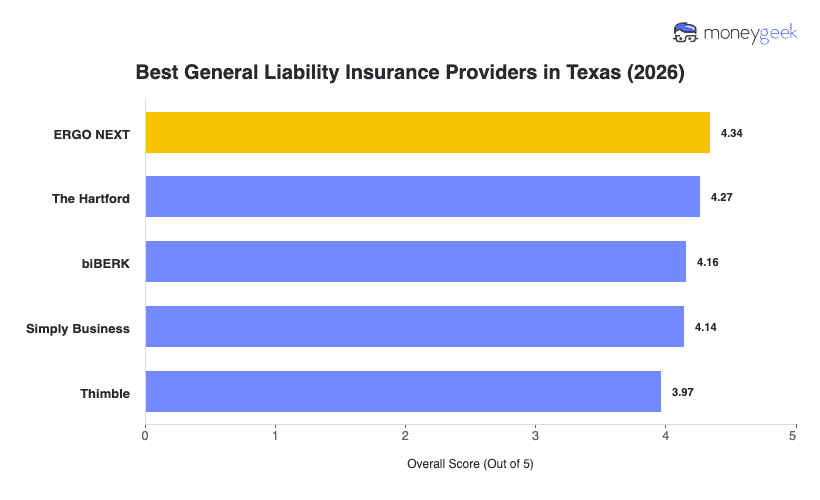
These insurers deliver strong value on cost, customer service and policy flexibility for small businesses operating in Texas. The profiles below show where each provider excels and they stack up for businesses navigating the state's diverse markets.

ERGO NEXT
4.34
Balance of digital buying experience and affordability, with strongest value for very small Texas businesses in hands-on industries like manufacturing, hospitality and repair services.
The Hartford
4.27
Lowest rates in Texas with the most savings for professional services like education, healthcare and tech, plus comprehensive coverage options including liquor liability and EPLI endorsements.
biBERK
4.16
Best savings opportunity for Texas service industries like cleaning, fitness and recreation. It has straightforward buying and claims processes that works well for service businesses with straightforward insurance needs.
Simply Business
4.14
Insurance marketplace connecting Texas businesses with multiple carriers in one comparison, offering the broadest coverage access including endorsements single carriers don't provide.
Thimble
3.89
Unique hourly, daily or monthly coverage options with instant quotes ideal for Texas gig workers, event-based businesses and construction contractors needing on-demand flexibility.

For our Texas general liability insurance ratings, we analyzed pricing, coverage options and customer experience across 408 industries within the state. Our analysis focuses on 1-to-4-person businesses, which represent nearly half of Texas's small businesses, while weighting results to ensure broader industry and location representation across Houston, Dallas, San Antonio, Austin and smaller markets throughout the state.

To do this, we evaluated over 20,000 business profiles, more than 9,200 customer experience data points and performed in-depth analysis of coverage contracts and endorsements to compare how insurers serve Texas businesses consistently across different industries and regions. We then rated each company across categories of affordability (50% of overall score), customer experience (30% of overall score) and coverage options and terms (20% of overall score) to form an overall rating. For a detailed breakdown of the metrics, scoring methodology and pricing analysis specific to Texas, see our full methodology.

95%
% of Small Businesses Covered
Over 20,000
Business Profiles Studied
9,278
Customer Experiences Analyzed

Find The Best General Liability Insurer For Your Texas Business

Select your industry and state to get a customized quote from your best general liability insurer match in TX.

Industry
State
Company Image
Best Overall, Best for Hands-On Industries

ERGO NEXT

ERGO NEXT’s digital-first buying process, consistently praised by Texas businesses, lands it in first for customer experience. Fort Worth, Austin and Houston small business owners report getting quoted, bound and receiving COIs in under 15 minutes. One Dallas contractor even said he secured coverage during a lunch break for a same-day job requirement. The app-based policy management delivers instant certificate generation and endorsement processing without requiring phone calls or agent appointments.

Coverage ranks lower since ERGO NEXT has no liquor liability, professional liability, or EPLI endorsements available, requiring separate policies for those risks. Texas businesses report settlement disputes during claims handling, as well as low initial offers, and slow resolution timelines for complex cases. However, affordability balances these gaps: rates average $106 monthly for small businesses, saving 14% compared to the Texas benchmark. Savings are particularly strong in hands-on industries like manufacturing (36% savings), hospitality (34%), and repair services (33%).

Where ERGO NEXT performs best:

  • Service businesses needing fast quotes and instant COI delivery
  • Sole proprietors and teams of one to four employees in Texas
  • Contractors in hospitality, manufacturing or repair industries
  • Businesses prioritizing app-based policy management over phone support

Where ERGO NEXT performs less competitively:

  • Healthcare, education, or wholesale businesses in Texas
  • Restaurants requiring bundled liquor liability coverage
  • Businesses expecting frequent or complex claims requiring negotiation

Learn More: ERGO NEXT Business Insurance Review

Company Image
Best Cheap General Liability Insurance

The Hartford

The Hartford ranks second overall for general liability insurance in Texas, but offers the lowest rates among all providers in our analysis. Premiums average $103 monthly for most small businesses, saving you 11% compared to the Texas benchmark. Those in professional services, such as education, healthcare, tech and financial services see the lowest rates, ranging 24% to 28% lower than the state average. The Hartford offers comprehensive coverage options, including liquor liability, employment practices liability insurance (EPLI), and pollution endorsements. You can also find higher per occurrence limits ($3 million to $5 million), a $1 million damage to rented premises sublimit and a separate $2 million products/completed operations aggregate.

Customer experience ranks low, driven by a slower, agent-dependent buying process. Texas businesses report quote turnaround times of three to five business days. One San Antonio contractor noted a four-day wait versus "instant from NEXT." However, policy management leads the market with responsive support and fast endorsement processing, and claims handling second with fair settlements and strong communication.

Where The Hartford performs best:

  • Professional services in education, healthcare, tech, and finance
  • Mid-sized Texas businesses with 10 to 49 employees
  • Businesses needing comprehensive endorsements like liquor liability or EPLI
  • Companies prioritizing agent relationships and claims reliability over speed

Where The Hartford performs less competitively:

  • Beauty, wellness, real estate or agriculture businesses in Texas
  • Businesses needing instant quotes and same-day coverage
  • Companies preferring fully digital, self-service policy management

Learn More: The Hartford Business Insurance Review

Company Image
Best for Soloprenuers and Service Businesses

biBerk

Service industries, such as  cleaning, fitness, and recreation & sports see the lowest rates from biBERK, saving 16% to 21% compared to Texas’ average.Most small Texas businesses spend around $111 monthly ($1,331 annually), saving 10% in premiums. It's also the cheapest option for sole proprietors, with rates 11% lower than the state average.

biBERK delivers quotes in 24 to 48 hours, faster than traditional carriers but slower than instant digital competitors. One Austin restaurant owner praised "quick quote turnaround" but noted the final premium was "$15/month higher than quoted." Endorsement changes taking three to five business days and COI requests fulfilled in 24 to 48 hours. The provider performs well for claims handling in straightforward cases but draws complaints for larger disputes, with one Houston contractor reporting an 8-week resolution with sparse communication. Despite offering limits up to $2 million per-occurrence and standard endorsements, coverage ranks seventh because it lacks add-ons that competitors provide. Products and completed operations share the same aggregate as general liability rather than having a separate limit.

Where biBERK performs best:

  • Sole proprietors and very small Texas businesses
  • Service industries like cleaning, fitness, and recreation
  • Businesses needing faster quotes than traditional carriers
  • Companies prioritizing affordability over premium service quality

Where biBERK performs less competitively:

  • Wholesale, construction or agriculture businesses in Texas
  • Restaurants needing bundled liquor liability coverage
  • Businesses requiring high limits or comprehensive endorsement options

Learn More: biBERK Review

Company Image
Best for Simultaneously Carrier Comparison

Simply Business

With an average monthly rate of $120 ($1,437 annually), small businesses save 4% compared to the Texas benchmark. That’s modest savings across most industries, though childcare services see 15% savings. What makes it different is that it's an insurance marketplace rather than a direct carrier, connecting Texas businesses with multiple carriers offering everything from basic digital-first policies to comprehensive traditional coverage, including endorsements like liquor liability and EPLI that single carriers may not offer.

Despite ranking second for customer experience, one Dallas retail business praised "multiple quote options" but noted having to "research carriers myself to understand differences." Quote comparison takes 10 to 15 minutes, all done on a single platform, but policy changes require contacting the underlying carrier directly, which adds complexity despite the portal's convenience. Claims handling also depends entirely on which carrier you select, not Simply Business itself.

Where Simply Business performs best:

  • Texas businesses wanting to compare multiple carrier options simultaneously
  • Childcare services needing competitive rates with coverage flexibility
  • Companies prioritizing coverage breadth over streamlined single-carrier service
  • Buyers comfortable researching policy differences across carriers themselves

Where Simply Business performs less competitively:

  • Marketing, nonprofit, or professional services businesses in Texas
  • Businesses wanting direct carrier relationships without broker intermediaries
  • Companies needing the absolute lowest rates available

Learn More: Simply Business Review

Company Image
Best for Flexible Short-Term Coverage

Thimble

Thimble offers unique flexible policy terms: hourly, daily, monthly or annual coverage that traditional carriers don't provide. One Austin photographer praised getting "coverage for a weekend event in five minutes." However, coverage still ranks last because it lacks endorsement options competitors offer and a $2 million per-occurrence maximum limits that appeals to gig workers and event-based businesses.

Small business save around 4% against Texas’ average, with a monthly rate of $112, but if you’re in construction or manufacturing, rates are lower as much as 22%. Customer experience ranks second for buying with instant quotes, but claims handling is weaker. Texas businesses report significant problems: a Houston photographer faced claim denial with "vague explanation" and difficulty getting human contact, a Dallas contractor cited a 10-week resolution with "minimal updates," and a San Antonio retailer needed lawyer involvement for a lowball settlement offer. BBB shows 200+ claims complaints in three years.

Where Thimble performs best:

  • Texas gig workers and event-based businesses needing flexible coverage
  • Construction and manufacturing businesses in Texas
  • Photographers, DJs, caterers requiring short-term on-demand policies
  • Businesses prioritizing instant quotes over comprehensive endorsement options

Where Thimble performs less competitively:

  • Hospitality, marketing, wholesale or childcare businesses in Texas
  • Businesses expecting frequent or complex claims requiring negotiation
  • Companies needing bundled liquor liability, EPLI or high limits

Learn More: Thimble Review

Explore The Best General Liability Insurance in Texas By Industry

A Fort Worth HVAC contractor replacing units during summer heat waves needs coverage for property damage and equipment failures, while an Austin food truck owner worries about customer injuries at festivals and special events. Both need general liability insurance, but the risks they're protecting against, and the claims they're likely to file, look nothing alike.

The resources below identify which insurers price competitively and handle claims effectively for different Texas industries. Match your business type to the closest industry category, then check which providers consistently deliver strong performance for those specific operational risks.

What Determines the Best General Liability Insurance for Texas Businesses

The best general liability insurance in Texas depends on what you actually need, not just the lowest quote. A Waco electrician working on commercial sites needs different coverage and service than a Galveston tour operator managing customer injuries, and strong insurers balance all three priorities for your specific situation.

    coins2 icon
    Affordability without pricing volatility

    Texas small businesses operate in a volatile environment: summer heat slows construction work in San Antonio, hurricane season disrupts Houston retail and contract demand swings with the economy. A roofing company or event rental business shopping for affordable general liability coverage can't afford premiums that jump 30% to 50% at renewal, especially when margins are already tight.

    Strong insurers price policies based on your actual risk and keep rates predictable as your revenue grows, rather than offering low first-year rates that spike sharply when you renew. Sudden rate increases force you to either shop annually or absorb unbudgeted costs, both of which make long-term planning nearly impossible.

    talk icon
    Responsive service throughout your policy term

    Texas businesses don't have time to chase down insurers when they need certificates of insurance for a last-minute contract or when a customer files a claim after an incident at their location. General liability coverage only works if your insurer delivers support when you actually need it, not just during the sales process. Strong service shows up in the moments that test your coverage:

    • Certificate of insurance delivered within hours when a Corpus Christi marina requires proof before your boat repair company can start work
    • Live claims adjuster assigned within 24 hours after a customer injury at your El Paso restaurant during the dinner rush
    • Same-day policy endorsement when you're adding commercial kitchen equipment to your Austin food trailer before a festival weekend
    • Clear answers about coverage limits when an Arlington office park demands higher liability before approving your janitorial contract

    Service failures during claims or urgent documentation requests can cost you contracts, delay revenue or force you to turn down work you're ready to handle.

    insurance2 icon
    Coverage options that fit common small business risks

    General liability policies in Texas cover bodily injury and property damage you cause to others during business operations, but that's rarely enough as your business grows. A Lubbock welding shop adding employees needs workers' comp, while a Plano marketing consultant taking on larger clients needs professional liability and cyber coverage. Choosing an insurer that offers multiple business insurance products and higher coverage limits means you can add protection as you scale without switching carriers.

    building icon
    Why consistency across all three areas matters most

    An insurer with rock-bottom rates but terrible claims service leaves you fighting for coverage when you need it, while one with great customer support but limited product options can't grow with your business as you expand operations across Texas. 

    The strongest general liability insurers balance competitive pricing, responsive service and comprehensive coverage, so you're not trading off one critical need for another. A San Marcos food manufacturer and an Amarillo HVAC company both need insurers that deliver on all three, because weakness in any single area creates problems that offset strengths in the others.

How to Choose the Best General Liability Insurance in Texas

Choosing the right general liability insurer in Texas starts with understanding what your business actually needs, not just grabbing the first quote. These six steps help you evaluate providers systematically, compare options that fit your operations and avoid costly mismatches between coverage and real-world risks.

  1. 1
    Optimize your payment and coverage structure

    Start by mapping your actual operational risks and how you'll structure payments to match your cash flow. Understanding where your business creates liability exposure helps you set the right limits and decide whether monthly premiums or an annual payment with a discount works better for your budget.

    Ask yourself:

    • Do you work on customer property, host clients at your location or operate a mobile service across multiple Texas counties?
    • Are you required to carry specific liability limits by client contracts, commercial leases or industry licensing requirements?
    • Can your business afford a higher deductible to lower monthly premiums, or do you need lower out-of-pocket costs when claims happen?
    • Does annual payment make sense for steady cash flow, or do monthly installments fit better when revenue fluctuates?

    Most Texas small businesses start with $1 million per occurrence and $2 million aggregate general liability coverage with monthly payments and a $500 to $1,000 deductible, though a Laredo moving company handling residential relocations might choose annual payment for the discount and a higher deductible since claims are rare. In contrast, a Tyler event production business managing festival contracts needs monthly payments to preserve working capital and a lower deductible given the higher frequency of customer injury claims during outdoor events.

  2. 2
    Choose your primary priority

    Decide which factor matters most right now: affordability, customer experience or coverage options. This becomes your tiebreaker when providers perform similarly across all three areas, and the right choice depends on your current business situation in Texas.

    • Prioritize affordability if tight margins mean a premium jump would cut into equipment upgrades or hiring, you run low-risk operations like a Midland bookkeeping firm or virtual assistant service or you're bootstrapping a startup in Austin's competitive tech scene where every dollar counts toward growth.
    • Prioritize customer experience if you need same-day certificates for Dallas construction permits or Houston energy sector vendor approvals, your San Antonio retail lease requires quick policy endorsements when expanding locations or slow claims support after a customer injury would cost you referrals and repeat business in tight-knit Texas communities.
    • Prioritize coverage options if you're scaling from solo work to hiring employees across the Texas Triangle, contracts in border trade or oil field services demand higher limits than standard policies offer or you need umbrella coverage and cyber protection as your El Paso e-commerce business handles more customer data and ships products statewide.
  3. 3
    Shortlist two to three providers

    Comparing eight or ten insurers across affordability, service and coverage takes too much time and creates decision paralysis, especially when some don't even write policies in all 254 Texas counties or cover your industry. Narrow to two or three providers that excel in your priority are and actually serve your area, whether you're operating in the Killeen-Temple corridor, the Rio Grande Valley or smaller Panhandle towns.

    This focused approach lets you compare certificate turnaround times, claims processes and coverage options in detail instead of collecting generic quotes from insurers you'll eliminate anyway once you discover they don't cover Beaumont manufacturers or Wichita Falls service businesses.

  4. 4
    Double check for dealbreakers before investing more time

    Before spending time on detailed comparisons, confirm each shortlisted provider meets your non-negotiables. Discovering a dealbreaker after collecting quotes and reviewing coverage wastes hours you could spend evaluating insurers that actually fit your needs.

    Common dealbreakers for Texas businesses:

    • Your industry isn't covered (insurers may exclude McAllen warehouses serving cross-border trade, Galveston restaurants with beachfront alcohol service or Odessa oilfield service companies)
    • Certificate delivery takes longer than four hours when Frisco general contractors need proof before accessing job sites or Round Rock tech companies need vendor approval to start projects
    • No mobile app or online portal for policy updates when you're managing coverage across San Antonio, College Station and Amarillo locations from the road
    • Minimum annual premiums of $800 to $1,000 exclude micro-businesses like Georgetown freelance consultants or New Braunfels mobile detailers whose actual coverage costs $400 to $600
  5. 5
    Compare your finalists using the same three lenses

    Evaluate each provider across affordability, customer experience and coverage options, not just your Step 2 priority. This reveals strengths and weaknesses you'd miss focusing on one area alone.

    • Affordability: Look at how rates change when expanding from Denton County to DFW-wide contracts, whether premium adjustments are explained clearly after hiring seasonal workers and how audits handle Corpus Christi revenue fluctuations during tourism season.
    • Customer experience: Evaluate certificate delivery speed for time-sensitive Brownsville cross-border work, whether you can reach underwriters who understand your needs and how quickly Tyler construction claims get adjusters assigned.
    • Coverage options: Review scaling from $1 million to $2 million limits for larger contracts, whether Waco leases accept the insurer's additional insured endorsements and adding commercial auto when acquiring vehicles.
  6. 6
    Use quotes as the final confirmation step

    Request general liability insurance quotes from your two or three finalists to confirm they can deliver the rates and coverage you expect. Quotes based on your actual details, whether you operate a single Kerrville shop or manage teams across Texarkana, Lubbock and Harlingen, validate that pricing holds once the insurer reviews your revenue, employee count and specific coverage needs, not just generic estimates that change after underwriting.

Best Small Business General Liability Insurance in Texas: Bottom Line

ERGO NEXT, The Hartford, biBERK, Simply Business and Thimble lead Texas general liability rankings, but fit depends on whether you operate statewide, across the Texas Triangle or in border markets. Strong providers balance competitive pricing, responsive certificate delivery and coverage that scales with expansion. This approach matches protection to your operations without sacrificing support for multi-city management and time-sensitive contract requirements.

Best General Liability Insurance For Small Business in Texas Chart

Best General Liability Insurance for Small Businesses in Texas: Next Steps

If you're ready to move forward, narrow your options to one or two providers from the rankings above and confirm pricing and availability using the same coverage assumptions for your Texas business.

This way, you'll avoid misleading comparisons and validate which insurer offers the best combination of affordability and policy features for your industry, business size and operating locations across the state.

If you want to confirm cost before deciding

Understanding typical general liability rates in Texas and what drives pricing helps set realistic expectations before requesting quotes, since premiums vary based on your industry classification, revenue, employee count and where you operate.

If you’re unsure how much coverage you need

Clarifying your general liability coverage needs now prevents discovering gaps when a client requires proof of higher limits or when filing a claim after a customer injury at your location.

If you’re ready to check quotes now

Quotes validate assumptions from your shortlist and confirm eligibility and pricing tied to your specific business details: your Texas location, industry classification, revenue and coverage limits. Use quotes to verify fit with providers you've already evaluated, not to restart your search from scratch.

  • Compare general liability insurance quotes using the same limits
  • Validate coverage terms before making a final decision

Find The Best General Liability Insurer For Your Texas Business

Select your industry and state to get a customized quote from your top general liability insurance match in Texas.

Industry
State

How We Chose the Best General Liability Insurance Companies

To identify the best general liability insurance companies for Texas small businesses, we evaluated insurers across pricing, customer experience and coverage options using a standardized, data-driven approach. Our goal was not to identify the cheapest option in every scenario, but to determine which providers deliver the most consistent overall value across common Texas small business profiles.

Our best recommendations reflect insurers that perform well across multiple dimensions and remain competitive across industries and business sizes in Texas.

Data and Analysis Scope

Our analysis is based on standardized estimates designed to represent the majority of Texas small businesses:

  • Providers analyzed: 10 major insurers serving Texas
  • Industries covered: 408 industries
  • Employee counts: 0–49 employees
  • Policy baseline: $1M per occurrence / $2M aggregate general liability policy
  • Pricing modeled: Just over 20,000 standardized estimates for Texas businesses

Modeled average revenues and payrolls were incorporated to improve pricing accuracy for Texas's business landscape.

Our Scoring Model

Each insurer received a composite score based on the weighted categories below.

  • Affordability (50% of overall score): Affordability reflects how competitively and consistently an insurer prices general liability coverage across all Texas business profiles studied.
  • Customer experience (30% of overall score): Customer experience measures how well insurers support Texas businesses throughout the policy lifecycle from purchase to claims. We also studied at each level of buying, policy management and claims sub-parts of the process that make it easier and more reliable within each as well for accuracy and comprehensive understanding.
  • Coverage options (20%): Coverage options reflect how well insurers support common Texas small business risks and allow for flexibility as businesses grow or change.

About Angelique Palenzuela-Cruz


Angelique Palenzuela-Cruz headshot

Angelique Palenzuela-Cruz is a Content Writer at MoneyGeek specializing in business insurance. She focuses on general liability, workers' compensation and professional liability coverage, helping small business owners cut through policy jargon and understand what they're actually buying.

Angelique has spent over five years reporting on personal finance, with deep experience in both insurance and lending markets. Her psychology background also gives her a unique understanding of how people actually process difficult financial decisions, allowing her to meet readers where they are, simplify complex concepts and build decision making frameworks that give them confidence. Whether you're learning about policies, comparing providers or trying to figure out requirements, Angelique does the legwork, digging into regulations, analyzing policy language and testing her explanations against agent-level standards so you get straight answers without fluff.


Copyright © 2026 MoneyGeek.com. All Rights Reserved