How Much Does General Liability Insurance Cost in Ohio?

The average cost of general liability insurance in Ohio is $110 per month, or $1,322 annually, for businesses with one to four employees. This sits 10% below the national average, ranking Ohio 22nd nationally for affordability.

Ohio's pricing aligns more closely with lower-cost neighbors than regional outliers. Kentucky and Indiana both run cheaper at $102 and $106 monthly, while Pennsylvania tracks higher at $129. Within the Midwest, Ohio sits nearer the median alongside Wisconsin ($108) and Michigan ($115), but well below Illinois ($141), the region's cost outlier. The state's below-average pricing reflects competitive market conditions and a moderate risk environment relative to the national baseline.

Treat Ohio's monthly average as a starting reference, as your actual premium will shift based on your industry's risk profile, payroll size, and claims history. Use this figure to assess whether quotes you receive cluster near the typical range or land meaningfully higher.


To estimate average general liability insurance costs in Ohio, we analyzed quote data from major U.S. small business insurance providers and modeled standardized premium estimates across common business profiles. These modeled results are designed to provide a consistent state benchmark and show how premiums vary by key baseline factors including business size, industry and location within Ohio.

Dataset Scope and Assumptions

Our cost modeling uses standardized inputs for consistent comparisons across Ohio businesses.

  • Providers analyzed: 10 major insurance providers
  • Industries covered: 25 general industry categories relevant to Ohio's business landscape
  • Employee count bands: zero, one to four, five to nine, 10 to 19 and 20 to 49 employees
  • Policy baseline: standard general liability policy with $1 million per occurrence / $2 million aggregate limits
  • Total estimates modeled: over 20,000 standardized pricing estimates across Ohio industry and employee count combinations

We also incorporated modeled average revenue and payroll personalized across all combinations of Ohio regions, industry and employee counts to improve the accuracy of pricing. To model these assumptions against our cost factors, we used data from these sources:

  • CBP (for employee size class density in Ohio by NAICS)
  • QCEW (for wage/payroll intensity by industry in Ohio)
  • Economic Census / SUSB (for receipts/output intensity by industry)
  • Calibrated against:
    • Private comp databases
    • IRS SOI totals

How We Calculated Average General Liability Costs in Ohio

Our published averages represent modeled premiums for standardized business profiles and were aggregated in two ways:

  • Ohio state average: The Ohio average cost reflects the modeled premium for a standardized one to four-employee small business across all industries included in our dataset for a standard general liability policy.
  • Segment averages: To show how costs vary within Ohio, we calculated average modeled premiums for our state base profile and isolated for variables, including:
    • Employee count (business size ranges)
    • General industry categories

Segment averages were produced by aggregating modeled pricing trends across the full dataset so readers can compare how premiums shift across business types and regions within Ohio.

Business Insurance Rates by State and Industry

Select your general industry and employee count for a personalized general liability insurance cost estimate for your Ohio business. Estimates are based for a $1 million per occurrence and $2 million aggregate policy.

Select Industry
Select Employee Count
Average Monthly Rate

What Factors Affect General Liability Insurance Costs Ohio?

General liability insurance in Ohio reflects both nationwide pricing patterns and state-specific market conditions. Costs vary based on how insurers evaluate claim probability and severity, with some factors applying universally while others stem from Ohio's regulatory and geographic profile.

Ohio Agnostic General Liability Insurance Cost Factors

Certain cost drivers operate independently of geography, shaped by your business characteristics rather than your location. These factors set your premium baseline before state-specific conditions adjust the number.

    smallBusiness icon
    Business size

    Employee count directly shapes general liability premiums because larger workforces generate more customer interactions, operational complexity and claim exposure. More employees typically signal higher revenue activity and greater liability potential.

    Sole proprietors pay 45% less than Ohio's average, while businesses with 20 to 49 employees pay 1,733% more.

    contractor icon
    Industry classification

    Industry type drives general liability premiums based on physical risk exposure and operational conditions. Desk-based work with minimal customer interaction carries lower claim potential, while hands-on operations involving jobsites, equipment or physical labor generate higher liability exposure.

    Tech and IT businesses in Ohio run 76% below the state average, reflecting minimal physical risk and office-based operations. Construction carries premiums 167% above that benchmark due to worksite hazards, equipment use and elevated injury potential.

Ohio-Specific General Liability Insurance Cost Factors

Beyond business characteristics, Ohio's legal system, licensing rules and competitive market create additional cost variation. These state-level factors influence how insurers assess risk and set premiums.

    ohio icon
    Ohio's Geographic Location and Population Density

    Businesses in urban areas like Columbus, Cleveland, and Cincinnati typically pay higher premiums than rural counterparts due to increased foot traffic, higher property values, more frequent customer interactions, and elevated claim frequency. Dense commercial districts generate more slip-and-fall exposure and property damage risk, which insurers price into premiums.

    congress icon
    Ohio's Legal and Tort Environment

    Ohio follows a modified comparative negligence system where plaintiffs must be less than 51% at fault to recover damages. The state caps punitive damages and sets a two-year statute of limitations for personal injury claims. The "open and obvious" doctrine can limit property owner liability for visible hazards, potentially reducing claim severity and moderating premium costs.

    driverLicense icon
    Ohio's Licensing and Regulatory Requirements

    State-licensed contractors must carry minimum general liability coverage ranging from $100,000 to $500,000, depending on jurisdiction and trade type:

    • The Ohio Construction Industry Licensing Board requires $500,000 for electricians, plumbers, HVAC, hydronics, and refrigeration contractors.
    • Municipalities enforce additional requirements: Columbus requires $300,000 per person and $500,000 per occurrence, Cleveland requires $200,000, and Cincinnati requires $100,000.
    • Commercial leases commonly mandate proof of coverage, creating baseline demand that influences market pricing.
    insurance2 icon
    Ohio's Insurance Market Competitiveness

    Ohio's general liability costs run approximately 10% below the national average, reflecting a competitive insurance marketplace with multiple carriers. Nearly one million small businesses operate in Ohio, creating economies of scale for insurers. Market competition and favorable risk conditions contribute to relatively moderate premium levels compared to other states.

Average General Liability Insurance Costs in Ohio by Business Size

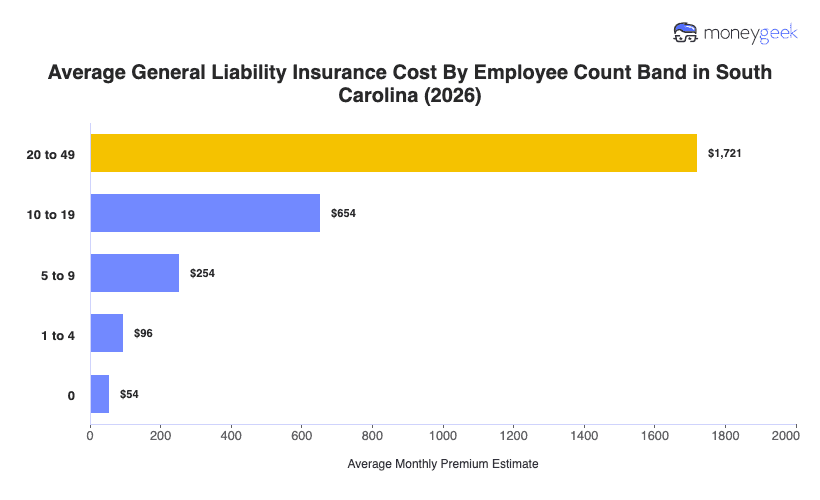
General liability premiums in Ohio scale with employee count, ranging from $54 monthly for sole proprietors to $1,721 monthly for businesses with 20 to 49 employees. Adding even one employee nearly doubles costs (78% increase), capturing the shift from individual contractor liability to employer-based exposure.

The steepest percentage increase occurs when hiring your fifth employee (164% increase), as insurers reprice from minimal to moderate claim probability. The table shows monthly and annual costs across all employee count tiers.

Ohio General Liability Insurance Cost Chart

Average General Liability Insurance Costs in Ohio by Industry

Most Ohio businesses operate in industries that cost well below the state average, creating a distribution heavily weighted toward lower premiums. The following insights reveal how industry characteristics drive this variation and where different business types fall within the cost structure.

  • Most Ohio industries cost less than the state average, creating a misleading benchmark. Eighty-eight percent of industries fall below the $110 monthly average, with the median at $72. Tech, consulting and marketing firms, which represent a substantial portion of Ohio's business base, cost $26 to $32 monthly or roughly 70% below average. Most businesses cluster in the $35 to $107 range. Identifying where your industry sits within this distribution provides more accurate cost expectations than relying on the statewide average alone.
  • Industry classification creates an 11-fold cost gap, the widest spread in Ohio's general liability market. Tech companies pay $26 monthly while construction firms pay $294, an 11.2x multiplier that exceeds the impact of business size, location or any other single factor. This gap stems from fundamental operational differences: office-based industries average $36 monthly, while physical labor sectors average $119 due to jobsite hazards, equipment use and elevated injury potential.
  • Ohio's fastest-growing industries face the state's highest insurance costs. Health care projects 16.5% employment growth through 2026 but charges $193 monthly for general liability, 75% above average. Construction follows the same pattern with 10.4% projected growth and $294 monthly premiums, 167% above average. Economic expansion centers on sectors with steep insurance barriers, potentially limiting new business formation.
  • Customer-facing businesses pay 70% more than B2B-focused operations. Direct consumer interaction raises costs from $53 monthly for B2B businesses to $89 for customer-facing operations, a 1.7x multiplier driven by slip-and-fall exposure and higher claim frequency. Retail, food service, hospitality and fitness sectors all cluster in this elevated tier. Tech, consulting and wholesale distribution benefit from limited public access.
  • Ohio's largest GDP contributors enjoy below-average insurance costs, creating economic advantages. Manufacturing generates 17.5% of state GDP while running 45% below the general liability average at $61 monthly. Financial services and real estate contribute 18.3% of GDP combined and cost $37-$46 monthly. The state's economic foundation rests on industries with manageable insurance expenses, unlike fast-growing sectors.
Data filtered by:
Select
Agriculture & Natural Resources$91$1,09417%
Arts, Media & Entertainment$35$41569%
Beauty, Body & Wellness Services$35$42468%
Childcare Services$109$1,3111%
Cleaning Services$88$1,05220%
Construction & Contracting$294$3,525-167%
Consulting Services$32$38371%
Education$46$55058%
Financial Services$37$44366%
Fitness Services$99$1,18610%
Food & Beverage$111$1,337-1%
Healthcare & Medical$193$2,316-75%
Hospitality, Travel & Tourism$93$1,12115%
Manufacturing$61$73345%
Marketing & Communications$31$36772%
Nonprofit & Associations$51$61054%
Other Professional Services$68$82038%
Pet Care Services$77$92930%
Real Estate & Property Services$46$54959%
Recreation & Sports$72$86335%
Repair & Maintenance$66$79140%
Retail & Product Rental$106$1,2764%
Tech/IT$26$31476%
Transportation & Logistics$81$97127%
Wholesale & Distribution$94$1,13314%

Use these resources to explore costs for your industry.

How to Lower General Liability Insurance Costs Without Sacrificing Coverage

Finding affordable general liability coverage in Ohio requires both immediate purchasing decisions and sustained risk management over time. Some strategies cut costs at your next renewal while others build premium reductions gradually through clean claims history and documented safety improvements that insurers reward with better rates.

Quick General Liability Cost Lowering Methods

These six methods lower your general liability costs through smarter purchasing decisions and policy adjustments. Most take minutes to implement through your insurance agent or during renewal, though results vary based on your business situation and claims history.

    insurance2 icon
    Provide clean, accurate underwriting information

    Give your insurer exact details about what you do, how many people work for you, your annual revenue and any past claims. A Cincinnati contractor who underreports subcontractor use faces audit penalties and retroactive charges when the insurer discovers the gap during mid-year reviews. Overstating your safety protocols creates coverage problems during claims investigations when actual practices don't match what you reported. Accurate applications prevent surprise bills and ensure your policy protects your operations when incidents occur.

    shoppingCart icon
    Compare multiple insurers

    Get general liability quotes from three to five carriers before buying coverage. A Cleveland retail shop might pay $1,200 annually with one insurer and $850 with another for identical protection, purely based on each company's appetite for that industry and current book composition. 

    Some carriers specialize in restaurants while others focus on tech startups or professional services, creating natural price advantages for businesses they understand. Shopping around reveals which insurers want your business type and compete hardest for it through lower rates and better terms.

    building icon
    Bundle general liability into business owner's policies (BOP)

    The cost of a business owner's policy (BOP) is 15% to 25% lower than if you buy general liability and commercial property insurance separately. This bundling approach works well if you run a Dayton salon, Akron office or Columbus coffee shop since you have a physical locations and equipment you need to protect. 

    Packaging both coverage types under one policy eliminates juggling multiple renewals with different carriers and expiration schedules, while the premium savings free up cash for payroll, inventory or expansion.

    coins2 icon
    Pay annually instead of monthly

    Skip monthly installments and pay your full premium once per year to avoid fees that add 5% to 15% to your total cost. Toledo manufacturing operations with strong spring and summer revenue can time their annual payment to coincide with high-cash-flow months, while seasonal businesses plan around their busy periods. Monthly plans look easier on your budget but include administrative charges and financing costs that disappear when you pay upfront, assuming you maintain sufficient reserves to handle the lump sum without straining operations.

    money2 icon
    Increase your deductible (if you can afford it)

    Raise your deductible from if you keep solid cash reserves and rarely file claims. A Youngstown marketing agency with six months of expenses saved can shoulder higher out-of-pocket costs in exchange for 20% to 30% lower premiums without risking financial stability. 

    This approach doesn't work for businesses facing frequent small incidents. A landscaping company dealing with regular property damage claims would drain savings paying deductibles, making lower deductibles the smarter choice despite higher premiums.

    loanReview icon
    Adjust your coverage limits

    Match your coverage to how much general liability you actually need instead of buying excess limits that inflate premiums unnecessarily. Construction and health care operations usually carry $2 million or more because their work creates significant liability exposure through job site accidents, medical errors and bodily injury claims. Many Ohio consultants default to these same general liability limits even though client contracts only require $1 million and their office-based work poses far less risk, resulting in higher premiums. 

    Review your lease requirements, vendor agreements and industry norms, then set limits based on real contractual obligations. Overpaying for unused protection wastes money that could strengthen your emergency fund or reduce business debt.

Long-Term General Liability Cost Lowering Methods

These methods take months or years to lower your premiums but create lasting rate reductions that compound at each renewal. Building a strong loss history and documented safety controls delivers the deepest long-term savings for Ohio businesses.

General Liability Insurance Cost in Ohio: Bottom Line

General liability insurance costs vary based on your industry classification, business size and claims history. Most small businesses pay an average of $110 per month in Ohio. This figure serves as a benchmark rather than a prediction of what you'll pay.

Use this report to understand where your business sits within Ohio's cost structure shaped by the state's manufacturing base and seasonal weather risks.

  1. How does your profile compare? Office-based consulting firms and IT businesses typically cost less than the state average. Manufacturing operations, health care facilities and restaurants pay more due to machinery hazards, slip-and-fall risks and injury exposure amplified by Ohio's freeze-thaw cycles.
  2. What drives your baseline cost? Your industry classification creates the starting point. Policy limits, deductibles and Ohio-specific factors like winter premises liability adjust the final premium.
  3. Which factors can you control? Your claims history, coverage limits and risk management practices influence rates more than fixed characteristics like location or years in business.

Focus on understanding which cost drivers apply to your operations rather than simply measuring yourself against the average.

General Liability Insurance Cost in Ohio: Next Steps

Use this report to understand how Ohio's general liability costs break down by industry, business size and risk factors. Then, once you know where your business sits within the state's cost structure, compare providers to find coverage that matches your profile and budget.

Request quotes from at least three insurers using the same employee count, revenue, coverage limits and industry classification. If the quotes vary considerably, check whether the difference stems from how each carrier views your specific risk profile, particularly for operations in manufacturing, health care or seasonal businesses affected by Ohio's winter liability exposure.

Get Personalized General Liability Insurance Quotes in Ohio

Select your industry and state to get a customized Ohio general liability quote.

Industry
State

About Angelique Palenzuela-Cruz


Angelique Palenzuela-Cruz headshot

Angelique Palenzuela-Cruz is a Content Writer at MoneyGeek specializing in business insurance. She focuses on general liability, workers' compensation and professional liability coverage, helping small business owners cut through policy jargon and understand what they're actually buying.

Angelique has spent over five years reporting on personal finance, with deep experience in both insurance and lending markets. Her psychology background also gives her a unique understanding of how people actually process difficult financial decisions, allowing her to meet readers where they are, simplify complex concepts and build decision making frameworks that give them confidence. Whether you're learning about policies, comparing providers or trying to figure out requirements, Angelique does the legwork, digging into regulations, analyzing policy language and testing her explanations against agent-level standards so you get straight answers without fluff.


sources
Copyright © 2026 MoneyGeek.com. All Rights Reserved