
How Much Does General Liability Insurance Cost in North Carolina?

Small North Carolina businesses face a middle-tier premium landscape. It’s not the region's cheapest option, but well below what companies pay in Virginia or Maryland. The cost of general liability insurance in the state averages $112 monthly ($1,341 annually) for businesses with one to four employees, making North Carolina 23rd for affordability nationally.

That position becomes clearer when you map the surrounding states. South Carolina undercuts North Carolina by $16 monthly, claiming the 6th most affordable spot nationally, while Tennessee’s rates are nearly identical to North Carolina at $112 monthly. But cross into Virginia and costs jump 21% to $136 monthly for similar business profiles. Maryland reaches $155 monthly, reflecting the legal and commercial pressures from Washington D.C.'s plaintiff-friendly courts and denser metro corridors.

MoneyGeek's analysis covers over 400 business types statewide, which means North Carolina's average blends vastly different risk profiles. Your actual cost depends on which variables push you away from that center point.

To estimate average general liability insurance costs in North Carolina, we analyzed quote data from major U.S. small business insurance providers and modeled standardized premium estimates across common business profiles. These modeled results are designed to provide a consistent state benchmark and show how premiums vary by key baseline factors including business size, industry and location within North Carolina.

Dataset Scope and Assumptions

Our cost modeling uses standardized inputs for consistent comparisons across North Carolina businesses.

  • Providers analyzed: 10 major insurance providers
  • Industries covered: 25 general industry categories relevant to North Carolina's business landscape
  • Employee count bands: zero, one to four, five to nine, 10 to 19 and 20 to 49 employees
  • Policy baseline: standard general liability policy with $1 million per occurrence / $2 million aggregate limits
  • Total estimates modeled: over 20,000 standardized pricing estimates across North Carolina industry and employee count combinations

We also incorporated modeled average revenue and payroll personalized across all combinations of North Carolina regions, industry and employee counts to improve the accuracy of pricing. To model these assumptions against our cost factors, we used data from these sources:

  • CBP (for employee size class density in North Carolina by NAICS)
  • QCEW (for wage/payroll intensity by industry in North Carolina)
  • Economic Census / SUSB (for receipts/output intensity by industry)
  • Calibrated against:
    • Private comp databases
    • IRS SOI totals

How We Calculated Average General Liability Costs in North Carolina

Our published averages represent modeled premiums for standardized business profiles and were aggregated in two ways:

  • North Carolina state average: The North Carolina average cost reflects the modeled premium for a standardized one to four-employee small business across all industries included in our dataset for a standard general liability policy.
  • Segment averages: To show how costs vary within North Carolina, we calculated average modeled premiums for our state base profile and isolated for variables, including:
    • Employee count (business size ranges)
    • General industry categories

Segment averages were produced by aggregating modeled pricing trends across the full dataset so readers can compare how premiums shift across business types and regions within North Carolina.

What Factors Affect General Liability Insurance Costs North Carolina?

Understanding what moves North Carolina general liability costs requires separating universal business characteristics from state-specific conditions. Some factors operate identically whether you're in Raleigh or anywhere else, while others trace directly to North Carolina's legal and geographic landscape.

North Carolina Agnostic General Liability Insurance Cost Factors

General liability premiums respond to a core set of business characteristics that operate independently of where you're located. These factors create the foundation of your quote before North Carolina-specific conditions adjust it further.

    smallBusiness icon
    Business size

    The gap between a solo operation and a team of 20 to 49 reflects more than headcount. Larger workforces signal greater customer interaction, operational complexity and claim exposure. All these translate into higher premiums based on statistical loss patterns.

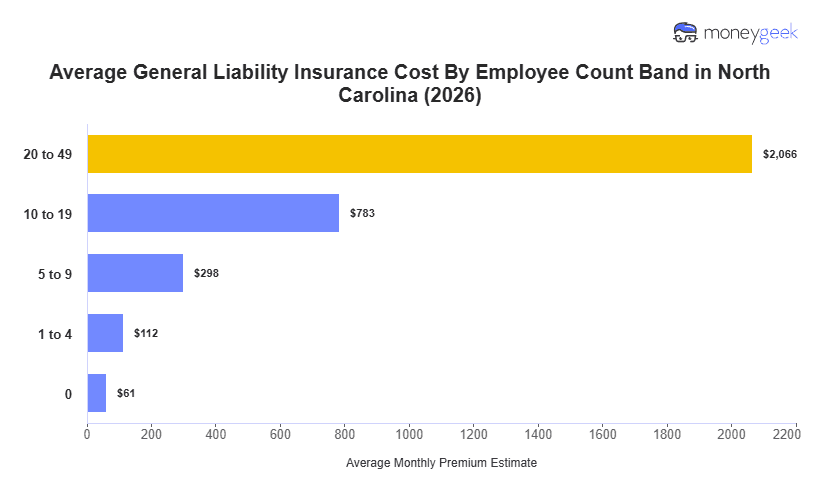
    Costs in North Carolina range from 46% below the state average for sole proprietors to 1,749% above it for businesses with 20 to 49 employees. If you're scaling from a solo practice to a larger team, expect premium increases to outpace linear headcount growth.

    contractor icon
    Industry classification

    Industry classification captures fundamental differences in how liability exposure materializes. Operations with minimal customer contact generate fewer claims than businesses handling physical materials, heavy equipment or working on customer sites.

    In North Carolina, Tech and IT businesses run 76% below the state average due to low physical risk. Construction & Contracting operations sit 171% above that benchmark, driven by job site hazards and injury potential. Where your industry falls in this spectrum determines your baseline cost.

North Carolina-Specific General Liability Insurance Cost Factors

Beyond business fundamentals, North Carolina's liability laws and geographic patterns introduce state-specific pricing layers. Insurers adjust baselines based on how courts handle claims, where operations sit, and what seasonal risks properties encounter throughout the year.

    congress icon
    North Carolina's Contributory Negligence Doctrine

    One of only four states where plaintiffs who are even 1% at fault cannot recover damages. This legal standard makes it harder for injured parties to win bodily injury and premises liability claims against businesses, reducing insurers' expected payouts and creating downward pressure on general liability premiums compared to comparative negligence states.

    wine icon
    North Carolina's dram Shop Liability Laws

    Bars, restaurants and alcohol-serving establishments carry liability when serving visibly intoxicated adults or minors who later cause harm. This exposure drives higher general liability premiums for hospitality businesses, particularly in tourism-heavy regions like Asheville's brewery corridor, Wilmington's coastal bars and Charlotte's nightlife districts, with many establishments requiring separate liquor liability coverage.

    business icon
    North Carolina's Regional Business Concentration

    The Research Triangle's office-based tech and biotech sectors carry minimal premises liability exposure, while coastal tourism businesses in Wilmington and the Outer Banks manage high customer interaction and slip-and-fall risks. Charlotte's financial district sits in the middle tier, and this geographic variation creates premium differences based on local industry mix and operational hazards.

    hurricane icon
    North Carolina's Weather and Climate Patterns

    Hurricane season, coastal humidity and Piedmont ice storms create seasonal premises liability spikes. Wet floors from rain, debris after storms, icy walkways in winter and power outages during hurricanes all increase slip-and-fall and injury risks. Coastal businesses face year-round elevated exposure, while mountain and Piedmont regions see winter-specific hazards driving seasonal claim frequency.

Average General Liability Insurance Costs in North Carolina by Business Size

Employee count creates one of the sharpest cost gradients in North Carolina's general liability market. A sole proprietor pays $727 annually, while a business with 20 to 49 employees reaches $24,790, scaling by a factor of 34 as customer touchpoints and operational exposure compound. 

The steepest single jump (167% increase) happens after hiring your fifth employee, though the pattern moderates afterward with mid-tier bands (five to nine, 10 to 19 and 20 to 49 employees) climbing consistently between 160% and 170%. The table captures this progression across five employee tiers, showing both monthly and annual benchmarks for each headcount range.

North Carolina General Liability Insurance Cost Chart

Average General Liability Insurance Costs in North Carolina by Industry

Beyond the headline numbers, North Carolina's industry-by-industry cost distribution reveals patterns that affect business planning and economic development alike. Five insights emerge from analyzing how premiums align (or don't) with the state's economic landscape.

  • North Carolina's economic growth happens where general liability is cheapest. Tech/IT (19% employment growth from 2018 to 2023), Professional Services (1.8% annual growth projected) and Arts/Entertainment (1.9% annual growth) all price 68% to 76% below the state average at $317 to $423 annually. This concentration means North Carolina's job creation engine runs in sectors where new businesses face minimal liability expense, creating favorable conditions for entrepreneurship in knowledge work rather than physical trades.
  • The state average misleads more than it informs for most business planning. Only four industries exceed the $1,341 benchmark (Childcare, Food & Beverage, Healthcare, Construction) while 21 fall below, creating a distribution where high-employment sectors pull the average upward despite representing a minority of establishments. A Raleigh consultant and Charlotte financial advisor will both pay far less than the published average suggests, while Wilmington restaurants and Asheville contractors face premiums well above it.
  • Most North Carolina businesses cluster in below-average cost tiers regardless of size. With 84% of industries priced below the $1,341 average and 99.6% of businesses employing fewer than 500 workers, typical small firms in Consulting, Real Estate or Marketing pay $385 to $554 annually. Most entrepreneurs enter markets where general liability represents a minor expense.
  • The industries driving GDP pay dramatically different premiums despite similar economic importance. Professional Services contributes $101 billion (15% of state GDP) but costs $385 annually, 71% below average. In comparison, Healthcare contributes $48 billion (7% of GDP) but runs $2,384, or 78% above average. Manufacturing adds $88 billion to the economy yet sits at just $757 annually. The disconnect shows economic value and liability exposure follow separate logic entirely.
  • Construction and Healthcare occupy isolated premium territory that doesn't reflect broader patterns. Construction ($3,639 annually) sits $1,254 above the next-highest industry despite strong employment growth, while Healthcare ($2,384) carries a $1,010 gap from Food & Beverage below it. Both operate in actuarial categories of their own, such as job site hazards for Construction, medical malpractice-adjacent claims for Healthcare, that separate them from the compressed mid-tier where most other physical-work industries cluster.
Data filtered by:
Select
Agriculture & Natural Resources$93$1,11817%
Arts, Media & Entertainment$35$42368%
Beauty, Body & Wellness Services$36$43068%
Childcare Services$113$1,352-1%
Cleaning Services$90$1,08519%
Construction & Contracting$303$3,638-171%
Consulting Services$32$38571%
Education$48$57157%
Financial Services$38$45866%
Fitness Services$102$1,2239%
Food & Beverage$114$1,374-2%
Healthcare & Medical$199$2,384-78%
Hospitality, Travel & Tourism$96$1,15714%
Manufacturing$63$75744%
Marketing & Communications$31$37172%
Nonprofit & Associations$52$62254%
Other Professional Services$70$83837%
Pet Care Services$75$89533%
Real Estate & Property Services$46$55459%
Recreation & Sports$57$68949%
Repair & Maintenance$68$81839%
Retail & Product Rental$107$1,2874%
Tech/IT$26$31776%
Transportation & Logistics$83$99026%
Wholesale & Distribution$98$1,17612%

Use these resources to explore costs for your industry.

How to Lower General Liability Insurance Costs Without Sacrificing Coverage

North Carolina businesses can reduce premiums through strategic coverage adjustments, insurer comparisons, and operational improvements without compromising protection levels. Finding more affordable general liability insurance requires understanding which cost-reduction methods deliver immediate savings versus those that build discounts over time through improved risk profiles.

Quick General Liability Cost Lowering Methods

Several adjustments take effect within your current policy period or at renewal, reducing premiums immediately without requiring operational changes or multi-year claims histories. These methods lower costs through better pricing alignment and strategic coverage decisions:

    insurance2 icon
    Provide clean, accurate underwriting information

    When underwriting your policy, insurers assess industry classification, annual revenue, and employee count to establish your rating tier. A Raleigh biotech startup with five employees faces different liability exposures than a Durham marketing consultancy since pharmaceutical development carries product liability risks that marketing doesn't. Verify your NAICS code and revenue projections to prevent mid-term adjustments that increase costs retroactively by 15% to 25%.

    shoppingCart icon
    Compare multiple insurers

    Request proposals from four to five insurers to identify competitive pricing. Carriers assess risk differently: an Asheville brewpub faces dram shop liability from craft beverage tourism, while a Biltmore-area hotel manages guest injury exposure. Regional insurers often price local conditions more accurately than national carriers. Identical $1 million/$2 million coverage can range from $140 to $280 monthly depending on carriers' underwriting approach and claims experience.

    building icon
    Bundle general liability into business owner's policies (BOP)

    Business owner's policies combine general liability with commercial property coverage at lower total cost than purchasing separately. Charlotte retail stores gain dual protection, with the policy covering customer slip-and-fall claims and inventory damage, while saving 15% to 25% compared to standalone policies. The cost of a Business Owner's Policy varies by industry, but a SouthPark boutique paying $95 monthly for general liability and $70 for commercial property could bundle into a $125 package, saving roughly $480 annually.

    coins2 icon
    Pay annually instead of monthly

    When you can cover the full year's premium upfront, annual payment saves 5% to 10% and eliminates monthly billing fees, which is particularly valuable for Eastern North Carolina agritourism operations locking rates before hurricane season. A Kinston u-pick farm paying $85 monthly saves $50 to $100 annually by prepaying, while avoiding potential mid-year rate increases after major storm events like Hurricane Helene's inland impact.

    money2 icon
    Increase your deductible (if you can afford it)

    Higher deductibles lower premiums but increase your responsibility per claim. Construction firms in Greensboro-Winston-Salem's booming market maintain operating capital from active project pipelines, allowing them to carry more risk. Raising your deductible from $500 to $2,500 reduces annual premiums by 15% to 30%, a worthwhile tradeoff if you have cash reserves to handle larger out-of-pocket expenses.

    loanReview icon
    Adjust your coverage limits

    Understanding how much general liability insurance you need prevents paying for coverage that exceeds your actual exposure. Wilmington medical practices face different liability profiles than surgical centers, so a coastal walk-in clinic treating minor injuries doesn't need the same $2 million aggregate limits as a facility performing procedures. Match your coverage to your services rather than defaulting to maximum available limits, reducing premiums without sacrificing necessary protection.

Long-Term General Liability Cost Lowering Methods

Building a favorable claims history and implementing formal risk controls require sustained commitment over multiple policy periods, but insurers reward these efforts with premium reductions that compound annually. North Carolina businesses using these strategies position themselves for rate decreases that persist long after initial implementation costs.

General Liability Insurance Cost in North Carolina: Bottom Line

General liability premiums vary because insurers estimate claim frequency and severity for your business, with industry classification, employee count, and location creating the largest price differences. North Carolina's $1,341 annual average provides a comparison benchmark, not a rate prediction.

Use the cost ranges and risk factors in this analysis to understand what drives your specific premium.

  1. How does your premium compare to North Carolina businesses like yours? Match your rate against the employee count and industry breakdowns to see whether you're paying more or less than similar operations.
  2. What creates the gap between your rate and the state average? Industry classification and employee count set your baseline risk, while limits, deductibles, and claims history adjust that starting point—some you inherit, others you control.
  3. Which North Carolina factors affect your cost-reduction options? Verify your industry classification, compare insurers covering coastal versus inland risks, and check whether safety programs addressing contributory negligence or hurricane preparation earn premium discounts.

Focus on understanding which drivers shape your rate and which levers reduce costs—not just distance from the average.

General Liability Insurance Cost in North Carolina: Next Steps

Identify where your business falls within North Carolina's employee count and industry ranges to set a baseline expectation, then use these resources to find carriers covering your profile.

Request quotes from multiple insurers using identical business details, coverage limits and deductibles so rate differences stem from actual underwriting variation rather than mismatched inputs. When quotes differ substantially from your baseline or from each other, verify whether insurers classified your industry differently, applied different credits for your claims history or structured coverage terms differently.

Get Personalized General Liability Insurance Quotes in North Carolina

Select your industry and state to get a customized North Carolina general liability quote.

Industry
State

About Angelique Palenzuela-Cruz


Angelique Palenzuela-Cruz headshot

Angelique Palenzuela-Cruz is a Content Writer at MoneyGeek specializing in business insurance. She focuses on general liability, workers' compensation and professional liability coverage, helping small business owners cut through policy jargon and understand what they're actually buying.

Angelique has spent over five years reporting on personal finance, with deep experience in both insurance and lending markets. Her psychology background also gives her a unique understanding of how people actually process difficult financial decisions, allowing her to meet readers where they are, simplify complex concepts and build decision making frameworks that give them confidence. Whether you're learning about policies, comparing providers or trying to figure out requirements, Angelique does the legwork, digging into regulations, analyzing policy language and testing her explanations against agent-level standards so you get straight answers without fluff.


sources
Copyright © 2026 MoneyGeek.com. All Rights Reserved