Key Takeaways
blueCheck icon

Ranking first in affordability and second in coverage options, The Hartford offers the best general liability insurance in Minnesota.

blueCheck icon

Minnesota businesses save $24 monthly (18%) with The Hartford, the cheapest general liability insurance provider at $105 per month.

blueCheck icon

The best companies perform consistently across rate stability, responsive customer service and flexible coverage, and your provider should deliver on all three.

Best General Liability Insurance Companies for Small Businesses in Minnesota

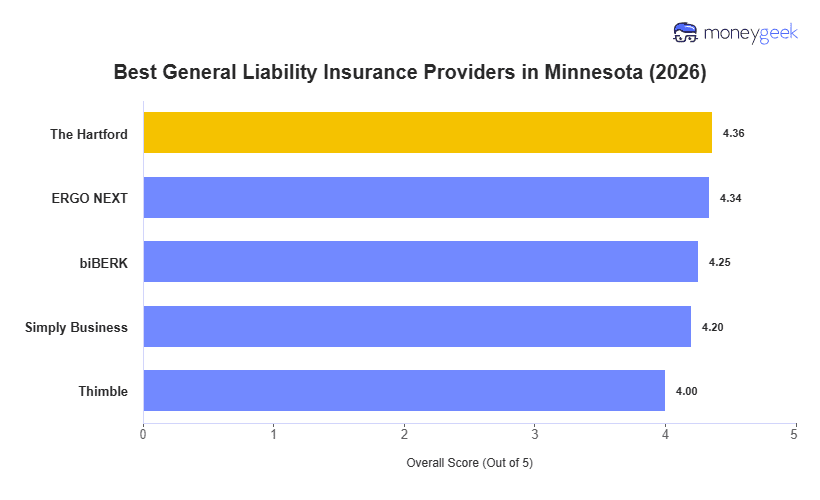
Not every insurer balances low rates with reliable claims service and flexible coverage. We analyzed 10 major providers at $1 million/$2 million limits across Minnesota, and these five stood out as the best and most affordable for small businesses statewide:

  1. The Hartford: Best Overall, Best for Professional and Institutional Businesses
  2. ERGO NEXT: Best for Customer Experience
  3. Simply Business: Best for Service Businesses (Especially With Physical Locations)
  4. biBERK: Best for Tech and It Businesses
  5. Thimble: Best for Short-Term and On-Demand Coverage

Whether you run a craft brewery in St. Paul or a snow removal service in Mankato, your risks shape which provider fits best. The table below lays out rankings and rates to help you compare options side by side.

The Hartford4.36$10582
ERGO NEXT4.34$11418
biBERK4.25$11847
Simply Business4.2$12724
Thimble4$119610
Coverdash3.97$13492
Progressive Commercial3.91$13879
Hiscox3.86$14436
Chubb3.84$14651
Nationwide3.75$147105

For our Minnesota general liability insurance ratings, we analyzed pricing, coverage options and customer experience across 408 industries within the state. Our analysis focuses on one-to-four-person businesses, which represent a large share of Minnesota's small business market, while weighting results to ensure broader industry and location representation across Hennepin County, Ramsey County, Dakota County and smaller markets throughout the state.

To do this, we evaluated over 20,000 business profiles, more than 1,600 customer experience data points and performed in-depth analysis of coverage contracts and endorsements to compare how insurers serve Minnesota businesses consistently across different industries and regions. We then rated each company across affordability (50%), customer experience (30%) and coverage options and terms (20%) to form an overall rating. For a detailed breakdown of the metrics, scoring methodology and pricing analysis specific to Minnesota, see our full methodology.

95%

% of Small Businesses Covered

Over 20,000

Business Profiles Studied

1,695

Customer Experiences Analyzed

The Hartford
Best Overall, Best for Professional and Institutional Businesses

The Hartford

On The Hartford's site

The Hartford tops our rankings for general liability insurance in Minnesota, with the most affordable rates on average and the second-strongest coverage options available. Minnesota small businesses save 15% to 18% on average compared to state benchmarks, though some industries see more cost advantages than others. These include education (34% savings), healthcare (31%) and retail (22%). The Hartford pairs affordable with flexible coverage: standard $1 million per occurrence limits, up to $1 million for damage to rented premises and add-on options including cyber liability, EPLI and hired/non-owned auto. 

Customer experience scores lower, but that reflects the buying process more than ongoing service quality. The Hartford leads in billing flexibility, endorsement processing and support responsiveness. Reviewers on BBB and Trustpilot report fair claim settlements and clear communication, though getting a quote takes longer and requires more detail than digital-first competitors.

Where The Hartford works best:

  • Minnesota businesses that prioritize low premiums across industries
  • Education, health care or retail operations looking for the deepest savings
  • Owners who want responsive service once a policy is active
  • Businesses that need flexible add-on options

Where The Hartford falls short:

  • Buyers who want fast, fully online quoting
  • Real estate or hospitality businesses looking for lower rates
  • Owners who prefer a modern digital buying experience

Learn More: The Hartford Review

ERGO NEXT
Best for Customer Experience

ERGO NEXT

On ERGO NEXT's site

ERGO NEXT ranks second in MoneyGeek's Minnesota general liability study, with the strongest buying experience scores and competitive premiums. Business owners report quotes in under 10 minutes with the option to buy immediately, and the online interface shows coverage details before you commit. The self-service portal generates insurance certificates instantly, a feature users consistently praise. Hands-on and service industries see the deepest savings: hospitality (36%), manufacturing (28%) and repair services (27%). Construction, childcare and pet care operations pay 19% to 21% less than the Minnesota average.

Coverage flexibility is narrower. ERGO NEXT offers standard limits and core endorsements, hired/non-owned auto and contractor tools coverage, but fewer specialized add-ons. Businesses needing higher limits or industry-specific endorsements may need to look elsewhere. Reviews show mixed results for settlement fairness and communication on complex claims.

Where ERGO NEXT works best:

  • Solo operators and businesses with one to four employees that want fast coverage
  • Hospitality, manufacturing or repair businesses looking for lower rates
  • Owners who prefer self-service over phone-based support
  • Businesses that rarely file claims and want easy COI access

Where ERGO NEXT falls short:

  • Health care, education or agriculture operations focused on affordability
  • Businesses that need specialized endorsements or higher limits
  • Owners who expect complex claims to require hands-on support

Learn More: ERGO NEXT Review

biBerk
Best for Service Businesses (Especially with Physical Locations)

biBerk

biBerk ranks third in MoneyGeek's Minnesota general liability study, with competitive premiums and an A++ AM Best rating through Berkshire Hathaway. Service industries with physical locations see the largest savings; wholesale and distribution, fitness centers and cleaning companies save 20% to 24%. Standard coverage includes $1 million per occurrence limits and common endorsements like hired/non-owned auto and waiver of subrogation.

The buying process is straightforward. Business owners report transparent underwriting and clear explanations of what's covered, though final premiums sometimes change after underwriting review. Policy management and claims handling land in the middle of the pack: the portal works but lacks polish, COI requests aren't instant and some policyholders report longer wait times for support.

Where biBerk works best:

  • Wholesale, fitness or cleaning businesses looking for lower rates
  • Owners who want the financial stability of Berkshire Hathaway backing
  • Midsized businesses that need affordable coverage
  • Owners comfortable with a direct-to-consumer buying process

Where biBerk falls short:

  • Childcare or consulting operations looking for savings
  • Businesses that need fast COIs or responsive ongoing support
  • Owners who prefer working with a local agent

Learn More: biBERK Review

Simply Business
Best for Tech and It Businesses

Simply Business

Simply Business ranks fourth in MoneyGeek's Minnesota general liability study, driven by strong customer experience scores and access to multiple carriers. Rather than underwriting policies directly, Simply Business connects Minnesota businesses with carriers like Hiscox and CNA through a marketplace model, letting buyers compare quotes side-by-side. Coverage options vary based on which carrier matches your profile;more flexibility, but less certainty on exact terms until you select a policy.

Tech and IT businesses see the largest savings in Minnesota, paying 22%, and education and food service operations also pay below average. The downside is consistency: policy management and claims go through the underlying carrier, not Simply Business, so ongoing service depends on who issues your policy.

Where Simply Business works best:

  • Technology and IT firms looking for the lowest Minnesota rates
  • Buyers who prefer comparing quotes from multiple carriers at once
  • Education or food service operations that want mid-range savings
  • Owners comfortable with different carriers handling their policy

Where Simply Business falls short:

  • Owners who want a single, consistent carrier relationship
  • Construction or marketing businesses looking for savings
  • Businesses that want predictable service and claims handling

Learn More: Simply Business Review

Thimble
Best for Short-Term and On-Demand Coverage

Thimble

Thimble ranks fifth overall in MoneyGeek's Minnesota general liability study. It sells on-demand coverage by the hour, day, week or month, a structure that works well for contractors taking single jobs, event vendors or seasonal operations that don't need year-round policies. Coverage options are narrower than traditional carriers: standard $1 million per occurrence limits, fewer endorsements and damage to rented premises capped at $100,000.

Thimble isn't the cheapest provider in the state, but construction and manufacturing businesses save 20% to 22%. The buying process is fast and mobile-friendly. Users praise the speed of getting short-term coverage for specific jobs, though reviews also flag slow communication and settlement disputes — pulling down claims handling scores.

Where Thimble works best:

  • Contractors or vendors that need coverage for a single job
  • Construction or manufacturing businesses looking for lower Minnesota rates
  • Gig workers or seasonal operations with variable schedules

Where Thimble falls short:

  • Hospitality or marketing businesses looking for low-cost coverage
  • Businesses that need specialized endorsements or higher limits

Learn More: Thimble Review

Explore the Best General Liability Insurance in Minnesota by Industry

What you pay for general liability coverage depends heavily on what your business actually does. An Iron Range mining supplier and an Edina marketing agency carry different levels of risk, and insurers price accordingly. The tables below compare rates and policy terms for construction, agriculture, manufacturing, healthcare and other industries common in Minnesota, so you can benchmark options against businesses like yours.

What Determines the Best General Liability Insurance for Minnesota Businesses

A snow removal contractor preparing for a brutal Twin Cities winter and a fishing guide running charters on Lake Mille Lacs both need general liability insurance in Minnesota, but their exposures, service needs and growth paths look nothing alike. Choosing based on price alone often leads to gaps that surface at the worst time: during a claim. These four factors separate insurers that work well on paper from those that work well in practice.

    coins2 icon
    Affordability without pricing volatility

    Minnesota's seasonal economy creates unique cash flow pressures. A Hibbing trucking company earns most of its revenue hauling during winter months, while an Alexandria lakeside resort generates income primarily between Memorial Day and Labor Day. 

    Your premium depends on industry classification, claims history, revenue swings and the limits you select. Any of these can shift at renewal and rate spikes at this time hit harder when your income fluctuates with the seasons. An insurer with competitive first-year pricing but aggressive renewal increases costs more over a three-year stretch than one with slightly higher but stable rates from the start.

    talk icon
    Responsive service throughout your policy term

    Good service shows up at specific moments, not just when you're buying. A food vendor scrambling for a certificate before setting up at the Minnesota State Fair needs same-day turnaround, and a property manager in St. Paul dealing with a tenant injury during a February ice storm needs clear guidance, not voicemail loops. 

    These touchpoints are green flags to watch out for:

    • Getting certificates within hours when a Minneapolis event venue or commercial landlord requires proof before you can start work
    • Reaching a representative who understands seasonal staffing swings common to outstate tourism businesses and holiday retailers
    • Adding coverage mid-term when you land a municipal snow plowing contract in Dakota County
    • Filing a claim after a customer slips on ice at your Mankato storefront and receiving updates without chasing

    When service breaks down, you absorb the stress and delays your insurer should be handling.

    insurance2 icon
    Coverage options that fit common small business risks

    A craft distillery in Northeast Minneapolis pouring samples to weekend visitors carries different exposure than an outfitter leading multi-day Boundary Waters canoe trips through remote terrain. The distillery may operate fine with lower per-occurrence limits given its controlled setting, while the outfitter likely needs higher aggregate limits to cover incidents that happen far from emergency services.

    Look for insurers offering flexible per-occurrence and aggregate options, plus endorsements that fit Minnesota realities: hired and non-owned auto for crews driving between Greater Minnesota job sites, equipment breakdown for operations relying on specialized machinery or liquor liability for taprooms and event venues. A policy with thin limits or missing add-ons may cost less upfront, but you cover the gap out of pocket when claims exceed your coverage.

    building icon
    Why consistency across all three areas matters most

    An insurer with rock-bottom rates but slow claims handling creates problems when a customer trips outside your Duluth storefront after a lake-effect snowfall. One with great service but rigid coverage options may not adapt when your Rochester consulting firm starts subcontracting with Mayo Clinic vendors. The strongest providers deliver consistent performance across pricing, service and coverage, not just one.

How to Choose the Best General Liability Insurance in Minnesota

Picking the right provider takes more than scanning a list of names. These six steps help you narrow options in a logical order, so you spend less time comparing and more time running your business.

  1. 1
    Optimize your payment and coverage structure

    Before comparing providers, get clear on your risk profile and what coverage structure fits your operations. A Hibbing excavation contractor on Iron Range job sites carries different exposure than a Wayzata wealth management firm with client meetings in a quiet office.

    Ask yourself:

    • What's the highest-dollar claim your business could trigger, a customer injury at your Roseville storefront or property damage during a Lake Minnetonka remodel?
    • Do clients, landlords or municipal contracts require specific minimums? Many Twin Cities commercial landlords and government projects set coverage floors you'll need to meet.
    • Does your work involve physical labor outdoors, where Minnesota's ice, snow and spring thaw cycles raise slip-and-fall or equipment damage risk?
    • How predictable is your revenue? Seasonal operators like North Shore tour guides or holiday pop-up retailers may need to time payments around leaner months.

    A home-based graphic designer in Northfield with no client visits needs less coverage than a general contractor bidding on Minneapolis-St. Paul commercial projects, where higher limits are often a contract requirement. Once you know how much general liability coverage you need, decide whether monthly or annual payments fit your cash flow and whether raising your deductible makes sense given your claims history.

  2. 2
    Choose your primary priority

    Not every business weighs the same factors equally. A seasonal fishing guide on Leech Lake has different concerns than a year-round software consultancy in downtown St. Paul. Identify which factor matters most; it becomes your tiebreaker when providers score similarly.

    • Prioritize affordability if your margins run thin or your revenue follows Minnesota's seasons. Landscapers, snowplow operators and Brainerd Lakes tourism businesses watch income drop sharply between summer and winter. Stable, predictable pricing matters more than the lowest quote when cash flow is uneven.
    • Prioritize customer experience if your operations require frequent certificate requests, mid-term policy changes or fast claims resolution. Caterers on the Twin Cities wedding circuit or contractors rotating between commercial sites in Rochester and Mankato need an insurer that responds in hours, not days.
    • Prioritize coverage options if your business carries specialized risks or plans to scale. A Stillwater craft brewery adding a taproom or a Duluth engineering firm taking on port infrastructure contracts needs flexible general liability limits and endorsement options that can expand with the operation.
  3. 3
    Shortlist two to three providers

    Evaluating every insurer you encounter wastes time and causes decision fatigue. Narrow your list to two or three providers that match your primary priority and meet baseline requirements for your industry and business size.

    Use Minnesota general liability costs as a benchmark, then filter for insurers that write policies for your trade, operate in your service area and offer the limits you identified in step one. A Fergus Falls ag equipment dealer and an Eagan mobile pet groomer pull from different provider pools; confirm each finalist actually serves your profile before moving forward.

  4. 4
    Double check for dealbreakers before investing more time

    Before comparing finalists in detail, confirm they clear basic requirements. A dealbreaker found now saves hours of wasted research later. Watch for:

    • The insurer doesn't write policies for your industry classification or flags your trade as high-risk; common for tree services and roofing contractors after Minnesota storm seasons
    • Required endorsements like liquor liability for taprooms or hired auto coverage for delivery operations aren't available
    • Certificate turnaround times won't meet deadlines from General Mills suppliers, 3M contractors or other large Minnesota clients requiring proof before work starts
    • The insurer lacks claims support familiar with Minnesota-specific issues like ice dam damage or slip-and-fall incidents during winter
  5. 5
    Compare your finalists using the same three lenses

    Even after choosing a primary priority, evaluate your finalists across all three areas:

    • Affordability: Look at renewal history, not just the initial quote. Ask how rate changes are communicated, whether audits trigger mid-term adjustments and what caused increases for similar businesses in your part of Minnesota.
    • Customer experience: Check certificate turnaround times, ease of making policy changes online or by phone, claims response windows and portal quality. An Ely canoe outfitter and a Shakopee event planner both need responsive service, but their touchpoints differ.
    • Coverage options: Check whether per occurrence and aggregate limits can scale as your business grows, which endorsements cover exposures like customer injuries on icy walkways or damage during severe summer storms and how flexible the insurer is with mid-term additions.
  6. 6
    Use quotes as the final confirmation step

    A quote puts your research to the test. Request general liability insurance quotes from your two or three finalists using your actual business details: your exact address in Plymouth or Red Wing, your payroll, revenue and the work you perform. Confirm pricing matches your expectations and review policy documents for general liability exclusions that could leave gaps, particularly around snow removal, subcontractor work or alcohol service if those apply. That confirms whether what looked good on paper actually works for how you run your business in Minnesota.

Best Small Business General Liability Insurance in Minnesota: Bottom Line

The Hartford, ERGO NEXT and biBerk rank highest in Minnesota, but the right match depends on your industry, team size and where you operate. The lowest quote matters less than pricing stability, responsive service and coverage that scales with your business; three things that align your risk exposure and budget with a policy built for your actual operations.

Best General Liability Insurance for Small Businesses in Minnesota: Next Steps

Narrow your options to one or two providers and confirm pricing and availability using the same coverage assumptions. That way you avoid misleading comparisons and can tell which insurer offers the best combination of affordability, certificate turnaround and policy features for your industry and location in Minnesota.

If cost is still your main deciding factor

If you’re unsure how much coverage you need

If you’re ready to check quotes now

How We Chose the Best General Liability Insurance Companies

To identify the best general liability insurance companies for Minnesota small businesses, we evaluated insurers across pricing, customer experience and coverage options using a standardized, data-driven approach. Our goal was not to identify the cheapest option in every scenario, but to determine which providers deliver the most consistent overall value across common Minnesota small business profiles.

Our best recommendations reflect insurers that perform well across multiple dimensions and remain competitive across industries and business sizes in Minnesota.

Data and Analysis Scope

Our analysis is based on standardized estimates designed to represent the majority of Minnesota small businesses:

  • Providers analyzed: 10 major insurers serving Minnesota
  • Industries covered: 408 industries
  • Employee counts: Zero to 49 employees
  • Policy baseline: $1 million per occurrence/$2 million aggregate general liability policy
  • Pricing modeled: Just over 20,000 standardized estimates for Minnesota businesses

Modeled average revenues and payrolls were incorporated to improve pricing accuracy for Minnesota's business landscape.

Our Scoring Model

Each insurer received a composite score based on the weighted categories below.

  • Affordability (50%): Affordability reflects how competitively and consistently an insurer prices general liability coverage across all Minnesota business profiles studied.
  • Customer experience (30%): Customer experience measures how well insurers support Minnesota businesses throughout the policy lifecycle from purchase to claims. We also studied at each level of buying, policy management and claims sub-parts of the process that make it easier and more reliable within each as well for accuracy and comprehensive understanding.
  • Coverage options (20%): Coverage options reflect how well insurers support common Minnesota small business risks and allow for flexibility as businesses grow or change.

Read our full business insurance methodology.

About Connor Bolton


Connor Bolton headshot

Connor Bolton is Senior SEO and Content Manager at MoneyGeek, where he leads the business and pet insurance editorial teams. As editorial lead for both verticals, Connor sets the research framework, data standards, and content structure that his writers execute, directly authoring in-depth guides himself and reviewing all team content for accuracy and practical value before it goes live. With over four years evaluating insurance products across personal, commercial, and specialty lines, he brings cross-vertical knowledge to every guide the team produces.

Connor architected MoneyGeek's insurance research infrastructure across all major verticals including auto, home, renters, life, health, business, and pet, building systems for pricing analysis, provider-level research, customer experience evaluation, and coverage analysis with AI support. The infrastructure includes over 6 million data points for business insurance across 408 industry areas, all 50 states, and 16 vehicle types, and over 5 million pet insurance profiles across 18 major providers and hundreds of breed and age combinations. Connor's insurance cost research and his team's work has been cited by the U.S. Chamber of Commerce, Allstate, Liberty Mutual, CBS News, Forbes and LegalZoom.

Beyond the data, Connor stays connected to how the market actually operates, drawing on direct conversations with underwriters and carrier liaisons at Ethos, The Hartford, NEXT Insurance, Nationwide, and State Farm, and monitoring business and pet owner communities including Reddit, to inform how he interprets findings and frames guidance for real buyers.

He is the direct editorial contact for methodology questions at connor@moneygeek.com and can be found on LinkedIn.