
How Much Does General Liability Insurance Cost in Michigan?

General liability insurance costs in Michigan average $115 per month, or $1,381 annually, for businesses with one to four employees. This sits 6% below the national average of $123 monthly. Michigan ranks 26th nationally for affordability, landing in the middle of the pack.

All three states bordering Michigan come in cheaper: Indiana at $106 monthly, Wisconsin at $108 and Ohio at $110. These neighbors cluster tightly within a $4 range and rank more affordable nationally. Across the broader Midwest, Illinois breaks the pattern at $141 per month, running 22% above Michigan and 46% over the national benchmark. This tight border-state grouping suggests Michigan sits just above a lower-cost Great Lakes tier but well below regional outliers.

Treat Michigan's average as orientation, not prediction. Two Michigan businesses can see very different premiums based on industry risk, business size and the coverage limits they select. These factors shift costs more than the state benchmark alone.

To estimate average general liability insurance costs in Michigan, we analyzed quote data from major U.S. small business insurance providers and modeled standardized premium estimates across common business profiles. These modeled results are designed to provide a consistent state benchmark and show how premiums vary by key baseline factors including business size, industry and location within Michigan.

Dataset Scope and Assumptions

Our cost modeling uses standardized inputs for consistent comparisons across Michigan businesses.

  • Providers analyzed: 10 major insurance providers
  • Industries covered: 25 general industry categories relevant to Michigan's business landscape
  • Employee count bands: zero, one to four, five to nine, 10 to 19 and 20 to 49 employees
  • Policy baseline: standard general liability policy with $1 million per occurrence / $2 million aggregate limits
  • Total estimates modeled: over 20,000 standardized pricing estimates across Michigan industry and employee count combinations

We also incorporated modeled average revenue and payroll personalized across all combinations of Michigan regions, industry and employee counts to improve the accuracy of pricing. To model these assumptions against our cost factors, we used data from these sources:

  • CBP (for employee size class density in Michigan by NAICS)
  • QCEW (for wage/payroll intensity by industry in Michigan)
  • Economic Census / SUSB (for receipts/output intensity by industry)
  • Calibrated against:
    • Private comp databases
    • IRS SOI totals

How We Calculated Average General Liability Costs in Michigan

Our published averages represent modeled premiums for standardized business profiles and were aggregated in two ways:

  • Michigan state average: The Michigan average cost reflects the modeled premium for a standardized one to four-employee small business across all industries included in our dataset for a standard general liability policy.
  • Segment averages: To show how costs vary within Michigan, we calculated average modeled premiums for our state base profile and isolated for variables, including:
    • Employee count (business size ranges)
    • General industry categories

Segment averages were produced by aggregating modeled pricing trends across the full dataset so readers can compare how premiums shift across business types and regions within Michigan.

What Factors Affect General Liability Insurance Costs Michigan?

General liability insurance in Michigan follows a two-layer pricing structure where insurers first apply core business factors, then add state-specific adjustments. Understanding both sets of inputs helps explain why quotes vary and which parts of your cost you control through business decisions.

Michigan Agnostic General Liability Insurance Cost Factors

Insurers use the same core pricing factors across all states, evaluating how your business characteristics affect claim likelihood and cost. These universal inputs establish the foundation of general liability pricing regardless of location.

    smallBusiness icon
    Business size

    Larger payrolls drive higher premiums because insurers tie employee count to claim frequency potential. Each additional worker expands the business's reach through more job sites, client interactions and opportunities for covered incidents.

    Businesses with 20 to 49 employees in Michigan pay 1,737% more than the state average, while sole proprietors pay 46% less.

    contractor icon
    Industry classification

    Industry type shapes premiums because insurers price based on claim probability tied to operational exposure. Office-based work involves minimal physical risk, while hands-on services mean more customer locations, equipment use and potential for bodily injury or property damage claims.

    Tech and IT businesses in Michigan run 77% below the state average, reflecting low physical risk and primarily digital operations. Construction and contracting carries the highest premiums at 167% above average, driven by jobsite hazards, equipment operation and elevated injury potential.

Michigan-Specific General Liability Insurance Cost Factors

Beyond these universal inputs, state-level characteristics create additional pricing pressures in Michigan's market. Insurers adjust general liability premiums based on how local conditions affect claim frequency, settlement costs and litigation exposure unique to this jurisdiction.

    winterStorm icon
    Michigan's Severe Winter Weather

    The state's five to six month winter season brings heavy lake-effect snow, frequent freeze-thaw cycles and black ice formation. These conditions create persistent slip-and-fall hazards on business premises, parking lots and walkways from October through April, requiring ongoing snow removal and salting to maintain safe conditions. Insurers see higher claim frequency in this extended winter exposure, driving up general liability premiums compared to warmer states.

    scale icon
    Michigan's 2023 Premises Liability Ruling

    The Michigan Supreme Court overturned the "open and obvious" doctrine in 2023, fundamentally changing winter slip-and-fall liability. Cases previously dismissed now proceed to trial, with juries determining fault rather than judges granting automatic summary dismissals. This legal shift increases settlement amounts and litigation costs for businesses, compounding the financial impact of Michigan's already hazardous winter conditions.

    methodologyTwo icon
    Michigan's High Manufacturing Concentration

    Manufacturing represents 16.1% of Michigan's total employment, above the national average, with transportation equipment as the top manufacturing industry. General liability policies cover product liability claims including manufacturing defects, design flaws and failure-to-warn cases. Michigan's heavy manufacturing presence expands the statewide risk pool for product liability exposure, driving up average general liability premiums across all industries.

    congress icon
    Michigan's Modified Comparative Negligence Law

    Michigan follows a 51% bar rule where plaintiffs more than 50% at fault cannot recover non-economic damages like pain and suffering. Economic damages use pure comparative fault, allowing recovery even at 99% fault with proportional reduction. This framework affects settlement negotiations and claim values across all liability scenarios, influencing how insurers price general liability coverage.

Average General Liability Insurance Costs in Michigan by Business Size

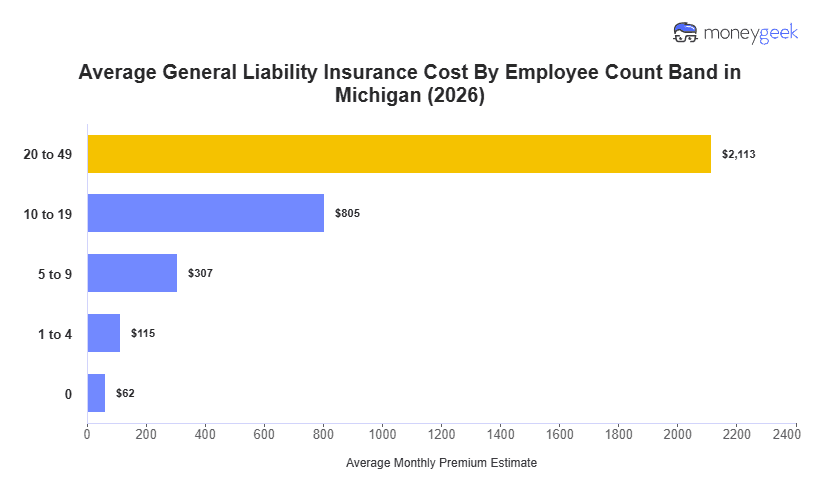
General liability premiums in Michigan scale from $62 to $2,113 per month as employee count increases, reflecting how payroll size expands claim exposure. The sharpest percentage increase occurs when businesses hire their fifth employee, where premiums jump 167%. The table shows monthly and annual benchmarks across five employee tiers.

Michigan General Liability Insurance Cost Chart

Average General Liability Insurance Costs in Michigan by Industry

General liability costs in Michigan span from $26 monthly for tech and IT businesses to $307 for construction and contracting, reflecting how physical work environments drive claim costs. Industry-specific pricing patterns reveal how insurers' claim expectations shape premiums across Michigan's business landscape:

  • Most Michigan businesses cluster in the middle premium band between $90 and $120 monthly. This range captures industries with the highest establishment counts: cleaning services, agriculture, hospitality, wholesale, fitness, retail, childcare and food service. Roughly 60% of Michigan's business establishments operate in sectors where general liability premiums track within 20% of the state average, making $115 monthly a reliable benchmark for typical operations.
  • Michigan's top GDP contributors carry lower general liability costs than common service industries. Manufacturing generates the state's largest economic output but runs 45% below average GL premiums due to controlled factory environments. Professional services also contribute substantial GDP while staying 39% below average. Meanwhile, construction, with moderate GDP contribution pays 167% above average, creating significant insurance burden for this common business type.
  • Fast-growing industries in Michigan concentrate in the lowest-cost insurance sectors. Tech and IT businesses expand fastest statewide while paying $26 monthly (77% below average). Professional services also grow steadily at $71 monthly (39% below average). Healthcare represents the exception, showing strong employment growth in a high-cost sector at $198 monthly (72% above average). Michigan's economic diversification into office-based work shifts the business mix toward lower general liability exposure.
  • Manufacturing premiums run 45% below state average despite Michigan's heavy industrial concentration. Michigan's signature industry pays just $64 monthly for general liability coverage. Controlled factory environments and limited public interaction reduce bodily injury exposure despite product liability risks. This below-average pricing for such a prevalent industry moderates Michigan's overall state average compared to less industrialized states.
  • Agriculture carries premiums 18% below average in Michigan's farm-heavy economy. Michigan leads nationally in tart cherry and blueberry production and ranks third for apples, with substantial dairy operations. Despite equipment operation and chemical exposure, agricultural businesses maintain lower general liability costs than construction or healthcare. Farm operations present different risk profiles than job-site work, with fewer public interactions and established safety protocols reducing expected claim frequency.
Data filtered by:
Select
Agriculture & Natural Resources$94$1,12718%
Arts, Media & Entertainment$36$42869%
Beauty, Body & Wellness Services$37$44168%
Childcare Services$115$1,3820%
Cleaning Services$91$1,09820%
Construction & Contracting$307$3,679-167%
Consulting Services$32$38672%
Education$46$55460%
Financial Services$39$46466%
Fitness Services$100$1,19813%
Food & Beverage$116$1,395-1%
Healthcare & Medical$198$2,377-72%
Hospitality, Travel & Tourism$97$1,16616%
Manufacturing$64$76545%
Marketing & Communications$31$37373%
Nonprofit & Associations$53$63454%
Other Professional Services$71$84639%
Pet Care Services$71$85238%
Real Estate & Property Services$46$55660%
Recreation & Sports$91$1,09621%
Repair & Maintenance$69$82740%
Retail & Product Rental$108$1,2916%
Tech/IT$26$31877%
Transportation & Logistics$81$97629%
Wholesale & Distribution$98$1,17815%

Use these resources to explore costs for your industry.

How to Lower General Liability Insurance Costs Without Sacrificing Coverage

Affordable general liability coverage in Michigan comes from both immediate policy adjustments and sustained risk management practices. Businesses can reduce premiums right away through smarter purchasing decisions, then build deeper discounts over time by demonstrating safety improvements and maintaining clean claims histories that insurers reward with better rates.

Quick General Liability Cost Lowering Methods

Michigan businesses can cut general liability costs without sacrificing protection by adjusting how they buy and structure coverage. Small changes to payment schedules, deductible amounts and insurer selection create real savings for Grand Rapids retailers, Detroit consultants and Traverse City seasonal operators while maintaining adequate claim protection.

    insurance2 icon
    Provide clean, accurate underwriting information

    When applying for coverage, insurers need precise details about your operations: how many welders work your Dearborn auto parts shop, total square footage of your Grand Rapids furniture showroom or annual catering revenue from your Traverse City restaurant. 

    Understating employee counts or misreporting revenue can trigger mid-policy audits that increase premiums retroactively. A Flint contractor who doesn't report the three-person framing crew he brings to jobs faces surprise bills when the insurer discovers the gap during claims review.

    shoppingCart icon
    Compare multiple insurers

    Five insurers might quote your Ann Arbor software consulting firm anywhere from $400 to $1,200 annually for identical coverage. Some carriers specialize in tech startups, others focus on established manufacturing. A Mackinac Island hotel owner benefits from insurers experienced with seasonal tourism risks, while a Detroit medical clinic needs carriers familiar with healthcare liability. Getting quotes from multiple carriers reveals which insurers understand your business model and price it competitively.

    building icon
    Bundle general liability into business owner's policies (BOP)

    Packaging liability with property coverage through a BOP cuts costs 15% to 25% versus separate policies. This works well if you run a Lansing accounting office, Kalamazoo retail shop, or Saginaw physical therapy clinic that needs commercial property insurance for equipment and furnishings. Construction companies and auto repair shops typically can't use BOPs, forcing them to buy standalone policies. Check the cost of a BOP to see if bundling saves money for your business.

    coins2 icon
    Pay annually instead of monthly

    Monthly installments add 5% to 10% in processing fees over the year. If you operate a cherry orchard near Leelanau Peninsula or a ski rental shop in Boyne City, paying your full premium after harvest or winter season matches when you actually have the money while avoiding surcharges. Year-round businesses like a Southfield consulting firm also save by eliminating monthly administrative fees through one annual payment.

    money2 icon
    Increase your deductible (if you can afford it)

    Raising your deductible from $500 to $2,500 typically drops premiums 10% to 20%, but you'll pay more out-of-pocket for small claims. A well-established Holland manufacturing plant with cash reserves can handle a minor claim, while a new Ypsilanti cafe operating on thin margins might struggle to cover a $2,500 slip-and-fall claim. Match your deductible to what you could pay tomorrow without disrupting operations.

    loanReview icon
    Adjust your coverage limits

    Many businesses carry $2 million in coverage when $1 million fits their actual exposure, unnecessarily inflating premiums 30% to 40%. A Troy IT consultant working from a home office faces different risks than a Port Huron marina with public boat launches. Understanding how much general liability coverage you need prevents overpaying for protection. Buying extra coverage to satisfy a lease requirement you could negotiate down wastes money.

Long-Term General Liability Cost Lowering Methods

Beyond quick policy fixes, Michigan businesses managing October-to-April slip-and-fall risks and seasonal tourism cycles build long-term savings by keeping claims records clean and installing safety controls. These strategies take several renewal periods to pay off but create growing discounts for manufacturers, marina operators and retailers committed to preventing incidents.

General Liability Insurance Cost in Michigan: Bottom Line

General liability costs in Michigan vary based on employee count, industry classification and how you operate. The national average serves as a reference point for small businesses with one to four employees, not a prediction of what you'll pay.

Use this report to understand where you fall in Michigan's cost distribution rather than focusing solely on benchmark figures.

  1. Compare your profile to the benchmark. Construction operations and seasonal restaurants shift from the baseline because of higher employee counts and industry-specific risks.
  2. Separate baseline drivers from policy choices. Every business has baseline risk it can't change, but deductibles, coverage limits and payment schedules remain controllable.
  3. Identify what you can verify or negotiate. Review whether contracts require higher limits, make sure insurers know about your winter safety measures, and check if annual payment eliminates fees.

The framework helps you understand how Michigan's seasonal exposure and industry concentration interact with your operations to shape premiums, not whether your quote matches an average across thousands of diverse businesses.

General Liability Insurance Cost in Michigan: Next Steps

Use this report's benchmarks to set realistic cost expectations, then compare quotes from Michigan insurers using consistent business details and coverage terms.

Identify where your business falls within Michigan's distribution based on employee count and industry classification. Request quotes with identical limits and deductibles so differences reflect insurer pricing rather than mismatched policy terms.

Get Personalized General Liability Insurance Quotes in Michigan

Select your industry and state to get a customized Michigan general liability quote.

Industry
State

About Angelique Palenzuela-Cruz


Angelique Palenzuela-Cruz headshot

Angelique Palenzuela-Cruz is a Content Writer at MoneyGeek specializing in business insurance. She focuses on general liability, workers' compensation and professional liability coverage, helping small business owners cut through policy jargon and understand what they're actually buying.

Angelique has spent over five years reporting on personal finance, with deep experience in both insurance and lending markets. Her psychology background also gives her a unique understanding of how people actually process difficult financial decisions, allowing her to meet readers where they are, simplify complex concepts and build decision making frameworks that give them confidence. Whether you're learning about policies, comparing providers or trying to figure out requirements, Angelique does the legwork, digging into regulations, analyzing policy language and testing her explanations against agent-level standards so you get straight answers without fluff.


sources
Copyright © 2026 MoneyGeek.com. All Rights Reserved