
How Much Does General Liability Insurance Cost in Connecticut?

General liability insurance costs in Connecticut average $159 monthly ($1,906 annually) for businesses with one to four employees carrying limits of $1 million per occurrence/$2 million aggregate. This benchmark runs 29% above the national average of $123 monthly, placing Connecticut 45th nationally for affordability, making it the sixth most expensive state for general liability coverage.

Connecticut's positioning reflects the broader Northeast cost structure, where costs vary considerably across neighboring and regional markets. Among adjacent states, Rhode Island averages $130 monthly, Massachusetts $169, and New York $180. Within the broader Northeast region, Maine ($112) and New Hampshire ($135) run $24 to $47 below Connecticut's benchmark. Connecticut sits in the upper-middle tier of this distribution, exceeding Rhode Island but remaining below both Massachusetts and New York.

Use this state average as a starting reference for understanding whether your quoted price falls within expected parameters given your operational profile, not as a prediction of your final premium.

To estimate average general liability insurance costs in Connecticut, we analyzed quote data from major U.S. small business insurance providers and modeled standardized premium estimates across common business profiles. These modeled results are designed to provide a consistent state benchmark and show how premiums vary by key baseline factors including business size, industry and location within Connecticut.

Dataset Scope and Assumptions

Our cost modeling uses standardized inputs for consistent comparisons across Connecticut businesses.

  • Providers analyzed: 10 major insurance providers
  • Industries covered: 25 general industry categories relevant to Connecticut's business landscape
  • Employee count bands: zero, one to four, five to nine, 10 to 19 and 20 to 49 employees
  • Policy baseline: standard general liability policy with $1 million per occurrence / $2 million aggregate limits
  • Total estimates modeled: over 20,000 standardized pricing estimates across Connecticut industry and employee count combinations

We also incorporated modeled average revenue and payroll personalized across all combinations of Connecticut regions, industry and employee counts to improve the accuracy of pricing. To model these assumptions against our cost factors, we used data from these sources:

  • CBP (for employee size class density in Connecticut by NAICS)
  • QCEW (for wage/payroll intensity by industry in Connecticut)
  • Economic Census / SUSB (for receipts/output intensity by industry)
  • Calibrated against:
    • Private comp databases
    • IRS SOI totals

How We Calculated Average General Liability Costs in Connecticut

Our published averages represent modeled premiums for standardized business profiles and were aggregated in two ways:

  • Connecticut state average: The Connecticut average cost reflects the modeled premium for a standardized one to four-employee small business across all industries included in our dataset for a standard general liability policy.
  • Segment averages: To show how costs vary within Connecticut, we calculated average modeled premiums for our state base profile and isolated for variables, including:
    • Employee count (business size ranges)
    • General industry categories

Segment averages were produced by aggregating modeled pricing trends across the full dataset so readers can compare how premiums shift across business types and regions within Connecticut.

What Factors Affect General Liability Insurance Costs Connecticut?

General liability insurance costs reflect two layers of pricing logic: baseline factors that apply universally across states, and regional conditions specific to Connecticut's market. Insurers start with workforce scale and operational risk patterns common to all businesses, then adjust for state-level regulatory requirements, economic conditions and geographic characteristics that shape claim frequency and severity in Connecticut.

Connecticut Agnostic General Liability Insurance Cost Factors

Employee count and industry category determine your starting rate regardless of location. A Hartford tech startup and a Bridgeport contractor may both carry general liability coverage, but their premiums diverge based on workforce size and operational exposure.

    smallBusiness icon
    Business size

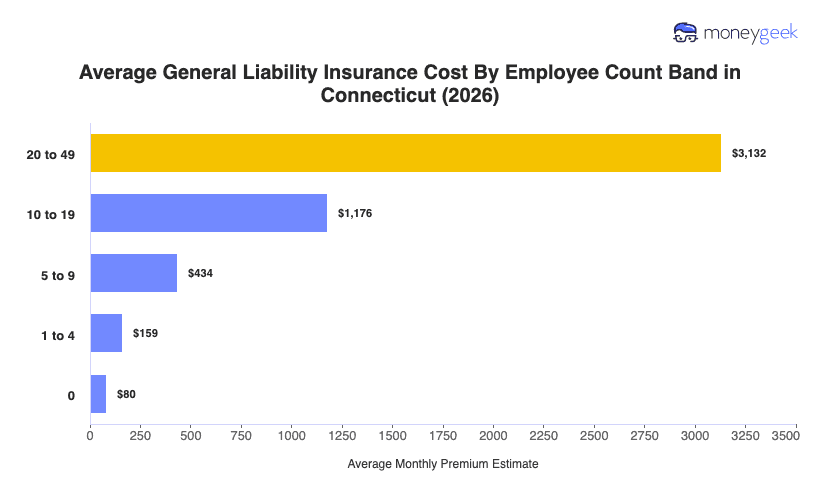
    Business size drives baseline pricing because workforce scale directly correlates with claim probability. More employees means greater public interaction volume, expanded operational footprints and multiplied touchpoints where liability incidents can emerge across customer-facing transactions and on-site activities in larger physical spaces. Compared to Connecticut's average, sole proprietors pay around $80 monthly (49% lower than average), while businesses with 20 to 49 employees pay around $3,132 monthly (1,872% higher)

    contractor icon
    Industry classification

    Industry classification determines baseline pricing because insurers evaluate operational risk profiles through claim frequency and severity lenses. A software consultancy operating from shared office space has different liability exposures than a contracting firm managing active construction sites. Across 25 general industries, general liability premiums range from $31 monthly for Tech and IT businesses to $464 monthly for Construction and Contracting operations.

Connecticut-Specific General Liability Insurance Cost Factors

Beyond workforce size and industry classification, Connecticut's regulations, economy and geography create pricing pressures distinct from national patterns. Dense urban areas, high income levels and sophisticated insurance markets add to the baseline exposure all businesses face, building state-specific cost factors into every general liability policy.

    congress icon
    Connecticut's Legal and Regulatory Environment

    Connecticut's anti-discrimination protections apply at three employees, well below the federal threshold of 15, expanding liability exposure for smaller operations. State law covers race, color, religious creed, age, sex, gender identity or expression, marital status, national origin, ancestry and disability, creating broader compliance requirements than many neighboring states. This lower threshold means more Connecticut businesses face employment-related liability risk earlier in their growth cycle compared to federal-only jurisdictions.

    connecticut icon
    Connecticut's Geographic Risk Profile

    Connecticut's urban centers (Bridgeport, Hartford and New Haven) concentrate foot traffic through commercial districts, multiplying premises exposure. The 96-mile coastline faces storm systems, while annual snowfall of 37 to 45 inches creates ice-related liability risks.

    I-95 and major commuter routes funnel heavy traffic through business zones. August 2024's flooding dropped over 10 inches of rain in hours, creating storm-damaged walkways and debris hazards lasting weeks.

    money2 icon
    Connecticut's Economic and Demographic Profile

    Connecticut's per capita income of $93,157 ranks first nationally, directly affecting claim costs. Lost wage claims for affluent customers run substantially higher than lower-income states. A Hartford professional earning $200,000 annually claims roughly $50,000 in lost wages for three months of recovery, compared to $8,159 for workers at Connecticut's $15.69 minimum wage. Higher-income claimants elevate settlement negotiations and legal defense costs statewide.

    insurance2 icon
    Connecticut's Industry Concentration and Insurance Market Dynamics

    Connecticut's finance, insurance and real estate sector dominates the economy, while healthcare leads employment growth. Professional services concentration creates elevated liability exposure as client interactions and advisory work generate more complex claims than manufacturing operations.

    Hartford's insurance headquarters cluster, including The Hartford and Travelers, creates sophisticated underwriting statewide. Insurers use granular risk assessment rather than broad averages, benefiting documented low-risk operations while scrutinizing marginal profiles more intensely.

    firstAidKit icon
    Connecticut's Healthcare Costs and Medical Claim Severity

    Connecticut's healthcare spending of $11,960 per capita ranks sixth nationally, running 17% above the national average. Medical expenses form a major component of bodily injury claims, meaning treatment costs at Connecticut facilities directly increase claim payouts compared to lower-cost states.

    Major academic centers like Yale New Haven Health deliver advanced care at premium pricing. Higher emergency, surgical and diagnostic costs elevate every injury claim, building regional medical differentials into liability premiums statewide.

    building icon
    Connecticut's Aging Urban Infrastructure and Premises Liability

    Connecticut's commercial building stock skews older than Sun Belt markets, with approximately 40% of structures predating 1970. Historic centers like Hartford, New Haven and Bridgeport contain extensive early-to-mid 20th century districts where building systems, sidewalks and structural elements require intensive maintenance.

    Aging infrastructure elevates premises liability through deteriorating walkways, outdated systems and weather-accelerated wear. Winter freeze-thaw cycles compound maintenance challenges, creating slip-and-fall risks and structural hazards that insurers factor into baseline pricing statewide.

Average General Liability Insurance Costs in Connecticut by Business Size

General liability costs in Connecticut scale directly with employee count, ranging from $80 monthly for sole proprietors to $3,132 monthly for businesses with 20 to 49 employees. The steepest increase occurs when adding the fifth employee, where costs jump 174% as operations expand premises exposure and customer interaction volume.

The table shows monthly and annual premiums across employee count brackets.

Connecticut General Liability Insurance Cost Chart

Average General Liability Insurance Costs in Connecticut by Industry

Connecticut premiums span from $31 monthly for tech businesses to $464 for construction operations, reflecting how physical jobsite hazards, equipment use and customer interaction patterns create different claim frequencies across the state's 25 general industry categories.

Our analysis of Connecticut's industry costs reveals five patterns:

  • Physical workspace risks outweigh customer volume in determining costs. Retail shops with constant foot traffic pay $122 monthly (23% below average), while construction sites with minimal public access pay $464 monthly (192% above average). Equipment hazards and jobsite conditions create far greater liability exposure than customer interactions alone.
  • Connecticut's economic concentration skews toward low general liability costs. Five of the state's seven most common industries (professional services, education, manufacturing, finance and retail) pay 23% to 80% below the state average, though health care's dominance (16% to 18% of employment at 67% above average) drives overall pricing pressure.
  • Hartford's insurance and financial sector, along with consulting firms statewide, pay $31 to $58 monthly (63% to 80% below the state average). Connecticut's concentrated professional services economy benefits from office-based operations with minimal physical hazards and controlled client interactions, creating rock-bottom general liability costs for the state's signature industries.

Connecticut's industry mix explains why many businesses receive quotes below the $159 state average (professional services, education and retail dominate employment while only four high-cost industries pull the baseline upward). Use the table to gauge where your business profile places you.

Data filtered by:
Select
Agriculture & Natural Resources$128$1,53220%
Arts, Media & Entertainment$48$58269%
Beauty, Body & Wellness Services$54$64266%
Childcare Services$185$2,219-16%
Cleaning Services$138$1,66213%
Construction & Contracting$464$5,567-192%
Consulting Services$35$41878%
Education$59$71463%
Financial Services$58$70263%
Fitness Services$122$1,46023%
Food & Beverage$174$2,083-9%
Healthcare & Medical$266$3,190-67%
Hospitality, Travel & Tourism$148$1,7777%
Manufacturing$97$1,15939%
Marketing & Communications$37$44577%
Nonprofit & Associations$75$89853%
Other Professional Services$102$1,22236%
Pet Care Services$87$1,04745%
Real Estate & Property Services$56$67065%
Recreation & Sports$106$1,26933%
Repair & Maintenance$106$1,27033%
Retail & Product Rental$122$1,46123%
Tech/IT$31$37380%
Transportation & Logistics$93$1,11442%
Wholesale & Distribution$150$1,8025%

Use these resources to explore costs for your industry.

How to Lower General Liability Insurance Costs Without Sacrificing Coverage

General liability cost reduction in Connecticut, where healthcare costs and urban density elevate baseline claims, balances premium savings against risk absorption. Some approaches require minimal effort beyond comparing rates, while others demand upfront payment or increased claim exposure. Chose methods that match your cash flow capacity and out-of-pocket cost tolerance.

Quick General Liability Cost Lowering Methods

These six strategies lower general liability costs without reducing coverage quality, though each requires different commitments of time, cash or risk tolerance.

    insurance2 icon
    Provide clean, accurate underwriting information

    Hartford insurance agencies carry different risk profiles than New Haven restaurants near Yale campus with high customer volume and kitchen operations. Your premium tier depends on three inputs insurers verify: business classification, revenue figures and employee headcount. Understating revenue or workforce size leads to mid-policy corrections that recalculate premiums from coverage start, sometimes adding penalty assessments.

    shoppingCart icon
    Compare multiple insurers

    Connecticut insurers with regional claims experience price coastal weather and urban foot traffic exposures differently than national carriers using broader models. Shoreline retailers and Hartford downtown businesses often see widely varying quotes from carriers familiar with Connecticut's conditions versus those applying generic pricing. Collect four to five proposals to identify carriers offering rates aligned with your operational profile.

    building icon
    Bundle general liability into business owner's policies (BOP)

    Packaging general liability with commercial property under a single business owner's policy delivers lower combined premiums than purchasing coverages separately. Mystic gift shops, New Haven coffee shops and Fairfield County retail stores protect against both customer injury claims and property losses from coastal storms, winter pipe freezing and flooding. All these are operational disruptions that create dual exposure during Connecticut's peak business periods.

    coins2 icon
    Pay annually instead of monthly

    Paying the full year's premium upfront unlocks 5% to 10% discounts while avoiding monthly billing fees. Connecticut HVAC contractors and seasonal landscaping businesses save hundreds annually through this strategy. However, covering twelve months of coverage at policy inception strains cash flow for businesses with revenue concentrated in spring through fall.

    money2 icon
    Increase your deductible (if you can afford it)

    Businesses must balance lower monthly premiums against increased costs when claims occur. Moving from a $500 deductible to $2,500 reduces annual insurance expenses but shifts more financial responsibility to the business owner at claim time. Shoreline hotels with concentrated summer revenue and New Haven restaurants serving steady college traffic can more easily cover higher out-of-pocket expenses when incidents happen.

    loanReview icon
    Adjust your coverage limits

    Injured parties in Connecticut can recover damages when sharing partial fault (up to 50%), and no caps limit pain-and-suffering awards in liability cases. Fairfield County event venues and Hartford fitness centers face elevated exposure from daily visitor volume, making $2 million/$4 million coverage worth the premium increase. Verify lower limits comply with venue rental or lease obligations before reducing coverage.

Long-Term General Liability Cost Lowering Methods

Long-term rate reductions require sustained claims performance and documented risk controls. Connecticut insurers evaluate progress across multiple renewals, with meaningful premium improvements appearing after two to three years.

General Liability Insurance Cost in Connecticut: Bottom Line

General liability insurance costs in Connecticut vary widely because insurers assess your business's claim probability and financial exposure through different underwriting models. Your premium reflects business size, industry classification and municipal location, plus Connecticut-specific factors like coastal storm exposure in shoreline communities, elevated healthcare claim costs from the state's medical pricing structure and premises liability in aging urban commercial districts.

Apply this report by considering context, not a single price:

  1. Where do you fall compared to Connecticut's distribution? (Hartford insurance agency vs. New Haven restaurant + 2 employees vs. 15 employees + professional services vs. food service industry tier)
  2. What is driving your cost? (baseline operational risk vs. shoreline weather exposure vs. New Haven's high foot traffic density vs. Connecticut's modified comparative negligence system allowing partial-fault claims)
  3. What would actually change your price? (coverage limits, deductible selection, bundling general liability with commercial property, providing accurate revenue figures and maintaining clean loss history)

Evaluate quotes and coverage options based on whether they reflect your specific operational profile within Connecticut's market conditions, not simply whether premiums fall above or below the $159 monthly state average.

General Liability Insurance Cost in Connecticut: Next Steps

We've prepared these resources to help you explore insurers offering general liability coverage for small businesses across Connecticut:

If you're ready to compare quotes, prepare your employee count, annual revenue and three-year claims history. Connecticut businesses benefit from brokers familiar with Hartford's insurance market who understand how regional carriers price shoreline weather exposure, aging commercial infrastructure and seasonal tourism revenue patterns differently than national underwriting models.

Get Personalized General Liability Insurance Quotes in Connecticut

Select your industry and state to get a customized Connecticut general liability quote.

Industry
State

About Angelique Palenzuela-Cruz


Angelique Palenzuela-Cruz headshot

Angelique Palenzuela-Cruz is a Content Writer at MoneyGeek specializing in business insurance. She focuses on general liability, workers' compensation and professional liability coverage, helping small business owners cut through policy jargon and understand what they're actually buying.

Angelique has spent over five years reporting on personal finance, with deep experience in both insurance and lending markets. Her psychology background also gives her a unique understanding of how people actually process difficult financial decisions, allowing her to meet readers where they are, simplify complex concepts and build decision making frameworks that give them confidence. Whether you're learning about policies, comparing providers or trying to figure out requirements, Angelique does the legwork, digging into regulations, analyzing policy language and testing her explanations against agent-level standards so you get straight answers without fluff.


Copyright © 2026 MoneyGeek.com. All Rights Reserved