
How Much Does General Liability Insurance Cost in Colorado?

General liability insurance costs in Colorado average $146 monthly ($1,755 annually) for businesses with one to four employees and limits of $1 million per occurrence/$2 million aggregate. This figure sits 19% above the national average of $123 monthly, ranking Colorado 41st nationally for affordability.

Colorado's costs exceed both neighboring and regional benchmarks. Adjacent states like Kansas, Wyoming and Utah fall 25% to 30% below Colorado. The same pattern exists across the broader Mountain West region: Montana and Idaho businesses pay around $95 to $97 monthly. Nevada, while having higher costs at $131, is still more affordable than Colorado.

This state average serves as a reference point, not a quote. Actual costs shift based on your industry's claim exposure, specific business operations and claims history, even when coverage limits remain the same.

To estimate average general liability insurance costs in Colorado, we analyzed quote data from major U.S. small business insurance providers and modeled standardized premium estimates across common business profiles. These modeled results are designed to provide a consistent state benchmark and show how premiums vary by key baseline factors including business size, industry and location within Colorado.

Dataset Scope and Assumptions

Our cost modeling uses standardized inputs for consistent comparisons across Colorado businesses.

  • Providers analyzed: 10 major insurance providers
  • Industries covered: 25 general industry categories relevant to Colorado's business landscape
  • Employee count bands: zero, one to four, five to nine, 10 to 19 and 20 to 49 employees
  • Policy baseline: standard general liability policy with $1 million per occurrence / $2 million aggregate limits
  • Total estimates modeled: over 20,000 standardized pricing estimates across Colorado industry and employee count combinations

We also incorporated modeled average revenue and payroll personalized across all combinations of Colorado regions, industry and employee counts to improve the accuracy of pricing. To model these assumptions against our cost factors, we used data from these sources:

  • CBP (for employee size class density in Colorado by NAICS)
  • QCEW (for wage/payroll intensity by industry in Colorado)
  • Economic Census / SUSB (for receipts/output intensity by industry)
  • Calibrated against:
    • Private comp databases
    • IRS SOI totals

How We Calculated Average General Liability Costs in Colorado

Our published averages represent modeled premiums for standardized business profiles and were aggregated in two ways:

  • Colorado state average: The Colorado average cost reflects the modeled premium for a standardized one to four-employee small business across all industries included in our dataset for a standard general liability policy.
  • Segment averages: To show how costs vary within Colorado, we calculated average modeled premiums for our state base profile and isolated for variables, including:
    • Employee count (business size ranges)
    • General industry categories

Segment averages were produced by aggregating modeled pricing trends across the full dataset so readers can compare how premiums shift across business types and regions within Colorado.

What Factors Affect General Liability Insurance Costs Colorado?

General liability insurance costs in Colorado start with how insurers evaluate any business anywhere: your workforce size and the type of work you do. From that baseline, premiums adjust further based on conditions specific to operating in Colorado.

Colorado Agnostic General Liability Insurance Cost Factors

Before Colorado's legal environment or weather patterns enter the equation, insurers start with two questions: How many people work for you, and what kind of work do they do? Business size and industry classification set your baseline premium. These universal pricing drivers apply whether you operate in Denver or Delaware.

    smallBusiness icon
    Business size

    Larger operations carry more exposure through increased work volume, customer interactions and employees. Each additional worker, transaction and square foot of operational space raises the probability that an incident requiring coverage will occur.

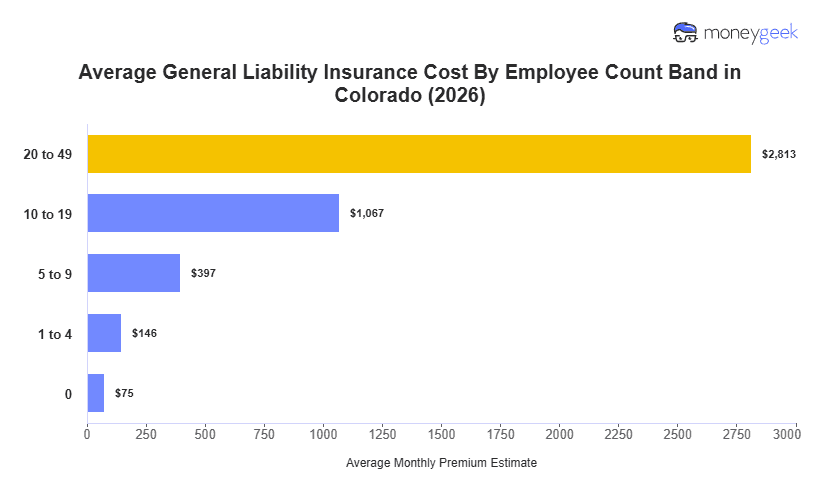
    In Colorado, costs for sole proprietors run 94% lower than average for businesses with one to four employees, while businesses with 20 to 49 employees pay 164% higher.

    contractor icon
    Industry classification

    Insurers price general liability based on claim frequency and severity potential tied to how work gets done. Office-based consulting faces different exposure than construction sites where physical risks accumulate with every project and worker interaction. Across 25 industries, Tech and IT businesses pay 80% lower than average, while Construction and Contracting operations pay 183% higher, reflecting the substantial gap between low-risk and high-exposure work environments.

Colorado-Specific General Liability Insurance Cost Factors

Colorado businesses pay 19% more than the national average for general liability coverage. That premium reflects conditions unique to operating in Colorado. Legal changes, medical cost trends, geographic differences and seasonal weather patterns all push claim costs higher than in neighboring states.

    congress icon
    Colorado's Legal and Regulatory Environment

    Colorado small businesses have operated under a different liability environment since January 1, 2025, when House Bill 24-1472 increased non-economic damage caps from $250,000 to $1.5 million and wrongful death caps to $2.125 million. Both caps adjust biennially for inflation starting in 2028. The American Tort Reform Association labels Colorado a "Lawsuit Inferno" due to expanded plaintiff protections. Attorney advertising and third-party litigation funding have intensified, pushing potential claim costs higher as claimants wait for larger settlements rather than accepting early offers.

    firstAidKit icon
    Colorado's Rising Medical and Healthcare Costs

    Medical expenses directly affect general liability insurance costs because policies cover treatment when customers get injured at businesses. Hospital operating expenses climbed 7.4% in 2024 while labor costs have increased more than 30% since 2019 as facilities compete for workers. Colorado faces a projected shortage of 54,000 healthcare workers by 2026, adding pressure on wages and service costs. Medical inflation continues accelerating even as general price increases slow. When slip-and-fall or customer injuries occur, insurers pay these inflated bills, translating to higher premiums for business owners.

    colorado icon
    Geographic Cost Variations Within Colorado

    Business location impacts general liability rates across Colorado, with Front Range metro areas like Denver, Aurora and Colorado Springs seeing higher premiums than Western Slope communities. Urban areas cost more due to increased foot traffic, more frequent customer injury claims and higher local medical costs. Metropolitan juries tend to award larger settlements than rural communities for similar incidents. A downtown Denver retail shop encounters more daily liability situations than a comparable Grand Junction business, and insurers price coverage accordingly.

    winterStorm icon
    Winter Weather and Slip-and-Fall Exposure

    Denver and Boulder require businesses to clear sidewalks within four hours after snowfall stops, creating strict liability timelines during Colorado's unpredictable winter season. Extreme weather creates serious slip-and-fall risks from ice, snow and rapid temperature changes. Colorado's freeze-thaw cycles produce hazardous conditions that recur throughout winter months rather than staying consistently frozen. Businesses face extended exposure periods where premises liability claims can arise from icy walkways, parking lots and entryways.

Average General Liability Insurance Costs in Colorado by Business Size

When estimating general liability costs, employee count determines baseline exposure before industry or Colorado-specific factors apply. Sole proprietors pay $75 annually while businesses with one to four employees start at $146, showing how hiring the first employee nearly doubles premiums. The steepest relative increase occurs when adding the fifth employee, where costs jump 171%. Use the table to identify your pricing tier based on current headcount.

Colorado General Liability Insurance Cost Chart

Average General Liability Insurance Costs in Colorado by Industry

Colorado premiums span from $27 monthly for tech businesses to $414 for construction operations, reflecting how physical jobsite hazards, equipment use and customer interaction patterns create different claim frequencies across the state's 25 industry categories.

Our analysis of Colorado's industry costs reveals four patterns:

  • Office-based businesses pay 60% to 78% less than Colorado's average, creating a cost advantage for the state's service economy. Professional services like consulting, tech and real estate account for the largest share of Colorado's 730,887 small businesses and benefit from minimal physical risk. Desk-based operations with no heavy machinery and limited premises access reduce claims frequency and severity.
  • Customer interaction alone doesn't drive costs, physical risk does. Food service businesses serve hundreds of daily customers yet pay just 6% above average, while construction contractors pay 183% more due to jobsite hazards, equipment operation and property damage exposure.
  • Colorado's two largest business sectors sit at opposite ends of the cost spectrum. Construction pays the state's highest rates, while professional and technical services pay the lowest This 14x spread reflects physical workspace risks insurers price into every policy.
  • Only four of Colorado's 25 industry categories pay above the state average. Only Food & Beverage, Childcare Services, Healthcare & Medical and Construction & Contracting drive the $146 baseline higher, while the remaining 21 industries (representing most Colorado businesses) pay below average. This explains why individual quotes often come in lower than statewide figures suggest.

If your industry pays below average, expect lower quotes. If above average, factor that into your budget planning and compare multiple insurers to find competitive rates within your category.Find your industry in the table to understand where you fall relative to Colorado's baseline.

Data filtered by:
Select
Agriculture & Natural Resources$117$1,40420%
Arts, Media & Entertainment$44$53270%
Beauty, Body & Wellness Services$49$58467%
Childcare Services$157$1,885-7%
Cleaning Services$124$1,48316%
Construction & Contracting$414$4,969-183%
Consulting Services$34$40777%
Education$53$64263%
Financial Services$52$62664%
Fitness Services$114$1,37322%
Food & Beverage$156$1,869-6%
Healthcare & Medical$247$2,961-69%
Hospitality, Travel & Tourism$133$1,5979%
Manufacturing$86$1,03341%
Marketing & Communications$35$42276%
Nonprofit & Associations$68$81753%
Other Professional Services$90$1,08438%
Pet Care Services$83$99643%
Real Estate & Property Services$53$63764%
Recreation & Sports$115$1,37422%
Repair & Maintenance$94$1,12836%
Retail & Product Rental$117$1,40720%
Tech/IT$30$35480%
Transportation & Logistics$89$1,06539%
Wholesale & Distribution$132$1,58610%

Use these resources to explore costs for your industry.

How to Lower General Liability Insurance Costs Without Sacrificing Coverage

Colorado businesses can find cheaper general liability insurance through strategic decisions about coverage limits, deductibles, payment timing and safety measures. Start with quick adjustments that lower premiums immediately, then implement long-term strategies that reduce your overall risk profile.

Quick General Liability Cost Lowering Methods

If you're looking to lower your Colorado general liability costs, these six methods reduce premiums while maintaining necessary coverage. Colorado businesses across industries use these strategies, with specific approaches varying by location, seasonal patterns, and risk exposure throughout the state.

    insurance2 icon
    Provide clean, accurate underwriting information

    Accurate underwriting information qualifies you for your lowest available rate by placing you in the correct risk tier. Denver healthcare providers reporting exact patient volume, clinical staff count, and service mix avoid overpaying for inflated risk classifications. Insurers price based on your specific exposure details. Vague or estimated information defaults you to higher-risk categories and higher premiums.

    shoppingCart icon
    Compare multiple insurers

    Comparing multiple insurers reveals significant rate differences for identical coverage. Colorado Springs contractors benefit from strong carrier competition due to Front Range construction boom activity. Local insurers familiar with regional projects often offer lower rates than national carriers because their experience with completed operations and subcontractor risks leads to more competitive pricing. Request four to five proposals to identify the lowest premium for your specific operations.

    building icon
    Bundle general liability into business owner's policies (BOP)

    Business owner's policies (BOPs) combine general liability with commercial property coverage at lower total cost than purchasing separately. BOP costs run lower because bundling protection for both client injury claims and winter slip-and-fall exposure on icy Fort Collins office premises reduces premiums for professional services firms. Single-policy structure eliminates duplicate administrative fees and qualification requirements. This strategy works best when you need both liability and property protection anyway.

    coins2 icon
    Pay annually instead of monthly

    Annual payment eliminates monthly billing fees and qualifies you for prepayment discounts. Prepaying before wildfire season begins allows mountain resort hospitality operations in Vail and Aspen to lock lower premiums and prevent mid-season increases when smoke events disrupt operations or regional claims rise. This approach requires covering the full annual premium upfront but reduces total cost compared to twelve monthly installments when you have cash reserves available.

    money2 icon
    Increase your deductible (if you can afford it)

    Higher deductibles reduce your premium by shifting more claim cost responsibility to you. Pueblo breweries and food manufacturers with stable cash flow can choose higher deductibles and accept covering more of each claim themselves in exchange for lower monthly costs. This strategy requires maintaining substantial emergency reserves to handle potential claims without disrupting operations. Evaluate whether premium savings justify increased out-of-pocket risk.

    loanReview icon
    Adjust your coverage limits

    Choosing the right amount of general liability coverage directly affects your premium. Higher limits cost more, lower limits cost less. Western Slope outdoor recreation retailers offering guided climbing or rafting need higher limits because Colorado's altitude increases injury severity when accidents occur. In contrast, low-traffic Grand Junction retail shops without adventure activities maintain standard limits and avoid paying for altitude-related risk pricing that doesn't apply to their operations.

Long-Term General Liability Cost Lowering Methods

Long-term premium reduction requires patience and upfront investment in safety measures. Colorado insurers track your claims patterns across multiple renewal cycles, with meaningful rate improvements appearing only after two to three years of documented progress.

General Liability Insurance Cost in Colorado: Bottom Line

General liability insurance costs in Colorado vary widely because insurers estimate your business's claim frequency and severity differently. Your premium moves based on business size, industry classification and location within the state, plus Colorado-specific factors like House Bill 24-1472's expanded damage caps, Front Range construction activity and winter slip-and-fall exposure. 

Apply this report by considering context, not a single price:

  1. Where do you fall compared to Colorado's distribution? (industry tier + Denver metro vs. mountain town + employee count)
  2. What is driving your cost? (baseline risk vs. comparative fault legal environment vs. winter weather exposure vs. construction zone proximity)
  3. What would actually change your price? (limits, deductible, bundling with property coverage, accurate underwriting details and claims management)

Frame your premium this way to evaluate quotes and coverage options based on whether they reflect your true risk profile within Colorado's market, not just whether they're above or below the state average.

General Liability Insurance Cost in Colorado: Next Steps

Two resources show which insurers write general liability policies for small businesses across Colorado:

If you're ready to get quotes, decide whether you prefer working with a local Colorado broker who knows state regulations or purchasing direct online. Gather your business details and request proposals from at least three carriers to compare how each prices your specific business profile.

Get Personalized General Liability Insurance Quotes in Colorado

Select your industry and state to get a customized Colorado general liability quote.

Industry
State

About Angelique Palenzuela-Cruz


Angelique Palenzuela-Cruz headshot

Angelique Palenzuela-Cruz is a Content Writer at MoneyGeek specializing in business insurance. She focuses on general liability, workers' compensation and professional liability coverage, helping small business owners cut through policy jargon and understand what they're actually buying.

Angelique has spent over five years reporting on personal finance, with deep experience in both insurance and lending markets. Her psychology background also gives her a unique understanding of how people actually process difficult financial decisions, allowing her to meet readers where they are, simplify complex concepts and build decision making frameworks that give them confidence. Whether you're learning about policies, comparing providers or trying to figure out requirements, Angelique does the legwork, digging into regulations, analyzing policy language and testing her explanations against agent-level standards so you get straight answers without fluff.


sources
Copyright © 2026 MoneyGeek.com. All Rights Reserved