


Jump to the section that meets your needs best below:
Best Contractor Insurance
Contractor insurance is a group of business policies that protects contractors from job-related liability, property and employee risks.
MoneyGeek helps you compare the best contractor insurers, coverage types and costs, so you can find the protection you need.
Ready to shop? Get matched with your top provider and start your contractor insurance quote.
Select state
Updated: September 14, 2026
Advertising & Editorial Disclosure
Best Business Insurance Companies For Contractors
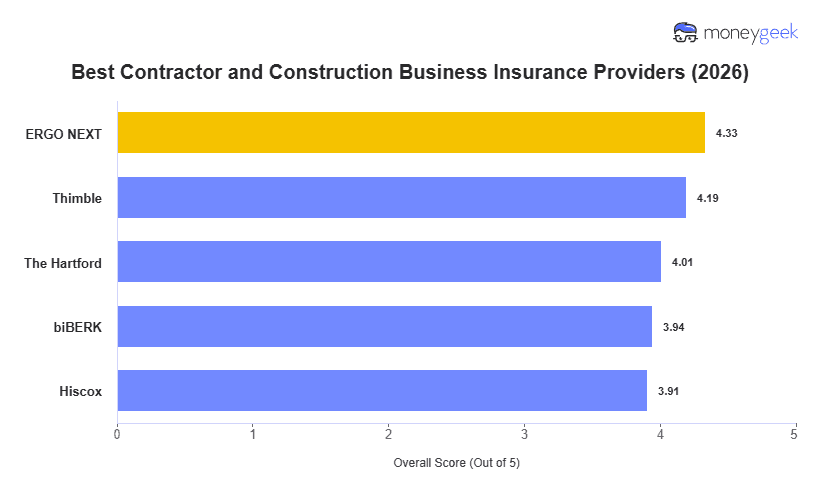
My analysis ranked these companies as the best small business insurers for contractors:
- Choose if you want the best value and do lower-risk work: ERGO NEXT
- Choose if you do project-based and high-risk work: Thimble
- Choose if you're a complex or larger construction firm: The Hartford
Given the expensive and often confusing nature of contractor and construction business insurance, I did not take my research lightly. My best contractor business insurance rankings are built on three things: what you'll actually pay, what happens when you need help, and whether the coverage holds up when it counts. I scored each provider across affordability (50%), customer experience (30%), and coverage options (20%) which are weighted that way because price is what determines what you can financially sustain, but it's rarely where the decision should end.
This is what made up my analysis of popular insurers, which was assisted (not run) by AI:
- Affordability: I pulled quotes isolating pricing factors for 45 of the most common contracting and construction industries , state (plus DC), employee count (5 ranges from 0 to 49), 16 vehicle types (for auto) and six of the most common coverage types, extrapolating 500,000+ estimates to get a full picture.
- Customer Experience: 300,000+ reviews, forum conversations and industry research were aggregated and manually parsed to see the trends that made customers enjoy and dislike service from insurers. I also went through what an actual small business owner would go through for all providers analyzed for their quotes experiences and policy management tools available (excluding claims due to limitations).
- Coverage Options: I read the fine print of policy terms, isolated the invisible exclusions or extra costs, and documented all options available for all providers to determine which has the best coverage for you now and as you grow your company.

ERGO NEXT: Best Overall, Best For Lower-Risk Industries
pros
Affordable rates for most contractors
Fast quotes and online coverage matching
Instant COIs and easy DIY policy management
cons
Expensive for high-risk professions
Service becomes shaky for larger companies
Coverage options can be limited for certain professions
COMPANY HIGHLIGHTS
As the clear winner across most industries in contracting and construction, ERGO NEXT delivers superior value applicable to most companies' work. It is the most affordable contractor insurer for low-risk professionals like painters and lawn care professionals, offering flexible job coverage terms that make getting lower prices in an often expensive field more feasible.
Buying a policy and managing it was easy in my experience as well, and I got a quote and a COI in under 6 minutes, could access proof of coverage on both their website and their app easily, and was able to make simple policy changes easily, all without an agent being involved. However, high-risk trades like roofers will find extremely high rates with the company and coverage options they have may not be sufficient.
Read Our Review: ERGO NEXT Business Insurance Review

Thimble: Best For Project-Based and High Risk Work
pros
Very flexible policy term lengths
Most affordable for high-risk professions
Easy subcontractor coverage management tools
cons
Very limited policy selection
Expensive for businesses with 5 or more employees
Customer support is offered only through email
COMPANY HIGHLIGHTS
Thimble earns second place for policy flexibility and generally affordable pricing. It uniquely offers general liability by the job, month or hour, making it a strong fit for seasonal contractors or those avoiding annual commitments. They also offer a Certificate Manager, which helps general contractors set subcontractor requirements, verify compliance and route subs to compliant coverage. Pricing is also very attractive for high-risk contractors like roofers and electricians, where all other competitors fall short.
The main limitation is claims and customer support, since they route these to third-party administrators who can only communicate via email, which creates friction when a dispute needs to be resolved quickly. They also don't offer many coverages past general liability and workers' comp, so unless you have simple coverage needs, you'll need to get a policy elsewhere.
Read Our Review: Thimble Business Insurance Review

The Hartford: Best For Complex and Larger Construction Firms
pros
Dedicated agent assigned to your business
200+ years of experience with industry-specific service teams
Brodest coverage inclusions and options
cons
Not as affordable for small companies
Buying and managing policies online is harder
No in-house commercial auto option
COMPANY HIGHLIGHTS
While The Hartford ranks only third in our study, it stands out as the best contracting and construction insurer for coverage options and offers complementary project and risk management support for all customers. With over 200+ years in the industry, they have dedicated teams assigned to your company to help you with simple to complex construction projects and coverage tailored packages for general liability and pollution liability with broad form coverage that others don't provide.
They also back up their customer experience with genuinely strong customer experience performance, ranking higher than anyone on my top 5 list for claims support, a lower-than-average NAICS complaints score (22% below average), and many testimonials speaking to how seamless the company made projects (See Hunt Construction's testimonial). All these perks come at a higher premium than the competition, which is not ideal for smaller companies, but for larger firms with more complex risks, it is a great fit.
Read Our Review: The Hartford Business Insurance Review
Cheapest Contractor Business Insurance Companies
ERGO NEXT and Thimble are the clear cheapest contractor insurance providers, with average savings of 22% and 18%, respectively, for small companies across the six most common coverage types. As your company grows, the gap shortens, and bigger insurance firms like The Hartford gain an increasing advantage in pricing.
While larger insurers don't supersede these two companies ever in pricing in my data, coverage limitations in terms of limits and specialty options make whatever savings small providers offer obsolete over time. Bundling opportunities may also help close the gap when you need more coverage, and agents with more established insurers are open to negotiating for lower pricing to get and keep your business.
ERGO NEXT | Low-risk professions (lawn-care, handymen, pest control), companies under 10 employees. | $149 | $1,785 | 22% |
Thimble | Sole proprietors, high-risk contractors (roofing, electrical, remodeling contractors) | $156 | $1,871 | 18% |
The Hartford | Companies with over 10 employees, general contractors needing broad coverage | $187 | $2,243 | 1% |
What Types of Insurance Do Contractors Need?
The first and most necessary policy for any contractor just starting out is general liability insurance, since most general contractors require it, and it covers the industry's most common risks. Tools and equipment coverage is next up to consider if you have $1,000 or more in equipment value. Past this, workers' comp, commercial auto, surety bonds and other policies may be required as you grow and take on more clients.
The table below summarizes the most common types of business insurance that contractors need to meet requirements and cover financial risks.
Claims and legal costs when someone outside your crew is injured or you damage their property | All contractors need this before taking their first paid job | Jobsite injuries and property damage can lead to costly legal and settlement costs, especially as construction claim severity has risen. | |
Injuries and property or vehicle damage after a work-related crash | You invest in a business-owned vehicle | Motor vehicle accidents are more likely to become large-loss claims, and about 30% of motor vehicle claims involve multiple body parts, increasing injury severity and cost. | |
Tools and equipment | Portable tools and mobile equipment stolen or damaged at jobsites or in transit | You’re carrying tools worth $1,000 or higher | Theft can stop work immediately; construction theft losses average about $6,000 per incident, which is a hefty expense that can be avoided with coverage. |
An employee’s medical bills and part of their lost wages after a work injury | When you hire employees | Serious construction injuries can lead to high medical and wage costs, and average medical costs for injuries that cause missed work rose 13% in 2024. | |
Surety bonds | Promises a client or government agency that you’ll meet a licensing or contract obligation | A license or project contract requires a bond | Required bonds can determine whether you qualify for certain licenses, bids or projects at all, and even when you don't, they are a strong trust signal that can earn you clients. |
Extra liability protection after another covered policy reaches its limit | A contract requires more coverage than your current liability policies provide | A severe liability or auto claim can exceed primary limits and leave your business responsible for the remainder, a more common occurrence for any contract work. | |
Builders risk | Covered damage to a structure and its materials while construction is underway | You’re responsible for insuring a structure during construction | Damage during construction can require replacing materials, redoing completed work and covering delays before the project is handed over, and coverage can stop this from cutting into your bottom line. |
Installation floater | Materials stolen or damaged before or while you install them | Materials become your responsibility before installation | Stolen or damaged materials can force contractors to repurchase supplies and absorb labor or scheduling costs before installation, which can be avoided with coverage. |
Pollution liability | Cleanup costs and claims after your work releases a hazardous substance | Your work could contaminate nearby soil or water | Contractor pollution claims can be severe, with total costs ranging from $120,000 to more than $700,000. |
Combines general liability with coverage for property kept at a fixed location | You keep equipment and supplies at an office or workshop | A BOP protects small contractors against both third-party liability claims and losses to their own property or income, avoiding the need to absorb multiple types of losses separately. | |
Costs from stolen data or an attack that locks you out of business systems | A cyberattack can stop estimating, scheduling, payments and client communication at once; MoneyGeek’s claims analysis shows losses can reach well into six figures depending on the incident. | A cyberattack can disrupt estimating, scheduling and payments while creating recovery and client-data costs. | |

WHY GETTING CONTRACTOR INSURANCE IS IMPORTANT
The contracting and construction industry is at the highest day-to-day risk of expensive claims for third-party property damage after a job is done, worksite injuries, and equipment theft, all of which are extremely common. Especially when you are just starting out, one mistake can sink your company before you can build it to sustain financial losses. While costs can be hundreds of dollars a month for a general liability policy, for example, if you have even a single $10,000 claim, being covered often makes years of premiums worth it.
How Much Does Contractor Business Insurance Cost?
Contractor insurance costs can range anywhere from $75/mo for cyber insurance up to $336/mo for general liability insurance for a typical small business with 1 to 4 employees. Though this is only a baseline, your rates will vary widely depending on your specific trade/profession, how many employees you have, your company's revenue, and your location.
For a more specific estimate, use our business insurance calculator below. Once you've gotten a good idea of what coverage may cost you, you can get matched to a provider by clicking Get Quotes.
Contractor Insurance Cost Calculator
Select your state and industry to view average business insurance premiums in your area. Rates are calculated based on a business with 5 employees and $500,000 in annual revenue.
Select Coverage Type
Select State
Select Employee Count
Select Vehicle Type
Monthly Cost Estimate—
Select Coverage Type
Monthly Cost Estimate—
Select State
Select Employee Count
Select Vehicle Type
How To Buy The Best Contractor Insurance
Use the how-to below to guide you through buying the best contractor insurance for your business. You can also download a companion worksheet to help you organize all the information you get from quotes and insurers.
- 1
Identify Required Coverages
As a first step, gather the requirements from the agency that issues your license and the insurance section of your next contract. If the contract asks you to add the project owner as an additional insured, send that wording to your insurer, who must add them through an endorsement. Simply giving the owner a certificate of insurance (COI) only proves you have coverage, so it doesn’t extend that coverage to them.
Read More: Business Insurance Requirements
- 2
Match Your Jobsite Risks to Coverage
Take each risk you identified and see which policy would pay if it happened. Suppose the cabinets you purchased were stolen after delivery but before installation. Tools coverage won’t cover them because the cabinets aren’t your equipment, but an installation floater would. Apply the same test to subcontracted work by asking whether your policy covers damage caused by a subcontractor or requires their insurer to respond. If you find any unanswered scenarios, consider them potential coverage gaps.
- 3
Set Appropriate Limits For Your Risk
Go through each coverage you need, assessing whether your risk falls into a low, medium or high based on your worst-case scenario and day-to-day risk. For example, for general liability coverage, if you're a roofer, you'll likely need more than a standard $1 million per occurrence and $2 million aggregate policy. This is due to a roof becoming damaged or failing, having a higher claim amount ceiling, especially if you work on a large number of homes day-to-day.
Read More: How Much Business Insurance Do I Need?
- 4
Research Providers Specific To Your Profession
An insurer may cover one contractor but refuse to cover another, even when both use the same business label. Even if they accept your specific profession, their coverage options, service and policy management tools may not meet your operation's requirements. So before ever getting quotes, look into providers along the lines of policies and endorsements, along with the service experience available with the company through insurer websites, reviews and industry research rankings.
- 5
Compare Pricing and Quotes Apples-To-Apples
Research what insurance costs for your contracting profession and business details up front before getting quotes to get a measuring stick. Then, compare business insurance quotes with identical coverage limits, endorsements and terms to be comparable. Doing your pricing search this way lets you determine the actual cheapest small-business insurer for you and get a clear measure of how much you are saving.
- 6
Review Your Policy Before Buying
Checking that your policy has the right terms, limits and endorsements before committing prevents issues with general contractors and your state regarding requirements. Pay close attention to the client's language and state requirements. Ensure that the terminology in your COI matches the terminology used to avoid miscommunication.
- 7
Reassess Your Needs As Your Company Changes
When you undergo major changes, such as hiring employees, getting your first commercial client, or buying a building to store your equipment, your coverage needs and requirements change. To ensure you're covering all bases, reassess your coverage to ensure any requirements and added financial risk are addressed with your business policy.
Contractor Insurance: FAQ
I've answered the following frequently asked questions below, beyond what is covered in this guide, to ensure you have everything you need before buying contractor insurance.
Contractor business insurance is a group of policies you combine to protect the way you work. One policy could respond when demolition debris damages a parked vehicle, while another replaces tools stolen overnight. Your mix can also cover injuries your employees sustain from work or satisfy a contract’s insurance requirements. Before buying, walk through a job and note where someone could get hurt or a loss could stop you from finishing.
Contractor insurance requirements depend on where you operate. A state licensing board or local government may require liability coverage before issuing a license, and your employee count can trigger workers’ compensation rules. Project contracts can come with their own general liability limits or require a surety bond, which guarantees you’ll complete the agreed work. If you’re bidding for a job, make sure to confirm government and contract requirements.
It depends on the state and the type of contractor license. Some states or local licensing authorities require proof of general liability insurance before issuing or renewing a license, while others require only a surety bond or have no statewide liability insurance requirement.
Many commercial clients and general contractors require at least $1 million per occurrence and $2 million aggregate in general liability coverage, although requirements can be higher for larger projects or higher-risk trades. Contracts may also require workers’ compensation, commercial auto, umbrella coverage or specific policy endorsements.
Most will request a certificate of insurance (COI) showing your active policies and coverage limits. Depending on the contract, they may also require additional insured status, primary and noncontributory wording or a waiver of subrogation, which generally must be added to the applicable policy rather than simply listed on the COI.
Compare the insurance section of the contract with your policy limits, coverage types and required endorsements before starting work. Your COI can confirm that coverage exists, but you should also verify that contractual requirements such as additional insured status or waiver of subrogation have actually been added to the policy.
Start with the state agency or licensing board that regulates your trade because contractor requirements can differ between general contractors, electricians, plumbers and other licensed trades. You may also need to check workers’ compensation agencies, motor vehicle or insurance departments and local licensing authorities because not every requirement is set at the state contractor-board level.
Requirements commonly change when you hire employees, add business vehicles, obtain a new trade license, subcontract work, take larger contracts or work for commercial or government clients. Each change can introduce new statutory or contractual requirements, so insurance should be reviewed when the way you operate changes rather than only at renewal.
Best Contractor Business Insurance: The Bottom Line
You now know which providers belong on your shortlist and what coverage your contractor business actually needs from them. When you start comparing quotes, the premium is not the whole picture. Two policies at the same price can have very different completed operations periods, pollution exclusions, and subcontractor terms behind them, details that don't matter until a claim happens. The best policy is the one that covers the work you actually do, at limits that reflect your real exposure by trade and crew size, from a carrier that will show up when something goes wrong on a job site.
And as a reminder before you compare, these are my top picks overall for contractors.
Get More Specific Contractor Trade Guidance
I also provide more specific guidance on contractor trades for the following professions.

Get Contractor Business Insurance Quotes
MoneyGeek can help connect you with tailored provider matches for your contractor business. You can then get quotes and compare coverage on your match's website in just minutes.
About Connor Bolton

Connor Bolton is Senior SEO and Content Manager at MoneyGeek, where he leads the business and pet insurance editorial teams. He sets the research framework, data standards and content structure for his team. All content goes through his accuracy review before publication. Connor also writes in-depth guides and has spent more than four years covering insurance products across personal, commercial and specialty lines.
The research infrastructure Connor built covers auto, home, renters, life, health, business and pet insurance across pricing analysis, carrier research, customer experience and coverage evaluation. It includes over 6 million data points for business insurance across 408 industry areas, all 50 states and 16 vehicle types. The pet insurance side covers over 5 million profiles across 18 major providers, 100+ breeds and ages up to 20 years. Connor’s insurance research and his team's work have been cited by the U.S. Chamber of Commerce, Allstate, Liberty Mutual, CBS News, Forbes and LegalZoom.
Connor also talks with underwriters and carrier liaisons at Ethos, The Hartford, ERGO NEXT, Nationwide and State Farm, and monitors business and pet owner communities on Reddit. Those sources shape how his team evaluates carriers, structures rate analysis and writes content for real pet owners.
Questions about MoneyGeek's business or pet insurance content? Reach him at connor@moneygeek.com or on LinkedIn.