
Cheapest Restaurant Business Insurance Companies

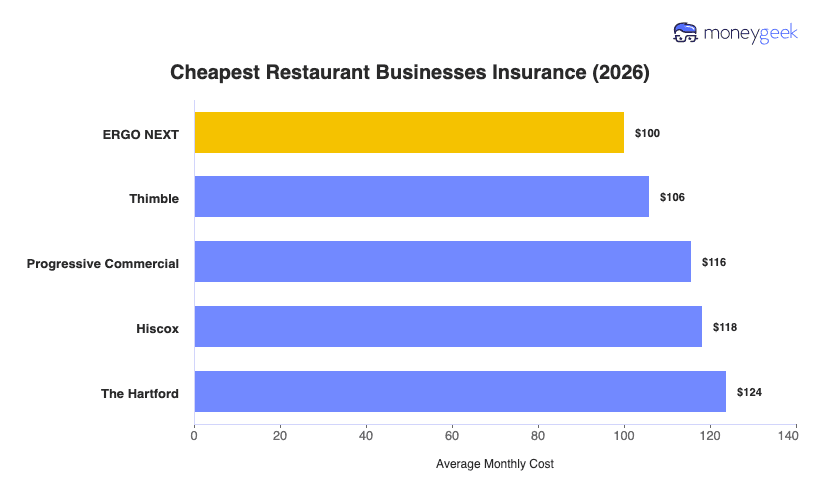
Full-service restaurants face more daily risk than most small businesses, from wet floors in the dining room to knife injuries in the kitchen to the liability that follows an over-served guest out the door. Finding affordable food business insurance is more within reach than many owners assume. ERGO NEXT leads at $100 per month, and the top three providers sit within $16 of each other. Nationwide and biBerk are the only two that price above the industry average.

Most providers in this market price below the industry average, and with the top three separated by just $16, none of them has a runaway price advantage. Whether you run a full bar with 20 servers or a 10-table BYOB with a small kitchen crew, your staffing structure and liquor service model will push your quotes toward different ends of that range.

ERGO NEXT$100$1,202
Thimble$106$1,271
Progressive Commercial$116$1,390
Hiscox$118$1,418
The Hartford$124$1,486
Nationwide$132$1,583
biBERK$134$1,609

How We Determined the Cheapest Restaurant Business Insurance Providers

Since these generalized cost estimates can't tell you who is cheapest for your restaurant's insurance, we've broken down trends at the company profile level for each of our cheap provider picks.

Cheapest Restaurant Business Insurance by Coverage Type

Three different providers lead across four coverage types: ERGO NEXT leads on workers' comp and commercial property, The Hartford prices lowest on general liability, and Progressive Commercial leads on commercial auto. If your restaurant needs all four coverage types and wants the lowest options, you might have to purchase policies from two or three carriers due to availability differences.

That split adds friction when restaurants feel it most. When a kitchen fire damages equipment and injures a line cook, you're filing with two carriers at once. When your landlord or liquor distributor asks for a certificate of insurance before your busy season, you're pulling COIs from different sources. So, to avoid this, we recommend bundling general liability, workers' comp and commercial property for the highest-level savings with ERGO NEXT and outsourcing to Progressive for Next's coverage gap there.

Workers' CompERGO NEXT$23$27831%
Commercial PropertyERGO NEXT$84$1,01025%
General LiabilityThe Hartford$110$1,31920%
Commercial AutoProgressive Commercial$158$1,89928%

If you want to compare by coverage type, review options for each policy to find the best fit for your budget:

Cheapest Restaurant Business Insurance by State

Where your restaurant sits on the map changes your premium, but in 49 states it doesn't change which carrier prices lowest. ERGO NEXT leads across almost every state, with Thimble undercutting it only in Maine and Rhode Island. Unless your restaurant is in one of those two states, ERGO NEXT is the carrier to quote first.

Alabama$85$1,02617%
Alaska$130$1,55719%
Arizona$95$1,13519%
Arkansas$86$1,03616%
California$132$1,58221%
Colorado$106$1,27418%
Connecticut$129$1,54914%
Delaware$107$1,28012%
Florida$119$1,43020%
Georgia$99$1,18217%
Hawaii$93$1,11418%
Idaho$73$87321%
Illinois$109$1,30321%
Indiana$91$1,09517%
Iowa$73$88117%
Kansas$85$1,02518%
Kentucky$91$1,09017%
Louisiana$102$1,22914%
Maryland$126$1,51413%
Massachusetts$126$1,51318%
Michigan$124$1,48622%
Minnesota$102$1,22917%
Mississippi$86$1,03017%
Missouri$97$1,15919%
Montana$78$93822%
Nebraska$83$99118%
Nevada$103$1,23518%
New Hampshire$97$1,16711%
New Jersey$127$1,52518%
New Mexico$82$98418%
New York$133$1,60019%
North Carolina$97$1,17017%
North Dakota$98$1,18115%
Ohio$113$1,35018%
Oklahoma$83$1,00221%
Oregon$102$1,23019%
Pennsylvania$95$1,13410%
South Carolina$94$1,13515%
South Dakota$88$1,06119%
Tennessee$88$1,06120%
Texas$106$1,26623%
Utah$86$1,03121%
Vermont$87$1,04611%
Virginia$105$1,26218%
Washington$131$1,57417%
Washington D.C.$147$1,76113%
West Virginia$89$1,06914%
Wisconsin$87$1,03717%
Maine$103$1,23713%
Wyoming$95$1,14021%
Rhode Island$115$1,38714%

Is the Cheapest Insurance Right for Your Restaurant Business?

A cheap option can be the right call for your restaurant if you know what to look for. Run any affordable option through these four checks to see if it's the best restaurant business insurance provider for you:

  • Coverage limits: A $1 million per occurrence general liability limit may not be enough if your restaurant serves alcohol. Liquor-related injury claims and DUI incidents can exceed standard limits quickly, so check what your landlord or contracting partner requires before accepting a lower limit to save on premium.
  • Deductibles: A higher deductible lowers your monthly premium, but a $2,500 out-of-pocket on a kitchen burn or slip-and-fall claim hits harder when your restaurant runs on thin weekly margins. Choose a deductible your cash flow can cover without disrupting payroll.
  • Add-ons: A cheap base policy often excludes the coverages full-service restaurants need most. Liquor liability, food spoilage from a walk-in cooler failure and equipment breakdown for commercial kitchen appliances are common gaps worth checking before you sign.
  • Claims handling and customer service: Look at how quickly a carrier processes claims. A slow assessment after a kitchen fire means lost covers, spoiled inventory and staff sent home while you wait.

Is The Cheapest Right For Your Business?

How to Get More Affordable Coverage Without Being Underinsured

Lowering your restaurant's insurance costs doesn't have to mean cutting coverage. These six strategies help you pay less without exposing your restaurant to gaps that end up costing more than you saved.

    smallBusiness icon
    Bundle policies with the same provider

    If your restaurant operates from a single location, you likely qualify for a business owner's policy (BOP), which bundles general liability and commercial property at a lower combined rate than buying each separately. Before bundling, confirm whether the BOP includes liquor liability or treats it as a separate endorsement. That distinction determines whether the bundle is actually cheaper than buying each policy on its own.

    checkList icon
    Check your business classification code

    Your workers' comp premium is based on classification codes assigned to each role in your restaurant. Cooks, servers, dishwashers and bartenders all carry different rates, and if your restaurant is miscoded, you may be overpaying or exposed to an audit adjustment at renewal. Getting a breakdown of your restaurant business insurance cost by employee role is the fastest way to catch a miscoding before your next audit.

    money2 icon
    Raise your deductible strategically

    A higher deductible on commercial property makes sense if your kitchen equipment is newer and well-maintained, since the likelihood of a large claim is lower. Think twice before raising your GL or workers' comp deductible if you run a high-volume bar or a large kitchen crew, where smaller claims happen more frequently and the cash flow hit arrives without much warning.

    vsDocuments icon
    Compare quotes using the same coverage limits

    When you're comparing prices across carriers, quotes can look cheaper on paper because one carrier excludes liquor liability or sets a lower general liability limit. Before committing, confirm each quote includes the same per occurrence limit, the same aggregate and the same liquor liability endorsement. A quote without liquor liability will always look cheaper, but it's covering less.

    calendarV2 icon
    Pay annually instead of monthly

    Most carriers charge a financing fee for monthly payment plans, typically adding 3% to 5% to your total annual cost. If your restaurant generates strong revenue during the holiday season or summer patio months, paying your annual premium upfront eliminates that fee and frees up monthly cash flow during slower periods.

    lowUnemploymentRate icon
    Reduce your claim risk

    Fewer claims mean lower premiums at renewal. In your restaurant, that means non-slip mats and regular floor inspections in dining rooms and bar areas, documented kitchen safety protocols to reduce burn and cut injuries, and staff training on responsible alcohol service to limit liquor liability exposure. Health code compliance also reduces the risk of food contamination claims that can trigger significant legal costs.

Cheap Restaurant Business Insurance: Bottom Line

ERGO NEXT, Thimble and Progressive Commercial are the most affordable options for full-service restaurants, but which carrier gets you to the lowest total cost depends on how your operation is built. A restaurant with beer-and-wine service, no delivery vehicles and a small kitchen crew can likely consolidate with one carrier. A full-bar restaurant running a catering fleet with a large front- and back-of-house staff probably can't. Your operational complexity, not your location, determines how many carriers you need to compare.

Cheap Restaurant Business Insurance: Next Steps

Your insurance costs are tied to how your restaurant operates. The type of service you run, how you staff it and your claims history shape your premium more than any national average.

Compare across coverage types as well as carriers. For a restaurant your size, knowing whether general liability, commercial property and workers' comp price better together or separately is often where the real cost difference hides.

If your quotes vary widely and you can't figure out why

If you're considering a higher deductible to bring your premium down

If your renewal came in higher but you had a quiet year

If you filed a claim and are worried about your renewal rate

How We Determined the Cheapest Restaurant Business Insurance Providers

To identify the cheapest restaurant business insurers, we analyzed real pricing data from seven major providers and modeled a large set of standardized pricing estimates across common U.S. restaurant business profiles.

Dataset scope and assumptions

  • Providers analyzed: 7 major insurance providers
  • Geography: all U.S. states and territories (including Washington, D.C.)
  • Employee count bands: 0, 1–4, 5–9, 10–19 and 20–49 employees
  • Policy baseline: standard $1 million per occurrence / $2 million aggregate for all coverage types except workers' comp, which uses state-mandated coverage limits
  • Pricing estimates modeled: 196,000 total estimates

We also incorporated modeled average revenues and payrolls across restaurant restaurant profiles to improve pricing accuracy.

How we determined which provider was "cheapest"

We used this dataset to determine which insurers were most often the lowest-cost option across different restaurant business profiles. Our "cheapest" rankings include both:

  • General Recommendation: Provider rankings based on average estimated pricing for a standardized 1–4 employee business profile across all restaurant sub-industries in our dataset.
  • Factor Combination Recommendations: Provider rankings based on which insurer was most often cheapest within specific business factor combinations. For example:
    • Restaurant pricing was compared using a standardized 1–4 employee profile
    • Coverage type affordability was derived by comparing aggregated pricing trends across restaurant sub-industries

Important note: These results represent standardized pricing estimates, not personalized quotes. Actual pricing can vary based on your business classification, revenue/payroll, claims history and the specific limits, deductibles and endorsements you choose. For the most accurate cheapest-provider answer, we recommend comparing quotes apples-to-apples using the same coverage limits.

About Connor Bolton


Connor Bolton headshot

Connor Bolton is Senior SEO and Content Manager at MoneyGeek, where he leads the business and pet insurance editorial teams. As editorial lead for both verticals, Connor sets the research framework, data standards, and content structure that his writers execute, directly authoring in-depth guides himself and reviewing all team content for accuracy and practical value before it goes live. With over four years evaluating insurance products across personal, commercial, and specialty lines, he brings cross-vertical knowledge to every guide the team produces.

Connor architected MoneyGeek's insurance research infrastructure across all major verticals including auto, home, renters, life, health, business, and pet, building systems for pricing analysis, provider-level research, customer experience evaluation, and coverage analysis with AI support. The infrastructure includes over 6 million data points for business insurance across 408 industry areas, all 50 states, and 16 vehicle types, and over 5 million pet insurance profiles across 18 major providers and hundreds of breed and age combinations. Connor's insurance cost research and his team's work has been cited by the U.S. Chamber of Commerce, Allstate, Liberty Mutual, CBS News, Forbes and LegalZoom.

Beyond the data, Connor stays connected to how the market actually operates, drawing on direct conversations with underwriters and carrier liaisons at Ethos, The Hartford, NEXT Insurance, Nationwide, and State Farm, and monitoring business and pet owner communities including Reddit, to inform how he interprets findings and frames guidance for real buyers.

He is the direct editorial contact for methodology questions at connor@moneygeek.com and can be found on LinkedIn.