The best restaurant business insurance is the carrier that holds up across pricing, service and coverage at the same time. If your insurer handles claims slowly after a kitchen fire, your dining room sits dark while repairs wait. If premiums spike unpredictably at renewal, your labor budget absorbs the hit. Evaluate each of these pillars before you commit to a provider:
Best Restaurant Business Insurance
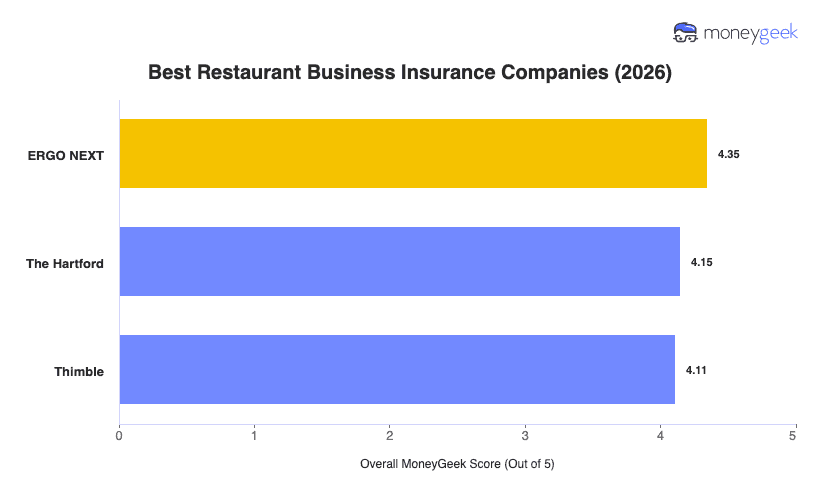
ERGO NEXT, The Hartford and Thimble are the best restaurant business insurance providers, based on affordability, coverage depth and customer experience.
Your restaurant needs general liability, workers' compensation and commercial property to start. ERGO NEXT is the top-ranked option for all those coverage types.
Find the best business insurance company for your restaurant and get a fast COI below.

Updated: May 4, 2026
Advertising & Editorial Disclosure
What Determines the Best Restaurant Business Insurance
Your premium is built on variables that shift as your restaurant grows: payroll across front- and back-of-house staff, alcohol sales volume if you run a bar program, dining room square footage and delivery vehicle use. A provider priced well for your current setup may become expensive once you add a second location or extend into catering. Predictable pricing across renewals matters more than a low opening rate that shifts at the first policy cycle.
When a guest slips near your host stand, or your hood system takes damage in a grease fire, how fast your insurer responds determines how long your restaurant stays closed. Slow claims handling means delayed equipment repairs, extended downtime and staff costs continuing while the kitchen sits idle. Look for a provider whose claims process moves at the pace your restaurant needs.
Depending on whether you serve alcohol, operate delivery vehicles or book private events, your restaurant may need liquor liability, commercial auto or food spoilage coverage in addition to general liability. The right provider covers what you need today and can add endorsements as your service model changes, whether you're adding a rooftop bar, launching a ghost kitchen or moving into catering.
Best Restaurant Business Insurance Companies
The best food business insurance providers vary across business types. A full-service restaurant with a full liquor license and a 20-person staff carries a different risk profile than a fast-casual owner-operator running lunch service, and no single carrier prices both the same way. We identified the five providers that score highest for restaurants, though your strongest fit depends on staff size, whether you serve alcohol and your service model.
- ERGO NEXT: Best Overall for Full-Service Restaurants
- The Hartford: Best for Coverage Depth
- Thimble: Best for Flexible Restaurant Coverage
Each of these providers scored well across the three areas that matter most when you're choosing restaurant insurance: rates that hold when your payroll grows or your liquor sales increase, claims support that gets your doors back open rather than stalling repairs, and coverage options deep enough for what your kitchen, service staff and liquor license actually expose you to. The table below shows how each provider compares.
| ERGO NEXT | 4.35 | 1 | 1 | 3 |
| The Hartford | 4.15 | 5 | 5 | 1 |
| Thimble | 4.11 | 2 | 2 | 7 |
| biBERK | 4.04 | 7 | 6 | 6 |
| Hiscox | 3.97 | 4 | 3 | 5 |
| Progressive Commercial | 3.95 | 3 | 4 | 4 |
| Nationwide | 3.88 | 6 | 7 | 2 |
For our overall best restaurant business insurance ratings, we analyzed pricing, coverage options, and customer experience across all 50 states and Washington, D.C. Our analysis focuses on 1-to-4-person restaurant businesses, while weighting results to ensure broader industry and location representation. To do this, we evaluated over six million business profiles, more than 100,000 customer experience data points and performed in-depth analysis of coverage contracts and endorsements to compare insurers consistently across industries and regions. We then rated each company across categories of affordability (50% of overall score), customer experience (30% of overall score) and coverage options and terms (20% of overall score) to form an overall rating.
See our full business insurance methodology.
95%
% of Small Businesses Covered
Over 235,294
Business Profiles Studied
23,529
Customer Experiences Analyzed

Best Overall for Full-Service Restaurants
ERGO NEXT
ERGO NEXT tops the rankings for full-service restaurant insurance, the only provider in this study to lead in both affordability and customer experience. It saves restaurants 19% against the sub-industry benchmark and ranks first for buying ease and policy management, covering the two stages where restaurant operators interact with their insurer most. Businesses with complex claims or specialized endorsement needs may find it less consistent than larger carriers.
Learn More: ERGO NEXT Business Insurance Review
- Restaurants with one to nine employees: Savings of up to 24% below benchmark at five to nine staff keep insurance from cutting into margins already thin for most independent restaurants.
- Single-location restaurants managing lease requirements: A new landlord or delivery platform that needs proof of insurance gets it in minutes from the app, without a callback or a wait.
- Full-service restaurants that serve alcohol: Dram shop laws can hold a restaurant liable when an intoxicated guest causes harm after leaving. Liquor liability as a GL add-on covers those incidents.
- New restaurant owners buying coverage fast: Restaurants that need a bound policy to satisfy a lease, license or health department requirement can go from quote to covered in about 10 minutes.
- Owner-only restaurants without any staff: For solo operators with no staff, the average monthly premium runs more than three times the sub-industry average, making other providers worth comparing first.
- Restaurants with active or complex claims: Dispute handling and settlement fairness rank below the top two providers, a gap that shows most when a foodborne illness claim or slip-and-fall escalates.
- Restaurants that need state-specific endorsements: Liquor liability isn't available in every state, so restaurants that need it for a lease or liquor license requirement should confirm coverage before binding.
Best for Coverage Depth
The Hartford
Coverage is where The Hartford earns its second-place overall ranking for full-service restaurant insurance, leading all 50 states and Washington D.C. Equipment breakdown and EPLI come standard in the BOP rather than as optional add-ons, and defense costs are paid on top of policy limits. Restaurants that need a faster, more self-service buying experience will find both affordability and customer experience rank fifth in this study.
Learn More: The Hartford Business Insurance Review
- Growing full-service restaurants: Savings reach 38% to 42% for establishments with at least 10 employees
- Full-service restaurants with layered coverage needs: Equipment breakdown, EPLI and liquor liability all come standard or as BOP endorsements, reducing the need to piece together coverage from multiple policies.
- Restaurants in high-traffic locations: When a slip-and-fall or alcohol-related claim becomes contested, settlement fairness and dispute handling both rank second, with adjusters assigned faster than most competitors.
- Restaurant owners who prefer agent guidance: The Hartford’s agent-based process lets owners verify endorsements, confirm liquor liability eligibility and review limits before binding, which matters more as the operation grows.
- Restaurants in high-premium states: Rates on average in Louisiana, Georgia and Michigan run 8% to 10% above the industry average.
- Bar-forward restaurants with high alcohol revenue: Liquor liability as a BOP endorsement is only available when alcohol is 50% or less of revenue, leaving high-volume bar concepts without that option.

Best for Flexible Restaurant Coverage
Thimble
Thimble ranks third overall for full-service restaurant insurance and second for both affordability and customer experience, saving restaurants 15% against the sub-industry benchmark across all 50 states and Washington D.C. Its monthly policy structure lets operators pause coverage during slow periods rather than carrying an annual premium through the off-season. The flexibility comes with a tradeoff as claims handling ranks seventh, the weakest in this study. So restaurants that file claims frequently will find stronger support elsewhere.
Learn More: Thimble Business Insurance Review
- Seasonal restaurants with fluctuating revenue: A monthly policy that can be paused for up to 30 days means premiums stop during slow periods, not running through an unused annual commitment.
- Newer restaurants testing their footing: Month-to-month terms and instant COI delivery let an early-stage operator stay insured without committing to a full-year premium before the business finds its rhythm.
- Budget-conscious restaurants: Thimble saves 15% against the sub-industry benchmark in every state, with no market where it runs above average, giving restaurants a consistent pricing floor.
- Restaurants with straightforward coverage needs: For restaurants without alcohol service, multiple locations or complex endorsement needs, the standard BOP covers the core exposures without gaps.
- Restaurants with a liquor license: No liquor liability is available, so any restaurant holding a liquor license or operating under dram shop laws will need to find that coverage elsewhere.
- Restaurants that prefer direct claims handling: Thimble routes all claims to third-party administrators once filed, which means the company the restaurant bought from is no longer the one managing the outcome.
Best Restaurant Business Insurance by Coverage Type
Running a restaurant means managing liability in your dining room, behind your line and across every transaction your operation processes:
- General liability (if a customer is injured in your dining room, claims illness after a meal or property is damaged during service)
- Commercial auto (if you run deliveries, since your personal vehicle policy won't cover a car or van used for business purposes)
- Commercial property (if your cooking equipment, fixtures or inventory is damaged, stolen or destroyed)
- Workers' compensation (if you employ line cooks, servers or any staff, even part-time)
- Cyber insurance (if your operation stores customer payment data or takes online reservations)
No single provider leads across all five coverage types, which means your top overall pick may not be the strongest option for every line your restaurant carries. ERGO NEXT scores highest for general liability, workers' comp and commercial property, while Progressive Commercial tops commercial auto. For cyber, Chubb ranks first on both coverage depth and customer experience. It's a specialist that doesn't appear in our restaurant rankings but outperforms the top-ranked providers on that specific line.
| Commercial Auto | Progressive Commercial | $156 | 1 | 4 |
| Commercial Property | ERGO NEXT | $86 | 2 | 6 |
| Cyber Insurance | Chubb | $84 | 1 | 1 |
| General Liability | ERGO NEXT | $90 | 1 | 7 |
| Workers' Compensation | ERGO NEXT | $26 | 1 | 6 |
If you want to know which carriers are best for different coverage types, our resources provide more detail:
Best Restaurant Business Insurance by State
Where your restaurant operates shapes your insurance costs more than you might expect, and not just because of general market differences. State-level dram shop laws affect what carriers charge for liquor liability. Workers' comp rates for kitchen and service staff vary by state classification, and regulatory environments in denser urban markets push liability premiums higher for your public dining room. ERGO NEXT is the top-ranked provider across all 51 jurisdictions, but its premium ranges from $73 monthly in Idaho to $147 monthly in Washington D.C. Those local variables drive the difference.
If your restaurant is in a high-cost state, ERGO NEXT's value case is stronger, offering peak savings advantage Michigan ($35 monthly), California ($34) and New York ($32). These are the same markets where your tipped staff payroll, liquor liability exposure and front-of-house liability already push baseline costs up. If ERGO NEXT isn't the right fit for your restaurant, Thimble is an affordable alternative in 26 states and The Hartford in 25. Use the table below to see which provider has the best restaurant business insurance in your state.
| Alabama | ERGO NEXT | 1 | 3 |
| Alabama | Thimble | 2 | 7 |
| Alabama | biBERK | 6 | 5 |
| Alabama | The Hartford | 3 | 1 |
| Alabama | Hiscox | 3 | 5 |
To see the best business insurance providers in each state, our resources offer more detailed information:
How to Choose the Best Restaurant Business Insurance
There's a logical order to choosing business insurance for your restaurant. Following it keeps you from comparing providers before you know what you actually need, or committing to a policy before you've matched it against how your kitchen and service model run.
- 1Map your Restaurant Coverage Needs to Your Operations
Not every restaurant needs the same coverage stack. A full-service dining room with a bar program needs general liability, liquor liability and workers' comp at minimum. Add commercial auto if you run deliveries, cyber insurance if you store payment data or take online reservations, and commercial property if you own your cooking equipment, fixtures or lease a dining room build-out. Once you know which coverage types apply to your operation, you can set the right limits for each.
- 2Set your Coverage Limits and Payment Structure
State minimums and standard policy baselines are a starting point, not a finish line. A busy dining room with 20 staff, nightly alcohol service and a commercial kitchen carries more exposure than a $1 million per occurrence general liability limit may fully address. A kitchen fire that damages equipment and injures a staff member at the same time can push a single incident past standard limits. Size your limits to your actual exposure, not just what a contract or license requires. Review the restaurant business insurance cost breakdown to understand how limit choices affect what you pay.
- 3Choose your Primary Priority
Your current situation, not the provider's strengths, should determine which dimension leads your evaluation. The priority that fits a restaurant opening its first location looks different from what an established operator who's had a bad claims experience needs. Identify your leading lens before you compare.
- Prioritize affordability if your restaurant is in its first two years, margins are tight and you need coverage that holds its pricing across renewals without surprises. If predictable premiums matter more than maximum coverage depth right now, start with affordable restaurant business insurance options and expand coverage as your revenue stabilizes.
- Prioritize customer experience if your restaurant runs tight service schedules and can't afford delays when something goes wrong. A burst pipe that floods your prep kitchen, a failed health inspection or an equipment breakdown during service creates immediate operational pressure. A carrier with slow claims handling or hard-to-reach support only makes it worse.
- Prioritize coverage options if your restaurant's exposure is more complex than a standard policy covers: a multi-location operation, a catering arm, a ghost kitchen or a full bar program with dram shop exposure. The right coverage architecture matters more than the lowest rate when your risk profile sits outside the standard restaurant template.
- 4Shortlist Providers that Write Restaurant Coverage
Most carriers don't write insurance for every restaurant type, and evaluating every available provider wastes time you could spend comparing the two or three that actually fit your operation. A focused shortlist of providers that write restaurant coverage produces a better comparison than a broad sweep. You're evaluating carriers that write the coverage mix your restaurant needs, not filtering out mismatches after the fact. Narrow your list, then use this filter to confirm each one belongs.
Before you go deeper on any provider, run this filter first:
- Carrier confirms appetite for full-service restaurants, not just general food service or hospitality
- Offers liquor liability as a policy endorsement, not a separate standalone policy requirement
- Includes food spoilage coverage or offers it as an available endorsement
- Writes workers' comp for kitchen and service staff in your state
- Does not exclude or materially limit coverage for delivery operations if you run your own drivers
- 5Compare your Finalists
Lead your comparison with the priority area you identified in Step 3, but don't let it carry a provider past a weakness in the other two. If you choose a carrier on price alone and then face a slow claims response after a kitchen fire, the savings disappear fast. Choosing on coverage depth and then finding no one available when a health inspection triggers a closure dispute is the same trade-off, just in a different direction. Use your priority to lead, not to excuse, then confirm your decision with quotes.
- 6Use Quotes as the Final Confirmation Step
Once you've compared your finalists, get restaurant business insurance quotes using your actual details: staff count, revenue, coverage mix and location. A quote at this stage confirms whether the pricing and coverage you evaluated holds for your restaurant's actual headcount and revenue, not the standardized profile used in general comparisons. Review what each policy does and doesn't cover before you sign.
Best Restaurant Business Insurance: Bottom Line
ERGO NEXT, The Hartford and Thimble are the strongest overall picks for restaurant businesses, each earning that position by holding up across coverage depth, affordability and customer experience. The most affordable option and the highest-rated overall option are the same provider, which most restaurant owners don't anticipate, but this is exactly the case with ERGO NEXT. It leads our overall assessment and carries the lowest average rates for restaurants. But ratings and averages only tell part of the story, and the better question is which provider you'd trust when your kitchen is down, your dining room has gone dark and you need someone to pick up.
Best Restaurant Business Insurance: Next Steps
If you're still working through the cost side before committing, it's worth checking whether the coverage types your restaurant needs price out better as a bundle or as separate policies. Some carriers offer better rates on workers' comp or liquor liability when paired with a general liability policy from the same provider. That bundling decision can affect what you pay across your full coverage stack more than the provider choice itself.
If you've done the comparison work and know what your restaurant needs, the next move is getting quotes against your actual operation: your front- and back-of-house headcount, your annual food and beverage revenue, whether you hold a liquor license and what state your location is in. A quote at this stage is confirmation, not research.
If something specific is still unclear, one of these may help.
How do I choose between two providers offering similar rates?
When quotes are close, the tiebreaker is rarely the premium. Look at how each carrier handles kitchen fire claims, food spoilage disputes and slip-and-fall incidents, the speed at which they issue certificates of insurance and whether coverage terms hold when you add a bar program or take on private events.
Can one policy cover my dining room and my catering business?
Not every carrier writes catering events away from your location and on-premises dining under the same program. Before you commit, confirm whether your shortlisted providers can cover dining room liability and off-site event exposure. If they can, check whether your off-site events require a separate endorsement or a different policy altogether.
Does my restaurant's new bar program change my coverage needs?
Adding full liquor service changes your liability exposure in ways a standard general liability policy may not fully address. If you're evaluating providers now, confirm that liquor liability is available as an endorsement and that your limits reflect the revenue your bar program generates.
Should I switch insurance providers when my restaurant policy renews?
Renewal is the right time to reassess. Compare your current policy's coverage limits, exclusions and premium trajectory against your shortlist. A carrier that priced well when you opened may no longer be the strongest fit if your kitchen crew has grown, your dining room has expanded or catering and delivery have become part of your model.
About Connor Bolton

Connor Bolton is Senior SEO and Content Manager at MoneyGeek, where he leads the business and pet insurance editorial teams. As editorial lead for both verticals, Connor sets the research framework, data standards, and content structure that his writers execute, directly authoring in-depth guides himself and reviewing all team content for accuracy and practical value before it goes live. With over four years evaluating insurance products across personal, commercial, and specialty lines, he brings cross-vertical knowledge to every guide the team produces.
Connor architected MoneyGeek's insurance research infrastructure across all major verticals including auto, home, renters, life, health, business, and pet, building systems for pricing analysis, provider-level research, customer experience evaluation, and coverage analysis with AI support. The infrastructure includes over 6 million data points for business insurance across 408 industry areas, all 50 states, and 16 vehicle types, and over 5 million pet insurance profiles across 18 major providers and hundreds of breed and age combinations. Connor's insurance cost research and his team's work has been cited by the U.S. Chamber of Commerce, Allstate, Liberty Mutual, CBS News, Forbes and LegalZoom.
Beyond the data, Connor stays connected to how the market actually operates, drawing on direct conversations with underwriters and carrier liaisons at Ethos, The Hartford, NEXT Insurance, Nationwide, and State Farm, and monitoring business and pet owner communities including Reddit, to inform how he interprets findings and frames guidance for real buyers.
He is the direct editorial contact for methodology questions at connor@moneygeek.com and can be found on LinkedIn.