



Jump to the section that meets your needs best below:
Average Dog Grooming Insurance Cost (2026 Report)
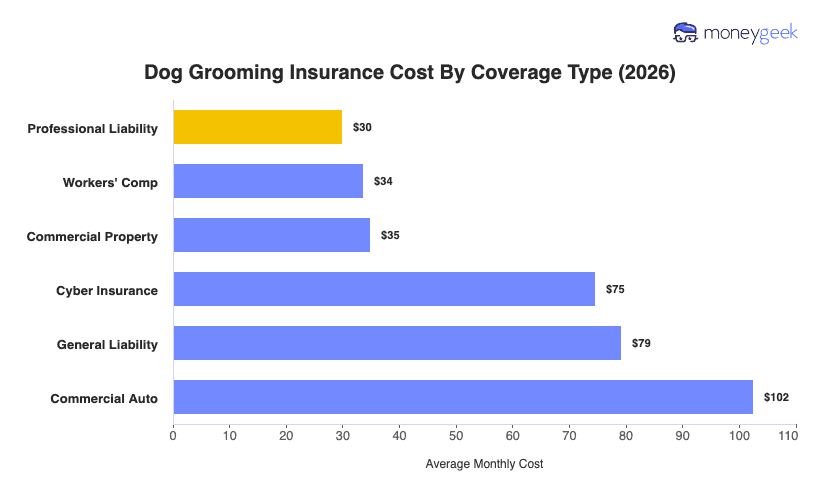
Dog grooming business insurance costs around $30 to $102 per month, depending on your shop's size, the breeds you handle and if you offer mobile pickup.
If you're ready to get a quote, get connected to the best dog grooming business insurer for your operations with our matching tool below.
Select state
Updated: October 12, 2026
Advertising & Editorial Disclosure
How Much Does Dog Grooming Business Insurance Cost?
If you run a brick-and-mortar dog grooming shop, you're looking at an average of $59 per month ($709 per year) across the six most common coverage types. Based on my analysis of pet business insurance costs for dog groomers, that's on the lower end for pet care businesses, largely because your fixed location carries a more predictable risk footprint than mobile operations or facilities that board animals overnight.
Individual policy costs range from $30 to $102 per month. Professional liability is the least expensive, because grooming advice and service-error claims rarely reach litigation at a fixed shop. Commercial auto costs the most, though that only applies if your shop operates a vehicle for pickups or deliveries. Use these figures as benchmarks, not quotes, since your actual premium depends on your payroll, shop location, claims history and the limits you select.
| Professional Liability | $30 | $356 | 47% | 25 |
| Workers' Comp | $34 | $403 | 70% | 116 |
| Commercial Property | $35 | $418 | 72% | 157 |
| Cyber Insurance | $75 | $895 | 10% | 212 |
| General Liability | $79 | $949 | -36% | 178 |
| Commercial Auto | $102 | $1,230 | 37% | 66 |
We analyzed quote data from major U.S. commercial insurance providers and modeled standardized premium estimates across business profiles representing around 95% of the market. Results are designed to provide a consistent national benchmark showing how premiums vary by key baseline factors including business size, restaurant profession type, location and vehicle type for operations that use commercial vehicles.
Dataset Scope and Assumptions
Our cost modeling uses standardized inputs for consistent comparisons across businesses.
- Total estimates modeled: just over 6 million standardized pricing estimates
- Providers analyzed: 10 major insurance providers
- Geography: all U.S. states including Washington, D.C.
- Employee count bands: solo practitioners, one to four, five to nine, 10 to 19, and 20 to 49 employees
- Vehicle types studied: Sedans, SUVs, pickup trucks, vans, taxis, limousines, tractors, food trucks, semi-trucks (non-HAZMAT and HAZMAT), tanker trucks (non-HAZMAT and HAZMAT), buses, box trucks, dump trucks, flatbed trucks
- Policies studied: general liability, workers' comp, professional liability, commercial auto, commercial property, and cyber insurance
- General liability: $1 million per occurrence and $2 million aggregate
- Workers' comp: state required coverage
- Professional liability: $1 million per claim and $1 million aggregate
- Commercial auto: minimum coverage
- Commercial property: personal property coverage limits personalized to industry, business size and state
- Cyber insurance: $1 million per occurrence and $1 million aggregate
How We Calculated Average Dog Grooming Business Insurance Costs
Our published averages represent modeled premiums for standardized business profiles and were aggregated in two ways.
- National benchmark average: The national average cost reflects the modeled premium for a standardized one to four employee business across all and states included in our dataset for a standard policies
- Segment averages: To show how costs vary, we calculated average modeled premiums for our national base profile and isolated for variables, including:
- Employee count (business size ranges)
- Vehicle types (for commercial auto)
- States (including Washington, D.C.)
Segment averages were produced by aggregating modeled pricing trends across the full dataset so readers can compare how premiums shift across coverage types and regions.
See our full business insurance methodology.
Get Dog Grooming Business Insurance Cost Estimates
If you want a more personalized estimate, use our dog grooming business insurance cost calculator before comparing rates.
Get Dog Grooming Insurance Cost Estimates
Select Coverage Type
Select State
Select Employee Count
Select Vehicle Type
Monthly Rate Estimate—
Select Coverage Type
Monthly Rate Estimate—
Select State
Select Employee Count
Select Vehicle Type
Factors Affecting Dog Grooming Business Insurance Costs
Several factors shape what you pay for dog grooming business insurance, and most of them come down to how your shop operates day to day. Our analysis found that service scope, staffing structure and animal handling volume tend to move the needle most for fixed-location grooming shops.
 Services offered
The range of services your shop offers directly affects your liability exposure. If you provide treatments beyond standard cuts and baths, such as medicated dips, teeth cleaning or de-shedding services, your risk profile shifts and insurers price accordingly. Sticking to basic grooming usually keeps your premiums lower across most coverage types.
 Animal handling volume
The more dogs moving through your shop each day, the greater your exposure to bite incidents, allergic reactions and property damage claims. Insurers assess your booking capacity because higher volume raises the likelihood of a claim, which affects what you pay across multiple coverage lines.
 Employee structure
Whether you run your shop solo, employ groomers on payroll or rent stations to independent contractors affects both your coverage obligations and your liability exposure. If you misclassify a booth renter as an independent contractor when your insurer considers them an employee, you may find coverage gaps that won’t surface until a claim is filed.
 Shop ownership vs. leasing
If you own your building, your commercial property coverage needs to reflect the full replacement cost of the structure. If you lease, your landlord’s policy covers the building but not your equipment, supplies or improvements you’ve made to the space. Most commercial leases also require you to carry a minimum liability limit as a condition of tenancy.
 Breed specialization
If your shop regularly handles large or aggressive breeds such as mastiffs, Akitas or dogs with documented bite histories, your risk profile differs from a shop focused on small or toy breeds. When a large share of your clientele falls into higher-risk categories, your insurer may apply a surcharge or require higher liability limits.
How to Lower Dog Grooming Business Insurance Costs
Reducing grooming shop insurance costs takes more than shopping around. MoneyGeek's analysis shows that the most effective methods span two timelines, covering changes that affect the next renewal and practices that reshape the risk profile over several policy periods. Exploring affordable business insurance options works best when the levers most relevant to the shop's specific structure have been identified.
 Compare quotes using the same coverage limits
Grooming shops often piece together coverage over time, which means your existing policies may carry inconsistent limits. When you request quotes, specify the same per-occurrence limit, aggregate limit and deductible across every insurer you contact. Comparing business insurance quotes with mismatched limits makes the pricing look different when the coverage actually is different, and you end up comparing the wrong thing.
 Right-size your coverage
A solo owner-operator grooming four dogs a day carries a different risk profile than if you have a three-groomer shop handling 20 or more. If your limits were set when your business was larger or smaller than it is now, your premium may not reflect your current exposure. Review your employee count, weekly volume and service mix before your next renewal to confirm your limits still fit.
 Bundle policies with the same provider
If you carry general liability and commercial property separately, consolidating them with one insurer typically lowers your combined premium. For a fixed-location grooming shop, your building contents, equipment and third-party liability are always in play, which makes these two policies the most practical place to start. Ask each insurer for a bundled quote alongside individual policy pricing so you can see the actual difference.
 Pay annually instead of monthly
Most insurers charge an installment fee when you pay monthly, which adds to your total cost without adding coverage. If your cash flow allows it, paying your full premium upfront is one of the simplest ways to reduce what your grooming shop pays over a policy year.
 Lower your risk profile
Bite incidents, slip-and-falls on wet grooming floors and allergic reactions to products are the claim types that most directly affect your renewal pricing over time. Insurers look at your claims history across multiple policy periods, so reducing incident frequency now adds up to lower rates over time.
- Keep a signed intake form for every dog that flags breed, bite history and known sensitivities before you begin the grooming session
- Install non-slip matting on all grooming station floors and in your bathing area to reduce fall-related incidents involving staff and animals
- Train all your groomers on restraint techniques for anxious or reactive dogs to reduce the likelihood of handling-related bite claims
- Conduct a quarterly walk-through of your shop to identify and log equipment hazards, chemical storage issues and any conditions that could lead to a liability claim
Dog Grooming Business Insurance Cost: Bottom Line
The average business insurance cost for dog grooming is around $59 per month, though that figure is a reference point, not a prediction. Your actual premium depends on a handful of operation-specific factors like your staffing model, the services you offer and where your shop is located.
When you request a quote, use these questions to put it in context:
- Where does the operation fall in the distribution? The quote should be located relative to the benchmarks by coverage type. A quote that sits well above the average for the trade and employee count is worth a closer look at what is driving it, while one that comes in well below warrants the same scrutiny before a decision is made.
- Is the quote consistent with the risk profile? The quote should be treated as a signal, not just a price. When it sits significantly above or below what shops with a similar employee count, service mix and state would expect to pay, the insurer should be asked what is driving that gap before accepting or walking away.
- Which cost drivers apply to the operation? Not every factor on this page carries equal weight for every grooming shop. A solo operator running a low-volume shop with no employees and no vehicle faces a different set of cost drivers than a multi-groomer shop offering specialty treatments to large breeds. The factors that actually apply to the specific operation should be identified before drawing conclusions from the averages.
Knowing what your quote is relative to the average is only one part of the picture, but understanding why it lands there tells you whether it's reasonable, improvable or worth challenging at renewal. The figures on this page give you a starting point for that conversation.
About Angelique Palenzuela-Cruz

Angelique Palenzuela-Cruz is a Business Insurance Content Writer at MoneyGeek, where she specializes in general liability, workers’ compensation and professional liability insurance. Her work helps small business owners understand how these policies apply to coverage, including risks like customer injuries, employee injuries, professional mistakes, client contract terms and industry-specific coverage requirements.
She primarily covers service-based businesses where liability and employee coverage decisions are especially important, including cleaning, consulting, beauty and wellness, childcare, education, fitness, food service, pet care, repair and maintenance, and other professional services.
Before joining MoneyGeek, Angelique spent nearly 12 years at Guthrie-Jensen Consultants, one of Southeast Asia’s largest management training firms, where she advanced from Training Consultant to Managing Consultant. In that role, she worked with business clients to assess operational needs, develop training programs and present performance analyses to executive decision-makers. She also helped establish Gladwin Training Consultancy, where she served in learning solutions and client service roles.
Her background gives her practical context for writing about how businesses operate, manage client expectations, structure teams and make risk decisions. At MoneyGeek, she applies that experience to business insurance content, connecting coverage to actual business needs.
LinkedIn: linkedin.com/in/ma-angela-cruz
Email Contact: angelique.palenzuela@moneygeek.com