
How Much Does General Contractor Business Insurance Cost?

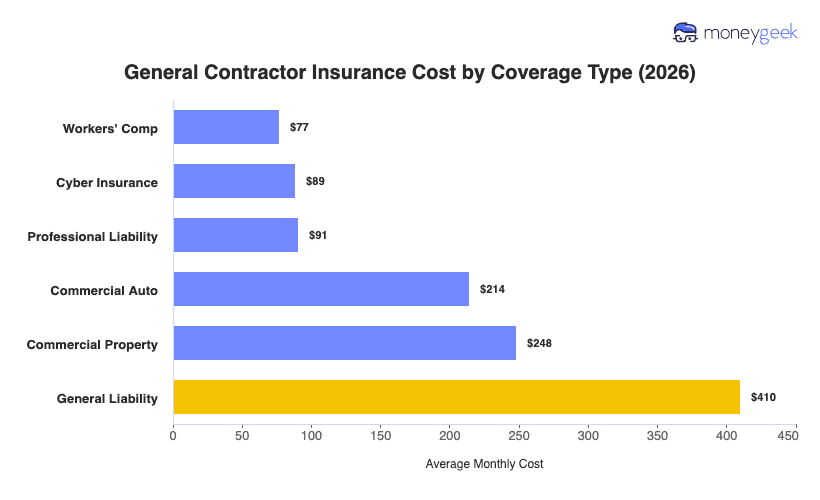
The average cost of business insurance for general contractors is $188 per month, or $2,256 per year, averaged across the six most common coverage types. That figure reflects businesses with one to four employees across all 50 states and Washington, D.C., modeled at standard policy limits of $1 million per occurrence and $2 million aggregate, with commercial auto sized across 16 vehicle types.

That average spans a wide range because your business carries several policies, each priced on different logic. Individual coverage costs run from $77 to $410 per month, and in our analysis, that $333 gap reflects two distinct pricing models. Workers' comp is payroll-rated, so your premium tracks what you pay your crew rather than how many jobs you run. General liability is exposure-rated, priced around the jobsite risk, completed operations and contract scope your business carries. 

The table below breaks both down by coverage type. Use the figures as benchmarks, since your actual premiums depend on your trade, crew size and state.


Workers' Comp$77$92032%236
Cyber Insurance$89$1,064-6%262
Professional Liability$91$1,094-62%131
Commercial Auto$214$2,569-31%345
Commercial Property$248$2,975-99%334
General Liability$410$4,916233%396

We analyzed quote data from major U.S. commercial insurance providers and modeled standardized premium estimates across business profiles representing around 95% of the market. Results are designed to provide a consistent national benchmark showing how premiums vary by key baseline factors including business size, restaurant profession type, location and vehicle type for operations that use commercial vehicles.

Dataset Scope and Assumptions

Our cost modeling uses standardized inputs for consistent comparisons across businesses.

  • Total estimates modeled: just over 6 million standardized pricing estimates
  • Providers analyzed: 10 major insurance providers
  • Geography: all U.S. states including Washington, D.C.
  • Employee count bands: solo practitioners, one to four, five to nine, 10 to 19, and 20 to 49 employees
  • Vehicle types studied: Sedans, SUVs, pickup trucks, vans, taxis, limousines, tractors, food trucks, semi-trucks (non-HAZMAT and HAZMAT), tanker trucks (non-HAZMAT and HAZMAT), buses, box trucks, dump trucks, flatbed trucks
  • Policies studied: general liability, workers' comp, professional liability, commercial auto, commercial property, and cyber insurance
    • General liability: $1 million per occurrence and $2 million aggregate
    • Workers' comp: state required coverage
    • Professional liability: $1 million per claim and $1 million aggregate
    • Commercial auto: minimum coverage
    • Commercial property: personal property coverage limits personalized to industry, business size and state
    • Cyber insurance: $1 million per occurrence and $1 million aggregate

How We Calculated Average General Contractor Business Insurance Costs

Our published averages represent modeled premiums for standardized business profiles and were aggregated in two ways.

  • National benchmark average: The national average cost reflects the modeled premium for a standardized one to four employee business across all and states included in our dataset for a standard policies
  • Segment averages: To show how costs vary, we calculated average modeled premiums for our national base profile and isolated for variables, including:
    • Employee count (business size ranges)
    • Vehicle types (for commercial auto)
    • States (including Washington, D.C.)

Segment averages were produced by aggregating modeled pricing trends across the full dataset so readers can compare how premiums shift across coverage types and regions.
See our full business insurance methodology.

Use our general contractor business insurance cost calculator below for more personalized estimates and to compare rates.

Estimate Average Business Insurance Costs for Your General Contractor Business

Plug in your coverage type, state, employee count and vehicle type (if you need commercial auto coverage) to get a cost estimate built around your operation. No personal information is required, and workers' comp estimates are calculated per employee.

Select Coverage Type
Select State
Select Employee Count
Select Vehicle Type
Monthly Rate Estimate—

How Much Does Workers’ Comp Insurance Cost for General Contractors?

Workers' comp is state-regulated, so your rate isn't just tied to your trade and payroll. It's also shaped by the rules, benefit structures and risk pools of the state where your crew works. That regulatory variation is why the average cost of workers' comp for general contractors ranges from $39 per employee per month in Indiana to $459 in New York, a spread that reflects fundamentally different state systems, not just different risk levels.

New York's outsized position isn't random. Its benefit structure, mandatory coverage rules and litigation environment consistently push contractor WC rates well above every other state, including California at $162 per employee per month. If your operation spans multiple states, the states where your employees are classified and paid carry as much weight as your experience modifier when insurers calculate your total WC spend.

Alabama$45$535
Alaska$113$1,358
Arizona$55$664
Arkansas$39$470
California$162$1,942
Colorado$70$843
Connecticut$128$1,534
Delaware$84$1,006
District of Columbia$144$1,728
Florida$64$767
Georgia$62$749
Hawaii$86$1,028
Idaho$44$526
Illinois$89$1,073
Indiana$39$466
Iowa$42$502
Kansas$45$537
Kentucky$48$575
Louisiana$65$785
Maine$61$730
Maryland$75$897
Massachusetts$115$1,383
Michigan$72$864
Minnesota$70$840
Mississippi$43$518
Missouri$56$667
Montana$58$697
Nebraska$45$536
Nevada$60$725
New Hampshire$72$864
New Jersey$121$1,457
New Mexico$51$617
New York$459$5,504
North Carolina$55$658
Oklahoma$59$705
Oregon$65$777
Pennsylvania$89$1,064
Rhode Island$75$903
South Carolina$64$767
South Dakota$40$482
Tennessee$50$597
Texas$48$573
Utah$45$540
Vermont$65$784
Virginia$52$624
West Virginia$60$716
Wisconsin$59$713

How Much Does General Liability Insurance Cost for General Contractors?

General liability is the policy general contractors need most and the one where your location can move the number most dramatically. West Virginia comes in at $249 per month, while California reaches $725, nearly three times higher for the same coverage type. That gap reflects differences in litigation environments, jury award patterns and the underlying cost of resolving third-party claims in each state.

California, Washington D.C., New York, Massachusetts and New Jersey sit at the top of the range, sharing dense urban markets, active plaintiff bars and high construction activity that keeps claims frequent and costly for contractors working in those states. If your work takes you into any of these markets, factor general liability costs for that state into your project pricing, not just your home-state rate.

Alabama$299$3,590
Alaska$538$6,452
Arizona$412$4,946
Arkansas$277$3,321
California$725$8,701
Colorado$498$5,974
Connecticut$565$6,779
Delaware$438$5,258
District of Columbia$698$8,371
Florida$512$6,148
Georgia$386$4,636
Hawaii$562$6,743
Idaho$286$3,437
Illinois$490$5,877
Indiana$343$4,111
Iowa$290$3,479
Kansas$320$3,846
Kentucky$317$3,799
Louisiana$348$4,180
Maine$354$4,248
Maryland$541$6,493
Massachusetts$632$7,587
Michigan$373$4,479
Minnesota$440$5,285
Mississippi$255$3,056
Missouri$342$4,105
Montana$287$3,448
Nebraska$324$3,890
Nevada$442$5,305
New Hampshire$451$5,411
New Jersey$587$7,042
New Mexico$302$3,630
New York$682$8,178
North Carolina$369$4,429
North Dakota$296$3,546
Ohio$358$4,293
Oklahoma$314$3,764
Oregon$473$5,671
Pennsylvania$426$5,108
Rhode Island$442$5,310
South Carolina$303$3,632
South Dakota$268$3,212
Tennessee$357$4,287
Texas$417$5,005
Utah$354$4,246
Vermont$405$4,861
Virginia$464$5,570
Washington$559$6,710
West Virginia$249$2,986
Wisconsin$354$4,248
Wyoming$287$3,443

How Much Does Commercial Auto Insurance Cost for General Contractors?

General contractors rely on vehicles to move crews, haul materials and transport equipment between job sites, which makes commercial auto a core part of your insurance program rather than a supplemental one. Rates for this coverage run from $174 per month in Iowa to $395 in New York, a difference of more than $220 per month for the same vehicle use profile.

Those differences come down to traffic density, accident frequency, repair costs and how aggressively each state's tort system handles vehicle-related claims. These are structural pressures that affect your commercial auto costs regardless of how safely your fleet operates or how clean your driving record is. If most of your driving happens within a lower-cost state, your rates may sit well below what contractors operating in high-density urban markets pay.

Alabama
$209
$2,513
Alaska
$359
$4,304
Arizona
$240
$2,875
Arkansas
$212
$2,540
California
$351
$4,207
Colorado
$262
$3,144
Connecticut
$268
$3,216
Delaware
$258
$3,096
District of Columbia
$357
$4,284
Florida
$293
$3,516
Georgia
$254
$3,048
Hawaii
$223
$2,676
Idaho
$181
$2,172
Illinois
$261
$3,132
Indiana
$211
$2,532
Iowa
$174
$2,088
Kansas
$218
$2,616
Kentucky
$232
$2,784
Louisiana
$308
$3,696
Maine
$207
$2,484
Maryland
$284
$3,408
Massachusetts
$271
$3,252
Michigan
$356
$4,272
Minnesota
$228
$2,736
Mississippi
$218
$2,616
Missouri
$232
$2,784
Montana
$214
$2,568
Nebraska
$213
$2,556
Nevada
$272
$3,264
New Hampshire
$221
$2,652
New Jersey
$330
$3,960
New Mexico
$203
$2,436
New York
$395
$4,740
North Carolina
$228
$2,736
North Dakota
$204
$2,448
Ohio
$220
$2,640
Oklahoma
$229
$2,748
Oregon
$247
$2,964
Pennsylvania
$199
$2,388
Rhode Island
$272
$3,264
South Carolina
$235
$2,820
South Dakota
$205
$2,460
Tennessee
$225
$2,700
Texas
$270
$3,240
Utah
$222
$2,664
Vermont
$192
$2,304
Virginia
$234
$2,808
Washington
$261
$3,132
West Virginia
$215
$2,580
Wisconsin
$218
$2,616
Wyoming
$208
$2,496

How Much Does Commercial Property Insurance Cost for General Contractors?

Commercial property coverage protects the tools, equipment and owned assets your operation depends on, and unlike some coverage types, where you're located has a relatively contained effect on what you pay. Rates across states run from $218 per month in North Dakota to $296 in New York, a spread of around $78 per month that reflects differences in property values, weather-related risk and local claims costs rather than dramatic regulatory variation.

That compressed range has a practical implication for your operation: the value and volume of what you own matters more to your property premium than the state you're in. If you're running heavy equipment or storing materials across multiple locations, your asset profile will move your rate further than your geography will.

Alabama$229$2,745
Alaska$275$3,304
Arizona$249$2,983
Arkansas$221$2,657
California$288$3,451
Colorado$258$3,100
Connecticut$277$3,324
Delaware$260$3,123
District of Columbia$289$3,470
Florida$276$3,315
Georgia$243$2,920
Hawaii$292$3,509
Idaho$236$2,836
Illinois$256$3,076
Indiana$229$2,754
Iowa$222$2,663
Kansas$222$2,666
Kentucky$226$2,713
Louisiana$254$3,051
Maine$236$2,837
Maryland$267$3,208
Massachusetts$282$3,383
Michigan$237$2,845
Minnesota$244$2,929
Mississippi$224$2,684
Missouri$227$2,722
Montana$230$2,760
Nebraska$220$2,643
Nevada$253$3,041
New Hampshire$245$2,945
New Jersey$288$3,456
New Mexico$232$2,778
New York$296$3,558
North Carolina$245$2,937
North Dakota$218$2,613
Ohio$237$2,842
Oklahoma$228$2,737
Oregon$261$3,129
Pennsylvania$262$3,150
Rhode Island$270$3,237
South Carolina$240$2,885
South Dakota$220$2,637
Tennessee$233$2,800
Texas$263$3,161
Utah$244$2,924
Vermont$238$2,858
Virginia$249$2,993
Washington$268$3,219
West Virginia$222$2,660
Wisconsin$234$2,809
Wyoming$225$2,701

How Much Does Professional Liability Insurance Cost for General Contractors?

General contractors taking on design-build work, construction management or project oversight carry professional liability costs to cover claims tied to errors in judgment, scheduling failures or cost estimates clients relied on. Across states, rates run from $84 per month in North Dakota to $104 in New York, the tightest range of any coverage type in this analysis, at just $20 per month between the lowest and highest state.

That stability reflects how PL is underwritten for contractors: insurers price primarily on the scope and complexity of your professional services, not your geography. If you're providing detailed cost guarantees or taking on design oversight for a large commercial project, you're carrying more exposure than you would doing pure trade execution, and that holds true regardless of which state you're working in.

Alabama$87$1,041
Alaska$95$1,139
Arizona$92$1,110
Arkansas$86$1,032
California$103$1,241
Colorado$93$1,110
Connecticut$94$1,133
Delaware$91$1,094
Florida$100$1,195
Georgia$95$1,142
Hawaii$96$1,157
Idaho$86$1,028
Illinois$98$1,174
Indiana$88$1,055
Iowa$86$1,031
Kansas$85$1,015
Kentucky$86$1,036
Louisiana$96$1,157
Maine$87$1,043
Maryland$94$1,126
Massachusetts$96$1,151
Michigan$90$1,086
Minnesota$90$1,079
Mississippi$94$1,131
Missouri$89$1,063
Montana$86$1,028
Nebraska$86$1,033
Nevada$93$1,113
New Hampshire$88$1,051
New Jersey$101$1,217
New Mexico$87$1,046
New York$104$1,247
North Carolina$89$1,067
North Dakota$84$1,005
Ohio$89$1,069
Oklahoma$87$1,040
Oregon$92$1,105
Pennsylvania$98$1,173
Rhode Island$92$1,107
South Carolina$91$1,087
South Dakota$85$1,021
Tennessee$90$1,075
Texas$96$1,151
Utah$86$1,037
Vermont$86$1,036
Virginia$91$1,089
Washington$93$1,115
Washington DC$98$1,173
West Virginia$87$1,050
Wisconsin$89$1,063
Wyoming$85$1,022

How Much Does Cyber Insurance Cost for General Contractors?

Cyber insurance is increasingly relevant for general contractors managing subcontractor bids, employee payroll data and project files across digital platforms, exposures that grow as your operation scales. State-level pricing runs from $75 per month in Alaska, Montana and Wyoming to $110 in Washington D.C., a spread of around 47% between the most and least expensive markets.

That range is the narrowest of all six coverage types in relative terms, which tells you something useful: cyber pricing is driven far more by the sensitivity of the data you handle and the platforms you rely on than by where your projects are located. If you've moved estimating, payroll and contract management onto cloud platforms, you're carrying more cyber exposure than you would running a paper-based operation, and that shift in how you work will move your cyber insurance costs more than your state will.

Alabama$85$1,025
Alaska$75$902
Arizona$90$1,080
Arkansas$81$977
California$104$1,250
Colorado$96$1,150
Connecticut$101$1,213
Delaware$99$1,182
District of Columbia$110$1,316
Florida$96$1,148
Georgia$94$1,132
Hawaii$79$953
Idaho$77$924
Illinois$101$1,213
Indiana$88$1,056
Iowa$79$957
Kansas$84$1,008
Kentucky$85$1,027
Louisiana$85$1,025
Maine$79$957
Maryland$101$1,212
Massachusetts$101$1,212
Michigan$90$1,080
Minnesota$90$1,080
Mississippi$81$977
Missouri$88$1,059
Montana$75$902
Nebraska$79$953
Nevada$99$1,181
New Hampshire$79$957
New Jersey$103$1,234
New Mexico$81$974
New York$107$1,286
North Carolina$92$1,107
North Dakota$76$903
Ohio$90$1,078
Oklahoma$84$1,007
Oregon$92$1,107
Pennsylvania$92$1,111
Rhode Island$79$957
South Carolina$85$1,028
South Dakota$77$924
Tennessee$88$1,059
Texas$96$1,148
Utah$83$1,005
Vermont$79$957
Virginia$98$1,178
Washington$99$1,181
West Virginia$77$926
Wisconsin$88$1,058
Wyoming$75$902

Factors Affecting General Contractor Business Insurance Costs

Several variables shape what you pay for general contractor business insurance, and they're more tied to how your operation runs than most owners expect. Our analysis shows that the factors that move the needle most reflect the physical nature of contracting work, how your projects are structured and who's on your jobsite.

    hammer icon
    Trade type and scope of work

    The kind of work you do is one of the strongest signals insurers use to assess your risk. If you run finish carpentry crews inside completed structures, you'll price differently than if you're doing foundation work or commercial framing. That distinction follows across most of your policies, not just one.

    contractor icon
    Subcontractor use

    When you bring in subcontractors, insurers want to know whether they carry their own coverage. Uninsured subs can be treated as your employees for rating purposes, pulling their payroll into your workers' comp calculation and expanding your general liability exposure on any project where their work generates a claim against you.

    building icon
    Jobsite conditions and project size

    The size and complexity of the projects you typically take on affects how insurers assess your risk. If you regularly work on commercial builds or multi-phase residential developments, you're bringing more workers on site, running longer timelines and carrying higher-value work in progress, and your premiums reflect all of that.

    pickupTruck icon
    Tools, equipment and vehicle fleet

    The equipment, vehicles and tools you own all factor into your overall insurance cost. If you run a multi-vehicle fleet or own heavy equipment, you're carrying more insurable assets, and that exposure gets priced across several of your policies at once.

    driverLicense icon
    Licensing, bonding and contract requirements

    The coverage levels your clients, GCs or state licensing boards require you to carry directly affect your premiums. If your contracts include additional insured endorsements or umbrella requirements, you're likely paying more than your base policies alone would cost. Working with commercial project owners typically means higher mandatory liability limits than residential clients require.

How to Lower General Contractor Business Insurance Costs

General contractor insurance costs are driven by factors that compound across multiple policies at once, which means the right moves can create savings across your whole program rather than just one line. The methods most likely to get you more affordable business insurance fall into two timeframes: changes you can act on now and practices that reduce what you pay at renewal over time.

    vsDocuments icon
    Compare quotes using the same coverage limits

    Your limit requirements often shift from project to project and client to client, which makes it easy to end up comparing quotes that aren't actually equivalent. Lock in consistent limits across all your policies before evaluating price, or you risk comparing cost without accounting for what each quote actually covers.

    shoppingBag icon
    Bundle policies with the same provider

    Carrying general liability, workers' comp and commercial auto through a single insurer often qualifies your business for multi-policy discounts. If you're carrying several coverage types, bundling also means fewer renewals to track and less risk of gaps opening up between policies from different carriers.

    uninsured icon
    Right-Size Your Coverage

    If your work has shifted toward smaller residential jobs, you may be carrying limits built for commercial builds you no longer take on. Review your policy limits against your current contract requirements and project mix each year, because excess coverage on one policy rarely protects you better. It just costs more.

    money2 icon
    Increase your deductible strategically

    Raising your deductible on tools, equipment or property coverage can reduce your premium meaningfully if you have a clean claims history. If you regularly absorb minor equipment losses without filing, a higher deductible on those lines likely reflects your actual risk better than a low one does.

    stackOfBooks icon
    Invest in risk management practices

    Your claims history is one of the most direct inputs into your renewal pricing, and the practices that reduce jobsite incidents are the same ones that reduce what you pay at renewal. For your business, that typically means focusing on the exposures that generate your most frequent and costly claims.

    • Run a formal jobsite safety program that documents hazard assessments, toolbox talks and incident reporting for every active project you manage
    • Before bringing in subcontractors, verify their certificates of insurance and check their claims history where possible
    • Track near-misses and minor incidents across your job sites, since patterns in small events often predict the larger claims that affect your experience modifier
    • Make sure your subcontractor contracts define liability boundaries, indemnification obligations and insurance requirements before work begins

General Contractor Business Insurance Cost: Bottom Line

The $188 monthly average across the six most common coverage types gives you a starting reference point, not a rate you'll necessarily see on a quote. Used it as a frame, something to measure against, not something to expect.

Three questions can help you put your quotes in context:

  1. Where do you fall in the distribution? Start by matching your profile to the benchmarks that most closely reflect how your business operates. If your quote lands well above or below those benchmarks, that gap is worth understanding before you decide what to do with it.
  2. 2. Is your quote consistent with your risk profile? If your quote sits meaningfully outside the range for your trade and state, something specific about your profile is likely driving that difference, whether its your claims history, the complexity of your projects or a coverage requirement buried in a contract. Knowing which factor is doing the work gets you further than shopping on price alone.
  3. 3. Which cost drivers apply to your business? The factors on this page won't all carry the same weight for your business. If you're managing multiple trades across a commercial build, subcontractor use will move your numbers far more than it would for a sole operator focused on residential renovation. Start with the drivers that actually match how your operation runs before drawing conclusions from the averages.

The gap between the industry benchmark and your actual quote usually comes down to a small number of factors specific to how your business operates. Understanding those factors is more valuable than knowing whether your quote is above or below average. Use the benchmarks on this page to ask better questions, not to set expectations.

General Contractor Business Insurance Cost: Next Steps

If you're still working out which coverage types apply to your operation, start there before focusing on cost. What you need depends on whether you have employees, use subcontractors, operate vehicles and what your contracts require. Those answers shape both your coverage mix and what you'll pay.

If you're ready to move forward on cost, the next step is comparing quotes across providers using your actual profile: your trade, crew size, location and project type. The benchmarks on this page give you a useful frame, but your actual premium depends on inputs specific to your business. For contractors with complex operations, the gap between providers can be meaningful.

If you're still unclear on costs, these frequently asked questions from general contractors may help:

What happens to my premium if your subcontractors don't carry their own insurance?

How will my insurance costs change when I move from residential to commercial work?

What coverage am I missing by using my personal auto policy for business vehicles?

Why did my general liability premium come in higher than the benchmarks on this page?

About Connor Bolton


Connor Bolton headshot

Connor Bolton is Senior SEO and Content Manager at MoneyGeek, where he leads the business and pet insurance editorial teams. As editorial lead for both verticals, Connor sets the research framework, data standards, and content structure that his writers execute, directly authoring in-depth guides himself and reviewing all team content for accuracy and practical value before it goes live. With over four years evaluating insurance products across personal, commercial, and specialty lines, he brings cross-vertical knowledge to every guide the team produces.

Connor architected MoneyGeek's insurance research infrastructure across all major verticals including auto, home, renters, life, health, business, and pet, building systems for pricing analysis, provider-level research, customer experience evaluation, and coverage analysis with AI support. The infrastructure includes over 6 million data points for business insurance across 408 industry areas, all 50 states, and 16 vehicle types, and over 5 million pet insurance profiles across 18 major providers and hundreds of breed and age combinations. Connor's insurance cost research and his team's work has been cited by the U.S. Chamber of Commerce, Allstate, Liberty Mutual, CBS News, Forbes and LegalZoom.

Beyond the data, Connor stays connected to how the market actually operates, drawing on direct conversations with underwriters and carrier liaisons at Ethos, The Hartford, NEXT Insurance, Nationwide, and State Farm, and monitoring business and pet owner communities including Reddit, to inform how he interprets findings and frames guidance for real buyers.

He is the direct editorial contact for methodology questions at connor@moneygeek.com and can be found on LinkedIn.