
What Is General Contractor Business Insurance?

General contractor business insurance is a bundle of policies covering the financial exposure that comes with running crews, managing subcontractors and handing over completed work on someone else's property. When you're managing a live job site, that risk is present at every phase, and no single policy covers all of it:

  • A worker on your framing crew falls from an unguarded floor opening on a second-story addition
  • Your excavation damages a neighboring property's foundation during a site prep phase
  • A roofing subcontractor you hired causes a fire, and the property owner names you in the claim
  • A kitchen remodel you completed eight months ago develops water damage behind the tile work
  • A truck from your fleet hauling materials to a commercial tenant improvement job is involved in an accident

No single policy covers all the risks from our list, because each one arises from a different part of how you operate and maps to a different coverage type. The crew fall, the excavation damage and the subcontractor fire are all exposures that exist while the job is active. The tile water damage is the one that tends to surprise GCs, because it arrives after the project is closed out and the final payment is cashed. That's what the completed operations portion of your GL is for: claims that surface months or years after you've moved on. Knowing how business insurance for contractors fits together across those exposures is what keeps the late-arriving ones from becoming out-of-pocket losses.

What Types of Insurance Do General Contractors Need?

As a GC, you're not running one type of operation. You're running several at once. On any given project you're an employer managing workers on a hazardous site, a contractor responsible for subcontractors whose mistakes can land on your policy, and the party whose name is on the permit if a completed job develops a problem. Each of those roles brings its own coverage requirement:

  • General liability (since you're responsible for third-party bodily injury and property damage on every job site you manage)
  • Workers' compensation (since most states require it the moment you have employees, and construction carries some of the highest injury rates of any industry)
  • Commercial auto (if you or your employees drive to job sites, haul materials or transport equipment in company vehicles)
  • Commercial property (if you own a yard, office or shop, or carry tools and equipment that a standard BOP won't cover off-premises)
  • Professional liability (if your scope includes design-build work or written specifications that could be the basis of a negligence claim)
  • Cyber liability (if you store contracts, plans or client financial data digitally and work with commercial clients who expect vendor data security)

We've found that your coverage picture as a GC shifts more by how you work than by how big you are. A solo owner-operator doing residential remodels faces a different exposure profile than you would running commercial projects with a crew of eight, even if your annual revenue is similar. The profiles below are built around those real operational differences.

How Much Does General Contractor Business Insurance Cost?

General contractor business insurance costs average around $188 per month or $$2,256 per year, with individual coverage types ranging from $77 per month for workers' comp to $410 per month for general liability. Workers' comp is where you'll likely start because your crew is on a job site every day, and a single serious injury to an uninsured worker on a framing or foundation job can cost more in medical bills and lost wages than several years of workers' comp premium combined. 

We've found that what you pay depends on which coverages your operation actually requires. A GC carrying only general liability pays around $410 per month, but once you add workers' comp and commercial auto, your monthly cost runs closer to $701. Use the figures below as a starting point, then adjust for your crew size, the trades you run and whether your clients require higher limits:

How did we determine business insurance rates for general contractors?

What you pay for general contractor business insurance depends on more than which coverage types you carry. Whether you work primarily on residential or commercial jobs affects what you pay for GL coverage, since commercial clients typically require higher limits before they'll sign a contract with you. How much work you hand off to subcontractors also moves it, since insurers price your GL policy partly based on your subcontracted labor costs. If you want a number that reflects your actual operation, the general contractor business insurance calculator gives you a more precise starting point.

Estimate Your Monthly General Contractor Insurance Cost

Enter your coverage type, state, number of employees and type of vehicle (if you need commercial auto coverage) to get a pricing estimate that fits your business. We do not collect any personal information, and all rates are aggregated for all 50 states and Washington D.C. Workers' comp rate estimates are provided on a per employee basis and all coverage types assume standard industry limit recommendations for most businesses.

Select Coverage Type
Select State
Select Employee Count
Select Vehicle Type
Average Monthly Cost—

Best General Contractor Business Insurance Companies

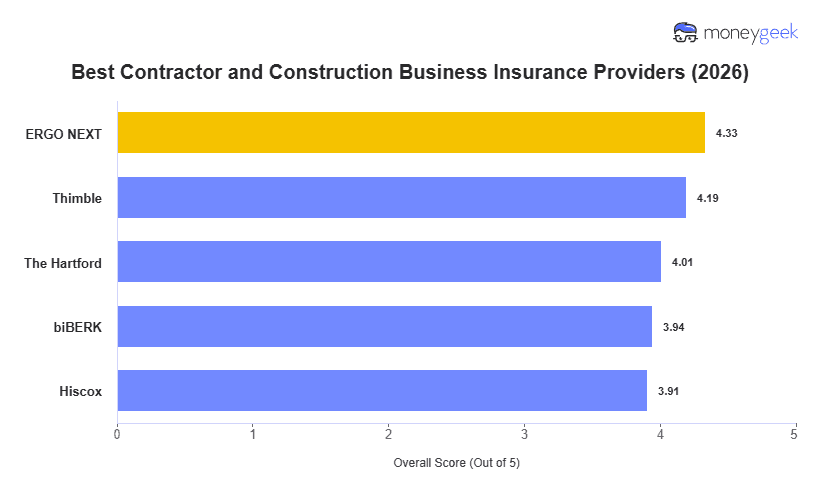
Whether you're a residential remodeler managing overhead or a commercial GC whose clients check your certificate before awarding contracts shapes which provider actually fits your operation. Our analysis showed that ERGO NEXT, Thimble and The Hartford performed best across cost, service and coverage for general contractor businesses.

ERGO NEXT ranks first overall, with the lowest average monthly rate of $148 and top scores for customer experience, with its instant COI and under-10-minute setup matter most when you need proof of coverage before a job starts. The Hartford ranks first on coverage strength, which matters most when your commercial contracts specify provisions a budget-first carrier may not meet.

ERGO NEXT4.39$14813
Thimble4.23$15447
The Hartford4.10$21331
Nationwide3.98$19562
biBERK3.97$19876
Hiscox3.96$19125
Progressive Commercial3.85$19354

How to Choose the Right General Contractor Business Insurance

Whether you're buying general contractor insurance for the first time or reassessing after a contract exposed a gap in your coverage, the order you make those decisions in matters. If you forgo the steps, you might buy the cheapest GL available and find out mid-contract that your policy's limits don't meet what your client required. These five steps walk though through the process:

  1. 1
    Understand your risk profile and what coverage it requires

    Start by understanding what risks your business actually faces before shopping for policies. Your risk profile depends on where you work, which trades you self-perform and whether your clients are homeowners or commercial entities who specify insurance requirements in their contracts. Your state licensing board tells you what's legally required, and your clients' contracts tell you what they expect. Beyond those two inputs, every other coverage decision is a judgment call based on how your operation runs.

  2. 2
    Choose the right coverage limits

    Your limits should reflect your worst realistic loss, not just the minimum your license or clients require. Think about the most expensive project you're currently running. On a mid-size build, legal fees, remediation and damages from a structural defect claim on your project can run past a $1 million per-occurrence limit. Workers' comp limits are state-mandated, but your GL, commercial auto and umbrella limits all require deliberate choices that go beyond the minimum.

  3. 3
    Evaluate providers who understand general contractors

    Most insurers don't write policies specifically for contractors, and those that do don't always structure coverage the way your work actually requires. Look for providers experienced in construction since they'll be more likely to offer subcontractor provisions, completed operations coverage and the additional insured endorsements your commercial clients require. Compare claims handling and how fast you can get a certificate of insurance because if a client is waiting on your certificate, falling short on either can cost you the job.

  4. 4
    Get compliance-ready

    Before your next job starts, confirm you can issue COIs quickly, verify your license bond is active and at your state's required limit if one applies, and review your client's contract insurance requirements against your actual policy limits and endorsements before you sign. Finding a mismatch after you've committed is harder and more expensive to fix than catching it in the contract review stage.

  5. 5
    Revisit your coverage as your general contractor business grows

    Your coverage needs shift whenever your business takes on a new type of work, a new employee or a new contract structure. Hiring your first employee triggers workers' comp in most states, and taking on your first commercial contract often means your GL limits need to go up. Adding a company vehicle or a new trade changes your insurance profile in ways your current policy may not account for. Review your coverage at least once a year and before signing any contract with new insurance requirements.

Get General Contractor Business Insurance Quotes

What you pay and which provider fits depends on how your business runs. If you're running residential remodels solo, your coverage needs look different from those of a commercial GC with multiple crews, where GL, workers' comp and commercial auto are all active at once. A provider built for the solo remodeler may not be structured for the multi-crew commercial operation. If you're ready to compare, requesting business insurance quotes shows you which carriers are actually built for your type of GC work.

About Connor Bolton


Connor Bolton headshot

Connor Bolton is Senior SEO and Content Manager at MoneyGeek, where he leads the business and pet insurance editorial teams. As editorial lead for both verticals, Connor sets the research framework, data standards, and content structure that his writers execute, directly authoring in-depth guides himself and reviewing all team content for accuracy and practical value before it goes live. With over four years evaluating insurance products across personal, commercial, and specialty lines, he brings cross-vertical knowledge to every guide the team produces.

Connor architected MoneyGeek's insurance research infrastructure across all major verticals including auto, home, renters, life, health, business, and pet, building systems for pricing analysis, provider-level research, customer experience evaluation, and coverage analysis with AI support. The infrastructure includes over 6 million data points for business insurance across 408 industry areas, all 50 states, and 16 vehicle types, and over 5 million pet insurance profiles across 18 major providers and hundreds of breed and age combinations. Connor's insurance cost research and his team's work has been cited by the U.S. Chamber of Commerce, Allstate, Liberty Mutual, CBS News, Forbes and LegalZoom.

Beyond the data, Connor stays connected to how the market actually operates, drawing on direct conversations with underwriters and carrier liaisons at Ethos, The Hartford, NEXT Insurance, Nationwide, and State Farm, and monitoring business and pet owner communities including Reddit, to inform how he interprets findings and frames guidance for real buyers.

He is the direct editorial contact for methodology questions at connor@moneygeek.com and can be found on LinkedIn.