



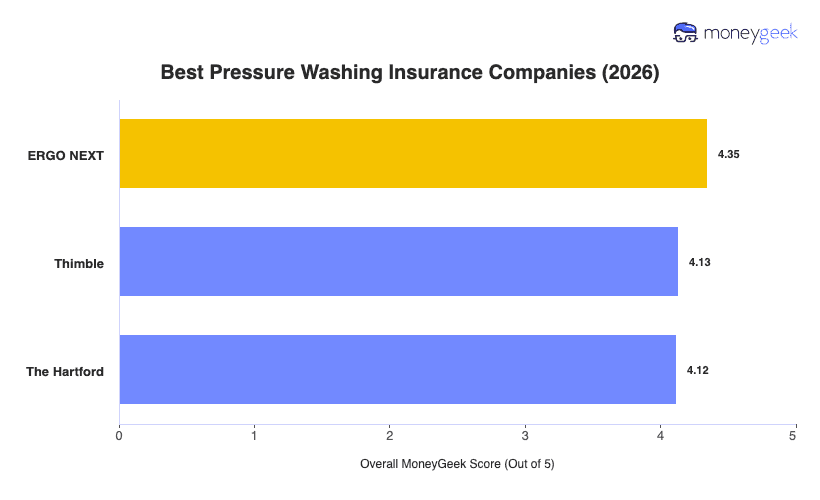
The three providers with the best business insurance for pressure washers are:
Best Pressure Washing Insurance
My analysis shows that ERGO NEXT, Thimble and biBerk are the best insurance companies for pressure washing businesses.
MoneyGeek helps you compare the best pressure washing insurers, coverage types and costs, so you can find the protection you need.
Ready to shop? Get matched with your top provider and start your contractor insurance quote using our tool below.
Select state
Updated: October 2, 2026
Advertising & Editorial Disclosure
Best Business Insurance Companies For Pressure Washers
Pressure washing puts your work right up against someone else’s property. I weighted the ranking around the problems that can get expensive fast, from surface damage to injuries at a job site. I also considered whether an insurer can keep up when you add equipment, take on commercial jobs or start hiring.
I used AI to support parts of the research, but I made the final editorial decisions on provider fit and ranking.
- Affordability (50%): I compared every insurer using the same pressure washing business profile. A lower premium helped, but I also checked what you get for the price. If an insurer costs more, I want to see a meaningful advantage in service, policy management or coverage.
- Customer Experience (30%): Pressure washers often need proof of insurance before a job starts. I looked at how quickly you can get a COI, add an additional insured, make policy changes and reach a person when something needs attention.
- Coverage Options (20%): General liability covers a big part of the risk, but it may not be enough as your business grows. I gave more credit to insurers that can also support equipment, commercial vehicles, employees or other needs without forcing you to piece everything together elsewhere.
See our full methodology.

ERGO NEXT: Best for Lower-Risk Work and Frequent COIs
pros
Lowest average premium in my study
Fast COIs for contractor and property-manager jobs
Mobile self-service for on-the-go policy management
cons
Commercial auto runs through a partner carrier
No pollution liability for chemical or runoff risks
Less suited to complex, multi-policy insurance needs
COMPANY HIGHLIGHTS
ERGO NEXT works best for owner-operated pressure washing businesses doing lower-risk residential or light commercial jobs. That kind of operator can get more value from its self-service setup since you can quote and buy online, manage your policy from the app and issue unlimited COIs without waiting on an agent. Its COI Analyzer also helps if contractors or property managers regularly send you their own certificate requirements. You’ll spend about $18 less per month for coverage, since ERGO NEXT’s average rate is 20% below the pressure washing average. That works out to around $222 in annual savings, which a solo operator could put toward detergent or routine equipment maintenance instead.
Learn More: ERGO NEXT Business Insurance Review

Thimble: Best for Flexible Coverage Terms and Per-Project Insurance
pros
Monthly coverage can pause during slow periods
Single-job coverage suits occasional pressure washing work
Immediate proof of insurance for short-notice jobs
Average premium runs 15% below industry average
cons
Equipment coverage capped at $5,000
No commercial auto or pollution liability
Claims handled by another insurer or administrator
COMPANY HIGHLIGHTS
Thimble is the best pressure washing insurer if your workload changes throughout the year. You can insure a single job or cover a longer stretch of work, which gives seasonal operators more control over when you pay for insurance. It also suits pressure washers who pick up occasional commercial jobs. You can issue unlimited COIs through the app, and most additional insureds don’t cost extra. If work slows down, Thimble lets you pause or adjust coverage instead of carrying the same policy setup year-round.
Learn More: Thimble Business Insurance Review

biBerk: Best for Buying Direct and Licensed Agent Support Available
pros
Cheapest for small crews
Buy directly without going through a broker
Online buying with licensed expert backup
Broader policies can stay with one insurer
cons
Second most expensive provider overall
Less flexibility for changing workloads
COMPANY HIGHLIGHTS
I’d recommend biBerk if you want to buy directly from the insurer instead of going through a broker. That removes an extra layer from the process, and biBerk says its model can save you up to 20% by cutting out the middleman. This setup works well for established owners who already know what they need and prefer dealing with the carrier themselves.
You’re not left entirely on your own, though. While biBerk lets you handle much of the quote and purchase online, you always have the option to bring in a licensed insurance expert when you need help sorting through coverage or finishing the application. It could also be a good fit if you want to keep more of your insurance with one company. For a pressure washing business with growing coverage needs, working directly with one insurer can mean fewer separate relationships to manage.
Learn More: biBerk Business Insurance Review
What Types of Insurance Do Pressure Washers Need?
Your insurance mix includes several policies, and the first one pressure washers get is general liability. More than just covering injuries or property damage your work might cause on the job, products and completed operations coverage responds when a problem tied to your work shows up after you’ve finished. For example, a customer might notice later that a surface was damaged during cleaning and file a claim.
I’d put tools and equipment coverage next because your gear is constantly moving with you. Theft is one of the most common causes of claims, so it’s worth protecting equipment like pressure washers and surface cleaners rather than having to cover the repair or replacement cost yourself.
Third-party injuries and property damage from your work. Think flying debris injuring someone or too much pressure damaging a customer’s siding. | You work on customer property. | High-pressure spray can cause serious wounds or send debris flying at people nearby. It can also damage the surface you’re cleaning if something goes wrong. | |
Tools and equipment | Protects portable gear you take from job to job if it’s stolen or damaged, including pressure washers and surface cleaners. | You transport equipment between jobs. | Generac lists commercial pressure washers at about $950 to $1,670 each. Tools coverage keeps one broken or stolen machine from turning into a four-figure cash purchase. |
Pays for covered accidents involving business-owned vehicles. That includes the pickup or van you use to haul your setup between jobs. | Your business owns a work vehicle. | Pressure washers often use pickups or vans to haul equipment between jobs. NHTSA estimated 39,345 traffic deaths in 2024, so every business-owned vehicle adds a real road exposure. | |
Helps with medical costs and lost wages when an employee gets hurt at work, such as slipping on a wet surface or straining while moving equipment. | You hire employees. | The broader services to buildings and dwellings industry recorded about 47,800 nonfatal workplace injuries and illnesses in 2024. That gives a crew-based pressure washing business a real reason to plan for employee injuries. | |
Trailer coverage | Protects the trailer itself against covered theft or physical damage while it carries your pressure washing setup. | You use a work trailer. | A pressure-washing trailer can represent a major equipment investment. If it’s stolen or badly damaged, replacing the setup can become a large out-of-pocket expense. |
Pollution liability | Responds to certain cleanup costs and liability claims when runoff or wash water carries pollutants off the job site. | You use chemicals or manage wastewater. | Wash water can carry chemicals and other pollutants into storm drains. Portland, for example, prohibits polluted pressure-washing runoff from entering its stormwater system and can issue penalties for violations. |
How Much Does Pressure Washing Insurance Cost?
The average cost of pressure washing insurance ranges from $21 per month for commercial property to $195 per month per vehicle for commercial auto coverage. Your actual rate, however, will depend on whether you usually clean residential driveways or roofs. Your exposure to wastewater and chemicals will also affect how much you spend on coverage.
At the policy level, expect each policy to average:
- General Liability: $61 per month or $732 per year
- Tools and Equipment: $31 per month or $372 per year
- Commercial Auto: $195 per month or $2,340 per year
- Workers' Comp: $102 per month or $1,224 per year
- Pollution Liability: $52 per month or $624 per year
- Commercial Property: $21 per month or $252 per year
- Cyber Insurance: $82 per month or $984 per year
What Are These Costs Based On?
I’d treat these pressure washing costs as a benchmark rather than a price you’re guaranteed to pay. Our main averages reflect businesses with one to four employees across all 50 states and Washington, D.C. We used the assumptions below to keep those comparisons consistent.
- General liability: $1 million per occurrence / $2 million aggregate
- Cyber insurance: $1 million limit
- Workers’ comp and commercial auto: State minimum requirements
- Commercial property: Based on the insured property value
- Tools and equipment: Based on an external small-business coverage benchmark
- Pollution liability: Based on an external pollution liability benchmark
Your own premium will depend on how your pressure washing business actually operates. A contractor cleaning residential driveways may pay differently from one taking on larger commercial properties, while adding employees or more expensive equipment can change the price again.
Use the business insurance calculator if you want an idea of what pressure washing insurance could cost before you start getting quotes. It'll help you figure out whether your current budget is in the right range. If you want to see provider options after that, select “Get Quote.”
Pressure Washing Insurance Cost Calculator
Select Coverage Type
Select State
Select Employee Cand
Select Vehicle Type
Average Monthly Cost—
Select Coverage Type
Average Monthly Cost—
Select State
Select Employee Cand
Select Vehicle Type
How To Buy The Best Pressure Washing Insurance
The best pressure washing insurance isn't always the option with the lowest rate. I've mapped out the steps to take and included a downloadable buying checklist. Use it as you go through the process. This way, you can keep all your information in one place, which can help you find a policy that meets your insurance requirements from a provider that fits your business.
- 1
Lock Down Your Legal and Job Requirements
Start with the insurance requirements mandated either by state law or your contracts. For example, if you have employees, check your state’s workers’ comp rules. You should also confirm what auto coverage your state requires if your business owns the truck or van that carries your pressure-washing rig.
The contracts for the work you want to take on could add requirements too. A property manager may set a minimum general liability limit before you can start. Another client might ask for a certificate of insurance (COI) and additional insured status. Write down the requirements exactly as they appear so you know the minimum your policy has to satisfy.
Read More: Business Insurance Requirements
- 2
Cover the Risks Your Requirements Leave Open
Now look at the parts of the job that create risks even when nobody requires coverage for them. Hose reels and spray guns travel with you from job to job, so tools and equipment coverage can help if that gear is stolen or damaged.
Some exposures come from how you work rather than what you carry. If wash water picks up chemicals or other contaminants, pollution liability may be worth adding. A trailer may need separate protection too, especially if your setup depends on it to get to the next job.
- 3
Set Limits Based on the Loss You’re Protecting Against
Start with any minimum a client or contract gives, but don’t assume that it’s automatically enough. Cleaning a residential driveway comes with different risks from working on a large commercial building, so think about the type of property you work on and how expensive a serious damage claim could become.
For tools and equipment coverage, use replacement cost as your guide. Add up what it would cost to replace the gear you regularly bring to jobs rather than picking a round limit and hoping it works. Pollution liability needs a different kind of check. Consider how much cleanup or third-party damage a runoff incident could realistically create based on the chemicals you use and where the work takes place.
Read More: How Much Business Insurance Do I Need?
- 4
Find Insurers That Fit Your Work and How You Operate
Don’t assume every insurer that writes pressure washing businesses will take every job you do. A carrier might cover driveway and siding work but restrict roof cleaning or work above a certain height.
But it’s not all about finding an insurer that’ll take your work. You also need to look at how well its setup fits you. If you handle insurance yourself, strong online policy management and quick COIs save time between jobs. If your operation’s harder to place, access to an agent or underwriter who understands pressure washing is more important than a fully self-service process.
- 5
Compare Quotes on Equal Terms
Get each insurer to quote the same limits and deductibles before you compare business insurance quotes. For pressure washing, also check whether coverage you care about is included or needs to be added separately. A cheaper quote isn’t really cheap once you account for those gaps.
- 6
Read the Policy for the Details That Can Change a Claim
Don’t stop at the coverage name and limit. In general liability, pay attention to the exclusions tied to the property you’re actually cleaning. For example, standard CGL wording can exclude damage to the specific part of a customer’s property you’re working on if your work damages it. That matters if you etch a driveway while cleaning it. Also check for endorsements that narrow completed-operations coverage, since a problem may not show up until after you leave.
Then read the conditions on your other core policies. Tools coverage may have rules around where equipment is stored or how a loss is valued, while pollution liability can turn on how the policy defines a pollution event and what cleanup costs qualify. If an endorsement changes the base policy, follow the endorsement because that wording controls.
- 7
Recheck Coverage When Your Business Changes
Your insurance should reflect the pressure washing business you run today, not the one you had when you first bought the policy. If you stop offering roof cleaning or sell equipment you no longer use, you could be paying for financial protection that you don't need. On the other hand, a bigger crew or larger commercial jobs can leave an older policy short.
Pressure Washing Insurance: FAQ
To make sure you have all the information you need, I've answered some frequently asked questions about pressure washing insurance:
Pressure washing insurance is a group of policies that helps protect your business when a job creates a financial problem. You might damage a customer’s siding or lose equipment to theft between jobs. Instead of paying the full cost yourself, the right coverage can step in for losses your policy covers.
That depends on where you work, because pressure washing doesn’t follow one nationwide licensing rule. Some areas treat it as contractor work, while others focus more on local business or wastewater requirements. Before you start taking jobs, check your state contractor board and local government so you know which rules apply to you.
Yes. Working solo may simplify your insurance setup, but it doesn’t remove the risks that come with pressure washing. You can still damage someone’s property or have equipment stolen, so build coverage around the losses you’d have to absorb yourself. Workers’ comp may not apply if you have no employees, depending on your state.
If you bring in subcontractors, don’t assume your policy automatically protects their work. Your insurer may expect them to carry their own coverage, and your policy can include conditions for subcontracted jobs. Ask for a current COI before work starts, then check your own policy so you know where your responsibility begins and ends.
You can. If pressure washing is something you only do during part of the year, look for coverage that matches that schedule instead of assuming an annual policy is your only option. Some insurers offer shorter terms or more flexible arrangements. Compare the total cost before you decide, because flexibility doesn’t always mean lower premiums.
A surety bond only becomes relevant when a licensing authority or contract requires one. It also works differently from insurance. Insurance helps pay covered losses your business faces, while a bond guarantees that you’ll meet a specific obligation. If the surety has to pay a claim because you didn’t, it can usually seek repayment from you afterward.
Best Pressure Washing Business Insurance: Bottom Line
The best business pressure washing insurers in my analysis are ERGO NEXT, Thimble and Hiscox. They're solid starting points, but they fit different pressure washing businesses. ERGO NEXT makes sense if you want strong self-service and frequent COIs, while Thimble's better suited for flexible or seasonal work. Consider Hiscox if you want a more traditional insurer with broader small-business support. The right choice depends on the work you do and how much help you want managing coverage.
Before you buy, though, ask this question: Would this policy protect you if the job went badly tomorrow? That means choosing limits you could defend, not just the cheapest premium, and checking the wording for anything that could narrow a claim. As your operation changes, your insurance should change with it. A policy that fit last year may not fit the work you’re taking on now.
Get Pressure Washing Insurance Quotes
Use the quote tool to see which insurers are willing to cover the pressure washing work you do. Once you have a few options, compare the coverage terms before you start judging them on price.
About Connor Bolton

Connor Bolton is Senior SEO and Content Manager at MoneyGeek, where he leads the business and pet insurance editorial teams. He sets the research framework, data standards and content structure for his team. All content goes through his accuracy review before publication. Connor also writes in-depth guides and has spent more than four years covering insurance products across personal, commercial and specialty lines.
The research infrastructure Connor built covers auto, home, renters, life, health, business and pet insurance across pricing analysis, carrier research, customer experience and coverage evaluation. It includes over 6 million data points for business insurance across 408 industry areas, all 50 states and 16 vehicle types. The pet insurance side covers over 5 million profiles across 18 major providers, 100+ breeds and ages up to 20 years. Connor’s insurance research and his team's work have been cited by the U.S. Chamber of Commerce, Allstate, Liberty Mutual, CBS News, Forbes and LegalZoom.
Connor also talks with underwriters and carrier liaisons at Ethos, The Hartford, ERGO NEXT, Nationwide and State Farm, and monitors business and pet owner communities on Reddit. Those sources shape how his team evaluates carriers, structures rate analysis and writes content for real pet owners.
Questions about MoneyGeek's business or pet insurance content? Reach him at connor@moneygeek.com or on LinkedIn.
Sources
- Bluevine. "Survey: 39% of Small Businesses Have Less Than a Month of Cash on Hand." Accessed October 8, 2026.
- Generac. "Pressure Washers." Accessed October 8, 2026.
- National Highway Traffic Safety Administration. "NHTSA Releases 2023 Traffic Deaths, 2024 Estimates." Accessed October 8, 2026.
- U.S. Bureau of Labor Statistics. "Table 2. Numbers of Nonfatal Occupational Injuries and Illnesses by Industry and Case Types, 2024." Accessed October 8, 2026.