
What Is Hair Salon Business Insurance?

Hair salon business insurance is a bundle of policies covering the risks specific to your work: chemical services applied directly to clients' scalps, heat tools used in close contact, a physical salon space you're responsible for and, in many cases, a team of licensed stylists on your payroll. These exposures show up in specific, recognizable ways:

  • A client develops a scalp reaction two days after a bleach and tone service, claiming no patch test was offered
  • A color developer spills and permanently stains a client's clothing or a leather bag left near the styling station
  • A stylist slips on a wet floor near the shampoo bowl and files a workers' comp claim against the salon
  • A shampoo bowl leak damages the flooring in your leased commercial space, putting you in a dispute with your landlord
  • A client disputes the outcome of a keratin straightening treatment, claiming her hair broke off at the application line

What makes beauty business insurance different for hair salons specifically is when the claims arrive. A slip near the shampoo bowl happens in the moment, but a scalp reaction from a bleach service or hair breakage from a keratin treatment can surface days after your client walks out. We consistently see salon owners surprised to learn that those delayed, post-service claims don't always fall under a standard general liability policy. Getting that coverage gap right is what separates a complete hair salon insurance plan from one that only covers half the risk.

What Types of Insurance Do Hair Salons Businesses Need?

Your salon sits at the intersection of professional services, physical client contact and a leased commercial space you're legally responsible for. Your landlord wants proof of coverage before you open, your stylists work in a wet, chemical-heavy environment and the services you perform create outcomes clients can and do dispute. Each of those realities points to a different type of coverage:

  • General liability (since clients move through your space constantly, creating slip, spill and property damage exposure at every appointment)
  • Professional liability (since the chemical and styling services you perform can produce disputed outcomes that a general liability policy doesn't cover)
  • Workers' compensation (if you employ any licensed stylists, shampoo techs or receptionists, since most states require it from your first hire)
  • Commercial property (if you've invested in styling chairs, shampoo bowls or a built-out salon space that would be expensive to restore after a fire or water event)
  • Commercial auto (if you travel to clients for bridal bookings, editorial work or on-site styling events)
  • Cyber insurance (if you store client payment data, use cloud-based booking software or process a significant volume of online transactions)

Most salon owners we speak with put general liability in place first because the lease demands it, and only encounter the professional liability question after a color service complaint. Your actual coverage needs depend less on how many chairs you have and more on which services you offer and how your salon is structured. The profiles in this section help you identify which combination fits your situation.

How Much Does Hair Salon Business Insurance Cost?

Hair salon business insurance costs an average of $57 monthly, or $684 annually, for a salon with one to four employees. The highest costs go to cyber insurance and commercial auto: cyber because booking platforms and stored payment data make your salon more data-exposed than you might expect, while commercial auto reflects the cost of insuring dedicated vehicle use.

We find that the $57 monthly average obscures how wide the actual range is. If you're a booth renter carrying general liability alone, you're looking at closer to $67 monthly, while a salon with employees, a built-out space and chemical services coverage puts you closer to $150 monthly or more. Your actual cost depends less on the industry average and more on which combination of coverage types your business structure requires.

Average costs by coverage type for hair salons:

How did we determine business insurance rates for hair salons?

What you actually pay for hair salon insurance depends on details the averages above can't capture. Adding chemical services to your menu adds professional liability to your premium. Your workers' comp cost tracks your total payroll, so paying three stylists full-time costs more to cover than three part-time ones. If you lease your own space, the replacement value of your build-out and equipment sets your commercial property rate. The hair salon business insurance calculator uses those variables to build an estimate around your specific salon.

Estimate Your Monthly Hair Salon Insurance Cost

Enter your coverage type, state, number of employees and type of vehicle (if you need commercial auto coverage) to get a pricing estimate that fits your business. We do not collect any personal information, and all rates are aggregated for all 50 states and Washington D.C. Workers' comp rate estimates are provided on a per employee basis and all coverage types assume standard industry limit recommendations for most businesses.

Select Coverage Type
Select State
Select Employee Count
Select Vehicle Type
Average Monthly Cost

Best Hair Salon Business Insurance Companies

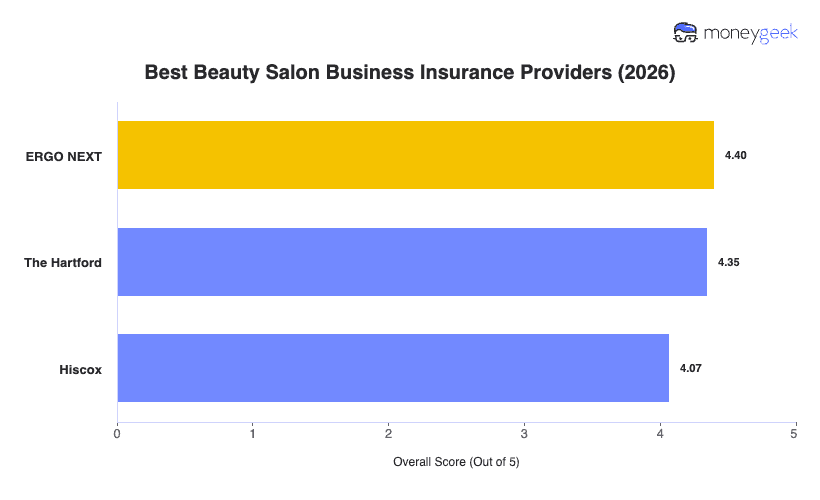
If you're a booth renter shopping for general liability, your priorities look nothing like those of a salon owner managing a workers' comp claim, and neither will your budget. Our analysis identified The Hartford, ERGO NEXT and Hiscox as the top three providers for hair salons, each strong across price, policy depth and service quality. 

The Hartford leads on affordability at $44 monthly and coverage breadth, the strongest fit if you're stacking multiple policies and watching costs. ERGO NEXT tops our customer experience rankings with a fully digital process, useful if you need a COI the same day you sign a lease. Which one fits depends on where your priorities sit.

ERGO NEXT4.41$5313
The Hartford4.37$4431
Hiscox4.09$5827
biBERK4.06$5676
Thimble4.04$6055
Progressive Commercial3.94$6344
Nationwide3.94$6562

How to Choose the Right Hair Salon Business Insurance

Choosing the right hair salon coverage is a process, and the order matters. We consistently see this play out: a landlord asks for proof of insurance, you buy general liability and stop there, leaving chemical service claims and employee injuries outside the plan. Getting business insurance right starts with what your operations expose you to, not just what your lease requires.

  1. 1
    Understand your risk profile and what coverage it requires

    Your risk profile depends on the services you offer, whether you have employees and what kind of space you work from. If you rent a suite and do cuts only, your exposure is narrow. A salon owner with employed stylists doing color and straightening treatments is managing something much broader. Clarifying where your operations sit tells you which policies state law requires, which your landlord or clients expect and which reflect the actual risk of your work.

  2. 2
    Choose the right coverage limits

    Most landlords require $1 million per occurrence in general liability, and that satisfies the lease. It may not be enough if a serious injury happens in your salon. For professional liability, your limit should reflect your chemical services volume. Doing occasional toning is a different exposure than taking on corrective color cases week after week. Set your limits around the claim that would hurt most, not the one that's easiest to imagine.

  3. 3
    Evaluate providers who understand personal training businesses

    If you rent a booth, look for a provider who offers standalone general liability and professional liability at a combined rate built for independent operators. If you employ stylists, prioritize a provider with experience in cosmetology workers' comp claims and the flexibility to grow with your team. Balanced performance across price, claims handling and coverage depth matters more than the cheapest option. A provider who is slow on claims costs more in practice than one priced slightly higher with better service on claims.

  4. 4
    Get compliance-ready

    Purchasing your policy is the start, not the finish. Provide your landlord with a certificate of insurance that names them as an additional insured on your general liability policy. Confirm your state cosmetology establishment license is current and that every stylist working in your salon holds an active individual license. If state law requires workers' comp from your first hire, have that certificate ready before your first employee works a shift.

  5. 5
    Revisit your coverage as your personal training business grows

    Your coverage needs shift when your salon does. Chemical services you add, a lease you sign on your own space, your first hire or a retail product line can each shift your risk in ways your current policy may not cover. Review your coverage at least once a year and before signing any new lease or service expansion. Updating your policy almost always costs less than a claim your outdated coverage can't reach.

Get Hair Salon Business Insurance Quotes

What you pay for hair salon insurance depends on how your salon actually operates. If you run a blowout bar out of a single suite with no chemical services, your coverage needs look nothing like those of a full-service salon owner with employed stylists, a color and treatment menu, a retail product line on the back bar. Requesting business insurance quotes with your actual service mix, employee count and space in hand lets you compare options that fit your salon, not the industry average.

About Connor Bolton


Connor Bolton headshot

Connor Bolton is Senior SEO and Content Manager at MoneyGeek, where he leads the business and pet insurance editorial teams. As editorial lead for both verticals, Connor sets the research framework, data standards, and content structure that his writers execute, directly authoring in-depth guides himself and reviewing all team content for accuracy and practical value before it goes live. With over four years evaluating insurance products across personal, commercial, and specialty lines, he brings cross-vertical knowledge to every guide the team produces.

Connor architected MoneyGeek's insurance research infrastructure across all major verticals including auto, home, renters, life, health, business, and pet, building systems for pricing analysis, provider-level research, customer experience evaluation, and coverage analysis with AI support. The infrastructure includes over 6 million data points for business insurance across 408 industry areas, all 50 states, and 16 vehicle types, and over 5 million pet insurance profiles across 18 major providers and hundreds of breed and age combinations. Connor's insurance cost research and his team's work has been cited by the U.S. Chamber of Commerce, Allstate, Liberty Mutual, CBS News, Forbes and LegalZoom.

Beyond the data, Connor stays connected to how the market actually operates, drawing on direct conversations with underwriters and carrier liaisons at Ethos, The Hartford, NEXT Insurance, Nationwide, and State Farm, and monitoring business and pet owner communities including Reddit, to inform how he interprets findings and frames guidance for real buyers.

He is the direct editorial contact for methodology questions at connor@moneygeek.com and can be found on LinkedIn.