



Jump to the section that meets your needs best below:
Average Beauty Salon Insurance Cost (2026 Report)
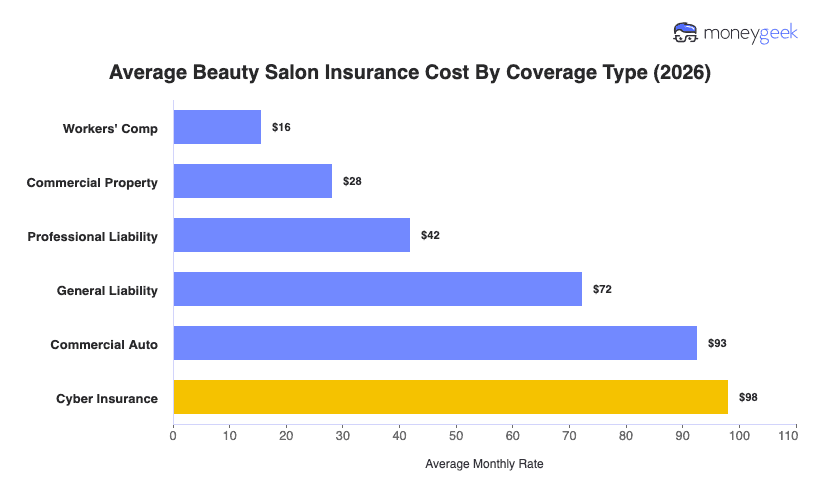
The average cost of beauty salon insurance range from $114 per month for a starting bundle to $367 per month for one that suits a staffed salon.
If you want pricing now, MoneyGeek can match you to the insurer that meets your beauty salon's coverage needs.
Select state
Updated: September 11, 2026
Advertising & Editorial Disclosure
How Much Does Beauty Salon Insurance Cost?
A starting insurance bundle for beauty salons costs an average of $114 per month. It combines general liability and professional liability insurance, and could be good fit if you recently opened, work on your own and provide standard beauty services from one location. This mix helps if a client slips in your salon, you damage a customer’s belongings, a treatment causes an injury or someone claims your service caused an injury, damaged their hair or skin, or required them to pay for corrective treatment.
These costs are only starting points because your services, location, payroll, coverage limits and claims history can all change what you pay. Plus, you'll probably need a broader bundle once you hire employees, buy more equipment, open another location or start using a vehicle for work. I’ve detailed each bundle below so you can see which one best matches how your salon operates.
Starting Bundle | General liability + professional liability | $114 | Solo cosmetologists without a storefront |
Recommended Bundle | Business owner’s policy (BOP) + professional liability + cyber insurance | $230 | Owner-run salons with one location |
Mobile and Event Services Bundle | Recommended bundle + tools and equipment insurance + hired and non-owned auto endorsement | $281 | Mobile stylists and event beauty teams |
Staffed Salon Bundle | Recommended bundle + workers’ compensation + employment practices liability | $367 | Staffed salons with a storefront |
To estimate beauty salon insurance costs, we built the model around how a salon’s insurance needs change as the business becomes more complex. We started with an independent cosmetologist, then added a physical salon, digital systems, mobile services and employees at the points where each change introduced a new risk. The pricing reflects quotes from 10 major U.S. commercial insurers.
- National benchmark average: Our national averages represent small beauty salons with fewer than five employees. Rather than pricing every possible policy at once, we matched coverage to the way each salon profile operates. Client-facing services drive liability needs, a permanent location adds property exposure, online booking and card payments introduce cyber risk, and hiring staff brings employee-related coverage into the mix.
- State averages: We used the same salon in every state so the comparison would reflect location rather than differences in the business. Services, payroll, equipment value, staffing and coverage details stayed fixed. Only the state changed. For specialised coverages outside our main dataset, we adjusted the national estimate using the state pricing pattern of the closest related coverage.
- Bundle averages: Each bundle represents a recognisable salon setup. The starting bundle reflects a self-employed cosmetologist focused on client and service claims. The recommended bundle fits an owner-operated salon with a location, business property and digital systems. Mobile work adds protection for portable tools and personal or rented vehicles used for business, while a staffed salon adds workers’ compensation and employment practices liability.
These figures are best used to set a realistic budget. Two salons can offer similar services and still pay different rates because of their service mix, client volume, equipment and product values, staffing setup, use of chemicals or heated tools, digital systems and location. Actual quotes also depend on the limits, deductibles and policy terms you choose.
See our full business insurance methodology.
Get Beauty Salon Business Insurance Cost Estimates
Enter your state, coverage type, employee count and vehicle type to view average insurance costs for a beauty salon. You can also select Get Quotes in our business insurance cost calculator to be matched with providers in our network.
Before using the calculator:
- No personal details are collected or stored
- Workers’ compensation estimates are calculated per employee
- Commercial auto estimates depend on the vehicle type selected
Get Beauty Insurance Cost Estimates
Select Coverage Type
Select State
Select Employee Count
Select vehicle_type
Monthly Rate Estimate—
Select Coverage Type
Monthly Rate Estimate—
Select State
Select Employee Count
Select vehicle_type
Factors Affecting Beauty Salon Insurance Costs
Beauty salon insurance costs reflect how you serve clients, what you use to do the work and who works alongside you. The services, tools, staffing setup and systems that keep your salon running can all change the risks you face and the coverage you need. I've detailed how these six factors affect your premiums.
 Services Offered
The treatments you provide can change how likely a client is to make a claim and how expensive that claim could be. Haircuts and basic styling usually carry fewer risks than bleaching, chemical straightening, waxing, facials, nail services or lash work, which can lead to burns, reactions, infections or other injuries.
 Use of Chemicals and Heat Tools
Bleach, dyes, relaxers, wax heaters and other heated tools can cause more serious harm when something goes wrong. If you use these products in your salon often, an insurer might see higher possibilities of client injuries, employee exposure or damage to your space.
 Number of Employees and Booth Renters
Once other professionals work from your salon, your insurance needs grow. Employees add workers’ comp and workplace risks. Booth renters might carry their own insurance, but you still need clear agreements showing who covers their services and any claims tied to them.
 Value of Salon Equipment and Retail Stock
A salon with expensive chairs, dryers, nail stations, skincare equipment and a large product inventory costs more to rebuild after a fire, theft or water leak. As the value of what you own increases, you may need higher property limits, which can raise your premium.
 Client Traffic and Appointment Volume
A busy salon has more people moving through treatment areas, wash stations and waiting spaces each day. That gives you more chances for slips, damaged belongings and complaints about services, so insurers usually charge more when your salon handles a high number of appointments.
 Use of Booking, Payment and Client-Record Systems
Online booking, card payments and stored client notes make your salon easier to run, but they also give hackers and scammers more ways into your business. The more you depend on these systems, the more cyber protection you may need to recover files, notify clients and keep appointments moving after an attack.
How to Lower Beauty Salon Insurance Costs
These are several ways you can get cheap business insurance for your beauty salon without leaving gaps in your coverage. Some changes can reduce what you pay now, while others may help over time by lowering the chance of claims. I've detailed these below:
 Compare quotes using the same coverage limits
I recommend comparing several quotes with the same policies, limits and deductibles. That way, you can tell whether one insurer is really cheaper or whether another offers a lower price because it leaves out professional liability, off-site tools or another protection your salon needs.
 Right-size your coverage
Match your policy mix to how your salon presently operates. A solo cosmetologist might not need workers’ comp or employment practices liability, while a staffed salon needs both. I’d also review your equipment values, services and staffing each year so you're not paying for coverage that no longer fits.
 Bundle policies with the same provider
You could save by combining general liability and commercial property in a business owner’s policy. Some insurers also offer discounts when you keep several policies with them. I’d still check the details, since a cheaper bundle may not include a coverage you need or have lower limits.
 Lower your risk profile
Insurers typically offer better rates when your salon consistently shows that you're running your operations responsibly. Keep your licences and policies active, address past safety problems, avoid missed payments or coverage lapses and update your insurer when you add new services, staff or locations. These make your business easier to assess and helps prevent sudden price increases at renewal.
 Invest in risk management practices
I’d focus on the everyday risks most likely to lead to claims. Strong controls can protect different areas of your beauty salon's operations while improving how insurers view your business over time.
- Use consultation forms and patch tests before colour, chemical, lash or skincare services to catch allergies and treatment risks early.
- Keep walkways, wash stations and treatment areas dry and clear to reduce client and employee slips.
- Service dryers, wax heaters, nail equipment and ventilation systems regularly to prevent fires, breakdowns and harmful chemical exposure.
- Limit access to booking, payment and client records, use strong passwords and train staff to spot scam emails.
Beauty Salon Insurance Cost: Bottom Line
I’d compare your insurance cost with the bundle that most closely matches how your salon runs today. An independent cosmetologist might spend around $114 per month, while an owner-operated salon with a physical location may spend closer to $230. The extra protection raises that total.
Three questions can help you judge whether a bundle fits:
- Which bundle matches your salon today? A solo cosmetologist mainly needs coverage for client injuries and service-related claims. A multiple-service salon with a storefront might also need property and cyber coverage, while mobile and staffed salons usually have more risks.
- What has changed in your operations? Hiring employees, adding more service lines, taking equipment to events or relying more on booking and payment systems all increase your coverage needs. Your bundle should reflect how you work now, not how the business looked when you opened.
- Does your quote include the same coverages as the benchmark? A lower quote may leave out a policy included in the bundle, while a higher one may add protection for staff, equipment or vehicles. Compare what each price includes before deciding whether it's reasonable or not.
Use these bundle costs as planning points, not target rates. The closest benchmark will be the one that reflects your services, staffing, property and the way clients interact with your business.
About Angelique Palenzuela-Cruz

Angelique Palenzuela-Cruz is a Business Insurance Content Writer at MoneyGeek, where she specializes in general liability, workers’ compensation and professional liability insurance. Her work helps small business owners understand how these policies apply to coverage, including risks like customer injuries, employee injuries, professional mistakes, client contract terms and industry-specific coverage requirements.
She primarily covers service-based businesses where liability and employee coverage decisions are especially important, including cleaning, consulting, beauty and wellness, childcare, education, fitness, food service, pet care, repair and maintenance, and other professional services.
Before joining MoneyGeek, Angelique spent nearly 12 years at Guthrie-Jensen Consultants, one of Southeast Asia’s largest management training firms, where she advanced from Training Consultant to Managing Consultant. In that role, she worked with business clients to assess operational needs, develop training programs and present performance analyses to executive decision-makers. She also helped establish Gladwin Training Consultancy, where she served in learning solutions and client service roles.
Her background gives her practical context for writing about how businesses operate, manage client expectations, structure teams and make risk decisions. At MoneyGeek, she applies that experience to business insurance content, connecting coverage to actual business needs.
LinkedIn: linkedin.com/in/ma-angela-cruz
Email Contact: angelique.palenzuela@moneygeek.com
Sources
- Bureau of Economic Analysis. "Regional Price Parities by State and Metro Area." Accessed October 5, 2026.
- Federal Bureau of Investigation. "2025 IC3 Annual Report." Accessed October 5, 2026.
- Michigan Department of Insurance and Financial Services. "Purchasing Auto Insurance FAQ." Accessed October 5, 2026.
- Pennsylvania Insurance Department. "Auto Insurance." Accessed October 5, 2026.
- Texas Department of Insurance. "Employer Resources." Accessed October 5, 2026.
- U.S. Census Bureau. "U.S. Census Bureau QuickFacts: District of Columbia." Accessed October 5, 2026.
- Workers’ Compensation Insurance Rating Bureau of California. "WCIRB Releases 2025 State of the California Workers’ Compensation Insurance System Report." Accessed October 5, 2026.