
Best Business Insurance Companies For Accountants & CPAs

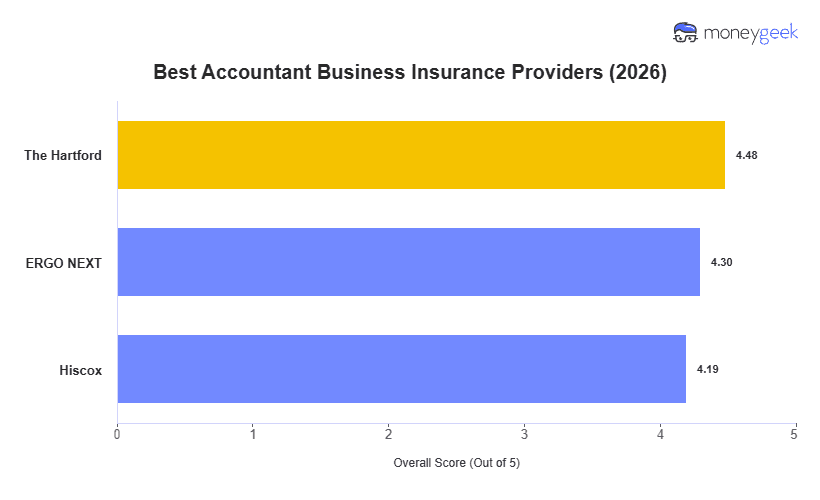
My analysis ranked these companies as the best small business insurers for accountants and CPAs:

  • Choose if your firm needs low-cost professional liability and cyber coverage : The Hartford
  • Choose if you want to buy, manage and prove coverage entirely online: ERGO NEXT
  • Choose if you prioritize professional liability coverage: Hiscox

Accountant and CPA business insurance can be deceptively complex since professional liability, cyber coverage and general liability all look straightforward until a claim reveals what your policy actually covers. My rankings are built on three things: what you'll actually pay, what happens when you need help and whether the coverage holds up against the risks accounting work creates. I scored each provider across affordability (50%), customer experience (30%) and coverage options (20%), weighted that way because premium cost determines what a solo practitioner or small firm can financially sustain, but it's rarely where the decision should end.

This is what made up my analysis of popular insurers, which was assisted (not run) by AI:

  • Affordability: I pulled quotes isolating pricing factors across accounting and financial services sub-industries, all 50 states (plus DC), employee count (5 ranges from 0 to 49), 16 vehicle types (for commercial auto) and six of the most common coverage types, extrapolating 500,000+ estimates to build a full pricing picture for accounting firms specifically.
  • Customer Experience: 300,000+ reviews, forum conversations and industry research were aggregated and manually parsed to identify the patterns that made customers enjoy and dislike service from each insurer. I also went through what an actual accounting firm owner would go through for all providers analyzed, testing their quoting experiences and policy management tools (excluding claims due to limitations).
  • Coverage Options: I read the fine print of policy terms, isolated the exclusions and hidden costs that affect accounting firms (like attest work carve-outs, retroactive date restrictions and cyber sub-limits), and documented every option available for all providers to determine which has the best coverage for your practice now and as your firm grows.
The Hartford

The Hartford: Best for CPA Firms Needing Coverage Depth

On The Hartford's site
checkmarkpros
  • Lowest average monthly cost

  • BOP includes $1M professional liability

  • With in-house claims adjusters and agent

closecons
  • Buying and managing policies requires more interaction

  • No in-house commercial auto

  • Binding policies take longer than competitors

COMPANY HIGHLIGHTS

I recommend The Hartford for most accountants because it combines the lowest average cost with the broadest policy selection. It runs 32% below the average of every other provider I ranked, and that gap holds across firm sizes. The Hartford's business owner's policy (BOP) includes professional liability (most BOPs only bundle general liability and commercial property), eliminating the need for a separate E&O policy. It also offers cyber coverage with data breach and ransomware protection along with employment practices liability insurance (EPLI) for firms navigating seasonal hiring cycles.

However, policy changes need to go through an agent rather than a self-service portal, and quoting takes more back-and-forth than competitors. The Hartford also doesn't write commercial auto for most small accounting operations, so audit fieldwork travel will need a separate carrier.

Read Our Review: The Hartford Business Insurance Review

ERGO NEXT

ERGO NEXT: Best for Small Digital-First Practices

On ERGO NEXT's site
checkmarkpros
  • Quote to COI in roughly 10 minutes

  • Ranks first in customer experience for accountants

  • 10% discount when adding professional liability

closecons
  • Professional liability lacks options for financial professionals

  • No accounting-specific agents for support

  • Cyber underwritten by Coalition, not in-house

COMPANY HIGHLIGHTS

ERGO NEXT is the right pick for accountants who value speed and simplicity over coverage depth. Backed by Munich Re and insuring over 750,000 businesses, it offers professional liability, general liability, BOP, workers' comp, commercial property and cyber for accounting practices. I had a bound policy with a downloadable COI in under 10 minutes without a single phone call. Its mobile app lets you pull COIs, adjust coverage and start claims at any hour, and a 10% discount applies when you stack professional liability onto an existing policy.

Where ERGO NEXT starts to fall short is with more complex practices. Professional liability caps at $1M per claim and $2M aggregate, which won't satisfy engagement contracts that call for higher limits. It also lacks broad form coverage and flexible reporting terms that firms doing audit or attest work need from their E&O policy. Cyber runs through Coalition rather than ERGO NEXT's own underwriting, adding a third party to one of accounting's most critical coverages.

Read Our Review: ERGO NEXT Business Insurance Review

Hiscox

Hiscox: Best for Solo CPAs Prioritizing E&O

checkmarkpros
  • Professional liability tailored specifically to accounting risks

  • Dedicated rep assigned on every claim

  • Monthly payments with zero installment fees

closecons
  • Narrow policy selection requires a second carrier

  • Higher-than-expected complaint volume with state regulators

  • Professional liability takes 2 to 5 days to bind

COMPANY HIGHLIGHTS

Hiscox is the strongest option for solo CPAs and small firms where professional liability is the primary concern. Its E&O policies are built around accounting risks like tax preparation errors, audit failures, missed filing deadlines and advisory missteps that cause a client financial harm. Coverage extends worldwide, which matters if your practice advises clients with international operations or your work product crosses state regulatory lines. Hiscox charges no installment fees on monthly payments and offers a 5% discount when you buy two or more products, both practical for a solo CPA managing uneven cash flow between tax seasons.

The gaps show up outside of E&O. Hiscox doesn't bundle coverage the way larger carriers do, so if you need workers' comp, commercial property or commercial auto alongside your professional liability, you're managing policies across multiple carriers. The application for professional liability also requires supplemental documentation about your services and client types, which means 2 to 5 business days to bind rather than minutes.

Read Our Review: Hiscox Business Insurance Review

What Types of Insurance Do Accountants & CPAs Need?

The first policy most accounting firms need is professional liability, because your signed work (returns, audits, financial statements) creates claims exposure that can surface years after the engagement ends. Cyber insurance is next since your systems hold Social Security numbers, tax returns and financial records that the FTC Safeguards Rule requires you to protect regardless of firm size. Beyond those two, workers' comp, general liability, commercial property and other policies come into play as your practice grows and takes on more clients.

The table below summarizes the most common types of business insurance that accountants and CPAs need to meet requirements and cover financial risks.

Defense costs and settlements when a client or third party claims your work caused them financial harm
Every accounting professional should carry this before taking on clients

About 46% of accountants have admitted to mistakes resulting in financial losses, and average claim settlements exceed $180,000 before defense costs.

Costs from data breaches, ransomware attacks and regulatory penalties when client records are compromised
Any firm that stores client financial data electronically

Cyber attacks on U.S. financial companies rose 27% in 2024, and the FTC Safeguards Rule carries penalties up to $50,120 per violation for tax preparers.

Claims and legal costs when a client is injured at your office or you damage someone's property during a visit
If clients visit your office or you work at a client's location
Slip-and-fall claims from client visits are the most common GL trigger for accounting firms, and even a straightforward injury claim can generate five-figure costs.
An employee's medical bills and lost wages after a work injury, including repetitive strain from sustained computer use
When you hire your first employee, including part-time or seasonal tax preparers

Nearly 946,500 workers reported musculoskeletal disorders in 2023, and office workers are particularly susceptible to carpal tunnel during extended busy season hours.

Damage or loss to your office space, servers, workstations and client file systems from fire, theft or other covered events
If you lease or own office space or work from home with business equipment
Your landlord's policy covers the building, not your contents, and a single server failure or office fire can destroy years of client records and the equipment your practice depends on.
Injuries and vehicle or property damage from work-related driving to client offices, audit fieldwork or bank runs
If your firm owns vehicles or staff regularly use personal vehicles for business
Personal auto policies typically exclude business-use claims, so an accident on the way to a client meeting leaves your firm fully exposed.
Combines general liability with coverage for property kept at a fixed location, often at a lower cost than buying each separately
Small practices that need both GL and property coverage
A BOP protects against both third-party liability claims and losses to your own property in a single policy, simplifying coverage and often reducing total premium.
Extra liability protection after your primary policy reaches its limit
A contract or client engagement requires limits above your base policies
A disputed audit opinion relied on by lenders or investors can generate claims that exceed standard $1M or $2M primary limits.
mglogo icon

WHY GETTING ACCOUNTANT INSURANCE IS IMPORTANT

Accounting firms face a risk most small businesses don't because your liability extends to people you never met. A lender who relied on your audit opinion, an investor who acted on a financial statement or an IRS agent reviewing a return you signed can all generate claims years after the work was done. While professional liability costs roughly $70 per month, a single uninsured claim can easily reach six figures in settlement and defense costs. One mid-sized firm's data breach in 2024 led to five class-action lawsuits after over 216,000 individuals were notified, a cost that would be existential without coverage.

How Much Does Accountant & CPA Business Insurance Cost?

Accountant business insurance costs for a small practice with 1 to 4 employees average $59 per month across all coverage types, with cyber insurance at $93 per month being the most expensive and workers' comp at $15 per month being the least. What you actually pay depends on your credential type, whether you do audit or attest work, the size of your client base and how much sensitive data your systems hold.

Here's an overview of costs for common coverage types:

What Are These Costs Based On?

Our business insurance calculator below can give you a more tailored estimate based on your practice details. It also connects you directly with a provider match when you're ready to get quotes.

Accountant Insurance Cost Calculator

Select your state and industry to view average business insurance premiums in your area. Rates are calculated based on a business with 5 employees and $500,000 in annual revenue.

Select Coverage Type
Select Employee Count
Select Vehicle Type
Select State
Average Monthly Cost—

How To Buy The Best Accountant & CPA Insurance

I've outlined the buying process below step by step. If you want something to take with you while gathering quotes, download the accountant business insurance buying worksheet to keep everything organized across providers.

  1. 1

    Identify Required Coverages

    Your starting point is whatever body governs your credential. Some state boards mandate professional liability minimums for licensed CPA firms, and others don't but your clients will. Pull the insurance section from your most recent engagement letter and note every coverage type, limit and endorsement it specifies. If a client requires additional insured status, that has to be added through your carrier as a policy endorsement. Handing them a certificate of insurance (COI) alone only proves coverage exists, it doesn't extend it.

    Read More: Business Insurance Requirements

  2. 2

    Map Your Practice Risks to Coverage

    Think through specific scenarios your firm could face and test which policy would actually pay. Say a former client's lender sues your firm over an audit opinion you signed two years ago. General liability won't touch that because no one was physically hurt, but a professional liability policy with an adequate retroactive date would. Do this for every meaningful risk in your practice, from a ransomware attack encrypting client files to an employee developing carpal tunnel during tax season, and flag anything without a clear policy match.

  3. 3

    Set Limits That Reflect Your Actual Exposure

    Your limits need to account for the worst claim your practice could realistically face, not what firms your size typically carry. A bookkeeper serving sole proprietors has a very different ceiling than a CPA whose audit opinions get relied on by lenders and investors. If your work product influences financial decisions worth hundreds of thousands of dollars, a $1M per occurrence limit may not be enough.

    Read More: How Much Business Insurance Do I Need?

  4. 4

    Vet Providers For Your Specific Services

    Some carriers exclude attest work from their professional liability policies entirely. Others will cover it but price cyber poorly for the volume of sensitive data accounting firms hold. Before you request any quotes, confirm that each insurer on your list actually covers your services, your credential type and the client base you serve. An insurer that writes great coverage for bookkeepers may be the wrong fit for a firm performing audits.

  5. 5

    Get Quotes With Identical Terms

    Look up what accountant insurance typically costs for your firm size and services so you have a reference point going in. Then request quotes using the same limits, deductibles and endorsements across every provider. A policy that looks cheaper per month but carries a higher deductible or narrows your retroactive date is not a real savings.

  6. 6

    Verify Your Policy Before Signing

    Go through the policy document line by line against your state board requirements and client engagement terms before committing. Check that your retroactive date on professional liability reaches back far enough to cover prior work, since a gap there can leave years of engagements exposed. Confirm the named insured matches your firm's legal name exactly, because even a small mismatch can create compliance problems with clients.

  7. 7

    Review Coverage When Your Practice Evolves

    Adding your first employee, taking on audit engagements, shifting from individual to business clients or restructuring your firm as an LLP all change what coverage you need and how much of it. Don't wait for renewal to find out your policy doesn't match how your practice actually operates now. Revisit your coverage before any major change takes effect.

Accountant Insurance: FAQ

Beyond what this guide covers, I've answered the most common remaining questions accountants and CPAs have before purchasing business insurance.

Best Accountant Business Insurance: The Bottom Line

You now have a clear picture of which providers belong on your shortlist and what coverage your accounting practice actually needs from them. When you start comparing quotes, remember that two policies at the same price can have very different retroactive dates, attest work exclusions and cyber sub-limits behind them. Those differences don't surface until a claim happens. The best policy is the one that covers the services you actually perform, at limits that reflect your real client exposure, from a carrier that handles professional liability disputes well.

Before you compare, these are my top picks overall for accountants.

Best Accountant Business Insurance Chart

Get Accountant Business Insurance Quotes

Use our matching tool below to find providers that fit your accounting firm. From there, you can get quotes and compare coverage directly on their site.

About Connor Bolton


Connor Bolton, Senior SEO and Content Manager (Business & Pet), MoneyGeek

Connor Bolton is Senior SEO and Content Manager at MoneyGeek, where he leads the business and pet insurance editorial teams. He sets the research framework, data standards and content structure for his team. All content goes through his accuracy review before publication. Connor also writes in-depth guides and has spent more than four years covering insurance products across personal, commercial and specialty lines.

The research infrastructure Connor built covers auto, home, renters, life, health, business and pet insurance across pricing analysis, carrier research, customer experience and coverage evaluation. It includes over 6 million data points for business insurance across 408 industry areas, all 50 states and 16 vehicle types. The pet insurance side covers over 5 million profiles across 18 major providers, 100+ breeds and ages up to 20 years. Connor’s insurance research and his team's work have been cited by the U.S. Chamber of Commerce, Allstate, Liberty Mutual, CBS News, Forbes and LegalZoom.

Connor also talks with underwriters and carrier liaisons at Ethos, The Hartford, ERGO NEXT, Nationwide and State Farm, and monitors business and pet owner communities on Reddit. Those sources shape how his team evaluates carriers, structures rate analysis and writes content for real pet owners.

Questions about MoneyGeek's business or pet insurance content? Reach him at connor@moneygeek.com or on LinkedIn.


Sources
  • CPA Professional Liability Insurance Cost (2026 Guide). "PIA Insurance Agency." Accessed September 17, 2026.
  • Top Cybersecurity Threats Facing Accounting Firms in 2025. "The Fino Partners." Accessed September 17, 2026.
  • Data Breach IRS Reporting for Tax Firms. "DiamondIT." Accessed September 17, 2026.
  • Office Job Injuries: Repetitive Strain and Workers' Comp Rights. "WorkersLaw." Accessed September 17, 2026.
  • Credential Theft Now Drives Most Cyberattacks: CPA Firms 2026. "Verito Technologies." Accessed September 17, 2026.