Georgia Elected an Insurance Commissioner Who Wants Credit Scores Out of Pricing. Poor Credit More Than Doubles a Georgia Driver's Car Insurance.

Updated: November 6, 2026

Advertising & Editorial Disclosure

Georgia Senate Bill 507 would have barred insurers from using credit scores to set rates. It went to committee in February and never got a vote.

On Nov. 3, Georgia voters elected an insurance commissioner who campaigned on the same idea. Democrat Keisha Sean Waites beat Republican incumbent John King 54.28% to 45.72% in unofficial returns. It was the only one of this year's four commissioner races to change party. Waites also pledged to stop insurers from pricing by ZIP code.

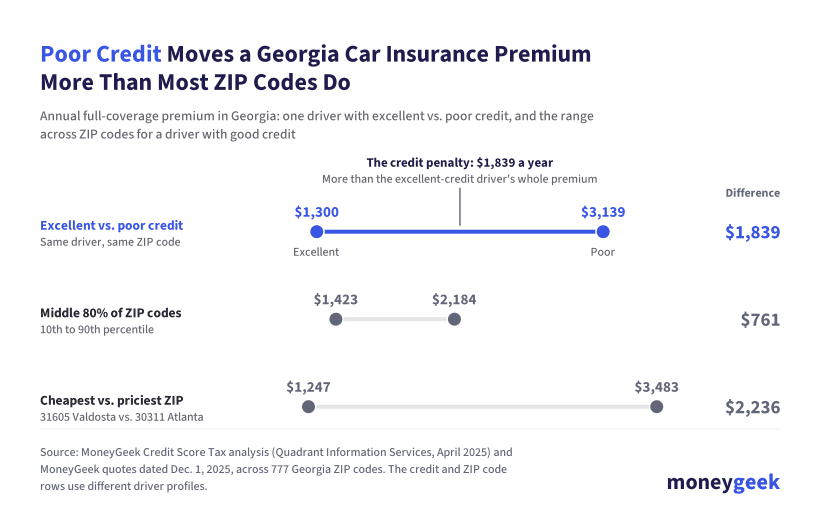
For most Georgia drivers, credit moves the premium more than ZIP code does. MoneyGeek's Credit Score Tax analysis found that a Georgia driver with poor credit pays $3,139 a year for full coverage, $1,839 more than the same driver with excellent credit, or about $153 a month. The penalty by itself is larger than the excellent-credit driver's entire $1,300 premium.
What Did Georgia's New Commissioner Promise?

Waites pledged to bar insurers from using ZIP codes and credit scores in pricing, to speed up claims payments and to effectively freeze some auto and homeowners rates, Insurance Journal reported. She takes office in January, replacing King, whom Gov. Brian Kemp appointed in 2019 and who won a full term in 2022.

Most of that agenda needs the General Assembly. Then-state Sen. Nabilah Islam Parkes, a Democrat, filed all three ideas as bills in February 2026:

  • SB 505 would require the commissioner to approve private passenger auto and homeowners rates before insurers use them.
  • SB 506 would bar auto insurers from using any geographic classification, including ZIP codes, to set rates.
  • SB 507 would prohibit insurers from using credit information and credit scores in underwriting and rating.

The Senate referred all three to committee on Feb. 17, 2026. None received a vote, and all three died when the 2025-2026 session ended. Any version would have to be filed again when the new General Assembly meets in January.

What Would a Credit and ZIP Code Ban Touch?

Experian reports four states that bar auto insurers from using credit in pricing: California, Hawaii, Massachusetts and Michigan. Maryland, Oregon and Utah limit how insurers use it. Georgia would be the fifth state with a ban if one passed.

Poor credit adds $1,839 a year in Georgia; most ZIP codes vary by $761 or less.

Across most of Georgia, ZIP code moves a premium less than the $1,839 credit penalty. In MoneyGeek's Dec. 1, 2025, quotes for a driver with good credit, the median Georgia ZIP code paid $1,582 a year for full coverage. The middle 80% of ZIP codes ranged from $1,423 to $2,184, a spread of $761.

The extremes are wider. ZIP code 30311 in southwest Atlanta was the most expensive in Georgia at $3,483 a year, 2.79 times the $1,247 quoted in 31605 in Valdosta, the least expensive.

A ban would move costs among drivers. Insurers would still expect the same claims and would price them through the rating factors left. Drivers with poor credit or in high-cost ZIP codes would likely pay less, and some drivers with excellent credit or in low-cost areas would pay more. MoneyGeek's data can't estimate what prices would look like after a ban. Drivers can check what they pay now against average car insurance costs in Georgia.

Where Do Long-Term Care Insurers Get the Least of What They Ask For?

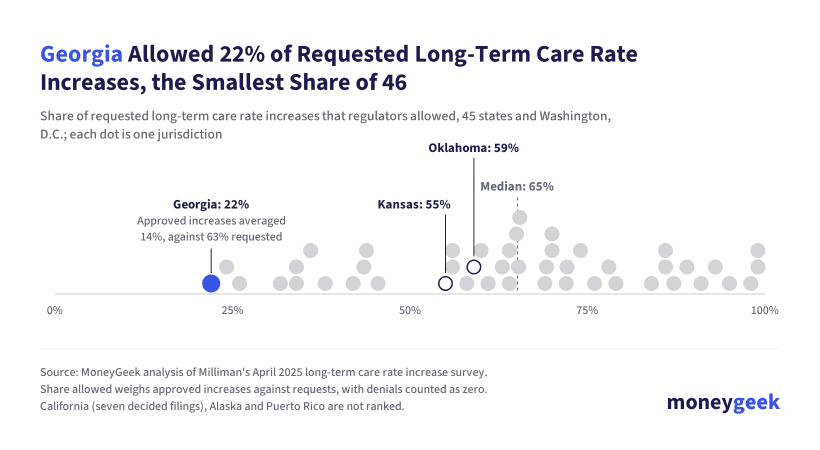
In Georgia. When long-term care insurers asked to raise rates, the department Waites takes over let through 22% of what they requested, the smallest share of 46 jurisdictions MoneyGeek ranked in its long-term care rate increase study. The median jurisdiction allowed 65%. Georgia also moved quickly, approving filings in an average of three months.

Georgia allowed 22% of requested long-term care hikes; the median of 46 was 65%.

Waites' rate-freeze pledge covers auto and homeowners policies. On long-term care, Georgia approved all 33 of its decided filings in Milliman's April 2025 survey at an average increase of 14%, against an average request of 63%. The department approves the filing and cuts the increase.

What Do the Other Three New Commissioners Inherit?

Oklahoma, Kansas and California also elected insurance commissioners on Nov. 3. Credit moves auto prices more than ZIP code in Oklahoma and Kansas too, and both states had higher homeowners premiums than Georgia in 2022.

Georgia
Keisha Sean Waites (D)
$1,839
$761
22% (smallest of 46)
$1,851 (20th)
Oklahoma
Bob Sullivan (R)
$2,008
$353
59% (17th-smallest)
$2,742 (3rd)
Kansas
Dan Hawkins (R)
$2,179
$190
55% (13th-smallest)
$2,425 (6th)
California
Jane Kim (D), leading
Banned
Not analyzed
Not ranked (7 decided filings)
$1,700 (28th)

Homeowners figures are inflation-adjusted Treasury Federal Insurance Office data that end in 2022 and exclude residual-market plans such as California's FAIR Plan.

oklahoma icon
OKLAHOMA

Republican Bob Sullivan won the open seat with 59% of the vote, Insurance Journal reported. He succeeds Glen Mulready and said he looks forward to "working alongside the Legislature to get prices down, increase transparency and more competition." Oklahoma's homeowners premium was third-highest in 2022 but grew only 1.2% above inflation from 2018 to 2022.

kansas icon
KANSAS

Republican Dan Hawkins, the outgoing House speaker, beat Democratic state Sen. Dinah Sykes 49% to 47% in complete but unofficial results, Sunflower State Journal reported. A Hawkins spokesperson told the paper he "remains focused on his plan to make insurance more accessible and affordable for all Kansans."

california icon
CALIFORNIA

Democrat Jane Kim declared victory over fellow Democrat Ben Allen on Nov. 6. She led 52.7% to 47.3%, SF Standard reported. Allen had not acknowledged the result publicly, no major outlet had called the race, and California counts mail ballots for weeks after Election Day. The winner replaces term-limited Commissioner Ricardo Lara.

Kim has proposed a public disaster insurance program that would guarantee wildfire coverage, and she has acknowledged it could take years to launch, CalMatters reported. California's homeowners premiums grew 22.0% above inflation from 2018 to 2022, second only to Colorado's. California homeowners can compare their premiums with average home insurance costs in California.

What Changes When Waites Takes Office?

No one's premium changes on inauguration day. Commissioners review rate filings, enforce claims rules and set regulations within the authority their legislatures give them. In Georgia, a credit or ZIP code ban or a prior-approval requirement would need the General Assembly to pass a bill in 2027.

Georgia drivers and policyholders can act before any of that:

  1. 1
    Compare quotes from several insurers.

    The poor-credit penalty differs by company, and some insurers weigh credit less than others. MoneyGeek's cheapest car insurance in Georgia rankings show which companies charge less for each driver profile.

  2. 2
    Ask your insurer to rerun your rate when your credit improves.

    Georgia allows credit-based pricing, and a better score can lower the next premium.

  3. 3
    Review a long-term care rate increase notice before the deadline.

    Many notices offer a smaller benefit in exchange for a smaller increase, and missing the deadline usually means the full increase takes effect.

Waites takes office in January able to review rates but not to take credit scores out of them. That takes a bill, and the last one, SB 507, never got a committee vote.

Methodology

MoneyGeek compared the four states that elected insurance commissioners on Nov. 3, 2026: California, Georgia, Kansas and Oklahoma. Election results are unofficial as of Nov. 6, 2026. Georgia's come from the Georgia Secretary of State's results site (all 159 counties reporting). Kansas' come from Sunflower State Journal. Oklahoma's come from Insurance Journal. California's come from SF Standard (Nov. 6).

About Nathan Paulus


Nathan Paulus, Head of Content and SEO, MoneyGeek

Nathan Paulus is the Head of Marketing and Brand Partnerships at MoneyGeek, where he leads content strategy and conducts original data research across insurance, consumer costs, transportation safety, housing, public policy and personal finance. He reviews studies for methodology, source quality and factual accuracy.

Research and Analysis

In more than six years at MoneyGeek, Nathan has published more than 100 original studies and explanatory guides. His insurance research includes 50-state comparisons of health care outcomes, costs and access, and an analysis of how uninsured rates track with state Medicaid expansion decisions and electoral patterns. 

He has analyzed full-coverage auto rates across major insurers in all 50 states and tracked how premium trends relate to industry underwriting losses. That research draws on combined ratio data from Fitch Ratings and AM Best, plus the Bureau of Labor Statistics CPI figures. Beyond insurance, his work spans vehicle pricing trends across the U.S. new car market, summer traffic fatality rates by state, homeowner underinsurance ratios using mortgage and policy data, and housing affordability across all 50 states.

His research has been cited by Bloomberg, the Los Angeles Times, Forbes, Fast Company, the San Francisco Chronicle, USA Today and NBC Los Angeles. Harvard, MIT, Stanford and Yale have referenced his work.

Career

Nathan traces his interest in personal finance back to his grandmother, who ran her household on a simple rule: spend less than you make and save the difference before anything else. That rule shows up in his work today. His writing skips jargon and complex strategy in favor of the basics that help someone living paycheck to paycheck.

He joined MoneyGeek in July 2020 as Director of Content Marketing, where he led the content team and oversaw data journalism production across insurance and personal finance verticals. A promotion to Head of Marketing and Communications followed in December 2023. The new role added digital PR and communications strategy to his responsibilities. He was appointed Head of Content and SEO in January 2025.

Before MoneyGeek, Nathan served as Director of Content Marketing and SEO at Ventrix Advertising, where he helped build two content sites from scratch, contributed to link-building programs that generated more than 1,500 unique referring domains within a year and co-managed a marketing team of more than 20 people. Two and a half years at ABUV Media preceded that role. He advanced from Marketing Research Analyst to Senior Marketing Tactics Analyst, where he built expertise in audience research, content strategy and SEO.


Sources