



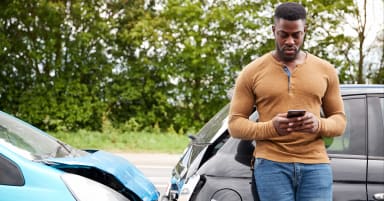
Liability coverage pays for damage you cause to another driver's vehicle when you're at fault. Most states require property damage liability as part of minimum coverage, covering repair or replacement costs for the other driver's car, truck, or motorcycle. Without it, you pay those costs out of pocket.
State minimum limits are routinely below the cost of modern vehicles. If your property damage liability limit is $25,000 and you total a $52,000 pickup truck, your insurer pays $25,000. You owe the remaining $27,000 personally. The other driver can sue you for it. A judgment can lead to wage garnishment or a lien on your home. Check your declarations page before assuming you're covered for what's in the lane next to you.
Does Car Insurance Cover Damage I Cause to Other Vehicles?
Updated: June 3, 2026
Advertising & Editorial Disclosure
Key Takeaways: Liability Coverage for Damage You Cause
Property damage liability coverage pays for damage you cause to other drivers' vehicles when you're at fault. It does not pay for damage to your own vehicle.
Your property damage liability limit caps what your insurer pays. Any repair costs above that limit come out of your pocket.
Most state minimums are not enough. A $25,000 property damage limit won't cover a totaled newer SUV. You owe the difference personally.
Liability coverage has no deductible. Filing costs you nothing up front. The risk is rate impact at renewal.
When Liability Coverage Pays for Damage to Other Vehicles

MONEYGEEK EXPERT TIP
"Liability coverage is the most foundational protection a driver carries. When you cause an accident, the other driver's damages are your financial responsibility. Liability coverage is what stands between you and a lawsuit."
- Mark Fitzpatrick, Licensed Insurance Agent
What Liability Insurance Covers — and What It Doesn't
Liability pays in these covered situations:
- You rear-end another vehicle at a stoplight and damage their bumper or trunk
- You run a red light and hit a car crossing the intersection
- You sideswipe a parked car and scrape the door or mirror
- You cause a chain reaction crash and damage two or more cars
Liability coverage does not pay in these situations:
The other driver was at fault. Their liability coverage pays for your damage.
Damage to your own vehicle. You need collision coverage for that.
You're driving a vehicle you aren't listed on. Coverage may not apply depending on the policy and how frequently you drive that vehicle.
You had a rideshare or delivery app open at the time. If you were using Uber, Lyft, or DoorDash when the accident happened, your personal liability coverage will likely be denied. Personal auto policies exclude commercial use. Filing a claim without disclosing app use may void coverage retroactively. If you drive for any gig platform, confirm your insurer has added a rideshare endorsement before your next trip.
The key distinction is fault. Liability coverage follows you as the at-fault driver. If you didn't cause the accident, it's the other driver's liability coverage that pays for your repairs.
How Your Liability Limits Affect What Gets Paid
Your property damage liability limit is the maximum your insurer pays for damage you cause to another vehicle or property in a single accident. Most policies state this as a split limit such as 25/50/25: $25,000 per person for bodily injury, $50,000 per accident for bodily injury, and $25,000 for property damage. Some policies use a combined single limit that applies to all damages in one accident.
State minimum property damage limits run from $5,000 to $25,000. A newer car can cost $15,000 to repair without being totaled. Totaling one can push past most state minimums even on an older model. Carrying at least $100,000 in property damage liability cuts your personal exposure on a serious accident. If you own a home or have savings, an umbrella policy adds $1 million or more on top of your auto policy limits.

ARE STATE MINIMUM LIABILITY LIMITS ENOUGH?
The average new vehicle costs over $49,000. State minimum property damage limits run from $5,000 to $25,000 in most states. At those levels, a single total-loss claim leaves you personally exposed for the difference.
Most insurance experts recommend at least $100,000 in property damage liability. If you own a home or have savings, an umbrella policy adds $1 million or more on top of your auto limits. Check your declarations page today. If your property damage limit is below $100,000, raising it is the most cost-effective coverage change you can make.
Do You Pay a Deductible When Liability Coverage Pays for Another Vehicle?
No. Deductibles apply only to collision and comprehensive coverage, which pay for damage to your own vehicle. When your liability coverage handles the other driver's repairs, your insurer pays from the first dollar up to your policy limit.
Your deductible does apply if you want your own vehicle repaired through your collision coverage after an at-fault accident. If your collision deductible is $500 and your repair estimate is $3,200, you pay $500 and your insurer covers $2,700. Check your declarations page or your insurer's app to confirm your deductible amount before you call.
One exception: in states that require a deductible for uninsured motorist property damage, you may pay a smaller deductible before that separate coverage starts. The range is $100 to $250.
Should You File a Claim When You Cause Damage to Another Vehicle?
File if the damage to the other vehicle exceeds a few hundred dollars. Liability coverage has no deductible, so filing costs you nothing up front.
Whether filing is worth the rate impact depends on your insurer's lookback window. MoneyGeek's cost data shows an average rate increase of 24% after an at-fault claim. Progressive and GEICO use a three-year lookback window. State Farm and Allstate look back five years. On a $150-per-month policy, 24% is $36 more per month. Over three years at Progressive or GEICO, that's $1,296 in cumulative rate increases. Over five years at State Farm or Allstate, it's $2,160. A $1,200 repair claim can cost you more in rate increases than the repair itself.
Pay out of pocket only if the damage is a minor scratch or small dent you can settle directly for under a few hundred dollars, and you're confident the other driver won't escalate. For anything with a formal repair estimate above $1,000, file.
Call your insurer and ask for the estimated rate impact before submitting. They are required to tell you. Do not wait more than a day. Most insurers expect same-day notification for at-fault accidents.
How to File a Claim After You Cause Damage to Another Vehicle
Getting the right information at the scene helps at-fault claims move faster. Here's how to handle a third-party property damage claim step by step:
- 1Stay at the Scene
Leaving the scene of an accident you caused is a criminal offense in every state and can result in felony charges if there are injuries. Stay until the situation is resolved.
- 2Call 911
Call if there are injuries or if damage is significant. A police report creates an official record of fault your insurer will need.
- 3Exchange Information
Get the other driver's name, contact details, license plate, insurance company and policy number.
- 4Document the Damage
Photograph both vehicles from multiple angles, license plates, the full scene and any skid marks or debris.
- 5Notify Your Insurer the Same Day
Most major insurers accept claims through their mobile app or 24/7 claims hotline. State Farm, GEICO and Progressive all offer both. Check your policy's reporting requirement. Late reporting can give your insurer grounds to deny the claim.
- 6Let Your Insurer Handle the Other Driver
You don't need to negotiate repairs yourself. Your insurer contacts the other driver directly once you file.
If the other party files a claim directly with your insurer, you don't need to file separately. Your insurer will contact you for your account of the accident.
Will an At-Fault Claim Raise Your Rates?
Yes, and how long you pay depends on your insurer. MoneyGeek's cost data shows an average rate increase of 24% after an at-fault accident. Progressive and GEICO use a three-year lookback. State Farm and Allstate look back five years. A first at-fault accident on an otherwise clean record produces a smaller increase than a second or third claim.
Some insurers offer accident forgiveness that prevents your first at-fault accident from raising your rate. Eligibility rules differ by insurer:
- GEICO: Free after five consecutive accident-free years for drivers over 21. Not available in California, Connecticut, or Massachusetts. Can be purchased as an add-on.
- Progressive: Claims under $500 are covered automatically for new customers at no charge. Covering a larger claim requires five years of accident-free history with Progressive specifically.
- Allstate: Requires three accident-free years on its Gold plan. The Platinum plan provides immediate coverage upon enrollment for an additional cost.
Call before your next renewal to confirm whether accident forgiveness is on your policy. Asking after an accident is too late. If you're deciding whether to file, ask your insurer for the estimated rate impact before you submit.
Liability Coverage for Other Vehicles: Bottom Line
Your property damage liability coverage pays for damage you cause to other vehicles up to your policy limit. Anything beyond that is your personal responsibility.
Do two things before you need it: confirm your property damage liability limit is at least $100,000, and ask your insurer whether accident forgiveness is on your policy. Both calls take under 10 minutes. Finding out your limit was $25,000 after you total a $50,000 truck is not a recoverable situation.
Does Car Insurance Cover Damage to Other Vehicles: FAQ
If your property damage liability limit is lower than the other driver's repair costs, you pay the difference out of your own pocket. The other driver can take you to civil court for the remaining balance, and a judgment against you can lead to wage garnishment or liens on your property. Higher liability limits or an umbrella policy protect you from that outcome.
Your property damage liability coverage applies to all vehicles you damage in a single accident, but your insurer won't pay more than your per-accident limit in total. If you damage three cars and the combined repair costs add up to $60,000, but your limit is $25,000, your insurer pays $25,000, split across all three claims. You'd owe the remaining $35,000 out of pocket.
Coverage follows the car, not the driver, in most cases. If you borrow a friend's car and cause an accident, their liability coverage pays for the other driver's vehicle damage first. Your own policy may act as secondary coverage if the damages exceed their limits. You won't be covered if you're excluded from their policy by name or if you're a regular user of that vehicle who was never added to their policy.
In most states, each driver's insurer pays proportional to their share of fault. There are some states, including Alabama, Maryland, North Carolina, Virginia and Washington D.C., where contributory negligence rules mean any fault on your part can bar you from recovering damages entirely. Your insurer determines fault percentages using the police report, photos and witness statements.
Yes. Property damage liability covers damage you cause to any property, not just vehicles. If you run into someone's fence, hit a utility pole or damage a storefront, your property damage liability coverage pays for repairs or replacement up to your policy limit.
Non-renewal after a single at-fault accident is uncommon but possible, especially with multiple prior claims or a severe accident. Insurers review your full record at renewal. If they choose not to renew, you'll receive advance notice, typically 30 days. The General and Dairyland specialize in high-risk drivers and are worth quoting if your insurer non-renews.
MoneyGeek's editorial team researched liability coverage rules using state insurance department publications, standard auto policy language from major insurers and interviews with licensed insurance professionals. Coverage information reflects standard personal auto policy terms and does not account for all policy endorsements or state-specific variations.
Rate impact data comes from Quadrant Information Services. Cost ranges represent typical outcomes and vary based on your insurer, driving history, location and coverage selections.




About Mark Fitzpatrick

Mark Fitzpatrick, a licensed Property and Casualty (P&C) Insurance Producer in Connecticut, is MoneyGeek's resident insurance expert. He has spent nearly a decade analyzing the market, first at LendingTree and now at MoneyGeek, where he produces original research on hundreds of carriers and millions of rates across auto, home, renters, health and life insurance.
He covers economics and insurance at MoneyGeek, and his work has been featured in The Washington Post, The New York Times and NPR, among other outlets.
Like all MoneyGeek analysts, he draws on independent cost and consumer experience data. No insurance company partnership influences his recommendations.
Mark holds a B.A. from Boston College and an M.A. in Economics and International Relations from Johns Hopkins University. He started his career in financial risk management at State Street and is also a five-time “Jeopardy!” champion.