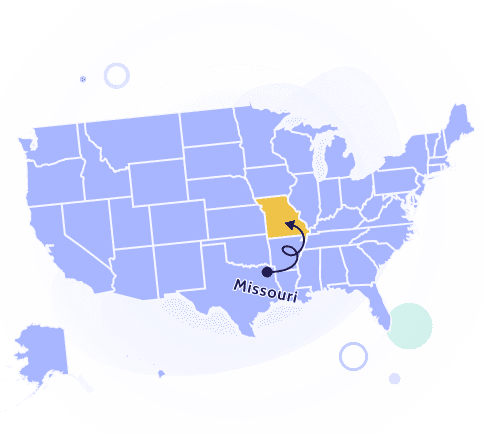




Missouri's best car insurance company will be different for every driver because it depends on your driver profile, location, and what you need from a policy. The right pick shifts based on your age, driving history, where you live, and how much coverage you're carrying.
Best Car Insurance in Missouri for 2026
Updated: August 15, 2026
Advertising & Editorial Disclosure
Our Experience Reviewing Missouri's Top Car Insurers
 Auto-Owners: Best Overall in Missouri
If you have a clean driving record and want the lowest possible full coverage rate in Missouri, Auto-Owners is the answer most of the time. At $97/month ($22 less than Progressive and $15 less than Farm Bureau) the savings compound to $264–360/year without sacrificing service quality. That rate advantage matters most for Missouri drivers who carry full coverage on a paid-off vehicle, where the math on switching carriers is purely about price and claims experience. Auto-Owners ranks #1 on both, which is why it leads the state rankings. But you can't get a quote or binding policy online — every transaction goes through an independent agent. For drivers who handle everything digitally, that friction is real. But for drivers who already work with an independent agent for home or life insurance, it often costs nothing extra in time.
- Travelers: Best Runner-Up for Price and Service
Travelers sits $4/month above Auto-Owners at $101/month — a gap small enough that the deciding factor between the two is almost never price. What Travelers offers instead is full digital access: you can quote, bind, and manage your policy entirely online, file claims through the app, and never speak to an agent if you don't want to. Travelers also offers Premier New Car Replacement coverage, which pays the full replacement cost of a totaled new vehicle rather than its depreciated value. On a $35,000 car in its first two years, that difference can exceed $8,000–10,000 over what standard comprehensive and collision would pay. Drivers who financed recently and want that protection from a carrier with strong digital infrastructure will find Travelers the most practical fit.
 Progressive: Best for Coverage Breadth
Progressive's strongest case in Missouri isn't about price — at $118/month it's the most expensive of the five — it's about who needs coverages the other four carriers don't offer. Gap insurance and rideshare endorsements are available only through Progressive among Missouri's top five. If you're financing a vehicle and owe more than it's currently worth, gap insurance is the coverage that pays the difference between your loan balance and the insurance payout after a total loss; without it, you could owe $3,000–8,000 out of pocket on a car you no longer own. If you drive for Uber or Lyft, Progressive's endorsement is a fraction of what a commercial policy would cost. For drivers who don't need either of those coverages, the $9–21/month premium over GEICO and Farm Bureau is harder to justify. But for drivers who do, no other top-five Missouri carrier offers both in a single policy.
 GEICO: Best for Straightforward Minimum Coverage
GEICO's advantage is narrow, but it's the cheapest option among Missouri's top five for drivers who want minimum coverage and nothing else. At $42/month for minimum coverage — $2 less than Farm Bureau and $4 less than Travelers — GEICO is the default answer for drivers who are legally required to carry insurance, own their vehicle outright, and aren't worried about coverage depth. The trade-off is when something goes wrong. GEICO's complaint index runs above the Missouri market average, meaning more customers report problems with claims handling, billing, and responsiveness relative to its size than at Auto-Owners or Travelers. In a state where roughly 1 in 5 drivers is uninsured and hail season runs April through June along the I-44 corridor, the odds of needing to file a claim are decent. Drivers who are comfortable accepting that trade-off in exchange for the lowest minimum rate will find GEICO competitive. Drivers who aren't should budget the extra $2–5/month for Travelers or Auto-Owners.
- Farm Bureau: Best for Missouri Regional Loyalty
Farm Bureau's edge is geographic and relational rather than statistical. In rural Missouri counties, national carrier agent networks thin out, and online-only carriers offer no local presence at all. A Farm Bureau agent in a rural county can file a claim on your behalf, follow up with adjusters directly, and show up in person after a hail or tornado event when online carriers' phone queues stretch to hours. At $112/month for full coverage, Farm Bureau is $15 more than Auto-Owners but $6 less than Progressive, putting it in a reasonable middle band on price. But the coverage limitation is hard to ignore: at 8 of 13 tracked coverages, Farm Bureau doesn't offer gap insurance, rideshare endorsements, or new car replacement, so drivers who need any of those three have to look elsewhere. For drivers who own their vehicle outright, don't drive for rideshare, and want a carrier with a physical presence in their community, Farm Bureau is a reasonable fit. For everyone else, the coverage gaps may be too significant to overlook.
Best Car Insurance Companies in Missouri: Scores and Methodology
| Auto Owners | 4.86 | 1 | 1 | 6 |
| Travelers | 4.83 | 2 | 2 | 5 |
| Progressive | 4.63 | 5 | 3 | 2 |
| GEICO | 4.55 | 3 | 6 | 7 |
| Farm Bureau | 4.47 | 4 | 4 | 8 |
Why You Can Trust MoneyGeek's Missouri Ratings
MoneyGeek evaluated insurance companies in Missouri, including national carriers and Missouri regional insurers. Rankings combine rate analysis, customer feedback, and coverage assessments across three weighted factors. MoneyGeek does not receive compensation tied to which companies rank highest. Rate data comes from Quadrant Information Services, which sources actual insurance filings across every ZIP code.
Affordability (60% of total score): Rate quotes were gathered for multiple driver profiles using a baseline 40-year-old male driver with good credit, a clean driving record, and no prior claims. Quotes covered full coverage at 100/300/100,000 limits with a $1,000 comprehensive and collision deductible, plus state-minimum coverage. Additional quotes covered young drivers and senior drivers. Driver profiles with violations were also tested, including DUI convictions, at-fault accidents, and speeding tickets, to measure how each carrier prices each category. Affordability scores reflect the carrier's performance across all of these driver profiles, with a baseline adult-driver clean-record rate weighted most heavily.
Customer experience (30% of total score): Customer satisfaction data was compiled from J.D. Power studies (including the 2025 U.S. Auto Insurance Study and the 2025 U.S. Auto Claims Satisfaction Study), AM Best financial strength ratings, and multi-platform review aggregation. NAIC complaint indexes also feed the composite score. J.D. Power scores shown in each carrier section are one input to the composite, not the full ranking.
Coverage options (10% of total score): Coverage scoring measures each provider's range of coverage types and Missouri-specific add-on availability. Standard coverages (bodily injury liability, property damage liability, uninsured motorist coverage, medical payments coverage, comprehensive, collision coverage) are included in the baseline score. Add-on coverages weighted in the score include accident forgiveness, new car replacement, rideshare endorsements, gap insurance, custom parts coverage, mechanical breakdown insurance, and pay-per-mile or telematics-based programs. Coverages restricted or unavailable under state law are excluded from the score for all carriers.
Rates and rankings on this page reflect a 40-year-old male driver with good credit and a clean record. Full coverage rates use 100/300/100,000 liability limits with a $1,000 comprehensive and collision deductible. Minimum coverage rates use Missouri's mandatory 25/50/25 liability limits without comprehensive or collision.
USAA is excluded from all rankings because it is available only to military members and their families, which limits its accessibility for most readers.
Similar scores can reflect very different strengths in Missouri:
- Auto-Owners and Travelers score nearly identically (4.86/5 vs. 4.83/5), but Auto-Owners leads on affordability rank (#1 vs. #2) while Travelers offers stronger digital tools and national brand support.
- Progressive scores 4.63/5 and ranks #2 in coverage breadth, ahead of both GEICO and Farm Bureau, but ranks #5 in affordability, meaning drivers pay more for that wider coverage menu.
- GEICO ranks #3 in affordability but #6 in customer experience, the weakest CX rank among the top five; Farm Bureau inverts that pattern with a #4 CX rank but a narrower coverage score.

WHAT'S DIFFERENT ABOUT CAR INSURANCE IN MISSOURI
Nearly 1 in 5 Missouri drivers carries no insurance — more than twice the rate in states like Maine or New York. Missouri law already requires uninsured motorist coverage at $25,000 per person and $50,000 per accident, but the bigger risk is the underinsured driver: if someone with the state minimum hits you and you have $80,000 in medical bills, their policy covers less than a third. Optional underinsured motorist coverage pays the difference, and in a state where uninsured drivers are this common, the ones who do carry insurance often carry the bare minimum.
Missouri is an at-fault state, so after a crash you recover from the driver who caused it — not automatically from your own insurer. If fault is disputed, Missouri's comparative negligence rule reduces your payout by your share of blame: 30% responsible on a $50,000 claim means you collect $35,000.
Missouri also averages 35 to 40 tornadoes per year, concentrated along the I-44 corridor, with hail season running April through June statewide. Neither tornado damage nor hail is covered by collision — only comprehensive covers weather events. Dropping comprehensive to save $30–60/month means a single hail storm becomes entirely out of pocket. For most Missouri drivers outside the low-risk northern counties, that's a trade-off that rarely pays off.
If you're in the St. Louis metro, theft rates and traffic density push rates above the state average — compare ZIP-code-level rates at the cheapest car insurance in St. Louis.
Best Missouri Car Insurance Company Ratings

Auto-Owners
Best Overall in Missouri
MoneyGeek Rating
4.9/ 5
4.9/5Affordability Score
4.9/5Customer Experience Score
3.8/5Coverage Score
Average Monthly Full Coverage Rate
$97Average Monthly Minimum Coverage Rate
$38J.D. Power Auto Insurance Study Score
654 (above region average)

Travelers
Best Runner-Up for Price and Service
MoneyGeek Rating
4.8/ 5
4.9/5Affordability Score
4.8/5Customer Experience Score
3.9/5Coverage Score
Average Monthly Full Coverage Rate
$101Average Monthly Minimum Coverage Rate
$40J.D. Power Auto Insurance Study Score
585 (below region average)

Progressive
Best for Coverage Breadth
MoneyGeek Rating
4.6/ 5
4.4/5Affordability Score
4.7/5Customer Experience Score
4.7/5Coverage Score
Average Monthly Full Coverage Rate
$118Average Monthly Minimum Coverage Rate
$46J.D. Power Auto Insurance Study Score
637 (below region average)

GEICO
Best for Straightforward Minimum Coverage
MoneyGeek Rating
4.5/ 5
4.7/5Affordability Score
4.2/5Customer Experience Score
3.6/5Coverage Score
Average Monthly Full Coverage Rate
$109Average Monthly Minimum Coverage Rate
$42J.D. Power Auto Insurance Study Score
641 (below region average)

Farm Bureau
Best for Missouri Regional Loyalty
MoneyGeek Rating
4.5/ 5
4.6/5Affordability Score
4.5/5Customer Experience Score
3.4/5Coverage Score
Average Monthly Full Coverage Rate
$112Average Monthly Minimum Coverage Rate
$44J.D. Power Auto Insurance Study Score
645 (below region average)
Rates at Missouri's Best Car Insurance Companies
Missouri car insurance rates vary by carrier, driver profile, and ZIP code. The Missouri full coverage state average runs approximately $119/month, which is above the national average of approximately $112/month. Urban drivers in St. Louis and Kansas City pay more than rural Missouri drivers due to higher claim frequency, theft rates, and traffic density. The table below shows full and minimum coverage monthly rates for Missouri's top-ranked carriers compared to state and national averages.
Auto-Owners | $97 | $38 | ~18% below |
Travelers | $101 | $40 | ~15% below |
Progressive | $118 | $46 | ~1% below |
Geico | $109 | $42 | ~8% below |
Farm Bureau | $112 | $44 | ~6% below |
Missouri State Average | $119 | $47 | — |
National Average | $112 | $44 | — |
Missouri's full coverage state average of approximately $119/month is above the national average of approximately $112/month. St. Louis metro drivers typically pay 15% to 25% above the state average due to higher theft rates, traffic density, and claim frequency, while drivers in rural southern Missouri often pay below the state average. Use the Missouri car insurance calculator to estimate where your specific profile and ZIP code land in that spread.
Coverage Options at Missouri's Best Car Insurance Companies
Missouri requires $25,000 per person, $50,000 per accident, and $25,000 in property damage liability, plus uninsured motorist coverage at the same injury limits. Your own medical bills aren't covered unless you add medical payments coverage separately. If you're anywhere near the I-44 corridor, don't drop comprehensive — it's the only coverage that pays for hail and tornado damage, which are Missouri's most common non-collision losses.
Bodily injury liability | ✓ | ✓ | ✓ | ✓ | ✓ |
Property damage liability | ✓ | ✓ | ✓ | ✓ | ✓ |
Comprehensive | ✓ | ✓ | ✓ | ✓ | ✓ |
Collision | ✓ | ✓ | ✓ | ✓ | ✓ |
Uninsured/underinsured motorist | ✓ | ✓ | ✓ | ✓ | ✓ |
Medical payments / PIP | ✓ | ✓ | ✓ | ✓ | ✓ |
Roadside assistance | ✓ | ✓ | ✓ | ✓ | ✓ |
Rental reimbursement | ✓ | ✓ | ✓ | ✓ | ✓ |
Accident forgiveness | ✓ | ✓ | ✓ | ✓ | — |
New car replacement | — | ✓ | — | — | — |
Rideshare coverage | — | — | ✓ | — | — |
Gap insurance | — | — | ✓ | — | — |
Custom parts coverage | ✓ | — | ✓ | — | — |
Coverage total | 10/13 | 10/13 | 12/13 | 9/13 | 8/13 |
All five of Missouri's top-ranked carriers offer comprehensive coverage, which pays for tornado and hail damage, the two weather perils most relevant to Missouri drivers. Missouri averages 35 to 40 tornadoes per year, concentrated along the I-44 corridor and in southern Missouri. A tornado that totals a $25,000 vehicle is entirely uncovered without comprehensive — collision coverage doesn't apply to weather damage. Comprehensive typically adds $30–60/month to a Missouri full coverage policy; for a driver in a high-exposure county, that premium buys protection against a loss that would otherwise require replacing the vehicle entirely out of pocket.
Missouri's mandatory 25/50 uninsured motorist coverage under RSMo Section 303.030 is a floor, not a ceiling. With roughly 1 in 5 Missouri drivers carrying no liability coverage, the optional underinsured motorist (UIM) add-on is worth carrying at limits above the state minimum. All five top-ranked carriers offer UIM stacking variants as an add-on in Missouri, though availability and pricing differ. Collision coverage is most relevant for drivers with financed vehicles or newer cars where the vehicle's value justifies the additional premium.
Progressive's Snapshot telematics program is the most distinctive add-on among Missouri's top five. It allows low-mileage or safe-driving Missouri motorists to reduce premiums based on actual driving behavior, a meaningful option for drivers who work from home or drive below the Missouri average of approximately 14,000 miles per year. Travelers' Premier New Car Replacement endorsement is the second most distinctive add-on, covering full replacement cost on totaled new vehicles in the first five years.
How to Use These Rankings to Find Your Best Missouri Carrier
The right Missouri carrier depends on your driver profile, location, and coverage priorities. Use the decision points below to match your situation to the top-ranked option.
 If price is your top priority:
Auto-Owners delivers the lowest full coverage rate among Missouri's top-ranked carriers at approximately $97/month, about 18% below the Missouri state average. Minimum coverage runs approximately $38/month. For a deeper look at the cheapest options across all Missouri carriers, see the cheapest Missouri car insurance breakdown.
 If you want the best Missouri claims experience:
Auto-Owners ranks #1 in customer experience among Missouri's top five, reflecting a below-average NAIC complaint index and strong claims handling signals. Travelers ranks #2 in customer experience and is a strong alternative for drivers who also want online policy management. Both carriers consistently outperform GEICO and Farm Bureau on customer experience measures in Missouri.
- If you want the best balance of price and coverage:
Auto-Owners tops Missouri's rankings with a 4.86/5 MoneyGeek composite score, combining the lowest full coverage rate with the strongest customer experience record. Its diminishing deductible program adds long-term value for Missouri drivers who maintain clean records, and its rate advantage over Travelers is modest but consistent across adult driver profiles.
 If you have a young driver in your household:
Travelers is among the most competitive carriers for young Missouri drivers, with rates that stay below the state average even for drivers under 25. Adding a young driver to an existing policy is typically cheaper than a standalone policy. See the best home and auto bundle in Missouri for multi-policy discount options.
- If you have a DWI or violation on your record:
Progressive is among the most competitive Missouri carriers for drivers with a DWI conviction, with rates that are more favorable than Auto-Owners or Travelers for nonstandard profiles. In Missouri a DWI conviction triggers a two-year SR-22 filing requirement with the Missouri Department of Revenue. An SR-22 is a certificate your insurer files with the Missouri Department of Revenue confirming you carry the state minimum coverage. The filing itself typically costs $15–50 as a one-time fee, but the real cost is the high-risk surcharge it signals to your carrier. Most Missouri drivers with an SR-22 requirement see premiums rise $50–150/month above their pre-conviction rate for the full two-year filing period, adding $1,200–3,600 to total insurance costs over that window. For full rate comparisons, see DWI car insurance in Missouri and SR-22 insurance in Missouri.
 If you live in St. Louis:
St. Louis is Missouri's largest metro, with rates above the state average due to higher theft rates, traffic density, and urban claim concentration. Auto-Owners and Travelers are competitive for St. Louis drivers with clean records. For ZIP-code-level rate comparisons across all carriers, see cheapest car insurance in St. Louis.
- If you live in Blue Springs or the eastern Kansas City metro:
Eastern Kansas City metro rates run above rural Missouri due to traffic density and higher claim frequency. Auto-Owners and Travelers remain competitive in this area. For ZIP-code-level comparisons across eastern KC metro carriers, see cheapest car insurance in St. Louis.
Best Missouri Car Insurance: FAQ
Missouri requires 25/50/25 liability coverage per RSMo Section 303.190, which means $25,000 bodily injury per person, $50,000 per accident, and $25,000 property damage, plus mandatory uninsured motorist coverage at 25/50 per RSMo Section 303.030. Missouri is an at-fault state and does NOT require PIP; medical payments coverage and underinsured motorist coverage are optional. Given Missouri's 20.7% uninsured rate, underinsured motorist coverage is worth carrying even though it is not required.
Per RSMo Section 303.160, driving without insurance triggers license suspension and registration revocation. A first offense can result in reinstatement fees, possible court fines, and a 90-day to 1-year license suspension depending on circumstances. The Missouri Department of Revenue (DOR), Driver License Bureau, operates the Missouri Automated Insurance Verification System (MAIVS) for electronic enforcement.
Missouri's 20.7% uninsured rate is nearly 50% above the national average of approximately 14%, meaning about 1 in 5 Missouri drivers carry no liability coverage. Mandatory uninsured motorist coverage at 25/50 covers bodily injury liability losses from uninsured drivers; optional underinsured motorist coverage fills the gap when the at-fault driver has insufficient coverage. Both are materially more valuable in Missouri than in lower-uninsured states.
Missouri is an at-fault state with pure comparative negligence per RSMo Section 537.765. The at-fault driver's liability covers the other party's damages, and a plaintiff can recover even at 99% fault, with damages reduced proportionally. Missouri does NOT have a no-fault PIP layer. The 5-year statute of limitations for personal injury claims per RSMo Section 516.120 is among the longest in the country.
Per the Missouri Department of Revenue, a DWI-related suspension requires 2 continuous years of SR-22 filing. Other triggers include 2 years for accident judgment suspensions and 3 years from reinstatement eligibility for false insurance suspensions. A lapse in coverage triggers immediate license suspension. DWI car insurance in Missouri covers rates across more carriers, and SR-22 insurance in Missouri explains the filing requirement in detail.
Only comprehensive coverage pays for tornado or hail damage. Liability and collision coverage do not cover weather-related damage. Missouri averages roughly 35 to 40 tornadoes per year with substantial hail exposure along the I-44 corridor and southern Missouri. Drivers in Tornado Alley counties should think carefully before dropping comprehensive from their policy.
Sources
- J.D. Power. "2025 U.S. Auto Insurance Study." Accessed June 2026.
- J.D. Power. "2025 U.S. Auto Claims Satisfaction Study." Accessed June 2026.
- RSMo Section 303.190 — Provisions of Owner's Policy of Liability Insurance. Accessed June 2026.
- Missouri Department of Commerce and Insurance (DCI). "Motor Vehicle Insurance (Financial Responsibility)." Accessed June 2026.
- Insurance Information Institute (III). "Facts + Statistics: Uninsured motorists." Accessed June 2026.
- NOAA Storm Prediction Center. "Historical Tornado Data by State." Accessed June 2026.
For the complete breakdown of MoneyGeek's scoring weights and rate baseline construction, see our full auto insurance methodology.

About Mark Fitzpatrick

Mark Fitzpatrick is a licensed Property and Casualty (P&C) Insurance Producer in Connecticut and MoneyGeek's resident expert in insurance and economics. In nearly a decade covering the insurance market at LendingTree and MoneyGeek, he's analyzed hundreds of carriers and millions of rates across auto, home, renters, health and life insurance.
His work has appeared in The Washington Post, The New York Times and NPR. He draws on independent cost and consumer experience data, and no insurance company partnerships affect his recommendations.
Mark studied at Boston College and later earned a master's in economics and international relations from Johns Hopkins University. He worked in financial risk management at State Street before joining MoneyGeek. He's also a five-time “Jeopardy!” champion.