
Outside Investors Are Turning Small Business Lawsuits Into an Asset Class

Advertising & Editorial Disclosure

No federal rule requires a plaintiff to disclose whether an outside investor is funding a lawsuit. For a small business responding to a claim, that blind spot can shape settlement outcomes without the defendant ever knowing it. The arrangement is called third-party litigation funding, or TPLF: investors with no connection to a legal dispute provide money to plaintiffs or law firms in exchange for a share of the proceeds.

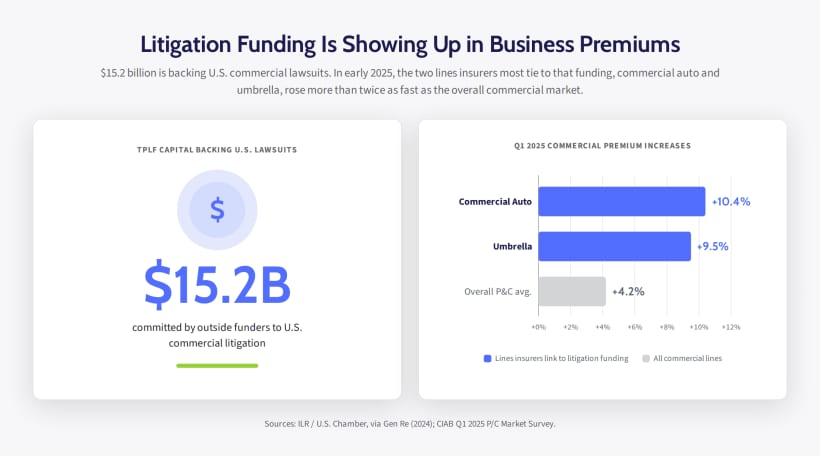
Commercial auto premiums rose 10.4% and umbrella premiums rose 9.5% in the first quarter of 2025, the two highest increases across all commercial lines, according to the Council of Insurance Agents and Brokers. Agents and brokers surveyed connected both increases to TPLF exposure. Even a business that is never sued can still pay for this trend through higher premiums, because insurers price TPLF-linked litigation risk into commercial lines across the board. Those 2025 pricing signals are already shaping small business insurance renewals heading into 2026.

mglogo icon
WHAT THE TPLF DATA SHOWS
  • Commercial auto premiums rose 10.4% and umbrella premiums rose 9.5% in Q1 2025, the two highest increases across all commercial lines. CIAB survey respondents connected both directly to TPLF exposure.
  •  Small businesses responding to a lawsuit usually have no way to see whether outside investors are backing the claim. No federal rule requires plaintiffs to disclose a litigation funder's involvement.
  • U.S. liability claims grew 57% over the past decade beyond what wages and medical costs explain, peaking at 7% annual growth in 2023. Swiss Re identifies TPLF as one of the structural forces behind that trend.
  •  Small businesses are less insulated from large verdicts than many assume. Swiss Re's 2025 behavioral study found a 25% nuclear verdict rate against small businesses, compared with 30% for large corporations, when plaintiff demands were high.
Chart showing $15.2B in U.S. litigation funding alongside Q1 2025 premium increases: commercial auto +10.4% and umbrella +9.5% versus a 4.2% commercial average

What Is Third-Party Litigation Funding?

Third-party litigation funding is a non-recourse financial arrangement. If the case fails, the plaintiff owes nothing back; if it succeeds, the funder takes 20% to 40% of the proceeds, plus interest that can compound at 20% or more per year. For how this exposure shows up in your small business insurance costs, see MoneyGeek's coverage guide.

TPLF originally took root in complex commercial litigation and class actions, where a single case can require millions in expert witnesses, discovery costs and legal fees over many years. Over the past decade, it has spread into personal injury cases: slip-and-fall incidents, motor vehicle accidents and product liability claims. One study of roughly 200,000 consumer TPLF cases from a single large funder found that about 59% involved motor vehicle accidents, according to Gen Re's August 2025 analysis citing Cornell Law Review research.

Burford Capital, one of the largest publicly traded litigation funders, reported 91% to 93% returns on concluded assets in its 2021 annual report, as cited by Gen Re, though returns vary widely by case and funder. Those returns are also uncorrelated with stock market performance, which makes litigation funding attractive to hedge funds and private equity firms looking for diversification. That investor appetite helps explain TPLF's rapid growth.

The $15.2 Billion Blind Spot Small Businesses Can't See

For small businesses, the defining feature of TPLF is that it's invisible. No federal rule requires plaintiffs to disclose a litigation funder's involvement to the opposing party. The plaintiff's attorney knows. The funder knows. The defendant, in most cases, doesn't.

That lack of disclosure matters most at the settlement stage. A business receiving a settlement demand may have no idea that a funder with a 30% stake has set minimum return thresholds that block any resolution below them. Gen Re's analysis describes the result: plaintiffs who have taken advance money need larger settlements to repay the funder after attorney fees, which makes early resolution less likely regardless of case merit.

The scale of funded litigation campaigns became clearer in November 2025, when the National Insurance Crime Bureau and 4WARN published a joint analysis of 783 insurance companies covering June through August 2025. It found that 74% had been targeted by litigation-related marketing campaigns, many of them backed by outside funders. One funder alone supported 13 law firms targeting 66 different insurers. For small businesses, the link is direct: those campaigns often target commercial auto and general liability claims, the same lines where premiums are rising.

The U.S. Chamber of Commerce Institute for Legal Reform has cited $15.2 billion in domestic commercial litigation investments, a market-size estimate Gen Re repeated in its August 2025 claims handling analysis.

Westfleet Advisors' 2024 Litigation Finance Market Report put the assets managed by active U.S. funders at $16.1 billion across 42 capital providers as of mid-2024. New capital commitments reached $2.3 billion in 2024, down 16% from 2023 and about 30% below the 2022 peak. Westfleet described the market as tighter than at any point in the past five years.

How TPLF-Linked Costs Show Up in Commercial Insurance Rates

Insurers point to four main cost pressures from TPLF in commercial auto insurance: claim volume, settlement values, litigation timelines and high opening demands (called “anchors”) that pull jury awards upward. Outside capital can fund more plaintiff-side advertising, which raises claim volume. Once a case is underway, claimants with pre-settlement money have less incentive to accept early offers, since they need a larger payout just to break even after fees and funding costs.

The same pressures affect commercial umbrella coverage. Litigation timelines lengthen when plaintiffs with pre-settlement money have less immediate pressure to resolve early. When funder-backed attorneys open with unusually high demands, that anchor can reshape how a jury thinks about a fair award.

Swiss Re's Social Inflation Index, published in sigma 4/2024, defines social inflation as the growth in liability claims costs beyond what economic factors like wages and medical costs explain. The index shows U.S. liability claims rose 57% over the past decade on that measure. In 2023, social inflation outpaced economic inflation as the main claims cost factor for the first time in two decades, reaching an annual peak of 7%.

TPLF is one of the structural forces Swiss Re identifies as sustaining that trend, alongside evolving jury attitudes and expanding theories of liability. Over the five years from 2019 through 2023, U.S. liability lines exposed to bodily injury claims posted cumulative underwriting losses of $43 billion.

The CIAB Q1 2025 survey found that agents and brokers cited TPLF as a factor in commercial auto and umbrella pricing, coverage terms and limits. Carriers have tightened underwriting in general liability insurance, umbrella and commercial auto over ongoing exposure concerns. Some have pulled back from heavy-vehicle accounts entirely, citing litigation funding as a contributor to their exposure. In 2023 alone, U.S. courts produced 27 verdicts of more than $100 million each, according to Swiss Re.

Small Businesses Are Not Insulated From Nuclear Verdicts

A common assumption in underwriting is that small businesses carry lower verdict risk than large corporations. Swiss Re's 2025 Behavioral Social Inflation Study, published September 2025, tested that assumption against 1,150 U.S. adults in nationally representative, randomized legal simulations and found it mostly wrong. Small business owners who rely on a business owners policy (BOP) as their main liability protection may be carrying less coverage than they think.

Injury severity, not company size, was the main factor in how Swiss Re's respondents set award amounts. In scenarios involving serious injuries such as a broken hip or spinal paralysis, respondents assigned blame and recommended high compensation at nearly the same rate against small local businesses as against large multinational corporations. In a product liability scenario involving severe injury from user error, 40% of respondents still thought the business should pay, versus 24% for a minor injury.

On nuclear verdicts, defined as awards above $10 million, the distance between small and large defendants is narrower than many risk managers expect. Swiss Re found a 25% nuclear verdict rate for small businesses versus 30% for large corporations when a $100 million plaintiff demand was in play. Average awards against small businesses rose from $2.4 million to $13.8 million as the plaintiff anchor moved from $5 million to $100 million. The study also found that 67% of respondents support punitive damages against small businesses, not just large corporations. TPLF capital is one tool plaintiff attorneys use to fund the anchoring strategies behind those outsized opening demands.

Small business liability limits written five or ten years ago may fall short in today's verdict environment. Employment practices liability insurance (EPLI) may also warrant review for businesses with litigation-heavy exposure. Professional liability insurance falls in the same category for service businesses.

The Attitude Shift Behind Larger Verdicts

Swiss Re describes the U.S. liability claims environment as a “self-reinforcing spiral” in its September 2025 behavioral study. Traditional economic factors (wage growth, medical cost inflation and core CPI) no longer explain how fast liability claims are growing. Public attitudes have shifted in ways that compound what TPLF capital can accomplish at trial.

In 2016, 90% of Americans told Swiss Re researchers there were too many lawsuits in the United States. By 2025, that share had dropped to 56%. Over the same period, the share who said damages awarded in lawsuits were too low or just right rose from 58% to 76%. Jurors now enter deliberations with a higher floor for what counts as fair compensation, which makes the anchoring strategies backed by TPLF capital more effective than they were a decade ago.

The demographic breakdown shows where that shift is concentrated. Respondents under 40 were far more plaintiff-friendly than those over 60: 83% of under-40s said current damages are too low or just right, compared with 41% of those over 60. As younger Americans make up a larger share of jury pools, Swiss Re projects the move toward larger verdicts will continue even if economic conditions change. Political affiliation mattered too, with self-identified Democratic respondents setting award amounts 25% to 65% higher than Republicans at equivalent plaintiff anchors.

Which States Have Passed TPLF Laws

Seven states passed TPLF laws in 2025: Arizona, Colorado, Georgia, Kansas, Montana, Oklahoma and Tennessee. The specifics vary, but most aim to add transparency around litigation funding, including disclosure requirements in several states, so defendants and courts can account for funder conflicts of interest.

At the federal level, the Litigation Transparency Act of 2025 (H.R. 1109) was introduced in February 2025. Its latest congressional action was a committee markup on Nov. 19, 2025, and its status remained “Introduced” as of July 1, 2026. A companion measure, the Protecting Our Courts from Foreign Manipulation Act (H.R. 2675), was introduced in April 2025; its latest action was Nov. 20, 2025, and Congress.gov also listed it as “Introduced.” H.R. 2675 would bar foreign government-controlled entities from funding U.S. litigation.

The U.S. Chamber of Commerce Institute for Legal Reform continues to push for federal civil rules changes that would require funder disclosure at the start of every case, according to its October 2025 analysis.

Westfleet Advisors' 2024 report said new capital commitments to TPLF dropped 16% in 2024 from the prior year, and the overall market contracted roughly 30% from its 2022 peak. Even with new commitments down, CIAB respondents still cited litigation funding as a 2025 pricing and underwriting concern. Funder activity and claims resolution run on a lag, so cases already in litigation keep affecting rates.

What Small Business Owners Can Do

Small businesses can't stop a plaintiff from using a litigation funder, but a few steps reduce exposure and help control premiums. Start by reviewing your commercial general liability limits against current verdict data in your state. Standard limits from five or ten years ago may not reflect the nuclear verdict environment Swiss Re's 2025 study documents.

Raising umbrella coverage limits is often the most cost-efficient way to extend that protection. Umbrella policies sit above your primary general liability and commercial auto coverage and absorb the excess when a verdict exceeds underlying limits.

Operational practices matter as much as coverage limits. Safety manuals, employee training records, organized maintenance logs, dash cameras for commercial vehicles and well-documented workers' compensation records all give defense attorneys material to challenge inflated claims early, before litigation costs compound. Gen Re's analysis says businesses with thorough safety documentation are better positioned to push back on inflated demands and resolve cases before funders can extend the timeline.

Working with a broker who tracks TPLF trends by industry and venue can sharpen conversations with carriers. Insurers are watching claim patterns that suggest funded plaintiff recruitment, including clusters of soft-tissue injury claims in specific areas or from specific law firms. A broker who can present your loss control record may help preserve coverage access as carriers tighten terms in high-exposure lines. If your business operates commercial vehicles, check whether your current commercial auto limits match the 10.4% rate trajectory CIAB documented in Q1 2025 and the bodily injury severity trend Swiss Re has tracked since 2019.

About Myryah Irby


Myryah Irby, Writer and Data Journalist

Myryah Irby is a writer and data journalist at MoneyGeek. Her work spans original data studies and how-to guides covering auto, home and health insurance, consumer costs, and transportation safety.

Research and Analysis

Since joining MoneyGeek in late 2025, Irby has produced data studies on insurance costs, consumer spending and transportation risk. Her published work includes a 50-state analysis of winter driving danger using fatality and weather severity data; research tracking the relationship between rhodium commodity prices and catalytic converter theft rates, including state-level theft trends and what those rates mean for insurance costs; a state-by-state comparison of winter home heating costs; and an analysis of the full cost of having a baby in America: hospital bills, insurance and out-of-pocket expenses.

Career

Irby has more than 20 years of editorial and writing experience. Since 2005, she has run Irby x Irby, her own editorial and copywriting practice, with clients including The New York Times, The San Francisco Chronicle, OpenAI and the National Park Service. From 2019 to 2023, she served as Senior Managing Editor and then Copywriting Manager at Callisto Media, a nonfiction publisher acquired by Penguin Random House in May 2023, where she led a team of writers and graphic designers.

Before that, she spent nearly 11 years at QuinStreet, a performance marketing company that runs content and comparison sites in insurance and personal finance. She rose from Managing Editor to Senior Managing Editor between 2010 and 2016. Earlier in her career, she edited at Collabrys for nearly four years and tutored doctoral candidates on dissertation writing at the University of San Francisco.


Sources