
Best Whole Life Insurance for Seniors (2026)


USAA, Gerber Life and Protective Insurance offer some of the best whole life insurance for seniors in 2026. Compare the best whole life insurance for seniors in 2026, including rates, coverage limits and top providers for different ages and health needs.

Find out if you're overpaying for life insurance below.

Select age group
Key Takeaways
blueCheck icon

USAA is the best whole life insurance for seniors overall, with coverage up to $10 million and a maximum issue age of 85.

blueCheck icon

Whole life insurance for seniors averages $204 per month for a 55-year-old woman at $100,000 in coverage, climbing to $1,242 by age 80. Buying earlier locks in lower premiums for life.

blueCheck icon

Seniors who can't qualify medically should consider guaranteed whole life insurance, which requires no exam and guarantees approval up to age 85 at most providers, though coverage tops out at $25,000 to $30,000.

Best Whole Life Insurance for Seniors

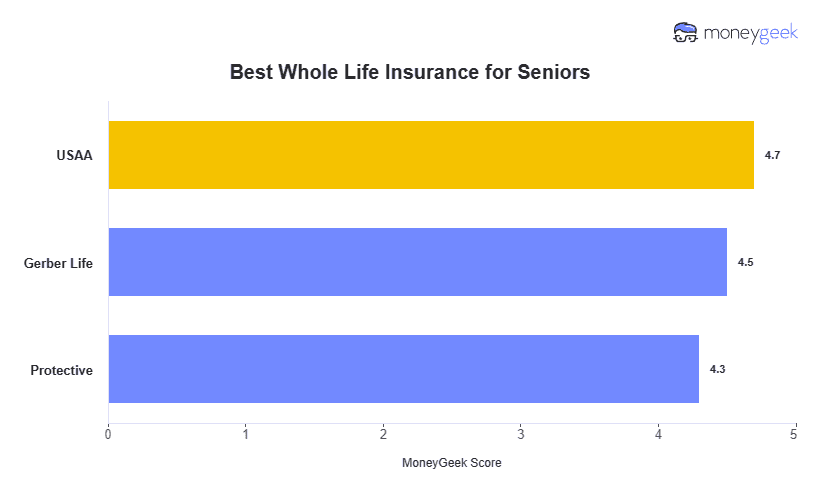
USAA is the best whole life insurance for seniors overall, with the highest issue age, high coverage limits and competitive rates. Gerber Life is the most affordable option for seniors ages 55 to 65, while Protective Insurance is best for senior smokers.

Seniors Under 65 Years Old
Gerber Life (Fabric)
$229 (F), $261 (M)
$575 (F), $645 (M)
80
Yes: $25k Max
4.5
Overall
USAA
$294 (F), $300 (M)
$499 (F), $533 (M)
85
Yes: $25k Max
4.7
Senior Smokers
Protective Insurance
$343 (F), $364 (M)
$592 (F), $667 (M)
80
No
4.3

Rates shown are for nonsmokers with average health on a $100,000 policy.

USAA

USAA

Best Overall for Seniors

MoneyGeek Rating
4.7/ 5
5/5Affordability
3.9/5Customer Experience
4.9/5Coverage
  • Avg. Monthly Rate

    $499 (F), $533 (M)
  • Max Issue Age

    85
Gerber

Gerber

Best for Seniors Under 65 Years Old

MoneyGeek Rating
4.5/ 5
5/5Affordability
3.7/5Customer Experience
4.3/5Coverage
  • Avg. Monthly Rate

    $575 (F), $645 (M)
  • Max Issue Age

    80
Protective

Protective

Best for Senior Smokers

MoneyGeek Rating
4.3/ 5
5/5Affordability
3.5/5Customer Experience
3.7/5Coverage
  • Avg. Monthly Rate

    $592 (F), $667 (M)
  • Max Issue Age

    80

Best Guaranteed Whole Life Insurance for Seniors

Guaranteed whole life covers seniors who can't qualify for traditional coverage, with no medical exam required. Coverage limits are lower than standard whole life policies, topping out at $25,000 to $30,000, but you’ll get guaranteed approval up to age 85.

Physicians Mutual is the best guaranteed whole life insurance company for seniors, offering the highest coverage limit in this group at $30,000 and the lowest average rates across different age groups. All five providers here issue policies through age 85, with the exception of Gerber Life, which caps eligibility at 80.

Physicians Mutual
$95 (F), $117 (M)
85
$30,000
4.6
USAA
$95 (F), $130 (M)
85
$25,000
4.4
AARP
$96 (F), $125 (M)
85
$30,000
4.4
AAA
$111 (F), $142 (M)
85
$25,000
4.3
Gerber Life (Fabric)
$113 (F), $148 (M)
80
$25,000
4.0

Rates shown are for nonsmokers with a $15,000 guaranteed whole life policy.

What to Look for in Whole Life Insurance as a Senior

Five factors matter most when comparing whole life insurance as a senior: maximum issue age, guaranteed acceptance availability, cash value growth rate, rider options and coverage limits at your age. Rates and eligibility shift considerably after 70, so the right policy depends as much on what you qualify for as what you can afford.

    calendar icon
    Maximum Issue Age

    Whole life issue ages vary by insurer from 70 to 85. If you're near the upper end of that range, confirm the insurer's maximum issue age before applying. Applying to an insurer whose cap falls below your current age results in automatic declination, not a higher rate.

    checkSign icon
    Guaranteed Acceptance Option

    Guaranteed acceptance whole life requires no medical exam or health questions. Seniors who can't qualify for standard underwriting should prioritize insurers that include this option. These policies carry a graded death benefit in the first two years, which means the full death benefit doesn't apply immediately.

    money2 icon
    Cash Value Growth Rate

    Whole life policies build cash value at a fixed rate, plus a potential dividend rate for mutual companies. If you're buying primarily for the death benefit, cash value growth won't factor much into your decision. To compare savings potential, look at the dividend history from mutual companies.

    signupBonus icon
    Available Riders

    The riders most relevant to senior applicants are accelerated death benefit (ADB), which allows early access to the death benefit if terminally ill, waiver of premium (WOP), which suspends premiums during disability, and guaranteed insurability option (GIO). 

    Not all insurers include all riders at senior ages, so confirm rider availability at your age before choosing a policy.

    umbrella icon
    Coverage Amount Limits at Older Ages

    Some insurers reduce maximum coverage amounts for people over 70 or 75. If you need $250,000 or more in coverage, confirm the insurer's coverage cap at your age. Guaranteed acceptance policies cap coverage at $25,000 to $50,000 at most insurers. They aren't suitable for income-replacement needs.

How Much Does Whole Life Insurance Cost for Seniors?

Whole life insurance costs for seniors vary widely depending on age, gender and policy type. Standard whole life policies offer higher coverage but come with steeper premiums, while guaranteed whole life trades lower coverage limits for near-certain approval and more manageable monthly costs.

Whole Life Insurance Cost for Seniors

Whole life insurance for seniors averages $204 per month for a 55-year-old woman and $239 for a man at the same age, based on $100,000 in coverage for nonsmokers in average health. Rates climb steadily with age for both genders, with 70-year-olds paying more than double what 55-year-olds pay.

55
$204
$239
60
$289
$308
65
$399
$434
70
$555
$615
75
$826
$918
80
$1,242
$1,380

Rates shown are for $100,000 whole life policies for nonsmokers in average health.

Guaranteed Whole Life Insurance Cost for Seniors

Guaranteed whole life insurance averages $65 per month for a 55-year-old woman and $80 for a man at the same age, based on $15,000 in coverage for nonsmokers. Rates are much lower than standard whole life policies at every age bracket due to the smaller coverage amounts.

55
$65
$80
60
$75
$94
65
$90
$116
70
$113
$145
75
$156
$195
80
$227
$290

Rates shown are for $15,000 guaranteed whole life policies for nonsmokers

Whole Life Insurance for Seniors: FAQ

What are the benefits of whole life insurance for seniors?

What’s the maximum age to buy whole life insurance?

Can seniors get whole life insurance without a medical exam?

Do whole life insurance policies pay dividends to seniors?

To help you find the best whole life insurance for seniors, we created a weighted scoring system grounded in the decision factors that matter most.

Our Scoring System

We ranked whole life insurance companies using three weighted factors:

  • Affordability makes up 50% of the score, since you’ll be paying premiums for life. We gathered quotes online and through agents to compare prices across different ages and coverage amounts.
  • Customer experience counts for 30% because whole life insurance is a long-term commitment. We reviewed customer forums, industry ratings, and complaint data from the National Association of Insurance Commissioners (NAIC) to find companies with consistently satisfied policyholders.
  • Coverage options contribute 20% of the score, because flexibility and rider choices help your policy adapt to changing needs. We looked at dividend participation, riders and customization options that go beyond the base death benefit.

Our base profile is a 70-year-old nonsmoker with average health on a $100,000 policy. For guaranteed whole life insurance, coverage amount is $15,000.

About Mark Fitzpatrick


Mark Fitzpatrick headshot

Mark Fitzpatrick, a Licensed Property and Casualty (P&C) Insurance Producer in Connecticut, is MoneyGeek's resident insurance expert. He has analyzed the insurance market for almost a decade, first with LendingTree and now with MoneyGeek, conducting original research on hundreds of insurance companies and millions of insurance rates for insurance shoppers. 

He writes about economics and insurance on MoneyGeek, breaking down complex topics so people can have confidence in their purchase. Like all MoneyGeek analysts, Mark collects and analyzes independent cost and consumer experience data on insurance companies to provide objective recommendations in our content that are independent of any of MoneyGeek's insurance company partnerships. 

His insights on products ranging from car, home and renters insurance to health and life insurance have been featured in The Washington Post, The New York Times and NPR, among others. 

Mark holds a master’s degree in economics and international relations from Johns Hopkins University and a bachelor’s degree from Boston College. He started his career working in financial risk management at State Street before transitioning to the analysis of the personal insurance market. He's also a five-time Jeopardy champion!