Best Life Insurance for Smokers in 2026


USAA, Banner Life, Penn Mutual and Pacific Life have the best life insurance for smokers, based on MoneyGeek's analysis of rates, coverage options and customer experience. A 40-year-old male smoker pays an average of $154 per month for a $500,000 20-year term policy, about three and a half times the $44 a nonsmoker pays for the same coverage. Penn Mutual is the most affordable term pick at $98 per month for women and $120 for men.

Find out if you're overpaying for life insurance below.

Select age group
Key Takeaways
blueCheck icon

Whole life for a 40-year-old male smoker averages $764 per month for a $500,000 policy, about five times the $154 average term rate. For most smokers, term life is the right starting point. But smokers with health conditions that may limit future insurability should lock in permanent coverage before eligibility narrows.

blueCheck icon

USAA is the top pick for whole and universal life, with coverage up to $10 million and a NAIC complaint index of 0.07. Whole life averages $720 per month for men and $655 for women for a 40-year-old smoker with $500,000 in coverage.

blueCheck icon

Banner Life leads for term life insurance, with rates at $123 per month for men and $98 for women on a 20-year, $500,000 policy. Its no-exam coverage reaches $5 million.

blueCheck icon

Penn Mutual has the most affordable rates for smokers, with average rates at $120 per month for men and $98 per month for women on a $500,000 20-year term policy.

blueCheck icon

Pacific Life is the top pick for smokers with health conditions, with term policies available to age 80 and riders covering chronic illness, critical illness and terminal illness.

Compare Life Insurance Rates

Get the best rate for your insurance. Compare quotes from the top companies.

Best Life Insurance for Smokers

USAA, Banner Life, Penn Mutual and Pacific Life are the best life insurance companies for smokers in MoneyGeek's analysis.

For smokers who need lifelong coverage, USAA is the top permanent life pick. Its universal policies average $395 per month for men and $370 for women at $500,000, available from age three months to 90. Whole life costs more at $720 for men and $655 for women, but builds cash value.

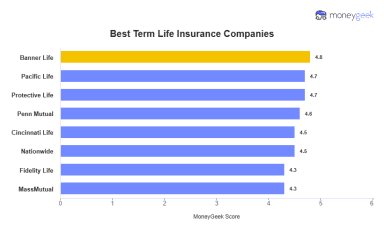
Among the term picks, Penn Mutual and Banner Life both average $98 per month for women on a $500,000 20-year policy. Penn Mutual leads for men at $120 per month; Banner Life charges $123. For smokers who want to skip the medical exam, Banner Life offers no-exam coverage up to $5 million. Pacific Life is the top pick for smokers managing health conditions, with term options available to age 80.


Whole and Universal
USAA

Whole: $655 (F), $720 (M)
Universal: $370 (F), $395 (M)

A++
5
Term
Banner Life

Term: $98 (F), $123 (M)

A
4.8
Affordability
Penn Mutual

Term: $98 (F), $120 (M)

A+
4.8
Smokers with Health Issues
Pacific Life

Term: $121 (F), $162 (M)

A+
4.8

*Rates are based on a $500,000 policy for 40-year-old smokers in otherwise good health. For smokers with health issues, we changed to poor health. Premiums vary depending on your profile and coverage needs.

Best Whole and Universal Life Insurance: USAA

USAA

USAA

MoneyGeek Rating
5.0/ 5
5/5Affordability
5/5Customer Experience
4.9/5Coverage Points
  • Average Monthly Cost (Whole)

    $655 (F); $720 (M)
  • Average Monthly Cost (Universal)

    $370 (F); $395 (M)
  • Ages supported (Whole)

    18–85
  • Ages supported (Universal)

    0–90 years old (universal)

Best Term Life Insurance: Banner Life

Banner Life

Banner Life

MoneyGeek Rating
4.8/ 5
4.9/5Affordability
4.6/5Customer Experience
4.7/5Coverage Points
  • Average Monthly Cost

    $98 (F); $123 (M)
  • Ages Supported

    20–75

Best for Affordability: Penn Mutual

Penn Mutual

Penn Mutual

MoneyGeek Rating
4.8/ 5
5/5Affordability
4.6/5Customer Experience
4.4/5Coverage Points
  • Average Monthly Cost

    $98 (F); $120 (M)
  • Ages Supported

    20–70

Best for Smokers with Health Issues: Pacific Life

Pacific Life

Pacific Life

MoneyGeek Rating
4.8/ 5
5/5Affordability
4.5/5Customer Experience
4.7/5Coverage Points
  • Average Monthly Cost

    $121 (F), $162 (M)
  • Ages Supported

    18–80

Can Smokers Get Life Insurance?

Smokers can get life insurance, though insurers classify them as higher-risk and charge more for coverage. A 40-year-old male smoker pays $154 per month ($1,848 per year) on average for a $500,000, 20-year term policy, compared to $44 per month ($528 per year) for a nonsmoker with the same coverage, according to MoneyGeek's analysis. Choosing the right insurer and policy type can cut that gap by hundreds of dollars a year.  

Most insurers reclassify you as a nonsmoker after 12 to 24 consecutive tobacco-free months. You’ll need a medical exam to confirm tobacco-free status.

Average Life Insurance Cost for Smokers

Whole life costs more relative to term as coverage increases. At $100,000, a 40-year-old female smoker pays $158 per month for whole life and $34 for term, more than four and a half times as much. At $1 million, whole life averages $1,348 and term costs $224, about six times the term rate.

Universal life is a middle option for smokers who want cash value without the full cost of whole life. At $500,000, a 40-year-old female smoker pays $478 per month for universal life, compared to $682 for whole life at the same amount. Smokers with health conditions that may affect future insurability should get permanent coverage, in any form, while they can still qualify.

Female
$34
$158
$111
Male
$42
$170
$131
Female
$66
$346
$247
Male
$83
$391
$296
Female
$119
$682
$478
Male
$154
$764
$582
$750,000
Female
$172
$1,015
$702
Male
$222
$1,128
$850
Female
$224
$1,348
$925
Male
$291
$1,489
$1,116

*Rates are based on average monthly quotes for a 40-year-old smoker with good health. Premiums vary depending on your profile and coverage needs.

Life Insurance Quotes for Smokers

MoneyGeek’s free online life insurance quote calculator provides instant rate estimates based on your age, coverage amount and smoking status. Smoker rates vary by more than $100 per month across carriers for the same profile. Compare at least three carriers before buying.

Life Insurance Rates by Age, Gender and Coverage

Get average life insurance premiums based on your profile.

Estimates shown are for people in good health with a 20-year term policy.

Select Age
Select Gender
Select Smoking Status
Select Coverage Level
Average Monthly Rate—

How Do Insurers Classify Smokers?

Most insurers classify you as a smoker if you use any tobacco product (cigarettes, cigars, vapes or chewing tobacco), even occasionally. Nicotine patches and gum also qualify under most companies’ definitions. Rules vary: some insurers make an exception for occasional cigar use, defined as fewer than 12 cigars per year, if a nicotine test comes back negative. Marijuana use is evaluated separately. Frequency of use and state legality both affect how insurers treat it.

Smoker Rate Classifications

Most life insurance companies rate smokers in two tiers: preferred and standard. Which one applies depends on tobacco use frequency and overall health.

Classification
Description

Preferred Smoker

Applies to occasional smokers who use fewer than five cigarettes daily or 12 per year. You'll likely need excellent health markers: normal blood pressure, healthy BMI and clean blood work. Preferred smoker rates are lower than standard smoker premiums.

Standard Smoker

Covers regular tobacco users who don't qualify for preferred rates. Most companies define regular users as those who smoke five or more cigarettes daily or use cigars weekly. Standard smoker rates often cost much more than nonsmoker premiums.

Insurers that include a preferred smoker tier charge less than those using only standard categories. Some skip it entirely and assign all tobacco users to standard rates.

Standard rates factor in overall health, not tobacco use alone. Even well-managed high blood pressure can push you to a higher rate in this tier.

Table Ratings for Smokers

Insurers use Table A through Table P to rate smokers with health conditions like COPD or heart disease. Each adds a percentage surcharge to the standard smoker base rate. Smokers with multiple health issues or chronic conditions should expect table ratings rather than standard approvals.

Table B adds about 50% to the base rate. Table D doubles it. At $500,000 in coverage,a 40-year-old male smoker at the standard rate of $154 per month would pay around $231 at Table B and $308 at Table D. These figures are approximations. Actual multipliers vary by insurer.

Independent agents who work with high-risk underwriting specialists can sometimes find better table ratings for the same health profile across different carriers.

How to Get the Best Life Insurance for Smokers

Smokers pay more for life insurance than any other lifestyle-based risk category in MoneyGeek’s review. Smokers pay more for life insurance than any other lifestyle-based risk category in MoneyGeek's review. How you shop matters as much as the fact that you smoke. How you shop matters as much as the fact that you smoke.

Term life is the right choice for most smokers. But smokers who need lifelong protection or have health conditions that may narrow future eligibility should buy permanent coverage.

  1. 1
    Quit Smoking

    Quitting tobacco is the single most effective way to cut your life insurance costs. Most insurers reclassify you as a nonsmoker after 12 consecutive tobacco-free months, confirmed by a medical exam. Based on MoneyGeek's rate data, a 40-year-old male smoker paying $154 per month for a $500,000 20-year term policy could pay as little as $44 per month after reclassification, a savings of about $1,320 per year.

  2. 2
    Compare Multiple Quotes

    How insurers treat smokers varies wildly. A smoker who qualifies for preferred rates at one company may land at standard rates at another. Standard rates mean a higher premium for the same coverage. Request quotes from at least five companies, including the cheapest life insurance for smokers. Their different underwriting rules (application evaluation) could save you thousands across the policy term.

  3. 3
    Choose the Right Policy Type

    Term life costs less for smokers than permanent coverage. A 40-year-old male smoker pays $154 per month for a $500,000 20-year term policy but $764 per month for whole life coverage at the same amount.

    Term coverage is the right choice for those who need protection through their working years or until dependents are financially independent. Permanent life insurance (whole or universal, both of which accumulate cash value over time) is worth the higher cost for those who need lifelong coverage or whose health may limit future insurability.

  4. 4
    Bundle Your Policies

    Bundling home and auto policies with your life insurance can reduce your total premiums. Check with your carrier, as not all life insurance companies offer multi-policy discounts, and the life insurance premium itself rarely changes. Confirm eligibility before buying.

  5. 5
    Use Group Life Insurance

    Employer group life insurance charges everyone the same rate regardless of smoking status. There’s no medical exam and no tobacco surcharge. Coverage at that level rarely replaces a full income, so treat group life as a supplement to a private policy.

  6. 6
    Focus on Overall Health

    Tobacco use determines your smoker classification, but overall health affects which tier you land in. Preferred Smoker rates apply to tobacco users with excellent overall health. This includes controlled blood pressure and a healthy BMI. Standard Smoker rates apply to everyone else. Better health markers at application time can move you from Standard to Preferred rates.

  7. 7
    Reapply After Quitting

    Existing policyholders who’ve already quit can apply for reclassification once they’ve been tobacco-free for 12 months. You’ll need a medical exam and written approval from your insurer. Reclassification drops the average 40-year-old male's $500,000 term premium by about 71%, from $154 per month to $44. Some insurers require a new application rather than reclassification of the existing policy. Health changes since your original application can raise costs on a new policy even with nonsmoker status.

heartWithPlus icon
HOW TO BE CONSIDERED A NONSMOKER AFTER QUITTING

Most life insurance companies require at least one year (12 months) tobacco-free to qualify for nontobacco rates. Some require two years (24 months) before reclassifying you as a nonsmoker.

If you have existing life insurance and want your rates reviewed, get company approval and complete a medical exam to prove tobacco-free status. You may pay for the exam out of pocket.

Best Life Insurance Companies for Smokers: Bottom Line

Penn Mutual is the right choice for smokers whose priority is low monthly cost: $98 per month for women and $120 for men on a $500,000 20-year term policy. For permanent life, USAA is the top pick: no other option in MoneyGeek's analysis reaches the same coverage ceiling of $10 million, and universal policies are available from age 3 months to 90.

Banner Life earns the top term pick, with no-exam coverage up to $5 million and the widest term selection among the picks (10 to 40 years). For smokers managing health conditions, Pacific Life covers applicants to age 80 with strong living benefits riders and a NAIC complaint index of 0.04, the lowest among the picks.

Smokers with health conditions alongside tobacco use will likely receive table ratings rather than standard approvals. Standard quoting tools don't cover table-rated policies. An independent agent with access to high-risk underwriting specialists can compare table ratings across carriers to find the best classification for a given health profile. For all smokers, quotes from at least three carriers reveal how differently each prices the same risk. Penn Mutual leads for men at $120 per month, $34 below the $154 market average and $408 less per year. Both Penn Mutual and Banner Life charge $98 per month for women.

Compare Life Insurance Rates

Get the best rate for your insurance. Compare quotes from the top insurance companies.

Life Insurance for Smokers: FAQ

Our Ratings Methodology

How We Found the Best Life Insurance for Smokers

Life insurance costs more when you smoke, and options narrow too. Reasonable rates, dependable service and an application process free of unnecessary hurdles were the focus of MoneyGeek's research.

We pulled thousands of life insurance quotes and rated each insurer on overall value, not price alone. Smokers already pay more, so the search centered on companies with the best experience and long-term worth.

Our Evaluation Framework

Each company was scored across three categories, up to five points each: affordability (50%), customer experience (30%) and coverage options (20%).

MoneyGeek's review drew on five inputs: premium data for different smoker profiles and coverage amounts; financial strength based on AM Best ratings and company history; claims satisfaction using NAIC complaint records and customer reviews; application process details, including online tools, medical exam requirements and approval time; and product range covering term, whole and other life insurance types.

Sample Smoker Profile

This baseline applies to all rate comparisons unless otherwise stated:

  • 40-year-old smoker
  • 5 feet 9 inches, 160 pounds (men)
  • 5 feet 4 inches, 120 pounds (women)
  • Good health rating

The baseline profile was varied by age, health condition and weight to test how each insurer prices across smoker demographics. Competitive rates and consistent service across those variables led to a higher score.

These rankings reflect practical value for smokers who need reliable coverage and fair treatment throughout the policy lifecycle.

Best Life Insurance for a Smoker: Related Articles

About Patrick Bryant


Patrick Bryant, Vertical Lead, Life & Health Insurance, MoneyGeek

Patrick Bryant is the Vertical Lead for Life and Health Insurance at MoneyGeek, where he researches insurance products, writes consumer guides and oversees provider scoring methodologies that are reviewed quarterly to reflect current market conditions and carrier data. He has analyzed more than 50 life insurance carriers across multiple policy types and collected thousands of quotes nationwide to compare pricing, coverage and underwriting requirements.