


New York homeowners pay rates below the national average. MoneyGeek analyzed premiums, J.D. Power satisfaction scores and coverage options from major insurers to find the best home insurance companies in New York.
Best Homeowners Insurance Companies in New York
Updated: November 11, 2026
Advertising & Editorial Disclosure
New York's Top Home Insurance Companies: Key Takeaways
State Farm is the best home insurance provider in New York, earning a 4.8 out of 5 rating from our review team.
Main Street America, Chubb, Farmers and Nationwide rank high for homeowners insurance in New York based on affordable rates, strong customer service and reliable coverage.
The best insurer for your home depends on your coverage needs, budget and preferred features like claims service or discount availability.
What Are the Best Home Insurance Companies in New York?
State Farm is our top pick in New York, with the lowest premiums in the state and above-average customer satisfaction. Main Street America, Chubb, Farmers and Nationwide fill out the rest of the top five. Chubb leads on premium coverage, and Farmers and Nationwide lean on local agents.
State Farm | 4.8 | $980 | Most New York homeowners |
Main Street America | 4.6 | $1,250 | Comprehensive add-ons |
Chubb | 4.5 | $2,137 | Customer satisfaction |
Farmers | 4.5 | $1,414 | Policy customization |
Nationwide | 4.4 | $1,359 | Financial stability |
*Our ratings consider various combinations of coverage levels, home features and homeowner details to identify the best overall options. Rankings may differ based on your profile.

State Farm
MoneyGeek Rating
4.8/ 5
5/5Affordability
4.6/5Customer Experience
4.6/5Coverage
J.D. Power Customer Satisfaction Score
657/1,000From the J.D. Power 2025 U.S. Home Insurance Study, which examines customer satisfaction based on responses from 14,511 homeowners and renters. The average score is 642/1,000.Average Annual Premium
$980Based on our methodology's base profile of a policy with $250K in dwelling coverage, $125K in personal property coverage and $200K in liability coverage with a $1,000 deductible

Main Street America Insurance
MoneyGeek Rating
4.6/ 5
4.8/5Affordability
4.2/5Customer Experience
4.7/5Coverage
J.D. Power Customer Satisfaction Score
N/AFrom the J.D. Power 2025 U.S. Home Insurance Study, which examines customer satisfaction based on responses from 14,511 homeowners and renters. The average score is 642/1,000.Average Annual Premium
$1,250Based on our methodology's base profile of a policy with $250K in dwelling coverage, $125K in personal property coverage and $200K in liability coverage with a $1,000 deductible

Chubb
MoneyGeek Rating
4.5/ 5
4.2/5Affordability
5/5Customer Experience
5/5Coverage
J.D. Power Customer Satisfaction Score
677/1,000From the J.D. Power 2025 U.S. Home Insurance Study, which examines customer satisfaction based on responses from 14,511 homeowners and renters. The average score is 642/1,000.Average Annual Premium
$2,137Based on our methodology's base profile of a policy with $250K in dwelling coverage, $125K in personal property coverage and $200K in liability coverage with a $1,000 deductible

Farmers
MoneyGeek Rating
4.5/ 5
4.6/5Affordability
4.6/5Customer Experience
3.9/5Coverage
J.D. Power Customer Satisfaction Score
631/1,000From the J.D. Power 2025 U.S. Home Insurance Study, which examines customer satisfaction based on responses from 14,511 homeowners and renters. The average score is 642/1,000.Average Annual Premium
$1,414Based on our methodology's base profile of a policy with $250K in dwelling coverage, $125K in personal property coverage and $200K in liability coverage with a $1,000 deductible

Nationwide
MoneyGeek Rating
4.4/ 5
4.7/5Affordability
4.5/5Customer Experience
3.1/5Coverage
J.D. Power Customer Satisfaction Score
641/1,000From the J.D. Power 2025 U.S. Home Insurance Study, which examines customer satisfaction based on responses from 14,511 homeowners and renters. The average score is 642/1,000.Average Annual Premium
$1,359Based on our methodology's base profile of a policy with $250K in dwelling coverage, $125K in personal property coverage and $200K in liability coverage with a $1,000 deductible
Best New York Home Insurance by City
Main Street America and Farmers tie for market leadership in New York. Main Street America ranks best in Albany, Buffalo, East Meadow and Syracuse. Farmers leads in Brooklyn, La Fayette, Queens Village and Yonkers. State Farm offers the best rates in Cooperstown and Rochester. Chubb provides top coverage in New York City.
| Albany | Main Street America Insurance | $824 |
| Brooklyn | Farmers | $1,340 |
| Buffalo | Main Street America Insurance | $750 |
| Cooperstown | State Farm | $1,024 |
| East Meadow | Main Street America Insurance | $1,386 |
| La Fayette | Farmers | $785 |
| New York | Chubb | $3,053 |
| Queens Village | Farmers | $1,114 |
| Rochester | State Farm | $930 |
| Syracuse | Main Street America Insurance | $640 |
| Yonkers | Farmers | $861 |
Cheapest New York Home Insurance Companies
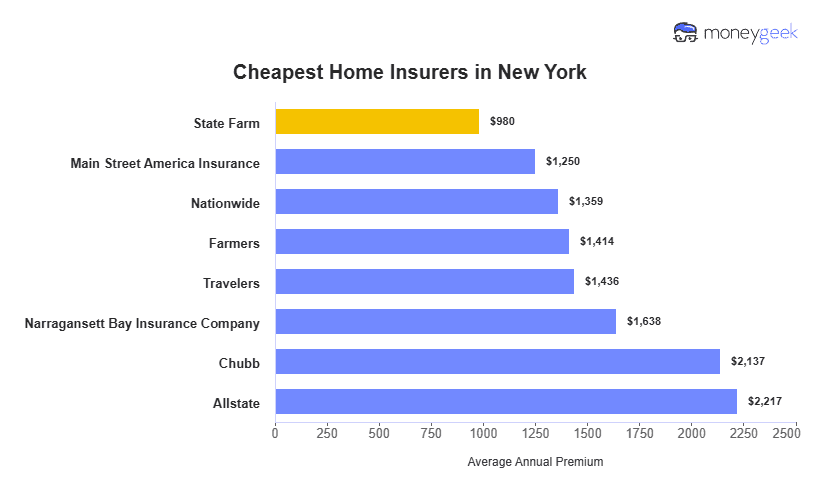
New York homeowners pay $1,554 a year on average, 55% less than the $3,467 national figure. Within the state, though, prices differ a lot. State Farm is the cheapest at $980 a year, 37% under the state average, according to our look at the state’s most affordable home insurance. Main Street America is next at $1,250, 20% below average. At the other end, Allstate charges 36% more than the national average, so compare quotes before you buy.
Guide to Finding the Best New York Home Insurance Company
Picking home insurance in New York comes down to three questions: what you can afford, what coverage you need and how much service you expect. Get quotes from several insurers and weigh each one against those three.
 Compare Quotes Strategically
Collect quotes from three to five insurers. Top New York providers charge anywhere from $980 to $2,137 a year. Don’t let price make the decision for you. A rock-bottom policy can hide gaps you find only when you file a claim after a storm or another covered loss.
 Check Customer Satisfaction Metrics
Check complaint rankings at the New York State Department of Financial Services, then compare J.D. Power scores. Top New York providers run from 631 to 677, and the industry average is 642. Pay the most attention to recent reviews about how insurers handled claims after storms, since those show you what happens when something goes wrong.
 Evaluate Coverage Needs
Set your coverage by what it would cost to rebuild, not by what your home would sell for. Building costs in New York jump after floods and hurricanes, so ask your insurer about extended replacement cost. Then see what your wind and hail deductible would cost you, and decide whether you need flood insurance.
 Match Service Preferences to Provider Strengths
If you’d rather handle everything on your phone, look at Lemonade, Hippo and Root. If you want to sit down with a person, State Farm, Allstate and Farmers have local agents. Choose the style that fits you, and you won’t pay for service you skip.

NEW YORK HOME INSURANCE RISKS
Floods cost New York more than $1 billion in 2021, according to the National Oceanic and Atmospheric Administration, which makes flooding a major threat to homes across the state. Your homeowners policy covers plenty of damage, but not flood. For that, you need a separate flood policy. Your homeowners policy may also set a named-storm deductible at 1% to 5% of your home’s insured value, and it has to spell that out.
Top-Rated Home Insurance Companies in New York: FAQ
Not sure how to pick a New York home insurer? The FAQ below answers the questions readers ask most.
No, standard homeowners insurance in New York doesn't cover flood damage, which requires separate flood insurance coverage. New York experienced over $1 billion in flood damage in 2021 according to NOAA, making flooding a leading cause of property damage statewide, so separate flood coverage is essential for most homeowners.
New York allows insurers to include flooding deductibles in homeowners policies, calculated as 1% to 5% of your home's insured value. These deductibles must be clearly stated in your policy and apply to flood-related claims.
Replacement cost coverage pays to rebuild your home or replace belongings at current market prices without factoring in depreciation. Actual cash value coverage deducts depreciation based on your property's age and condition, resulting in lower claim payments. While actual cash value policies cost less upfront, you'll pay more out of pocket when filing a claim.
Most New York home insurance policies exclude sinkhole damage, as the state doesn't mandate this coverage. Western New York, especially around the Finger Lakes region, faces higher sinkhole risks due to geological conditions. Review your policy's exclusions and consider purchasing additional coverage if you live in a high-risk area to protect against potential sinkhole damage.
Our Methodology: Determining the Best New York Home Insurers
New York homeowners deal with tornado risks, hurricane exposure and fluctuating construction costs. Our ranking system weighs affordable premiums, quality coverage and reliable claims handling.
We scored insurers across three factors:
Affordability (55%): We compared rates for identical coverage across major providers and evaluated discount availability.
Customer satisfaction (30%): J.D. Power ratings, Trustpilot reviews and app feedback reveal how insurers handle claims after storms damage your home.
Coverage options (15%): We assessed add-on availability, including water backup protection and inland flood options for New York's risks.
Our Sample Profile
Rates reflect a homeowner aged 41-60 with good credit and no prior claims insuring a 2,500-square-foot home built in 2000. Coverage includes $250,000 dwelling coverage, $125,000 personal property coverage, $200,000 personal liability coverage and a $1,000 deductible.
Your rates will vary based on your home's age, location, claims history and credit score.
About Mark Fitzpatrick

Mark Fitzpatrick is a licensed Property and Casualty (P&C) Insurance Producer and MoneyGeek's resident expert in insurance and economics. In nearly a decade covering the insurance market at LendingTree and MoneyGeek, he's analyzed hundreds of carriers and millions of rates across auto, home, renters, health and life insurance.
His work has appeared in The Washington Post, The New York Times and NPR. He draws on independent cost and consumer experience data, and no insurance company partnerships affect his recommendations.
Mark studied at Boston College and later earned a master's in economics and international relations from Johns Hopkins University. He worked in financial risk management at State Street before joining MoneyGeek. He's also a five-time “Jeopardy!” champion.
Sources
- NOAA. "National Oceanic and Atmospheric Administration." Accessed November 17, 2026.