



Jump to the section that meets your needs best below:
Average Moving Company Insurance Cost (2026 Report)
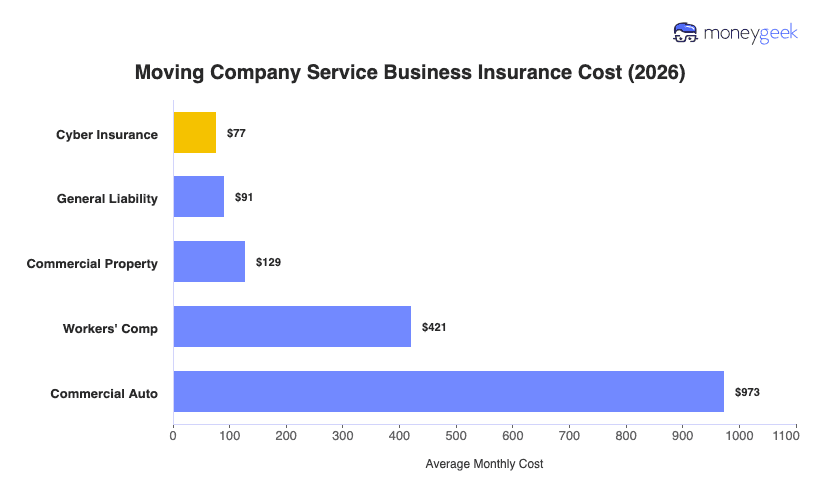
Moving company business insurance runs $77 to $973 per month, with fleet size, crew payroll and whether you operate across state lines shaping your rate.
If you're ready to get a quote, get matched to the best business insurance company for your moving company with our tool below.
Select state
Updated: September 13, 2026
Advertising & Editorial Disclosure
How Much Does Moving Company Business Insurance Cost?
Business insurance costs for moving companies average $338 per month, or about $4,059 per year, based on our team's analysis of quotes for movers with less than five employees across five coverage types, 16 commercial vehicle types and all 50 states plus DC carrying limits of $1 million per occurrence and $2 million aggregate. I found that moving companies cost more 71% of business types within the transportation and logistics cluster.
Individual coverage types range from $77 to $973 per month, a difference that reflects how differently insurers price your risks. Cyber insurance is the most affordable because your customer data exposure, while real, isn't something you encounter on daily basis. You'll pay the most for commercial auto insurance because your trucks are on the road every day with cargo carries third-party liability on each job.
The breakdowns in the table below are benchmarks, not quotes, as your actual premiums vary by fleet size, payroll, driving history and state:
| Cyber Insurance | $77 | $929 | 7% | 221 |
| General Liability | $91 | $1,094 | -26% | 210 |
| Commercial Property | $129 | $1,544 | -3% | 295 |
| Workers' Comp | $421 | $5,048 | -273% | 392 |
| Commercial Auto | $973 | $11,681 | -496% | 382 |
We analyzed quote data from major U.S. commercial insurance providers and modeled standardized premium estimates across business profiles representing around 95% of the market. Results are designed to provide a consistent national benchmark showing how premiums vary by key baseline factors including business size, restaurant profession type, location and vehicle type for operations that use commercial vehicles.
Dataset Scope and Assumptions
Our cost modeling uses standardized inputs for consistent comparisons across businesses.
- Total estimates modeled: just over 6 million standardized pricing estimates
- Providers analyzed: 10 major insurance providers
- Professions covered: 6 real estate profession categories
- Geography: all U.S. states including Washington, D.C.
- Employee count bands: solo practitioners, one to four, five to nine, 10 to 19, and 20 to 49 employees
- Vehicle types studied: Sedans, SUVs, pickup trucks, vans, taxis, limousines, tractors, food trucks, semi-trucks (non-HAZMAT and HAZMAT), tanker trucks (non-HAZMAT and HAZMAT), buses, box trucks, dump trucks, flatbed trucks
- Policies studied: general liability, workers' comp, professional liability, commercial auto, commercial property, and cyber insurance
- General liability: $1 million per occurrence and $2 million aggregate
- Workers' comp: state required coverage
- Professional liability: $1 million per claim and $1 million aggregate
- Commercial auto: minimum coverage
- Commercial property: personal property coverage limits personalized to industry, business size and state
- Cyber insurance: $1 million per occurrence and $1 million aggregate
How We Calculated Average Moving Company Business Insurance Costs
Our published averages represent modeled premiums for standardized business profiles and were aggregated in two ways.
- National benchmark average: The national average cost reflects the modeled premium for a standardized one to four employee business across all and states included in our dataset for a standard policies
- Segment averages: To show how costs vary, we calculated average modeled premiums for our national base profile and isolated for variables, including:
- Employee count (business size ranges)
- Profession / industry categories
- Vehicle types (for commercial auto)
- States (including Washington, D.C.)
Segment averages were produced by aggregating modeled pricing trends across the full dataset so readers can compare how premiums shift across coverage types and regions.
See our full business insurance methodology.
Get Moving Company Business Insurance Cost Estimates
Use our business insurance cost calculator below for more personalized estimates and to compare rates.
Get Moving Company Insurance Cost Estimates
Select Coverage Type
Select State
Select Employee Count
Select Vehicle Type
Monthly Rate Estimate—
Select Coverage Type
Monthly Rate Estimate—
Select State
Select Employee Count
Select Vehicle Type
Factors Affecting Moving Company Business Insurance Costs
Your physical operation, such as the trucks you run, where they travel and who drives them drives the most differences in moving company business insurance costs. Our analysis shows these vehicle-and-operations factors account for the largest share of cost differences between moving companies of similar size.
 Fleet Size and Vehicle Type
More trucks and heavier vehicles raise your insurance costs directly. Each vehicle you add increases your commercial auto exposure, and a semi with a 53-foot trailer carries far more liability and cargo risk than a box truck. Insurers also consider whether your routes typically stay within the metro or involve long-distance hauls.
 Operating Territory
Where your trucks travel affects your rates, not just where your business is based. Urban routes carry higher accident frequency than rural corridors, and that difference shows up directly in your commercial auto costs. If you hold FMCSA interstate authority, federal coverage minimums also apply on top of your state requirements.
 Driver Records and Qualifications
Insurers review motor vehicle records for every listed driver, and violations, at-fault accidents or license suspensions push your premium up. For CDL-required vehicles, FMCSA driver qualification rules set additional standards that interstate carriers must meet before a driver can operate commercially.
 Type of Moves You Handle
The type of work you take on directly shapes your risk profile. Long-distance jobs keep your cargo in transit longer at higher values, while commercial relocations expose you to IT equipment and time-sensitive deliveries. If you offer piano moving or storage-in-transit, your insurer may treat those as separate exposures.
 Cargo Value and Type
The cargo your crews handle shapes your liability costs. Moving antiques, electronics or high-end furniture puts you in a higher-risk category than standard household goods. If you accept declared-value shipments or move items above standard per-item limits, your insurer may rate your policy to reflect that exposure.
How to Lower Moving Company Business Insurance Costs
Your moving company's premiums run high because the work is physically demanding and done in transit. We identified the methods with the most traction for lowering your business insurance costs, and they work across two timelines. While some take effect at your next renewal, others compound as your operation becomes a better risk over time.
 Compare quotes using the same coverage limits
Shopping multiple insurers at the same coverage limits is the fastest way to find out whether you're overpaying. Commercial auto and cargo pricing varies widely, and your rate depends on whether your insurer specializes in transportation or applies a generalist model. When you compare business insurance quotes, match limits and vehicle classifications exactly so you're not mistaking reduced coverage for savings.
 Right-Size Your Coverage
Carrying more coverage than your operation needs costs you money every month. If you run two trucks locally, you likely don't need the limits built for a 10-truck interstate carrier, and many moving companies carry a standard package rather than one matched to their routes, cargo type and client base. Review your limits against your largest realistic claim scenario.
 Increase your deductible strategically
Raising your deductible on commercial auto or cargo coverage can reduce your premium meaningfully because these are high-cost lines where the savings potential is larger. A higher deductible means absorbing more of smaller claims out of pocket, so set it at a level your business can cover without disrupting cash flow after a cargo or vehicle incident.
 Bundle policies with the same provider
Placing multiple policies with the same insurer typically generates a multi-policy discount that compounds across your full coverage stack. Moving companies often carry commercial auto, general liability, cargo and commercial property simultaneously, and bundling with a carrier that writes transportation accounts can reduce your overall spend. Confirm that your chosen insurer writes all the policies you need before committing.
 Invest in risk management practice
Your two most expensive policies, commercial auto and workers' comp, are directly influenced by your claims history, which is shaped by how you manage risk day to day. If you want to lower rates at renewal, start with documented safety practices that reduce claim frequency over time.
- Implement a formal driver safety program that tracks MVRs annually and sets clear standards for violations that disqualify drivers from operating your vehicles.
- Train your crews on proper cargo wrapping, furniture disassembly and loading techniques to reduce the frequency of damage claims on high-value residential and commercial moves.
- Establish a pre-move safety checklist covering ramp conditions, lift protocols and stairwell navigation to reduce back injuries and slip-and-fall incidents among your crew.
- Keep your vehicles on a regular maintenance schedule and run pre-trip inspections to catch mechanical issues before they cause an accident or a failed DOT roadside inspection.
Moving Company Business Insurance Cost: Bottom Line
At around $338 per month, your moving company's insurance costs come from modeled estimates, not a quote built to your operation. Your actual premium depends on your fleet size, payroll and operating territory.
These questions help you put that figure in context for your operation:
- Where do you fall in the distribution? Your fleet size, route type and state all affect where your costs land. The closer your operation matches a given benchmark, the more useful that number becomes when you're reviewing a quote.
- Is your quote consistent with your risk profile? If your quote sits above or below the benchmarks, look at what's behind it. Your fleet classification, payroll and claims history can each shift the number in ways that don't show up in the industry average.
- Which cost drivers apply to your business? Commercial auto and workers' comp carry more weight in your total premium than your other lines. If you run local moves with one van, your cost mix looks very different from a crew-based carrier on interstate routes.
The gap between a benchmark and your actual quote comes from a handful of factors specific to your operation. Knowing which ones apply matters more than knowing how close your premium is to the average. The benchmarks here are most useful for understanding why your quote lands where it does.
About Angelique Palenzuela-Cruz

Angelique Palenzuela-Cruz is a Business Insurance Content Writer at MoneyGeek, where she specializes in general liability, workers’ compensation and professional liability insurance. Her work helps small business owners understand how these policies apply to coverage, including risks like customer injuries, employee injuries, professional mistakes, client contract terms and industry-specific coverage requirements.
She primarily covers service-based businesses where liability and employee coverage decisions are especially important, including cleaning, consulting, beauty and wellness, childcare, education, fitness, food service, pet care, repair and maintenance, and other professional services.
Before joining MoneyGeek, Angelique spent nearly 12 years at Guthrie-Jensen Consultants, one of Southeast Asia’s largest management training firms, where she advanced from Training Consultant to Managing Consultant. In that role, she worked with business clients to assess operational needs, develop training programs and present performance analyses to executive decision-makers. She also helped establish Gladwin Training Consultancy, where she served in learning solutions and client service roles.
Her background gives her practical context for writing about how businesses operate, manage client expectations, structure teams and make risk decisions. At MoneyGeek, she applies that experience to business insurance content, connecting coverage to actual business needs.
LinkedIn: linkedin.com/in/ma-angela-cruz
Email Contact: angelique.palenzuela@moneygeek.com