
How Much Does General Liability Insurance Cost in Utah?

The average cost of general liability insurance in Utah is $110 per month ($1,319 per year) for most small businesses. That benchmark sits 11% below the national average of $123 per month ($1,474 per year).

Utah ranks 21st in affordability, placing it on the less-expensive side nationally. Neighboring-state benchmarks cover a wide range: Idaho averages $97 per month, while Arizona averages $122 and Colorado averages $146, with Utah falling between those reference points. States within the Mountain region average from $95 in Montana to $146 in Colorado per month, with Utah clustering in the lower-middle of that spread.

This state average is a benchmark, not a quote, as premiums can shift with industry exposure, revenue or payroll size, and coverage limits. As a checkpoint, Utah’s average helps you see whether you’re landing near the benchmark or meaningfully above it. Comparing the neighbor and regional ranges can also help identify which drivers explain most of the difference in your case, especially when operations or limits push costs toward the higher end.


To estimate average general liability insurance costs in Utah, we analyzed quote data from major U.S. small business insurance providers and modeled standardized premium estimates across common business profiles. These modeled results are designed to provide a consistent state benchmark and show how premiums vary by key baseline factors including business size, industry and location within Utah.

Dataset Scope and Assumptions

Our cost modeling uses standardized inputs for consistent comparisons across Utah businesses.

  • Providers analyzed: 10 major insurance providers
  • Industries covered: 25 general industry categories relevant to Utah's business landscape
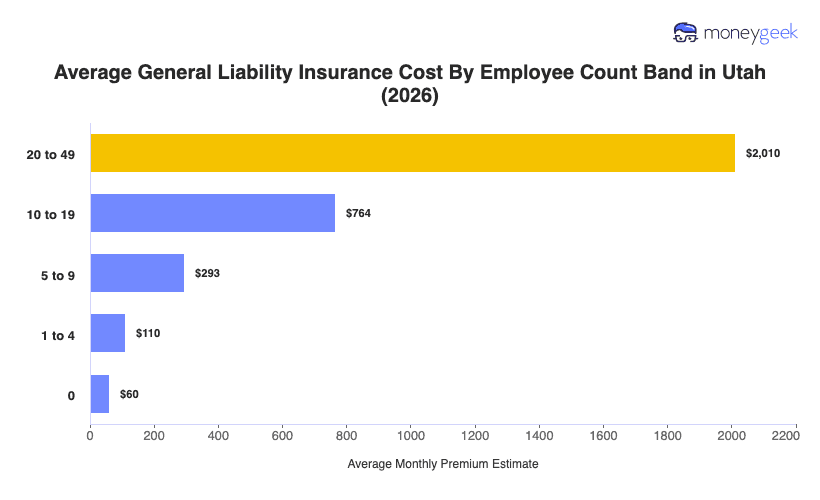
  • Employee count bands: zero, one to four, five to nine, 10 to 19 and 20 to 49 employees
  • Policy baseline: standard general liability policy with $1 million per occurrence / $2 million aggregate limits
  • Total estimates modeled: over 20,000 standardized pricing estimates across Utah industry and employee count combinations

We also incorporated modeled average revenue and payroll personalized across all combinations of Utah regions, industry and employee counts to improve the accuracy of pricing. To model these assumptions against our cost factors, we used data from these sources:

  • CBP (for employee size class density in Utah by NAICS)
  • QCEW (for wage/payroll intensity by industry in Utah)
  • Economic Census / SUSB (for receipts/output intensity by industry)
  • Calibrated against:
    • Private comp databases
    • IRS SOI totals

How We Calculated Average General Liability Costs in Utah

Our published averages represent modeled premiums for standardized business profiles and were aggregated in two ways:

  • Utah state average: The Utah average cost reflects the modeled premium for a standardized one to four-employee small business across all industries included in our dataset for a standard general liability policy.
  • Segment averages: To show how costs vary within Utah, we calculated average modeled premiums for our state base profile and isolated for variables, including:
    • Employee count (business size ranges)
    • General industry categories

Segment averages were produced by aggregating modeled pricing trends across the full dataset so readers can compare how premiums shift across business types and regions within Utah.

Business Insurance Rates by State and Industry

Select your general industry and employee count for a personalized general liability insurance cost estimate for your Utah business. Estimates are based for a $1 million per occurrence and $2 million aggregate policy.

Select Industry
Select Employee Count
Average Monthly Rate

What Factors Affect General Liability Insurance Costs Utah?

General liability insurance in Utah reflects both nationwide pricing mechanics and state-specific conditions. Insurers weigh universal exposure indicators alongside Utah's legal environment, regional economics, and geographic risks when calculating premiums. Understanding these layers helps businesses interpret their quotes.

Utah Agnostic General Liability Insurance Cost Factors

Before turning to Utah-specific conditions, it helps to start with the pricing drivers that apply in any state. These drivers are universal and shape how often claims happen and how costly they can be.

    smallBusiness icon
    Business size

    As headcount grows, general liability pricing often rises because insurers see more activity to cover. More jobs, more customer contact and more operational complexity result in more factors that can lead to claims. In Utah, annual costs for 0 employees are 45% lower than Utah's average, while 20 to 49 employees are 1,728% higher.

    contractor icon
    Industry classification

    General liability pricing shifts with exposure, such as where the work happens, how physical it is and how easily a third party could be hurt or have property damaged.

    Utah's data shows that pattern clearly: Tech/IT runs 76% below the state average, while Construction & Contracting lands 164% above it, reflecting a shift from desk-based work to jobsite risk where claims are more likely.

Utah-Specific General Liability Insurance Cost Factors

After the universal drivers, Utah’s own context helps explain why premiums can land differently in the state. State rules shape how claims are handled, and local conditions can influence what losses show up. These factors summarize Utah-specific cost signals:

    congress icon
    Utah’s Modified Comparative Fault Rule

    Utah assigns damages based on each party’s share of fault and limits recovery when the claimant’s fault reaches the statutory threshold. This can change expected payouts and settlement dynamics, especially in multi-party incidents. When more fault shifts away from the insured, costs can run lower; when fault concentrates on the insured, costs can rise.

    calendarV2 icon
    Utah’s Four-Year Timelines for Many Civil Actions

    Utah law sets four-year filing windows for several common civil claims. That timing affects how long liability exposure stays open after an incident. Longer windows can keep claim activity alive and add defense costs over time, which can pressure premiums upward. Tighter timing can narrow exposure and, in some cases, temper pricing.

    money2 icon
    Utah’s Notice-Of-Claim Timing Gate for Government-Related Claims

    Claims involving a governmental entity or employee generally require a notice of claim within a defined period, or the claim may be barred. This procedural step can reduce or reshape claim frequency in situations involving public venues, public works or government contracts. Fewer viable claims can pull costs down, while higher government-facing exposure can still push them up.

    wine icon
    Utah’s Alcoholic Product Liability Framework

    Utah statute defines when alcohol providers can be held liable for injuries tied to alcohol service. That clarity concentrates exposure for bars, restaurants, and event operators where alcohol is part of operations. Where alcohol service raises the likelihood of third-party injury claims, insurers may price higher. For businesses with no alcohol exposure, this factor has little effect.

    business icon
    Utah’s Rules For Claims Tied to Improvements in Real Property

    Utah sets specific time limits for actions connected to construction and improvements to real property. These limits influence how long certain construction-related disputes can surface, which affects long-tail liability expectations. Shorter windows can reduce extended exposure and help contain costs, while active construction markets can still elevate risk.

    fire icon
    Utah’s Hazard Profile (Wildfire, Drought, Flooding and Earthquake Risk)

    Utah faces recurring wildfire and drought conditions, periodic flooding and severe storms, and meaningful earthquake risk along the Wasatch Front. These hazards can increase third-party injury and property damage scenarios tied to premises (smoke, debris, slips, damaged structures, closures). More frequent or severe hazard conditions can add volatility that insurers reflect in pricing.

Average General Liability Insurance Costs in Utah by Business Size

Monthly Utah general liability benchmarks shift sharply by employee count, showing how pricing changes as operations scale. Costs run from $59.98 for solo operators to $2,010 for mid-sized companies (those with 20 to 49 employees). 

Growth in business size reflect in how cost increases. Hiring your first employee raises rates by 83.31%, but the steepest scaling appears when a fifth member joins your team (a 166.44% jump). Scan the table for your employee band, then use the adjacent tiers and the full range as reference points.

Utah General Liability Insurance Cost Chart

Average General Liability Insurance Costs in Utah by Industry

General liability costs in Utah vary by industry because different types of work create different kinds of third-party risk. Analyzing the cost data across 25 general industries surfaced these insights:

  • Most Utah industries come in below the state benchmark. Twenty-two of 25 general categories price below the state average, one sits roughly at the benchmark (Food & Beverage) and two land above it (Healthcare & Medical and Construction & Contracting). The pattern is “many below, a few high,” which can pull the statewide average upward.
  • High-presence Utah sectors lean toward lower-cost categories. Utah’s largest small-business sectors include professional services and real estate. In your cost table, the closest matches (Tech/IT, consulting, marketing, real estate or property services) sit well below the benchmark, which sets a lower cost expectation for many firms in the state.
  • Construction stands out as both common and high-cost. Construction is one of Utah’s largest small-business sectors by count is the highest-cost category in our dataset. This creates a clear upper-tail story: one widely represented sector can sit far above the benchmark even when most categories run below it.
  • Desk-based professional services form a distinct low-cost cluster. Technology and IT, marketing, and consulting anchor the low end of Utah’s distribution. The shared logic is exposure: less physical work and fewer jobsite hazards tend to reduce the conditions that lead to third-party injury and property damage claims.
  • GDP size and liability cost do not always move together. Utah’s largest GDP-contributing industries align with lower-cost categories, especially in service-heavy segments. Higher-cost categories often reflect heavier exposure per operation rather than sheer economic size.
Data filtered by:
Select
Agriculture & Natural Resources$90$1,08618%
Arts, Media & Entertainment$34$41169%
Beauty, Body & Wellness Services$35$42268%
Childcare Services$108$1,2962%
Cleaning Services$87$1,04121%
Construction & Contracting$291$3,488-164%
Consulting Services$32$38071%
Education$42$50162%
Financial Services$37$43967%
Fitness Services$95$1,13614%
Food & Beverage$110$1,3210%
Healthcare & Medical$186$2,228-69%
Hospitality, Travel & Tourism$92$1,10416%
Manufacturing$60$72445%
Marketing & Communications$30$36672%
Nonprofit & Associations$51$61254%
Other Professional Services$68$81438%
Pet Care Services$72$86335%
Real Estate & Property Services$46$54759%
Recreation & Sports$92$1,10516%
Repair & Maintenance$65$78141%
Retail & Product Rental$106$1,2753%
Tech/IT$26$31376%
Transportation & Logistics$79$94528%
Wholesale & Distribution$93$1,11615%

Use these resources to explore costs for your industry.

How to Lower General Liability Insurance Costs Without Sacrificing Coverage

Affordable general liability coverage in Utah comes from immediate adjustments that reduce premiums within your current policy and sustained practices that build favorable risk profiles over time. Both approaches lower costs without reducing protection against third-party claims.

Quick General Liability Cost Lowering Methods

Some changes affect price right away because they adjust pricing inputs or billing terms. These quick methods help you tighten information, compare terms and match how much GL coverage you need to real obligations in Utah without cutting core protection.

    insurance2 icon
    Provide clean, accurate underwriting information

    General liability pricing reflects what an insurer can verify about your operation. Clean underwriting details include business description, Utah locations and where work occurs (shop, office, jobsite), revenue, payroll, subcontractor use, years in business, prior coverage and recent claims.

    When details are missing or inconsistent, insurers may assume higher exposure or assign a conservative class code, which can raise costs. This matters in Utah when operations span multiple sites along the Wasatch Front or shift seasonally.

    shoppingCart icon
    Compare multiple insurers

    Requesting multiple general liability quotes helps you see the Utah market range for your operation instead of treating the first price as the benchmark. Side-by-side quotes also show which inputs are driving cost: classification, rating basis (revenue vs payroll), deductible or limits.

    Also review general liability exclusions line by line, since they can change what “covered” means in practice. Two quotes can look similar until exclusions and endorsements are aligned.

    building icon
    Bundle general liability into business owner's policies (BOP)

    A business owner’s policy (BOP) packages general liability with commercial property coverage and often business interruption in one structure. For many Utah small businesses, the bundle can price more efficiently than separate policies by reducing duplicated admin and lining up underwriting across coverages.

    This fit strengthens when you need commercial property coverage for a storefront, office suite, inventory, or equipment. The combined price will still reflect both the liability and property exposures.

    coins2 icon
    Pay annually instead of monthly

    Monthly billing can include installment or finance charges, while annual payment often avoids those add-ons and reduces administrative handling. If you need general liability coverage year-round, annual payment can lower total cost without changing coverage terms.

    In Utah, this can be easier to justify for steady, predictable operations and less comfortable for seasonal swings tied to tourism or outdoor recreation. The trade-off is cash flow timing, not coverage.

    money2 icon
    Increase your deductible (if you can afford it)

    Raising your deductible can lower premium by shifting more first-dollar risk to the business. The trade-off is higher out-of-pocket cost when something happens, so the deductible becomes a real budget item, not just a number on paper.

    The key test is whether you could pay it after a general liability claim without disrupting payroll or project schedules. In Utah, that exposure can rise with higher customer traffic during peak seasons.

    loanReview icon
    Adjust your coverage limits

    General liability limits are a direct pricing lever: higher limits raise the insurer’s potential payout and usually raise premium. Costs can climb when limits exceed what contracts require or what your exposure profile supports.

    In Utah, the practical lens is matching limits to the way you sell and deliver work since vendor requirements, venue contracts and jobsite agreements can push limits up even for otherwise low-risk operations.

Long-Term General Liability Cost Lowering Methods

Quick tweaks can move pricing now, but longer-lasting savings usually come from how your business performs over time. In Utah, insurers tend to reward fewer preventable incidents and consistent, documented controls. The next methods focus on improvements that show up at renewal.

General Liability Insurance Cost in Utah: Bottom Line

General liability prices vary because insurers estimate how often a claim could happen and how expensive it could be, then adjust for baseline drivers like industry classification, business size, and where you operate in Utah (one location versus multiple sites). Treat Utah's average cost of $110 per month as a benchmark for orientation, not a prediction of what you’ll pay.

Use this report to compare context, not just price, so your benchmark check reflects how your business operates.

  1. Where do you land versus the benchmark? Compare your Utah footprint, size and industry to the closest peer group.
  2. What’s doing most of the pricing work? Separate baseline exposure (customer traffic, jobsite work) from policy design (limits, deductible, add-ons).
  3. What could move the price next? Focus on controllable levers, then verify the assumptions behind your quote, such as classification, payroll or revenue basis, and key exclusions.

Use these questions to gauge which cost factors shape your liability exposure in Utah, rather than judging the number only by whether it is above or below the state average.

General Liability Insurance Cost in Utah: Next Steps

Use this report to set a baseline for Utah general liability costs and to line up your quote inputs before you compare providers. Once you’ve pinned down your business size, industry classification and Utah footprint, the links below help you move from benchmarks to provider lists.

Keep quote requests consistent (same business details, locations, payroll or revenue basis, and the same general liability limits, deductible and key endorsements) so differences are easier to read as baseline risk, coverage design or underwriting assumptions.

Get Personalized General Liability Insurance Quotes in Utah

Select your industry and state to get a customized Utah general liability quote.

Industry
State

About Angelique Palenzuela-Cruz


Angelique Palenzuela-Cruz headshot

Angelique Palenzuela-Cruz is a Content Writer at MoneyGeek specializing in business insurance. She focuses on general liability, workers' compensation and professional liability coverage, helping small business owners cut through policy jargon and understand what they're actually buying.

Angelique has spent over five years reporting on personal finance, with deep experience in both insurance and lending markets. Her psychology background also gives her a unique understanding of how people actually process difficult financial decisions, allowing her to meet readers where they are, simplify complex concepts and build decision making frameworks that give them confidence. Whether you're learning about policies, comparing providers or trying to figure out requirements, Angelique does the legwork, digging into regulations, analyzing policy language and testing her explanations against agent-level standards so you get straight answers without fluff.


sources
Copyright © 2026 MoneyGeek.com. All Rights Reserved