
How Much Does General Liability Insurance Cost in Texas?

In Texas, the average cost of general liability insurance is $122 monthly ($1,462 annually), nearly matching the national average of $123 monthly. Texas ranks 28th nationally for affordability.

Adjacent states like Oklahoma, New Mexico and Louisiana all price 13% to 18% below Texas. Arkansas, though not an adjacent state, is in the South Central region and extends the pattern. The consistent gap places Texas at the high end of the regional distribution and suggests that the state’s regulatory environment, claims climate or market density drives costs above neighboring baselines.

Use Texas's average as your starting reference point. The regional gap adds important context: businesses operating near state lines or planning regional expansion may encounter different pricing structures even with similar operations and limits. The controllable variables are Texas-specific drivers when benchmarking against these figures.

To estimate average general liability insurance costs in Texas, we analyzed quote data from major U.S. small business insurance providers and modeled standardized premium estimates across common business profiles. These modeled results are designed to provide a consistent state benchmark and show how premiums vary by key baseline factors including business size, industry and location within Texas.

Dataset Scope and Assumptions

Our cost modeling uses standardized inputs for consistent comparisons across Texas businesses.

  • Providers analyzed: 10 major insurance providers
  • Industries covered: 25 general industry categories relevant to Texas's business landscape
  • Employee count bands: zero, one to four, five to nine, 10 to 19 and 20 to 49 employees
  • Policy baseline: standard general liability policy with $1 million per occurrence / $2 million aggregate limits
  • Total estimates modeled: over 20,000 standardized pricing estimates across Texas industry and employee count combinations

We also incorporated modeled average revenue and payroll personalized across all combinations of Texas regions, industry and employee counts to improve the accuracy of pricing. To model these assumptions against our cost factors, we used data from these sources:

  • CBP (for employee size class density in Texas by NAICS)
  • QCEW (for wage/payroll intensity by industry in Texas)
  • Economic Census / SUSB (for receipts/output intensity by industry)
  • Calibrated against:
    • Private comp databases
    • IRS SOI totals

How We Calculated Average General Liability Costs in Texas

Our published averages represent modeled premiums for standardized business profiles and were aggregated in two ways:

  • Texas state average: The Texas average cost reflects the modeled premium for a standardized one to four-employee small business across all industries included in our dataset for a standard general liability policy.
  • Segment averages: To show how costs vary within Texas, we calculated average modeled premiums for our state base profile and isolated for variables, including:
    • Employee count (business size ranges)
    • General industry categories

Segment averages were produced by aggregating modeled pricing trends across the full dataset so readers can compare how premiums shift across business types and regions within Texas.

What Factors Affect General Liability Insurance Costs Texas?

General liability costs in Texas reflect a combination of business characteristics and state-level conditions that insurers evaluate when pricing coverage. Understanding which drivers create the largest rate differences helps businesses identify where they fall within the cost distribution and which variables influence their premiums most directly.

Texas Agnostic General Liability Insurance Cost Factors

Several pricing drivers affect general liability costs regardless of where a business operates. These factors reflect how insurers assess baseline exposure before applying state-specific adjustments or market conditions.

    smallBusiness icon
    Business size

    Insurers price employee count as a proxy for exposure, since larger workforces drive more customer interactions, operational complexity and payroll-related liability events—all of which increase claim probability.

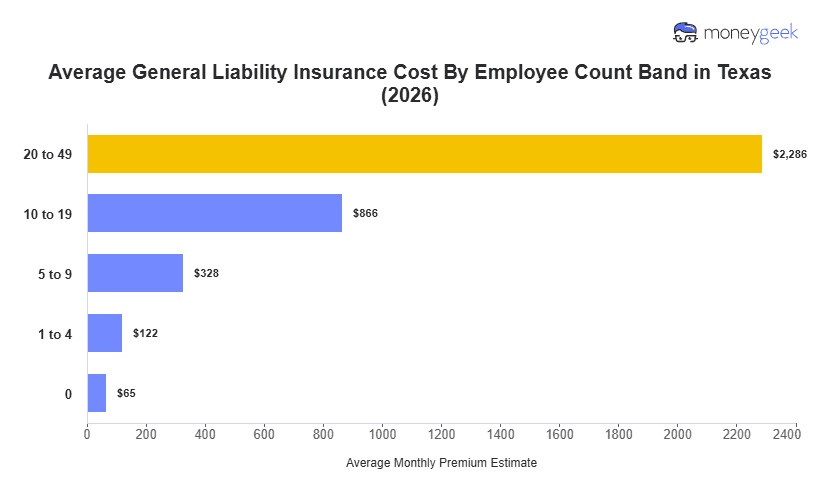
    In Texas, sole proprietors pay 47% less than the average, while businesses with 20 to 49 employees pay 1,776% more. The spread indicates employee count is the primary driver of pricing tiers for business size.

    contractor icon
    Industry classification

    Insurers price industry type based on liability exposure, with claim frequency tied to physical hazards, customer interaction intensity and worksite conditions. As a result, hands-on trades at customer locations carry higher risk profiles than desk-based operations.

    In Texas, tech and IT businesses run 78% below the state average, reflecting their low-risk office environments and limited physical exposure. Construction carries costs 181% above that benchmark, driven by jobsite hazards, equipment use and higher injury potential.

Texas-Specific General Liability Insurance Cost Factors

Beyond industrywide drivers, Texas businesses face state-level conditions that create distinct pricing patterns. These localized forces interact with operational risk to determine where premiums fall within the broader cost distribution and how regional markets price general liability exposure.

    congress icon
    Texas's Legal and Litigation Environment

    Texas ranks among four states that collectively produce half of the nation's nuclear verdicts (jury awards exceeding $10 million), according to the U.S. Chamber of Commerce. Social inflation drives claim costs beyond economic inflation through third-party litigation funding and anti-corporate jury sentiment. Defense costs remain unlimited and frequently exceed $50,000. Gulf Coast regions show higher litigation rates, compounding unpredictable verdict risk and driving costs up through larger settlements and extended litigation.

    hurricane icon
    Texas's Weather and Natural Disasters

    Hurricane Harvey caused $125 billion in damage in 2017, making it the second-costliest U.S. hurricane, according to NOAA. Texas experiences the nation's highest tornado frequency, widespread hailstorms and recurring floods. Weather events create premises liability when storm-damaged walkways or structures cause customer injuries. Insurers price these risks through regional adjustments, with Gulf Coast and tornado-prone areas carrying higher baseline rates that drive costs up.

    houseRebuild icon
    Texas's Economic and Construction Factors

    Construction materials costs rose significantly post-pandemic, and labor wages also increased substantially from 2021 to 2023. Higher material and labor costs directly affect general liability settlements as insurers pay current market rates for property damage repairs and incorporate rising medical costs into bodily injury settlements. These escalating costs drive claim severity up across property damage and bodily injury categories.

    texas icon
    Texas's Geographic and Regional Variations

    Urban density creates pricing tiers, with downtown Dallas and Houston businesses paying 10% to 15% more than suburban counterparts. The 14 Gulf Coast counties in TWIA's service area carry compounded hurricane exposure and higher litigation rates. Local crime rates, population density and weather patterns create additional regional variation. Insurers segment Texas into pricing zones, driving costs UP in high-density urban cores and coastal regions while costs trend DOWN in suburban and rural locations.

    business icon
    Texas's Industry Mix and Economic Diversity

    Texas's concentrated oil and gas sector carries high-risk operations with hazardous materials and heavy equipment, pushing premiums higher. Construction activity varies regionally, affecting contractor liability frequency. However, the growing technology sector and professional services pull costs in the opposite direction with minimal physical hazards.

Average General Liability Insurance Costs in Texas by Business Size

General liability costs in Texas scale directly with employee count. Sole proprietors pay $775 annually while businesses with 20 to 49 employees pay $27,426. That's a 35x multiplier across the size distribution. Hiring the first employee nearly doubles costs, marking the shift from solo operation to employer status. 

The steepest percentage jump occurs when adding the fifth employee, which triggers a 169% increase as insurers account for expanded operational complexity and claim frequency. Use your employee count to locate yourself within the table's range and identify which tier-to-tier transitions drive your pricing.

Texas General Liability Insurance Cost Chart

Average General Liability Insurance Costs in Texas by Industry

Texas's most common industries occupy opposite ends of the general liability cost spectrum. Our analysis of 25 general industries in Texas led to these four insights:

  • The state's most common businesses face dramatically different general liability costs. Professional services dominates Texas with 70,165 establishments but pays just $33 monthly, which is 73% below the state average. Construction ranks fourth by establishment count yet tops the cost distribution at $343 monthly. Healthcare presents the sharpest paradox: it's the second-most common industry but carries the second-highest costs at $209 monthly. Industry prevalence doesn't predict affordability, and actual premiums vary with specific operations, coverage limits and employee count.
  • Physical risk exposure divides Texas industries into four distinct cost tiers. Office-based businesses like tech and consulting avoid premises liability and pay roughly three quarters less than the state average. Service operations in controlled environments fall in the middle range, while customer-facing businesses with physical locations pay moderately below average due to slip-and-fall exposure. High-risk sectors including food service, childcare, healthcare and construction cluster at or above the state average. Construction costs reach 12 times what tech companies pay, driven entirely by jobsite hazards and injury frequency. Individual businesses may shift between tiers based on claims history and coverage choices.
  • Fast-growing sectors enjoy a general liability cost advantage, with one major exception. Financial services and professional services both expand above 5% annually while paying roughly two thirds below the state average, allowing growth without GL expense drag. Construction breaks this pattern, sustaining strong growth despite costs that run 181% above average. Energy, which contributes $170.97 billion to state GDP, maintains moderate costs that support the state's industrial base. Growth rates measure job creation rather than profitability, and GL costs represent one operational expense among many.
  • Establishment size explains why most industries pay below average while employment concentrates in higher-cost sectors. Professional services businesses average 6 employees each, keeping them in low-cost tiers where sole proprietors and small teams dominate. Construction and healthcare average 10 to 13 employees per establishment, pushing more firms into brackets where premiums jump sharply after hiring the fifth worker. Most establishments pay below the state average, but high-headcount industries like restaurants and construction employ millions of workers and pull the average upward. Individual establishments may fall outside these patterns depending on their specific size and risk profile.
Data filtered by:
Select
Agriculture & Natural Resources$99$1,18519%
Arts, Media & Entertainment$37$45069%
Beauty, Body & Wellness Services$42$50865%
Childcare Services$125$1,499-3%
Cleaning Services$98$1,17919%
Construction & Contracting$343$4,111-181%
Consulting Services$33$39173%
Education$49$58660%
Financial Services$42$49966%
Fitness Services$104$1,24815%
Food & Beverage$124$1,493-2%
Healthcare & Medical$209$2,511-72%
Hospitality, Travel & Tourism$106$1,27513%
Manufacturing$69$82344%
Marketing & Communications$32$38374%
Nonprofit & Associations$56$67154%
Other Professional Services$74$89339%
Pet Care Services$89$1,07327%
Real Estate & Property Services$48$57761%
Recreation & Sports$73$87140%
Repair & Maintenance$74$89239%
Retail & Product Rental$110$1,31510%
Tech/IT$27$32778%
Transportation & Logistics$84$1,00331%
Wholesale & Distribution$105$1,26613%

Use these resources to explore costs for your industry.

How to Lower General Liability Insurance Costs Without Sacrificing Coverage

Lower rates for general liability insurance come from two types of strategies: tactical changes you can implement immediately through payment terms and coverage design, and long-term investments in risk controls that compound over time. Both approaches reduce costs while maintaining protection aligned to your operational risks.

Quick General Liability Cost Lowering Methods

General liability costs respond to business decisions you control, from how you pay premiums to which coverage limits you select. Strategic adjustments lower expenses while maintaining protection that matches your actual contract requirements and operational risks.

    insurance2 icon
    Provide clean, accurate underwriting information

    Insurers calculate premiums by matching your business to industry risk tables based on classification codes, annual revenue and employee count. Austin tech consultants carry fundamentally different liability exposure than Houston construction firms or Dallas healthcare practices, which is why accurate reporting matters for getting appropriate rates. Understating revenue or employee count might seem like a way to lower premiums, but insurers recalculate retroactively when they discover discrepancies during audits, adding penalty charges that exceed any initial savings. Accuracy reflects your actual risk profile, not desired pricing.

    shoppingCart icon
    Compare multiple insurers

    General liability pricing varies dramatically between carriers because each insurer uses different claims data and risk models to evaluate the same business. Houston contractors might receive quotes ranging from $280 to $420 monthly depending on how each carrier prices Gulf Coast construction exposure, a 50% spread across the pricing distribution. Regional insurers often understand Texas-specific risks better than national carriers, while specialty insurers focus on particular industries. Request proposals from four to five insurers to identify the most competitive pricing for your specific risk profile.

    building icon
    Bundle general liability into business owner's policies (BOP)

    Businesses that need commercial property insurance for equipment, inventory or furnishings, like a San Antonio restaurant, can reduce total insurance costs 15% to 25% by bundling property and liability coverage into a business owner's policy instead of purchasing separately. Compare the cost of a BOP for your business against separate policies to confirm the savings apply to your coverage needs.

    coins2 icon
    Pay annually instead of monthly

    Prepaying your annual premium eliminates monthly billing fees and earns 5% to 10% discounts that insurers offer for reducing their administrative costs. This strategy works best for businesses with predictable cash flow like Dallas professional services firms and Austin tech companies that can allocate funds without disrupting operations. Seasonal businesses like Gulf Coast tourism operators might be better off paying monthly to preserve working capital during slower periods.

    money2 icon
    Increase your deductible (if you can afford it)

    Higher deductibles reduce monthly premiums because you're assuming more financial responsibility for the first portion of each claim, which lowers the insurer's risk exposure. Raising your deductible from $500 to $2,500 cuts premiums 20% to 30%, but only makes financial sense. 

    Houston energy companies and San Antonio professional services firms with strong balance sheets and low claim frequency benefit most as they most likely maintain cash reserves to cover that out-of-pocket expense when claims occur. Businesses with tight margins or frequent small claims should keep lower deductibles to avoid unpredictable cash drains.

    loanReview icon
    Adjust your coverage limits

    Many Texas businesses carry $2 million/$4 million aggregate limits because that's the industry standard, but you only need general liability insurance high enough to satisfy your actual contract requirements and protect business assets. El Paso manufacturers whose clients require $1 million/$2 million coverage overpay by 15% to 25% when they purchase higher limits unnecessarily. Review your contracts to identify the minimum required coverage, then balance that against your revenue and asset exposure to avoid paying for protection you don't need. Contract requirements set your floor, not industry averages.

Long-Term General Liability Cost Lowering Methods

Premium reductions from clean claims records and verified safety programs compound over time, creating savings that increase with each renewal. These strategies require upfront investment but deliver returns that quick fixes cannot match.

General Liability Insurance Cost in Texas: Bottom Line

General liability costs in Texas vary because each business presents different claim risks to insurers. Your employee count, industry classification and location set your baseline rate, while coverage limits and deductible choices adjust the final premium. The state average of $122 monthly serves as a reference point, not a prediction of what you'll pay.

Use this report to understand where your business sits within Texas's pricing landscape and which factors you can influence. Consider three questions:

  1. How do your employee count and industry compare to the benchmarks shown in this analysis?
  2. Which cost drivers stem from what you do, such as operational hazards, litigation exposure, geographic risks, versus what you choose through coverage limits and deductibles?
  3. What can you adjust immediately through payment terms and carrier comparison versus what requires building a stronger loss profile over multiple renewal cycles?

Understanding these cost drivers helps you set realistic budget expectations and identify where you can influence your premium.

General Liability Insurance Cost in Texas: Next Steps

Translate the cost patterns in this report into a structured comparison process that produces meaningful quotes. Start by reviewing which Texas insurers align with your industry classification and business size, then identify carriers that compete on price within your risk profile:

Request quotes using identical business details, coverage limits and deductible amounts so differences reflect true carrier competitiveness rather than inconsistent inputs. When quotes vary, determine whether pricing stems from baseline risk assessment: how each carrier evaluates your industry and location or from coverage design choices you control.

Get Personalized General Liability Insurance Quotes in Texas

Select your industry and state to get a customized Texas general liability quote.

Industry
State

About Angelique Palenzuela-Cruz


Angelique Palenzuela-Cruz headshot

Angelique Palenzuela-Cruz is a Content Writer at MoneyGeek specializing in business insurance. She focuses on general liability, workers' compensation and professional liability coverage, helping small business owners cut through policy jargon and understand what they're actually buying.

Angelique has spent over five years reporting on personal finance, with deep experience in both insurance and lending markets. Her psychology background also gives her a unique understanding of how people actually process difficult financial decisions, allowing her to meet readers where they are, simplify complex concepts and build decision making frameworks that give them confidence. Whether you're learning about policies, comparing providers or trying to figure out requirements, Angelique does the legwork, digging into regulations, analyzing policy language and testing her explanations against agent-level standards so you get straight answers without fluff.


sources
Copyright © 2026 MoneyGeek.com. All Rights Reserved