
How Much Does General Liability Insurance Cost in Pennsylvania?

The cost of general liability insurance in Pennsylvania averages $129 monthly ($1,545 annually) for businesses with one to four employees across over 400 business types. That rate places Pennsylvania 31st nationally for affordability, roughly $6 below the U.S. benchmark. 

Pennsylvania shares the Mid-Atlantic region with New Jersey and New York, both of which are also geographically adjacent. Pennsylvania sits between these clusters, pricier than Midwestern markets (New Jersey at $160 monthly, New York at $180 monthly), but more affordable than its eastern neighbors (Ohio at $110 monthly). The gap reflects differences in litigation climate and commercial density: New Jersey and New York face higher claim costs from plaintiff-friendly courts and concentrated business districts, while Ohio benefits from different tort structures and lower settlement patterns.

The state average provides a useful reference point, though actual costs shift based on operational factors. That means a contractor with five employees and prior claims will pay considerably more than a consultant with no staff and clean history, even under identical coverage limits. Use the state average as orientation rather than prediction since the variables specific to your business determine where you fall in the distribution.

To estimate average general liability insurance costs in Pennsylvania, we analyzed quote data from major U.S. small business insurance providers and modeled standardized premium estimates across common business profiles. These modeled results are designed to provide a consistent state benchmark and show how premiums vary by key baseline factors including business size, industry and location within Pennsylvania.

Dataset Scope and Assumptions

Our cost modeling uses standardized inputs for consistent comparisons across Pennsylvania businesses.

  • Providers analyzed: 10 major insurance providers
  • Industries covered: 25 general industry categories relevant to Pennsylvania's business landscape
  • Employee count bands: zero, one to four, five to nine, 10 to 19 and 20 to 49 employees
  • Policy baseline: standard general liability policy with $1 million per occurrence / $2 million aggregate limits
  • Total estimates modeled: over 20,000 standardized pricing estimates across Pennsylvania industry and employee count combinations

We also incorporated modeled average revenue and payroll personalized across all combinations of Pennsylvania regions, industry and employee counts to improve the accuracy of pricing. To model these assumptions against our cost factors, we used data from these sources:

  • CBP (for employee size class density in Pennsylvania by NAICS)
  • QCEW (for wage/payroll intensity by industry in Pennsylvania)
  • Economic Census / SUSB (for receipts/output intensity by industry)
  • Calibrated against:
    • Private comp databases
    • IRS SOI totals

How We Calculated Average General Liability Costs in Pennsylvania

Our published averages represent modeled premiums for standardized business profiles and were aggregated in two ways:

  • Pennsylvania state average: The Pennsylvania average cost reflects the modeled premium for a standardized one to four-employee small business across all industries included in our dataset for a standard general liability policy.
  • Segment averages: To show how costs vary within Pennsylvania, we calculated average modeled premiums for our state base profile and isolated for variables, including:
    • Employee count (business size ranges)
    • General industry categories

Segment averages were produced by aggregating modeled pricing trends across the full dataset so readers can compare how premiums shift across business types and regions within Pennsylvania.

What Factors Affect General Liability Insurance Costs Pennsylvania?

Understanding what moves Pennsylvania general liability costs requires separating universal business characteristics from state-specific conditions. Some factors operate identically whether you're in Raleigh or anywhere else, while others trace directly to Pennsylvania's legal and geographic landscape.

Pennsylvania Agnostic General Liability Insurance Cost Factors

Some cost drivers work the same way nationally. Recognizing which business characteristics move premiums universally allows you to assess whether your baseline exposure sits closer to low-risk or high-risk benchmarks.

    smallBusiness icon
    Business size

    Employee count directly scales exposure. Larger workforces increase operational volume, customer interactions and claim probability since each additional staff member expands the surface area for potential liability events.

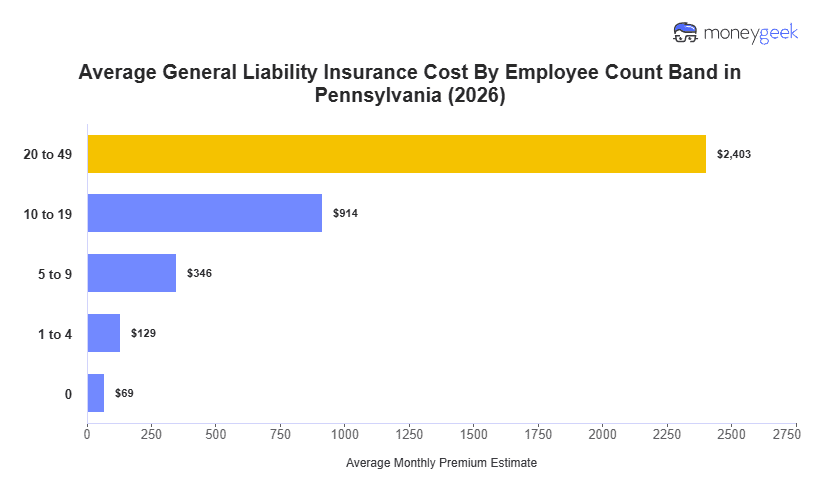
    In Pennsylvania, sole proprietors with no employees pay 47% less than the state average, while companies with 20 to 49 employees pay 1,766% more. That's  a reflection of the exponential rise in insurable risk as payroll grows.

    contractor icon
    Industry classification

    Industry type reflects the nature of liability exposure. Office-based operations carry minimal physical risk, while businesses involving hands-on work, customer locations or hazardous materials see higher claim frequency and severity potential.

    In Pennsylvania, Tech/IT businesses run 78% below the state average since desk work and digital delivery minimize physical liability events. Construction and contracting sits 172% above that benchmark, driven by worksite accidents, equipment use and third-party property damage exposure inherent to building trades.

Pennsylvania-Specific General Liability Insurance Cost Factors

Beyond industry and business size, location-based variables shape your premium within Pennsylvania. These state-level conditions, from legal frameworks to market dynamics, explain why two similar businesses can see different costs depending on where they operate and the regional environment they navigate.

    congress icon
    Pennsylvania's Legal/Tort Environment

    Pennsylvania uses a modified comparative negligence system, where plaintiffs can recover damages if they're less than 51% at fault. This balanced approach creates predictable claim outcomes without the extremes seen in pure comparative negligence or contributory negligence states. The state's two-year statute of limitations for personal injury claims and Fair Share Act (limiting joint liability to defendants more than 60% at fault) help contain costs for businesses in multi-party lawsuits.

    money2 icon
    Pennsylvania's Economic Conditions

    Pennsylvania's medical costs and wage levels track close to national averages, keeping claim settlements moderate. The state's economy spans urban centers like Philadelphia and Pittsburgh alongside rural areas, creating regional cost differences. Metro areas see higher medical expenses and larger pain-and-suffering verdicts tied to local living costs. Rural regions produce lower settlement amounts. These gradients mean insurers price coverage differently across Pennsylvania zip codes.

    checkList icon
    Pennsylvania's Claims Climate

    Philadelphia Court of Common Pleas has drawn national attention for its plaintiff-friendly litigation environment, though outcomes vary significantly across other Pennsylvania counties. Urban jurisdictions tend toward higher verdicts, while rural courts produce more conservative outcomes. Pennsylvania's Fair Share Act, enacted in 2011, limits joint and several liability to defendants more than 60% at fault , which has helped stabilize insurer loss ratios and contain extreme exposure in multi-party claims.

    pennsylvania icon
    Pennsylvania's Geographic and Weather Factors

    Pennsylvania's geography creates diverse liability exposures. Philadelphia and Pittsburgh's population density increases slip-and-fall incidents and customer interactions, pushing metro premiums higher. Winter ice and snow create seasonal liability spikes statewide, though tornado and flood exposure remains low compared to Midwest and Gulf states. Businesses in high-traffic urban corridors pay more than similar operations in rural counties with lighter foot traffic.

    supplyAndDemand icon
    Pennsylvania's Market Competition

    Pennsylvania's general liability market features strong carrier participation from national insurers and regional specialists. This competition keeps rates near national benchmarks. Philadelphia and Pittsburgh metro areas offer the deepest insurer presence, while rural regions may have fewer options. The state's regulatory stability and predictable legal environment help attract and retain insurers across most industry sectors.

Average General Liability Insurance Costs in Pennsylvania by Business Size

Business size drives premiums upward in Pennsylvania, but not evenly. Small businesses with one to four employees average $129 monthly, but adding a 5th employee increases costs by $218 per month, marking the first sharp jump as businesses expand. From there, each employee tier costs about 165% to 170% more than the tier below it, driven by higher claim exposure from increased work volume and customer interactions.

The table shows monthly and annual premiums across five employee bands, from sole proprietors through mid-size operations.

Pennsylvania General Liability Insurance Cost Chart

Average General Liability Insurance Costs in Pennsylvania by Industry

Industry type creates substantial cost differences in Pennsylvania's general liability market. Physical work environments and customer contact frequency shape premiums more than business size or economic impact. The patterns below show how operational characteristics translate to insurance costs across major sectors:

  • Pennsylvania's economically significant industries span the full cost spectrum. Manufacturing, a major employer and GDP contributor, pays $72 monthly, sitting 44% below average. Healthcare employs 1.32 million workers but pays $220 monthly, running 71% above average. Economic importance doesn't predict insurance costs. Operational risk drives premiums instead.
  • Most Pennsylvania industries pay less than the state average. Twenty-one of 25 industry categories fall below the $129 monthly baseline. The state average reflects the actual mix of businesses operating in Pennsylvania. Healthcare facilities, construction firms and food service operations pull costs upward, while office-based sectors create a lower-cost floor that most industries occupy.
  • Construction costs exceed all other sectors by a wide margin. Construction and contracting premiums reach $350 monthly, sitting 172% above the state average. That's 2.7 times what manufacturing pays. Worksite accidents, equipment damage and third-party property claims create this cost ceiling. No other Pennsylvania industry comes close.
  • Office-based industries create Pennsylvania's lowest-cost tier. Tech, consulting, marketing and financial services pay $28 to $44 monthly, running up to 78% below the state average. Pittsburgh and Philadelphia's banking hubs drive significant economic value while generating minimal liability claims. Digital service delivery removes most physical injury and property damage exposure.
  • Agriculture sits in Pennsylvania's moderate-cost range. The state leads nationally in mushroom production and runs major dairy operations, yet farmers pay $103 monthly, landing 20% below average. Field work and equipment operation carry some risk. Limited customer interaction keeps costs moderate. The mix creates balanced exposure between office sectors and high-contact service businesses.
  • Fast-growing industries show no cost pattern. Pennsylvania's strategic growth sectors range from $28 monthly for tech and robotics to $220 monthly for healthcare and life sciences. Investment priorities and insurance expenses operate on separate tracks. Growth potential doesn't determine liability costs across the state's economic development targets.
  • Service sectors split sharply by customer contact levels. Low-contact professional services like consulting, financial planning and real estate pay $33 to $49 monthly. High-contact operations like fitness centers, hospitality and retail pay $108 to $113 monthly. The $60 to $70 monthly gap reflects slip-and-fall frequency and premises liability. Physical presence on business property drives claim probability more than service complexity.
Data filtered by:
Select
Agriculture & Natural Resources$103$1,23720%
Arts, Media & Entertainment$39$46970%
Beauty, Body & Wellness Services$42$50467%
Childcare Services$133$1,591-3%
Cleaning Services$104$1,25219%
Construction & Contracting$350$4,196-172%
Consulting Services$33$39674%
Education$51$61460%
Financial Services$44$52866%
Fitness Services$108$1,29816%
Food & Beverage$133$1,590-3%
Healthcare & Medical$220$2,638-71%
Hospitality, Travel & Tourism$112$1,34813%
Manufacturing$72$86944%
Marketing & Communications$33$39375%
Nonprofit & Associations$59$70355%
Other Professional Services$78$93639%
Pet Care Services$80$96438%
Real Estate & Property Services$49$58962%
Recreation & Sports$108$1,30016%
Repair & Maintenance$79$94839%
Retail & Product Rental$111$1,33713%
Tech/IT$28$33378%
Transportation & Logistics$86$1,02933%
Wholesale & Distribution$113$1,35712%

Use these resources to explore costs for your industry.

How to Lower General Liability Insurance Costs Without Sacrificing Coverage

Pennsylvania businesses can reduce premiums through strategic coverage adjustments, insurer comparisons, and operational improvements without compromising protection levels. Finding more affordable general liability insurance requires understanding which cost-reduction methods deliver immediate savings versus those that build discounts over time through improved risk profiles.

Quick General Liability Cost Lowering Methods

Cost reduction opportunities vary by business type and location within Pennsylvania. Manufacturing operations in Lehigh Valley face different optimization paths than healthcare practices in Philadelphia or farms in Lancaster County. These methods show how businesses across Pennsylvania's key industries and regions reduce premiums while maintaining appropriate coverage.

    insurance2 icon
    Provide clean, accurate underwriting information

    Insurers set your rates based on revenue, employee count and service classifications. If you understate billings or misclassify staff roles, your insurer will recalculate your premium mid-term and charge you retroactively. Give precise details upfront to lock in accurate rates and avoid penalty charges. For example, Philadelphia hospitals carry different risks than rural clinics, so accurate classification matters even more for healthcare operations.

    shoppingCart icon
    Compare multiple insurers

    Get quotes from four to five insurers to find competitive pricing. A Pittsburgh contracting firm might see quotes from $180 to $350 monthly for the same $1 million/$2 million coverage. The range depends on each carrier's appetite for construction risk and recent claims. Regional carriers often price worksite accidents differently than national insurers, which creates rate gaps worth checking.

    building icon
    Bundle general liability into business owner's policies (BOP)

    Business owner's policies combine general liability with commercial property coverage. This cuts total costs by 10% to 15% versus buying separate policies. Harrisburg consulting firms that lease office space get dual protection for premises liability and property coverage. BOP costs average $500 to $3,000 annually based on your property value and revenue, which saves money over standalone policies.

    coins2 icon
    Pay annually instead of monthly

    Annual payment saves 5% to 10% and removes monthly billing fees. For Lancaster County farms, that means covering $1,200 to $1,800 upfront. Farm operations benefit from matching insurance payments to harvest cash flow rather than spreading costs across lean months. Most insurers offer this discount automatically, but verify the savings before you commit to annual terms.

    money2 icon
    Increase your deductible (if you can afford it)

    Compare premium savings against claim costs before raising deductibles. Lehigh Valley pharmaceutical makers with strong cash reserves can handle $2,500 or $5,000 per-claim costs instead of $500 deductibles. This cuts annual premiums by 15% to 25%. Small food trucks on thin margins shouldn't risk high deductibles. One slip-and-fall claim could wipe out quarterly profits. Check whether your business absorbs claim costs without strain.

    loanReview icon
    Adjust your coverage limits

    Standard $1M/$2M limits work for most businesses. Small breweries in Pennsylvania's rural areas serving 50 to 100 customers weekly may need only $500K/$1M coverage if revenue and premises risk stay low. Food processors distributing regionally should maintain higher limits. How much general liability coverage you need depends on your actual customer volume, revenue and distribution reach rather than defaulting to industry averages.

Long-Term General Liability Cost Lowering Methods

Finding cheap general liability insurance in Pennsylvania starts with comparing carrier rates, but sustained savings come from strategic cost management. The methods below split into quick adjustments that cut premiums immediately and long-term approaches that build progressive discounts through documented safety improvements and clean claims records.

General Liability Insurance Cost in Pennsylvania: Bottom Line

General liability costs vary because insurers judge each business's claim risk differently, with business size, industry type and location creating the biggest premium gaps in Pennsylvania. The national average of $135 monthly serves as a benchmark, not a prediction of what you'll pay.

Use this report's cost data to gauge where you fit in Pennsylvania's pricing:

  1. Where you sit: Compare your industry and employee count against state benchmarks to see if your baseline risk runs higher or lower than Pennsylvania's $129 average.
  2. What drives your rate: Separate fixed classification factors (industry, location, size) from adjustable choices you control (deductibles, limits, policy structure).
  3. What changes your cost: Find which reduction methods match your business and check if your coverage shows accurate pricing or leaves savings available.

The goal is understanding how Pennsylvania's cost factors shape your specific rate, not just measuring against one statewide number.

General Liability Insurance Cost in Pennsylvania: Next Steps

Use this report's benchmarks to set realistic expectations when comparing insurance quotes.

If you're ready to compare providers:

Start by matching your business to the cost ranges shown here for your industry, employee count and Pennsylvania location. Then get quotes using the same coverage limits and deductibles so you're comparing equal policies. Rate differences show your baseline risk level, your coverage choices and how well you've described your business to each insurer.

Get Personalized General Liability Insurance Quotes in Pennsylvania

Select your industry and state to get a customized Pennsylvania general liability quote.

Industry
State

About Angelique Palenzuela-Cruz


Angelique Palenzuela-Cruz headshot

Angelique Palenzuela-Cruz is a Content Writer at MoneyGeek specializing in business insurance. She focuses on general liability, workers' compensation and professional liability coverage, helping small business owners cut through policy jargon and understand what they're actually buying.

Angelique has spent over five years reporting on personal finance, with deep experience in both insurance and lending markets. Her psychology background also gives her a unique understanding of how people actually process difficult financial decisions, allowing her to meet readers where they are, simplify complex concepts and build decision making frameworks that give them confidence. Whether you're learning about policies, comparing providers or trying to figure out requirements, Angelique does the legwork, digging into regulations, analyzing policy language and testing her explanations against agent-level standards so you get straight answers without fluff.


sources
Copyright © 2026 MoneyGeek.com. All Rights Reserved