
How Much Does General Liability Insurance Cost in New Jersey?

New Jersey ranks as the 4th most expensive state for general liability insurance, with businesses employing one to four people paying an average of $160 monthly ($1,916 annually). General liability costs in New Jersey are $37 above the national average and in the upper tier of a regional cluster: Pennsylvania sits at $129, while New York is at $180. The $51 spread across these three neighboring states reflects differences in litigation costs and claims density rather than sharp state-by-state breaks.

Delaware, another bordering state, averaging $131 monthly, clusters with Pennsylvania at the lower end of the adjacent-state range. That position reinforces New Jersey's separation from most of its neighbors. The pattern suggests market factors tied to commercial concentration and legal environments tend to weigh more heavily in New Jersey than in its lower-cost neighbors, though not as intensely as in New York.

New Jersey’s average captures premium estimates across over 400 business types in MoneyGeek's statewide analysis. Individual quotes vary depending on your industry's exposure profile, annual revenue, claims record and coverage structure. Use the state average to gauge whether your pricing aligns with typical New Jersey costs, then identify which business-specific factors explain any gap.

To estimate average general liability insurance costs in New Jersey, we analyzed quote data from major U.S. small business insurance providers and modeled standardized premium estimates across common business profiles. These modeled results are designed to provide a consistent state benchmark and show how premiums vary by key baseline factors including business size, industry and location within New Jersey.

Dataset Scope and Assumptions

Our cost modeling uses standardized inputs for consistent comparisons across New Jersey businesses.

  • Providers analyzed: 10 major insurance providers
  • Industries covered: 25 general industry categories relevant to New Jersey's business landscape
  • Employee count bands: zero, one to four, five to nine, 10 to 19 and 20 to 49 employees
  • Policy baseline: standard general liability policy with $1 million per occurrence / $2 million aggregate limits
  • Total estimates modeled: over 20,000 standardized pricing estimates across New Jersey industry and employee count combinations

We also incorporated modeled average revenue and payroll personalized across all combinations of New Jersey regions, industry and employee counts to improve the accuracy of pricing. To model these assumptions against our cost factors, we used data from these sources:

  • CBP (for employee size class density in New Jersey by NAICS)
  • QCEW (for wage/payroll intensity by industry in New Jersey)
  • Economic Census / SUSB (for receipts/output intensity by industry)
  • Calibrated against:
    • Private comp databases
    • IRS SOI totals

How We Calculated Average General Liability Costs in New Jersey

Our published averages represent modeled premiums for standardized business profiles and were aggregated in two ways:

  • New Jersey state average: The New Jersey average cost reflects the modeled premium for a standardized one to four-employee small business across all industries included in our dataset for a standard general liability policy.
  • Segment averages: To show how costs vary within New Jersey, we calculated average modeled premiums for our state base profile and isolated for variables, including:
    • Employee count (business size ranges)
    • General industry categories

Segment averages were produced by aggregating modeled pricing trends across the full dataset so readers can compare how premiums shift across business types and regions within New Jersey.

What Factors Affect General Liability Insurance Costs New Jersey?

General liability costs in New Jersey reflect both universal business characteristics and location-specific conditions. While some pricing variables apply nationwide, such as employee count, industry risk, others stem directly from state regulations, geography and regional economics. Understanding both categories helps you identify which cost drivers you control and which you don't.

New Jersey Agnostic General Liability Insurance Cost Factors

Some cost drivers reflect your business fundamentals rather than geography. Insurers apply these universal pricing mechanics nationwide, meaning operational characteristics influence premiums regardless of where you operate.

    smallBusiness icon
    Business size

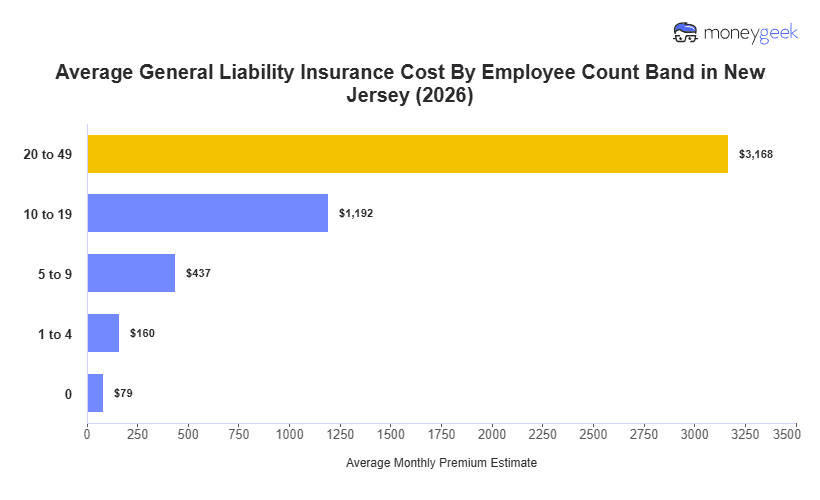
    In New Jersey, sole proprietors pay 50% less than the state average, while companies with 20 to 49 employees pay 1,884% more. Employee count drives this spread because larger workforces generate more customer interactions, expand operational complexity and increase claim probability. Insurers price for cumulative exposure that scales with headcount. Use your employee tier to estimate baseline costs, recognizing that industry risk and claims history also shift individual quotes.

    contractor icon
    Industry classification

    Tech and IT businesses run 81% below the New Jersey's average, anchored by desk-based work with minimal liability exposure. At the opposite end, Construction and Contracting operations run 202% above that benchmark, driven by physical hazards and elevated bodily injury risk. 

    Industry classification shapes premium variation because operational exposure differs sharply across business types. Low-risk office environments minimize physical interaction and hazard potential, while hands-on operations at customer sites or with equipment increase claim frequency and severity. Locate your industry tier to estimate baseline costs, recognizing that specific operations within that category also shift individual quotes.

New Jersey-Specific General Liability Insurance Cost Factors

State-specific conditions in New Jersey add layers of cost complexity beyond employee count and industry classification. Regulatory mandates, environmental legacy and regional economic factors combine to create a pricing environment that differs materially from most other states.

    congress icon
    New Jersey's Regulatory Requirements

    New Jersey requires home improvement contractors to maintain $500,000 minimum general liability coverage per occurrence. This regulatory floor sets a baseline premium threshold that affects contractor insurance costs statewide, regardless of business size or claims history. Businesses operating in regulated industries face higher compliance-related insurance expenses compared to states with less stringent mandates.

    injury icon
    New Jersey's Population Density

    New Jersey ranks first nationally in population density, concentrating more businesses and potential liability exposures in smaller geographic areas compared to other states. Higher density means greater foot traffic, more customer interactions per square mile, and increased probability of slip-and-fall incidents or property damage claims. Insurers price these elevated exposure levels into general liability premiums for New Jersey businesses.

    forest icon
    New Jersey's Environmental Liability Exposure

    New Jersey leads the nation with 115 federal Superfund sites as of 2024, reflecting decades of industrial activity. Businesses operating near contaminated areas face heightened environmental liability risks, including potential cleanup costs, third-party pollution claims, and regulatory enforcement actions. This legacy contamination increases demand for environmental impairment liability coverage and raises baseline general liability premiums in industrialized regions.

    money2 icon
    New Jersey's Regional Cost Structure

    The New York-Newark-Jersey City metro area, which encompasses most of New Jersey, ranks among the nation's highest cost-of-living regions, with the overall CPI running 4.3% above the prior year as of December 2024. Regional economic conditions affect medical care expenses and bodily injury claim settlements, as juries and insurers factor local costs into damage awards. Higher settlement values translate directly to increased general liability premiums for New Jersey businesses.

    flood icon
    New Jersey's Coastal Exposure

    New Jersey's 1,792 miles of tidal shoreline creates unique liability exposures for businesses in coastal and waterfront zones compared to inland operations. Storm surge risk, flood damage to customer property, and weather-related slip-and-fall incidents increase claim frequency along the coast. Businesses operating in hurricane-prone areas or managing waterfront facilities pay premium surcharges reflecting these heightened coastal hazards.

Average General Liability Insurance Costs in New Jersey by Business Size

General liability premiums in New Jersey range from $80 monthly for sole proprietors to $3,168 for businesses with 20 to 49 employees, reflecting how workforce size affects claim exposure and operational complexity. Hiring your first employee doubles baseline costs as insurers price in payroll-related liability and increased customer interactions. 

Each successive employee tier adds progressively larger premium increases ($80, then $278, then $755, then $1,976),  meaning businesses approaching the next employee threshold should budget for exponential rather than linear cost jumps.

New Jersey General Liability Insurance Cost Chart

Average General Liability Insurance Costs in New Jersey by Industry

Industry costs vary dramatically across New Jersey's economy. While the state average is $160 monthly, most businesses pay significantly less. Understanding where your industry sits in this distribution helps set realistic budget expectations.

  • Most industries in New Jersey pay below the $160 state average. Sixty-eight percent of industries actually pay less, with the median cost at just $107 monthly, 33% below published figures. Three high-risk outliers (construction, health care, childcare) pull the average upward, meaning most small businesses pay lower premiums than headline figures suggest. Check your specific industry classification before budgeting based on state averages.
  • Construction contractors pay extreme insurance costs that exceed all other industries. At $482 monthly, construction premiums run 202% above the state average and 1.8 times higher than even healthcare ($272). This creates a 15-fold cost gap between construction and tech firms ($31), placing contractors in a separate risk tier. Construction businesses should budget $500+ monthly for general liability coverage.
  • Professional service businesses benefit from dramatic cost advantages over physical industries. Tech ($31), consulting ($35), marketing ($37), and finance ($59) average just $40 monthly, 75% below the state average. Desk-based operations with minimal customer interaction and no physical hazards create low liability exposure. White-collar entrepreneurs entering New Jersey's knowledge economy pay premiums averaging less than typical software subscription costs.
  • Health care employs the most workers but pays nearly the highest premiums. With 508,800 employees (14% of the private sector), healthcare is New Jersey's largest employment sector yet pays $272 monthly premiums, 70% above average and second only to construction. Large workforce creates more exposure rather than economies of scale. Medical practices and healthcare startups carry dual cost burdens from staffing and insurance.
  • Industries contributing most to New Jersey's GDP benefit from favorable insurance economics—except healthcare. Transportation and logistics generates $72.4 billion in GDP but pays just $93 monthly (42% below average). Manufacturing contributes $52.6 billion while paying $97 monthly (39% below average). Health care also contributes $52.8 billion but pays $272 monthly premiums (70% above average), making it the only major GDP sector with unfavorable cost-to-value ratios.
Data filtered by:
Select
Agriculture & Natural Resources$129$1,54319%
Arts, Media & Entertainment$49$58669%
Beauty, Body & Wellness Services$59$71163%
Childcare Services$188$2,259-18%
Cleaning Services$140$1,67613%
Construction & Contracting$482$5,783-202%
Consulting Services$35$42178%
Education$60$72262%
Financial Services$59$70863%
Fitness Services$127$1,52321%
Food & Beverage$176$2,111-10%
Healthcare & Medical$272$3,261-70%
Hospitality, Travel & Tourism$152$1,8285%
Manufacturing$97$1,16839%
Marketing & Communications$37$44777%
Nonprofit & Associations$75$90353%
Other Professional Services$103$1,23236%
Pet Care Services$89$1,06345%
Real Estate & Property Services$56$67565%
Recreation & Sports$72$86855%
Repair & Maintenance$107$1,28233%
Retail & Product Rental$122$1,46424%
Tech/IT$31$37381%
Transportation & Logistics$93$1,11842%
Wholesale & Distribution$151$1,8175%

Use these resources to explore costs for your industry.

How to Lower General Liability Insurance Costs Without Sacrificing Coverage

Reducing premiums doesn't require downgrading protection levels. Strategic policy adjustments, smarter shopping practices and operational improvements all lower what you pay while maintaining full coverage. Finding cheap general liability insurance in New Jersey starts with understanding which cost-reduction tactics deliver immediate savings versus those requiring sustained effort over multiple renewals.

Quick General Liability Cost Lowering Methods

You control several cost factors through coverage decisions made at purchase or renewal. These strategies lower premiums through policy structure adjustments and payment choices, without requiring any operational changes to your New Jersey business.

    insurance2 icon
    Provide clean, accurate underwriting information

    Misreporting employee counts or annual revenue triggers mid-term premium adjustments that erase initial savings. Insurers price your staff size, square footage and customer interaction levels to establish your rating tier. For example, a Newark medical practice with high patient traffic prices differently than a Princeton consulting firm with occasional client meetings. Understating these factors during underwriting leads to retroactive rate increases, sometimes with audit penalties for material discrepancies.

    shoppingCart icon
    Compare multiple insurers

    Carriers price coastal storm and flood exposure based on their regional claims history, creating significant rate differences for businesses near port areas. A Jersey City warehouse operator comparing four to five insurers might find quotes ranging from $110 to $240 monthly for the same $1 million/$2 million coverage. Regional carriers familiar with nor'easter wind and water damage patterns typically assess risk more precisely than national insurers using broader data sets.

    building icon
    Bundle general liability into business owner's policies (BOP)

    Shore businesses in Monmouth and Ocean counties need coverage for both customer liability and property damage from nor'easters and hurricanes—especially when summer revenue must sustain year-round operations. Business owner's policies bundle general liability with commercial property protection, typically reducing combined premiums by 15% to 25%. Reviewing BOP costs against your current standalone policies reveals whether consolidation makes financial sense.

    coins2 icon
    Pay annually instead of monthly

    Monthly installment plans add $8 to $15 in billing fees per payment, totaling $96 to $180 annually that annual payment eliminates entirely. For Atlantic City hospitality businesses managing New Jersey's high insurance costs, paying the full $900 to $2,100 premium when summer revenue peaks captures an additional 5% to 10% discount. A hotel paying $1,800 annually avoids $144 in fees and gains $90 to $180 in discount savings.

    money2 icon
    Increase your deductible (if you can afford it)

    Weigh premium savings against out-of-pocket claim costs before raising deductibles as moving from $500 to $2,500 typically reduces annual premiums by 15% to 30%. Princeton area consulting and finance firms with strong cash reserves and low claim frequency can better absorb higher per-incident expenses in exchange for immediate rate reductions. A business paying $1,200 annually saves $180 to $360 by raising its deductible, recovering the increase after one to two claim-free years.

    loanReview icon
    Adjust your coverage limits

    Camden contractors working on urban redevelopment projects often need $2 million/$4 million limits due to aging infrastructure liability and municipal contract requirements and that 25% to 40% more than standard $1 million/$2 million policies. Most New Jersey businesses don't face this level of exposure and can operate safely within lower limits. A Princeton consulting firm or shore retail shop rarely encounters claims exceeding $1 million, making the premium increase for higher coverage an unnecessary expense that doesn't match actual operational risk.

Long-Term General Liability Cost Lowering Methods

Premium reductions from claims prevention and risk controls build gradually, typically showing measurable results after three to five years. Unlike immediate adjustments, these strategies require operational commitment but produce sustained savings that compound with each renewal cycle.

General Liability Insurance Cost in New Jersey: Bottom Line

New Jersey's compressed geography creates sharp cost variations across short distances. A 30-mile difference between coastal and inland locations can shift premiums by 40% even for identical operations. 

Use this report to identify which factors drive your rate:

  1. Where does your industry fall within New Jersey's cost spectrum? Industry classification creates the largest baseline difference: physical liability exposure from customer interaction, equipment use and premises hazards determines your starting rate before other factors apply.
  2. Where does your industry fall within New Jersey's cost spectrum? Your industry's claim frequency patterns and average severity costs establish baseline pricing. Operations with high customer traffic or physical work price higher than office-based businesses.
  3. Where does your industry fall within New Jersey's cost spectrum? Industry classification determines baseline rates based on historical claim patterns. Physical liability exposure (customer contact levels, equipment risks and premises hazards) creates cost differences before business-specific factors apply.

The relevant question isn't whether your premium seems high in absolute terms, it's whether your rate reflects controllable factors or simply the cost of doing business in your specific New Jersey context.

General Liability Insurance Cost in New Jersey: Next Steps

Once you understand where your business falls within New Jersey's cost structure, compare how different carriers price your specific profile. Regional insurers often assess Atlantic City hospitality risks or Camden construction exposure differently than national carriers lacking state-specific claims data. Use these resources to identify your options:

Request quotes using identical specifications (same coverage limits, same deductible amount, same business classification), so rate differences reflect how carriers evaluate your risk rather than policy design variations.

Get Personalized General Liability Insurance Quotes in New Jersey

Select your industry and state to get a customized New Jersey general liability quote.

Industry
State

About Angelique Palenzuela-Cruz


Angelique Palenzuela-Cruz headshot

Angelique Palenzuela-Cruz is a Content Writer at MoneyGeek specializing in business insurance. She focuses on general liability, workers' compensation and professional liability coverage, helping small business owners cut through policy jargon and understand what they're actually buying.

Angelique has spent over five years reporting on personal finance, with deep experience in both insurance and lending markets. Her psychology background also gives her a unique understanding of how people actually process difficult financial decisions, allowing her to meet readers where they are, simplify complex concepts and build decision making frameworks that give them confidence. Whether you're learning about policies, comparing providers or trying to figure out requirements, Angelique does the legwork, digging into regulations, analyzing policy language and testing her explanations against agent-level standards so you get straight answers without fluff.


sources
Copyright © 2026 MoneyGeek.com. All Rights Reserved