
How Much Does General Liability Insurance Cost in Georgia?

The cost of general liability insurance for Georgia businesses with one to four employees averages $121 monthly, or $1,451 annually, based on MoneyGeek's analysis of premium estimates from over 400 business types statewide. Georgia's rate is just $2 more per month, ranking it 27th for affordability among all states.

Adjacent states reveal distinct pricing patterns. Alabama businesses pay roughly $100 monthly, about $21 less than Georgia's benchmark, while North Carolina sits closer at $112. Florida, which also shares a border with Georgia, diverges substantially at $144 per month. A Warner Robins café owner budgeting $121 monthly would spend $144 across the state line in Jacksonville, which is an additional $276 annually for comparable coverage. Within the broader Southeast, costs range from South Carolina's $96 monthly average to Maryland's $155, positioning Georgia in the middle tier.

These figures represent aggregated estimates and don't predict individual quotes. An Atlanta roofing crew confronts different liability exposures than a Statesboro graphic design studio, which means actual premiums diverge based on industry classification, prior claims experience and selected policy limits. Use the state average to locate your business relative to the broader market, then identify which operational factors besides geography drive your specific premium.

To estimate average general liability insurance costs in Georgia, we analyzed quote data from major U.S. small business insurance providers and modeled standardized premium estimates across common business profiles. These modeled results are designed to provide a consistent state benchmark and show how premiums vary by key baseline factors including business size, industry and location within Georgia.

Dataset Scope and Assumptions

Our cost modeling uses standardized inputs for consistent comparisons across Georgia businesses.

  • Providers analyzed: 10 major insurance providers
  • Industries covered: 25 general industry categories relevant to Georgia's business landscape
  • Employee count bands: zero, one to four, five to nine, 10 to 19 and 20 to 49 employees
  • Policy baseline: standard general liability policy with $1 million per occurrence / $2 million aggregate limits
  • Total estimates modeled: over 20,000 standardized pricing estimates across Georgia industry and employee count combinations

We also incorporated modeled average revenue and payroll personalized across all combinations of Georgia regions, industry and employee counts to improve the accuracy of pricing. To model these assumptions against our cost factors, we used data from these sources:

  • CBP (for employee size class density in Georgia by NAICS)
  • QCEW (for wage/payroll intensity by industry in Georgia)
  • Economic Census / SUSB (for receipts/output intensity by industry)
  • Calibrated against:
    • Private comp databases
    • IRS SOI totals

How We Calculated Average General Liability Costs in Georgia

Our published averages represent modeled premiums for standardized business profiles and were aggregated in two ways:

  • Georgia state average: The Georgia average cost reflects the modeled premium for a standardized one to four-employee small business across all industries included in our dataset for a standard general liability policy.
  • Segment averages: To show how costs vary within Georgia, we calculated average modeled premiums for our state base profile and isolated for variables, including:
    • Employee count (business size ranges)
    • General industry categories

Segment averages were produced by aggregating modeled pricing trends across the full dataset so readers can compare how premiums shift across business types and regions within Georgia.

What Factors Affect General Liability Insurance Costs Georgia?

The cost of general liability insurance in Georgia responds to both universal pricing mechanisms and state-specific market conditions. Business size and industry classification create the foundation for premium calculations across all markets, while Georgia's tort environment, litigation patterns and claim frequency trends add localized cost pressures that distinguish the state's general liability landscape from national benchmarks.

Georgia Agnostic General Liability Insurance Cost Factors

Several universal factors drive general liability premiums regardless of location. Business size and industry classification shape costs most directly, with spreads reaching hundreds or thousands of dollars annually.

    smallBusiness icon
    Business size

    Employee count drives general liability premiums because larger operations generate more customer contact, handle greater work volume and confront higher claim probability. Each additional worker expands the business's exposure to liability events, increasing both the frequency and potential severity of incidents insurers must account for in pricing.

    In Georgia, sole proprietors pay 46% less than the state average, while operations with 20 to 49 employees pay 1,727% more. That spread reflects how dramatically exposure scales with workforce size.

    contractor icon
    Industry classification

    Industry classification shapes general liability premiums based on operational risk profiles. Businesses operating primarily from desks and digital environments encounter fewer physical hazards and customer injury scenarios than those involving jobsite work, heavy equipment or direct hands-on services, differences insurers translate into pricing tiers.

    Georgia's tech/IT sector runs 78% below the state average, given minimal physical risk exposure and limited customer interaction at commercial sites. Construction and contracting operations carry premiums 164% above that benchmark, driven by equipment use, worksite hazards and elevated bodily injury claim potential.

Georgia-Specific General Liability Insurance Cost Factors

Three Georgia-specific factors further shape general liability costs: the state's evolving tort environment, concentrated metropolitan litigation patterns and accelerating premises liability claim frequency statewide.

    congress icon
    Georgia's Tort Environment and 2025 Legislative Reform

    Georgia's modified comparative negligence rule (51% fault bar) established baseline liability standards, but nuclear verdicts surged from 2013 to 2024, adding $1,370 annually to small business insurance costs. Governor Kemp signed comprehensive tort reform in April 2025, eliminating phantom damages, mandating bifurcated trials and tightening negligent security standards. The Insurance Commissioner projects 3% to 5% premium reductions as insurers price in reduced nuclear verdict exposure and stricter evidentiary requirements.

    checkList icon
    Georgia's Regional Litigation and Cost Variation

    Metro Atlanta's 6.4 million residents concentrate liability exposure in Fulton, DeKalb and Gwinnett counties, which generated 41% of Georgia's nuclear verdicts despite representing a fraction of state geography. Atlanta-area businesses confront premiums running roughly 20% above state averages, while rural counties track 15% to 25% below. High-crime neighborhoods see particularly steep surcharges, with some DeKalb County operations experiencing coverage costs jumping from $50 to over $1,500 per unit.

    graph icon
    Georgia's Premises Liability Claim Patterns

    General liability claim frequency in Georgia increased 24.9% from 2019 to 2023 compared to the previous five-year period, with premises liability cases accounting for 26% of the state's nuclear verdicts during this surge. Notable judgments include a $43 million CVS parking lot shooting verdict and multiple eight-figure awards for negligent security claims. Georgia's litigation rate for liability cases runs nearly three times the median state level, concentrating costs particularly in commercial real estate and retail sectors.

Average General Liability Insurance Costs in Georgia by Business Size

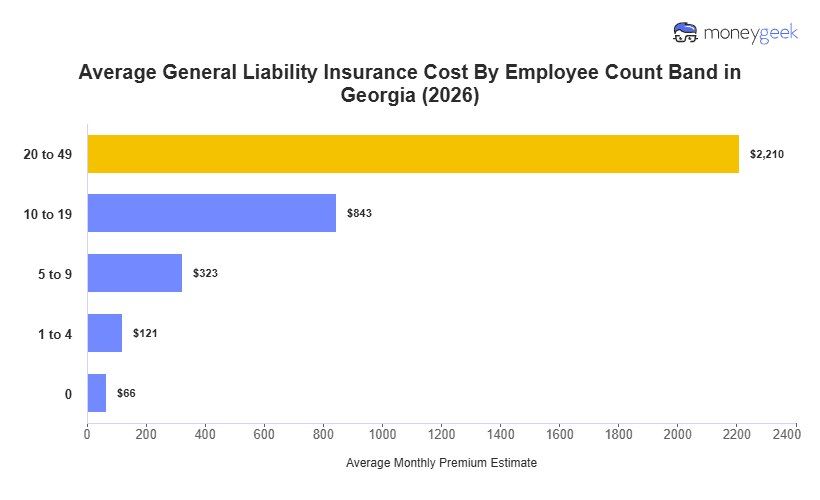
General liability premiums in Georgia scale with workforce size, reflecting increased customer interaction and operational exposure as employee counts grow. Sole proprietors pay $790 annually, while adding the first employee nearly doubles costs to $1,451. 

While while businesses with 20 to 49 employees spend $26,519 for coverage, the steepest relative jump occurs between five to nine and 10 to 19 employees, where premiums increase 161% as businesses cross the double-digit workforce threshold. The table shows annual and monthly costs across five employee bands.

Georgia General Liability Insurance Cost Chart

Average General Liability Insurance Costs in Georgia by Industry

General liability premiums in Georgia span a 12:1 ratio, from $27 for tech firms to $319 for contractors. Insurers price this $292 gap by evaluating customer exposure, physical work environments and medical liability risks differently across industry categories.

Four pricing dynamics characterize Georgia's insurance market:

  • Economic growth happens in low-cost territory. The state's fastest-growing sectors (e-mobility manufacturing, data centers, clean energy production and film operations) operate at $27 to $67 monthly. Georgia's $27.3 billion e-mobility investment and $23 billion clean energy expansion occur in industries paying 44% to 78% below average, meaning economic growth won't drive statewide general liability costs upward as employment shifts toward these sectors.
  • GDP leaders pay below average. Industries generating 36.8% of Georgia's GDP pay $32 to $67 monthly. Atlanta's Fortune 500 headquarters and professional services concentration faces minimal liability insurance burden despite producing the largest share of state economic output, creating a structural cost advantage where GDP growth and insurance costs move independently.
  • Employment concentration skews toward mid-cost. Accommodation and food services employ 277,660 workers, despite 60% of industries falling in the low-cost tier. The state's 17,322 restaurants and hospitality establishments carry $121 monthly premiums exactly at the state average, meaning more Georgia workers are exposed to mid-tier insurance costs than industry distribution suggests.
  • Construction stands as catastrophic outlier. Construction costs $319 monthly, 2.6 times health care's $206 and 11.8 times tech's $27. Metro Atlanta's building boom concentrates this extreme expense across thousands of contractors paying nearly triple the baseline, though sector averages don't reflect residential versus commercial specialization differences.

The table below shows monthly and annual costs across all 25 general industries, allowing you to benchmark your business against Georgia's industry-specific pricing structure.

Data filtered by:
Select
Agriculture & Natural Resources$97$1,15920%
Arts, Media & Entertainment$37$44070%
Beauty, Body & Wellness Services$38$45369%
Childcare Services$120$1,4391%
Cleaning Services$95$1,14421%
Construction & Contracting$319$3,832-164%
Consulting Services$32$38973%
Education$48$58160%
Financial Services$40$48367%
Fitness Services$104$1,24814%
Food & Beverage$121$1,4490%
Healthcare & Medical$206$2,477-71%
Hospitality, Travel & Tourism$101$1,21216%
Manufacturing$67$79945%
Marketing & Communications$32$37974%
Nonprofit & Associations$54$65155%
Other Professional Services$73$87340%
Pet Care Services$71$85641%
Real Estate & Property Services$47$56961%
Recreation & Sports$116$1,3904%
Repair & Maintenance$72$86441%
Retail & Product Rental$109$1,30510%
Tech/IT$27$32278%
Transportation & Logistics$84$1,00431%
Wholesale & Distribution$101$1,21716%

Use these resources to explore costs for your industry.

How to Lower General Liability Insurance Costs Without Sacrificing Coverage

Affordable general liability coverage in Georgia comes from combining quick administrative fixes with long-term operational improvements. Some methods lower costs within your current policy period, while others cover sustained practices build favorable claims histories and documented risk controls that Georgia insurers reward at renewal.

Quick General Liability Cost Lowering Methods

Six strategies reduce general liability costs immediately without changing your operations or coverage quality. These methods work within Georgia's insurance market structure, requiring only administrative actions like correcting classifications, comparing carriers or adjusting payment terms.

    insurance2 icon
    Provide clean, accurate underwriting information

    Atlanta event planners often get misclassified as event venues, which doubles general liability premiums because insurers assume property ownership and liquor liability exposure. Coordinators who arrange vendor contracts pay $45 monthly while venues hosting events pay $110. Verify your industry classification matches your actual operations becaues your revenue, employee count and business activities determine your rating tier. Misreporting triggers mid-term recalculations that increase premiums retroactively.

    shoppingCart icon
    Compare multiple insurers

    Request proposals from four to five insurers to identify competitive pricing across Georgia's varied risk landscape. A Savannah roofing contractor might receive quotes ranging from $180 to $340 monthly for identical $1 million/$2 million coverage, with carriers pricing hurricane exposure differently based on catastrophe models. Regional insurers familiar with Georgia-specific risks like coastal storms, metro litigation and seasonal tourism, often beat national carriers lacking local claims data.

    building icon
    Bundle general liability into business owner's policies (BOP)

    Business owner's policies (BOPs) combine general liability with commercial property coverage, reducing total costs by 15% to 25% compared to separate policies. Macon retailers exploring BOP costs gain dual protection for inventory damage and customer slip-and-fall claims under one premium, eliminating the need to coordinate separate liability and property policies.

    coins2 icon
    Pay annually instead of monthly

    Paying the full year's premium upfront saves 5% to 10% through paid-in-full discounts and eliminates monthly billing fees that add $3 to $8 per installment. North Georgia mountain lodge and tour operators with seasonal revenue concentration can time annual payments after peak summer and fall visitor months when cash reserves are highest, locking in annual savings without straining operational budgets.

    money2 icon
    Increase your deductible (if you can afford it)

    Weigh premium savings against out-of-pocket claim costs before raising deductibles from $500 to $2,500 or $5,000. Columbus manufacturers with established cash reserves can absorb higher per-claim expenses while reducing premiums 15% to 25%. Atlanta restaurants and Savannah cafés experiencing frequent minor incidents, such as kitchen accidents, customer slips and small property damage, should keep lower deductibles even with higher monthly premiums.

    loanReview icon
    Adjust your coverage limits

    When your assets and contract requirements permit flexibility, adjusting coverage limits offers savings opportunities. Augusta solo consultants with minimal assets may safely reduce from $2 million/$4 million to $1 million/$2 million, cutting premiums by 30% to 40%. Healthcare facilities with patient interaction and significant property values require higher limits though premiums increase. Under-insuring creates catastrophic exposure; over-insuring wastes money on protection you don't need.

Long-Term General Liability Cost Lowering Methods

Long-term cost reduction depends on building a favorable claims history and implementing verifiable risk controls. These methods require sustained operational changes and disciplined claims management, but they compound savings as your loss history and risk profile improve year over year.

General Liability Insurance Cost in Georgia: Bottom Line

Your actual premium depends on risk factors insurers weigh differently: location exposure, claims history and operational controls. Understanding what drives these differences helps you evaluate whether your rate reflects your actual risk or just broad industry assumptions.

Three questions help you interpret where you fall among Georgia's industry costs, business size tiers and state-specific risk factors:

  1. What location-specific exposures affect pricing in your area? County-level litigation patterns, coastal versus inland operations and metro versus rural concentration create baseline rate differences before individual business factors apply.
  2. What separates two businesses in the same industry? Loss history, documented risk controls and operational practices create wider premium spreads than revenue or employee count differences within the same industry tier.
  3. Which cost drivers can you verify or influence? Some factors (industry classification, tort environment, contract requirements) are fixed. Others (claim frequency, safety documentation, deductible selection) you can adjust.

Compare your rate against the patterns in this report to gauge whether your premium reflects Georgia-specific factors or primarily your industry's baseline risk profile.

General Liability Insurance Cost in Georgia: Next Steps

Use this report's benchmarks to evaluate quotes and understand what drives differences in your offers.

Start with these resources to compare Georgia carriers:

Compare your business against Georgia's industry and size benchmarks, then request quotes with matching coverage terms. Rate variations show whether carriers price your location differently, weight your claims record more heavily or interpret your classification distinctly.

Get Personalized General Liability Insurance Quotes in Georgia

Select your industry and state to get a customized Georgia general liability quote.

Industry
State

About Angelique Palenzuela-Cruz


Angelique Palenzuela-Cruz headshot

Angelique Palenzuela-Cruz is a Content Writer at MoneyGeek specializing in business insurance. She focuses on general liability, workers' compensation and professional liability coverage, helping small business owners cut through policy jargon and understand what they're actually buying.

Angelique has spent over five years reporting on personal finance, with deep experience in both insurance and lending markets. Her psychology background also gives her a unique understanding of how people actually process difficult financial decisions, allowing her to meet readers where they are, simplify complex concepts and build decision making frameworks that give them confidence. Whether you're learning about policies, comparing providers or trying to figure out requirements, Angelique does the legwork, digging into regulations, analyzing policy language and testing her explanations against agent-level standards so you get straight answers without fluff.


sources
Copyright © 2026 MoneyGeek.com. All Rights Reserved