Estimate Average Business Insurance Costs for Your Tax Preparer Business

Plug in your coverage type, state, employee count and vehicle type (if you need commercial auto coverage) to get a cost estimate built around your operation. No personal information is required, and workers' comp estimates are calculated per employee.

Select Coverage Type
Select State
Select Employee Count
Select Vehicle Type
Monthly Rate Estimate—

How Much Does Tax Preparer Business Insurance Cost?

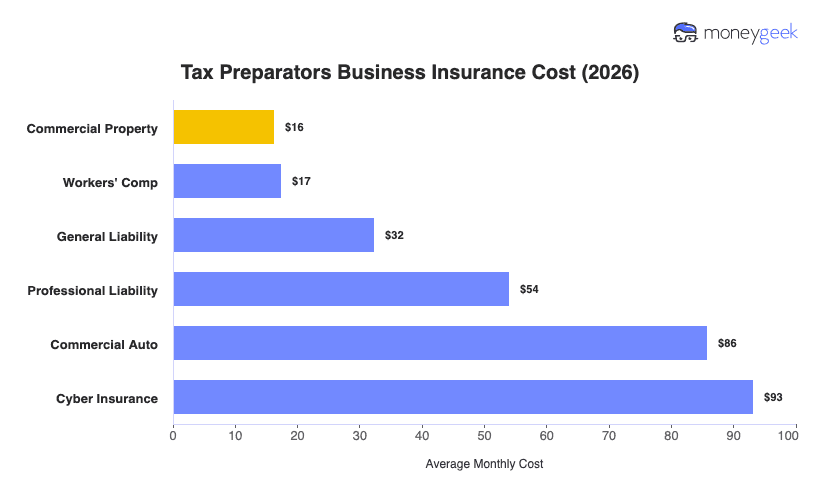
The average cost of business insurance for tax preparers is $50 per month, or $598 per year, averaged across six common coverage types, using standardized profiles for businesses with one to four employees and $1 million per occurrence limits.

For a single coverage type, your cost will fall somewhere from $16 to $93 per month. Commercial property sits at the low end as tax prep offices typically carry modest equipment and operate from small offices, so insured values stay low. Cyber insurance prices highest because tax preparers collect Social Security numbers, bank account details and financial records for every client. 

The breakdowns below are benchmarks as your actual premium depends on your business profile:

Commercial Property$16$19587%41
Workers' Comp$17$20985%37
General Liability$32$388-74%45
Professional Liability$54$6523%96
Commercial Auto$86$1,02947%4
Cyber Insurance$93$1,120-12%270

We analyzed quote data from major U.S. commercial insurance providers and modeled standardized premium estimates across business profiles representing around 95% of the market. Results are designed to provide a consistent national benchmark showing how premiums vary by key baseline factors including business size, restaurant profession type, location and vehicle type for operations that use commercial vehicles.

Dataset Scope and Assumptions

Our cost modeling uses standardized inputs for consistent comparisons across businesses.

  • Total estimates modeled: just over 6 million standardized pricing estimates
  • Providers analyzed: 10 major insurance providers
  • Geography: all U.S. states including Washington, D.C.
  • Employee count bands: solo practitioners, one to four, five to nine, 10 to 19, and 20 to 49 employees
  • Vehicle types studied: Sedans, SUVs, pickup trucks, vans, taxis, limousines, tractors, food trucks, semi-trucks (non-HAZMAT and HAZMAT), tanker trucks (non-HAZMAT and HAZMAT), buses, box trucks, dump trucks, flatbed trucks
  • Policies studied: general liability, workers' comp, professional liability, commercial auto, commercial property, and cyber insurance
    • General liability: $1 million per occurrence and $2 million aggregate
    • Workers' comp: state required coverage
    • Professional liability: $1 million per claim and $1 million aggregate
    • Commercial auto: minimum coverage
    • Commercial property: personal property coverage limits personalized to industry, business size and state
    • Cyber insurance: $1 million per occurrence and $1 million aggregate

How We Calculated Average Tax Preparer Business Insurance Costs

Our published averages represent modeled premiums for standardized business profiles and were aggregated in two ways.

  • National benchmark average: The national average cost reflects the modeled premium for a standardized one to four employee business across all and states included in our dataset for a standard policies
  • Segment averages: To show how costs vary, we calculated average modeled premiums for our national base profile and isolated for variables, including:
    • Employee count (business size ranges)
    • Vehicle types (for commercial auto)
    • States (including Washington, D.C.)

Segment averages were produced by aggregating modeled pricing trends across the full dataset so readers can compare how premiums shift across coverage types and regions.
See our full business insurance methodology.

How Much Does Professional Liability Insurance Cost for Tax Preparers?

Tax preparers carry professional liability coverage because a filing error, missed election or incorrect advice can expose a client to direct financial harm, and that claim comes back to your practice. Depending on where you operate, professional liability costs run from around $47 per month in Maine, North Carolina and North Dakota to around $64 per month in Washington, DC.

That 36% gap between the lowest and highest states comes down to litigation climate and how aggressively professional claims are pursued locally. If your practice is based in New York, Pennsylvania, California or New Jersey, expect your quote to sit above the national average, while practices in the Southeast and upper Midwest tend to land below it.

Alabama$49$589
Alaska$45$541
Arizona$48$571
Arkansas$48$571
California$56$674
Colorado$50$595
Connecticut$55$656
Delaware$54$644
Florida$54$650
Georgia$51$614
Hawaii$52$626
Idaho$48$571
Illinois$55$662
Indiana$49$583
Iowa$48$571
Kansas$49$583
Kentucky$47$559
Louisiana$57$680
Maine$44$523
Maryland$48$571
Massachusetts$53$632
Michigan$47$565
Minnesota$47$565
Mississippi$50$601
Missouri$50$595
Montana$50$595
Nebraska$47$565
Nevada$57$686
New Hampshire$50$595
New Jersey$57$680
New Mexico$51$607
New York$58$698
North Carolina$44$523
North Dakota$44$523
Ohio$47$559
Oklahoma$47$565
Oregon$47$559
Pennsylvania$58$692
Rhode Island$55$662
South Carolina$52$620
South Dakota$47$565
Tennessee$49$583
Texas$51$607
Utah$48$571
Vermont$48$577
Virginia$46$547
Washington$57$686
Washington DC$59$710
West Virginia$53$632
Wisconsin$49$589
Wyoming$47$559

How Much Does Cyber Insurance Cost for Tax Preparers?

Tax preparers collect Social Security numbers, financial records and banking details for every client they serve, making data breach exposure a core risk for your practice. The average cost of cyber insurance ranges from around $79 per month in Alaska, Montana, North Dakota and Wyoming to around $116 per month in Washington, D.C.

If your practice is in Washington, DC or a surrounding market, you'll pay nearly 1.5 times what practices in the lowest-cost states pay, a gap driven by data privacy laws, litigation activity and local breach frequency assumptions. Rural and mountain states cluster at the low end while the Northeast and major coastal markets sit at the top, a reliable guide for where your practice falls.

Alabama$90$1,081
Alaska$79$951
Arizona$95$1,137
Arkansas$85$1,028
California$110$1,321
Colorado$101$1,213
Connecticut$106$1,274
Delaware$103$1,241
District of Columbia$116$1,384
Florida$100$1,209
Georgia$99$1,191
Hawaii$84$1,007
Idaho$81$974
Illinois$106$1,274
Indiana$93$1,115
Iowa$84$1,006
Kansas$88$1,058
Kentucky$90$1,081
Louisiana$90$1,079
Maine$84$1,007
Maryland$106$1,278
Massachusetts$106$1,278
Michigan$95$1,135
Minnesota$95$1,137
Mississippi$85$1,028
Missouri$93$1,113
Montana$79$952
Nebraska$84$1,007
Nevada$104$1,245
New Hampshire$84$1,006
New Jersey$108$1,299
New Mexico$85$1,027
New York$113$1,351
North Carolina$97$1,169
North Dakota$79$952
Ohio$94$1,133
Oklahoma$88$1,059
Oregon$97$1,169
Pennsylvania$97$1,167
Rhode Island$84$1,006
South Carolina$90$1,082
South Dakota$81$971
Tennessee$92$1,111
Texas$101$1,213
Utah$88$1,061
Vermont$84$1,006
Virginia$103$1,243
Washington$103$1,241
West Virginia$81$973
Wisconsin$92$1,111
Wyoming$79$952

How Much Does General Liability Insurance Cost for Tax Preparers?

General liability covers third-party claims that arise when clients visit your office, including bodily injury, property damage and related legal costs. The average cost of general liability for tax preparers runs from around $21 per month in West Virginia to around $53 per month in Washington, D.C., where practices pay more than twice what West Virginia-based operations pay.

Most of that spread comes from local litigation rates and jury award levels as your location carries more weight on general liability than on almost any other policy you carry. If you operate in a rural Southern or Midwest market, expect to land well below average, but a major urban market will push your rate well above it.

Alabama$13$152
Alaska$24$284
Arizona$17$207
Arkansas$12$145
California$28$334
Colorado$21$256
Connecticut$24$286
Delaware$19$223
District of Columbia$28$338
Florida$20$241
Georgia$16$198
Hawaii$25$296
Idaho$13$150
Illinois$21$249
Indiana$15$174
Iowa$13$152
Kansas$14$163
Kentucky$13$161
Louisiana$13$160
Maine$15$180
Maryland$23$275
Massachusetts$26$312
Michigan$16$190
Minnesota$19$225
Mississippi$11$136
Missouri$14$172
Montana$13$154
Nebraska$14$165
Nevada$19$225
New Hampshire$19$229
New Jersey$24$290
New Mexico$13$154
New York$26$317
North Carolina$16$188
North Dakota$13$158
Ohio$15$182
Oklahoma$13$156
Oregon$20$240
Pennsylvania$18$216
Rhode Island$19$225
South Carolina$13$154
South Dakota$12$143
Tennessee$15$182
Texas$17$204
Utah$15$180
Vermont$17$206
Virginia$20$236
Washington$24$284
West Virginia$11$133
Wisconsin$15$180
Wyoming$13$151

How Much Does Workers’ Comp Insurance Cost for Tax Preparers?

Workers' comp is legally required in most states once you hire staff, priced per employee based on payroll and state classification rates. Most states run from around $13 per employee per month in Texas to around $17 in New York. Delaware and Pennsylvania are notable exceptions, where state-specific pricing pushes workers' comp costs to around $80 and $84 per employee per month respectively.

Delaware and Pennsylvania reflect assigned-risk structures that price this industry differently from the national market, so if you're hiring in either state, factor those figures separately. For every other state, the spread is narrow at about $5 per employee, and your state's classification rules matter more than your industry in determining where your premium lands.

Alabama$14$162
Alaska$17$204
Arizona$14$165
Arkansas$13$154
California$23$273
Colorado$14$169
Connecticut$18$215
Delaware$15$177
District of Columbia$20$244
Florida$14$170
Georgia$14$168
Hawaii$16$195
Idaho$13$160
Illinois$16$188
Indiana$13$153
Iowa$13$158
Kansas$13$161
Kentucky$14$167
Louisiana$15$179
Maine$15$176
Maryland$15$181
Massachusetts$16$196
Michigan$15$178
Minnesota$14$172
Mississippi$14$172
Missouri$14$167
Montana$14$174
Nebraska$13$161
Nevada$14$171
New Hampshire$15$175
New Jersey$18$210
New Mexico$14$171
New York$18$216
North Carolina$14$167
Oklahoma$15$175
Oregon$14$173
Pennsylvania$15$185
Rhode Island$16$190
South Carolina$15$180
South Dakota$13$154
Tennessee$14$165
Texas$13$152
Utah$13$160
Vermont$15$175
Virginia$13$155
West Virginia$15$177
Wisconsin$14$173

How Much Does Commercial Property Insurance Cost for Tax Preparers?

Commercial property coverage protects your office equipment, furniture and leased space contents against damage or loss. Monthly premiums for tax preparers range from around $14 in North Dakota to around $19 in New York, where your premium could run about 37% above what practices in the lowest-cost states pay.

Local property replacement costs and weather-related risk drive most of that variation: if your office is in a coastal or major urban market, expect to sit near the top of the range, but a rural Midwest location will push you toward the low end. Commercial property has the narrowest spread of all six coverage types, so your location is unlikely to move this premium dramatically unless you're in an extreme market.

Alabama$14$166
Alaska$16$196
Arizona$15$177
Arkansas$13$161
California$17$204
Colorado$15$184
Connecticut$16$197
Delaware$15$185
District of Columbia$17$206
Florida$17$201
Georgia$15$177
Hawaii$17$208
Idaho$14$168
Illinois$15$182
Indiana$14$163
Iowa$13$157
Kansas$13$157
Kentucky$14$164
Louisiana$15$185
Maine$14$168
Maryland$16$190
Massachusetts$17$201
Michigan$14$168
Minnesota$14$173
Mississippi$14$163
Missouri$13$161
Montana$14$163
Nebraska$13$156
Nevada$15$180
New Hampshire$15$175
New Jersey$17$205
New Mexico$14$164
New York$18$211
North Carolina$15$178
North Dakota$13$154
Ohio$14$168
Oklahoma$13$162
Oregon$15$185
Pennsylvania$16$187
Rhode Island$16$192
South Carolina$15$175
South Dakota$13$156
Tennessee$14$170
Texas$16$187
Utah$14$173
Vermont$14$170
Virginia$15$181
Washington$16$191
West Virginia$13$161
Wisconsin$14$166
Wyoming$13$160

How Much Does Commercial Auto Insurance Cost for Tax Preparers?

Commercial auto applies when you use a vehicle for business purposes, including traveling to client sites, picking up documents or running practice-related errands, since personal auto policies typically exclude business use. The average cost of commercial auto for tax preparers ranges from around $40 per month in Iowa to around $64 per month in Washington, D.C.

That $24 monthly gap reflects differences in accident frequency, traffic density and state litigation activity, factors that affect your rate based on where you operate. If you only use your vehicle occasional in your practice, your actual spend will likely track toward the lower end of your state's range regardless of location.

Idaho
$40
$479
Iowa
$40
$474
Vermont
$41
$491
Montana
$43
$511
Nebraska
$43
$519
New Mexico
$43
$522
Arkansas
$44
$532
Hawaii
$44
$530
New Hampshire
$44
$530
Wisconsin
$44
$533
Alabama
$45
$536
Kansas
$45
$539
Mississippi
$45
$540
Oklahoma
$45
$538
West Virginia
$45
$539
Kentucky
$46
$553
North Dakota
$46
$555
South Dakota
$46
$554
Utah
$46
$548
Indiana
$47
$562
Tennessee
$47
$559
Arizona
$48
$574
Maine
$48
$571
North Carolina
$48
$577
South Carolina
$48
$572
Wyoming
$48
$581
Minnesota
$49
$593
Georgia
$50
$597
Missouri
$50
$601
Oregon
$50
$600
Louisiana
$51
$606
Colorado
$52
$624
Virginia
$52
$621
Nevada
$53
$635
Rhode Island
$53
$637
Ohio
$54
$652
Illinois
$55
$665
Maryland
$56
$675
Pennsylvania
$56
$674
Texas
$56
$667
Alaska
$58
$699
Connecticut
$58
$691
Massachusetts
$58
$702
Florida
$59
$704
New Jersey
$60
$716
California
$61
$734
Delaware
$61
$729
Michigan
$62
$738
New York
$62
$749
Washington
$62
$741
Washington, DC
$64
$767

Factors Affecting Tax Preparer Business Insurance Costs

What you pay for tax preparer business insurance depends on a mix of operational, service-scope and data-handling factors specific to how your practice runs. We found that tax preparers are unusual in facing concentrated exposure on both the advice and data sides of risk simultaneously.

    tax icon
    Services offered

    The range of services your practice offers is one of the clearest cost signals insurers use. Basic individual returns carry a different risk profile than business tax advisory, audit representation or IRS examination support, where a single error can expose your client to meaningful tax penalties.

    users icon
    Client data volume

    The number of clients your practice serves each season directly affects how insurers assess your data exposure. When your client volume is high, you're processing large amounts of sensitive personal and financial data in a short window, which insurers treat as elevated data exposure and factor into your premium.

    workplace icon
    Office arrangement

    Where and how your practice operates physically shapes your insurance profile across multiple coverage areas. If you lease commercial space, you'll likely need to meet your landlord's minimum coverage requirements, while a co-working or shared location raises questions about whose policy covers an incident on the premises.

    car icon
    Vehicle use

    If your practice involves traveling to client sites, picking up tax documents or making office runs during filing season, the vehicles your business uses become a rating factor. Personal auto policies typically exclude coverage for business use, so the frequency and purpose of your driving matters to insurers.

    calendarV2 icon
    Seasonal staffing

    If you bring on temporary or part-time preparers for the January through April filing rush, your headcount doesn't stay flat and neither does your coverage exposure. Insurers may treat seasonal fluctuations in your payroll differently than a stable year-round team, and some require mid-term policy adjustments to reflect the change.

How to Lower Tax Preparer Business Insurance Costs

Your practice carries an unusual combination of advice-based and data-related risk, and we found that addressing both takes more than shopping for a better quote. Some methods reduce your tax preparer business insurance costs within the current policy period; others build the kind of risk profile that moves your premiums over time. The five below cover both:

    vsDocuments icon
    Compare quotes using the same coverage limits

    Comparing quotes for professional liability and cyber coverage can reveal real pricing differences across carriers, though the exercise only works when you're holding limits constant. If one quote uses a $500,000 professional liability limit and another uses $1 million, the price difference tells you nothing useful about which carrier is more competitive for your profile.

    uninsured icon
    Right-Size Your Coverage

    Coverage limits that made sense when you first launched your practice may no longer reflect your actual exposure. If you handle a stable, lower-volume client list and operate without employees, your actual exposure may be narrower than your current policy reflects. Reviewing your limits against your client volume and service scope can reveal coverage you're paying for but don't need.

    shoppingBag icon
    Bundle policies with the same provider

    If you're already carrying more than one coverage type, which most tax preparers are, you may be leaving a multi-policy discount on the table by splitting your lines across different carriers. Bundling your professional liability with your general liability or cyber coverage through a single carrier can reduce your total premium without reducing your protection.

    barChart icon
    Lower your risk profile

    Your premium reflects how insurers assess the likelihood of a claim against your practice. When you hold active credentials like CPA or enrolled agent status, maintain a clean claims history and stay current on continuing education, underwriters see a lower-risk profile. That combination tends to show up in how carriers price your renewal over time.

    stackOfBooks icon
    Invest in risk management practices

    Most of the claims that hit your practice hardest, filing errors, missed elections and data breaches, are preventable if you build consistent protocols around them. In our experience, when you document your risk management approach, underwriters tend to view your practice more favorably at renewal, particularly on the lines where your exposure is highest.

    • Use signed engagement letters with every client that define your scope of work, limit your liability and establish clear deadlines for document submission.
    • Build a documented review process for your returns before filing, including a second-preparer check on complex business or multi-state work.
    • Use encrypted storage and secure client portals for all personal and financial data your practice handles, particularly during the high-volume filing season.
    • Stay current on tax law changes and IRS compliance procedures through annual continuing education to reduce advice-based errors in your practice.

Tax Preparer Business Insurance Cost: Bottom Line

At around $50 per month, the tax preparer business insurance average reflects a wide spread of practice configurations. Your actual premium depends on the services you offer, your practice size and your location.

These three questions help you read any quote you receive against your specific profile:

  1. Where do you fall in the distribution? Use benchmarks matched to your practice type, employee count and state first. A smaller practice in a lower-cost market will often find the average sits above what you'll actually pay.
  2. Is your quote consistent with your risk profile? If your quote runs well above the benchmark for your profile, look at what's driving it before drawing conclusions. One coverage type carrying a higher limit than your baseline can explain much of the gap.
  3. Which cost drivers apply to your business? Not all cost drivers here apply to your practice equally. If you offer advisory services from a leased office, your profile looks different than a home-based preparer handling individual returns. Start with the ones that fit your situation.

The gap between a benchmark and your actual quote almost always comes down to a small number of operation-specific factors, which means understanding why the difference exists is more useful than knowing the distance. Treat the figures here as a lens for that question, not a number to match.

Tax Preparer Business Insurance Cost: Next Steps

If you're still figuring out which coverage types apply, start by mapping your actual exposure: the services you offer, who your clients are and whether any agreements require you to carry specific coverage before you can work.

If your focus is finding the most competitive rate, carriers that specialize in financial services or professional practices tend to price more favorably for tax preparers than generalist providers. Knowing your scope and employee count beforehand makes quotes easier to compare.

The gap between industry benchmarks and your actual quote tends to surface the same frequently asked questions for tax preparers:

Why is my quote higher than the industry averages?

Do I really need all six coverage types?

Will adding staff this year change what I pay?

Will my costs change if I start serving business clients?

About Connor Bolton


Connor Bolton headshot

Connor Bolton is Senior SEO and Content Manager at MoneyGeek, where he leads the business and pet insurance editorial teams. As editorial lead for both verticals, Connor sets the research framework, data standards, and content structure that his writers execute, directly authoring in-depth guides himself and reviewing all team content for accuracy and practical value before it goes live. With over four years evaluating insurance products across personal, commercial, and specialty lines, he brings cross-vertical knowledge to every guide the team produces.

Connor architected MoneyGeek's insurance research infrastructure across all major verticals including auto, home, renters, life, health, business, and pet, building systems for pricing analysis, provider-level research, customer experience evaluation, and coverage analysis with AI support. The infrastructure includes over 6 million data points for business insurance across 408 industry areas, all 50 states, and 16 vehicle types, and over 5 million pet insurance profiles across 18 major providers and hundreds of breed and age combinations. Connor's insurance cost research and his team's work has been cited by the U.S. Chamber of Commerce, Allstate, Liberty Mutual, CBS News, Forbes and LegalZoom.

Beyond the data, Connor stays connected to how the market actually operates, drawing on direct conversations with underwriters and carrier liaisons at Ethos, The Hartford, NEXT Insurance, Nationwide, and State Farm, and monitoring business and pet owner communities including Reddit, to inform how he interprets findings and frames guidance for real buyers.

He is the direct editorial contact for methodology questions at connor@moneygeek.com and can be found on LinkedIn.