
Best General Liability Insurance Companiesin New York

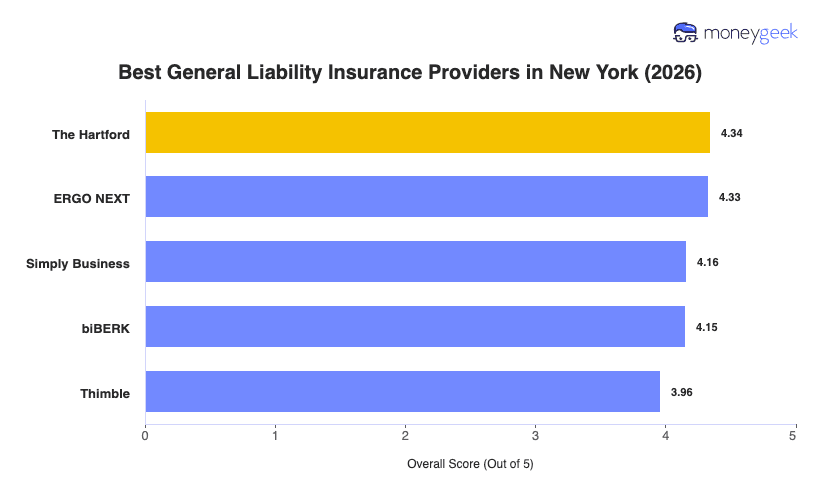
To find New York’s best general liability providers, I looked at how insurers explain eligibility and how easily you can update your policy or get proof of insurance. I then compared average rates of quotes from 10 insurers across 25 general industries, including professional and technical firms and transportation businesses, to see whether policies fit different types of work.

My top picks are:

  • Choose if you're in professional services: The Hartford
  • Choose if your business is customer-facing: ERGO NEXT
  • Choose if you want more coverage options: Simply Business
  • Choose if you a service-based business: biBerk
  • Choose if you're a freelancer or a gig worker: Thimble

For our New York general liability insurance ratings, we analyzed pricing, coverage options and customer experience across 408 industries within the state. Our analysis focuses on one-to-four-person businesses, which represent nearly half of New York's small businesses, while weighting results to ensure broader industry and location representation across New York City, Buffalo, Rochester, Syracuse and smaller markets throughout the state.

To do this, we evaluated over 20,000 business profiles, more than 5,700 customer experience data points and performed in-depth analysis of coverage contracts and endorsements to compare how insurers serve New York businesses consistently across different industries and regions. We then rated each company across affordability (50%), customer experience (30%) and coverage options and terms (20%) to form an overall rating. For a detailed breakdown of the metrics, scoring methodology and pricing analysis specific to New York, see our full methodology.

95%

% of Small Businesses Covered

Over 20,000

Business Profiles Studied

5,739

Customer Experiences Analyzed

The Hartford

The Hartford: Best Overall, Best for Professional Services

On The Hartford's site
COMPANY HIGHLIGHTS

The Hartford tops our analysis of general liability insurers in New York, leading in affordability and ranking strong for coverage options. It saves New York businesses 17% on average and is the most affordable option for companies with one to 49 employees. Businesses in education, health care and agriculture see the most savings with The Hartford. 

While it leads nationally for policy management and claims handling, the buying experience is less competitive. The Hartford’s model requires you to speak with an agent to finish purchasing your policy, leading to quotes taking two to three business days rather than completing everything online.

Learn More: The Hartford Business Insurance Review

ERGO NEXT

ERGO NEXT: Best for Customer-Facing Service Businesses

On ERGO NEXT's site
COMPANY HIGHLIGHTS

ERGO NEXT ranks second overall for New York small businesses. Service quality is its strength: customers ranked the buying experience first and policy management second. Claims handling ranks sixth. Though the fully digital platform quotes and covers you in 15 minutes, some policyholders report disputes over settlement fairness and slow communication.

Most New York businesses pay $154 monthly, 13% less than the state average. Food service and hospitality businesses get the lowest rates, saving up to 30% monthly. Coverage options rank ninth due to limited endorsements and lower sublimits. ERGO NEXT covers damage to rented premises up to $100,000 versus the standard $300,000. That gap may leave NYC businesses in high-rent commercial spaces underinsured.

Learn More: ERGO NEXT Business Insurance Review

Simply Business

Simply Business: Best for Coverage Options

On Simply Business site
COMPANY HIGHLIGHTS

Simply Business ranks third for customer experience. It connects New York small businesses with multiple carriers, including Hiscox, Travelers and The Hartford, through one submission. Coverage options rank fourth: you can weigh several carriers' policy structures side by side, though sorting out different sublimits and endorsements across quotes adds complexity. Post-purchase service depends entirely on which carrier underwrites your policy.

New York businesses pay $175 monthly, 2% less than the state average. Retail and repair businesses see the biggest savings, at 16% to 17%.

Learn More: Simply Business Review

biBerk

biBerk: Best for Service-Based Businesses

COMPANY HIGHLIGHTS

biBerk ranks fourth overall for New York small businesses, with competitive affordability and buying experience alongside mid-pack policy management and coverage. Berkshire Hathaway owns the company, which offers a hybrid model: agents are available during purchase to help with New York requirements. Reviewers point to agents explaining Scaffold Law disclosures and liquor liability without the rushed feel of traditional carriers.

New York businesses pay $165 monthly, an 8% savings. Service industries see the biggest rate cuts: hospitality saves 30%, repair and maintenance 28%, and health care 24%. Post-purchase service is a weaker spot. New York contractors report mixed results with certificates of insurance: simple requests process instantly, but complex NYC commercial real estate requests take one to two days for agent review.

Learn More: biBerk Review

Thimble

Thimble: Best for Freelancers and Gig Workers

COMPANY HIGHLIGHTS

Thimble ranks fifth overall for New York small businesses. Its on-demand model is unlike anything else on this list, but coverage and affordability both fall short. The platform's strength is flexible coverage periods: New York freelancers and gig workers can activate policies by the hour or day for a single project, then deactivate between jobs. Affordability is inconsistent. Most New York businesses pay $166 monthly, an 8% savings, but hospitality businesses pay 26% more than the typical rate, and marketing firms pay 17% more.

Coverage ranks last. Thimble doesn't cover New York construction businesses with Scaffold Law exposure, offers no liquor liability, and provides very limited endorsements. Claims handling trails the top options too: New York reviewers report settlement offers 30% below repair quotes, plus weeks-long gaps in communication.

Learn More: Thimble Review

What Determines the Best General Liability Insurance for New York Businesses

The right provider should understand how your New York business operates, not just where it’s registered. A contractor may need revised insurance documents for several job sites, while a food producer needs protection that continues after a product leaves its facility. The best general liability insurance should be able to address those needs.

How to Choose the Best General Liability Insurance in New York

To get general liability insurance that matches your New York operations, start with knowing what your business needs. Then use the steps below to narrow the field and find an insurer that provides value both for the short- and long-term.

  1. 1
    Optimize your payment and coverage structure

    Start by identifying the liability risks your New York business actually carries, then match coverage levels to that reality. A Bronx food service business serving alcohol needs different limits and endorsements than a freelance graphic designer working from a home office in Rochester. Work through these questions first:

    • Would paying the annual premium upfront put too much pressure on your cash flow? Monthly billing spreads out the payments, but installment fees increases the total cost.
    • What liability limits do your leases and client contracts require? Check whether you also need to add a landlord or client as an additional insured.
    • Are you planning to open another location or offer a new service within the next year? Make sure the insurer accepts those operations and can update your policy when the change happens.

    Most New York small businesses start at $1 million per occurrence and $2 million aggregate. From there, actual needs shift based on what you do, who you work with and any additional general liability requirements from contracts. A Manhattan event planning company managing high-value weddings needs higher limits and host liquor liability, while a solo IT consultant working from home in Buffalo can stay at standard coverage.

    Read More: How Much General Liability Insurance Do You Need?

  2. 2
    Choose your primary priority

    Pick the factor that matters most right now. That's your tiebreaker when providers score close to each other.

    • Affordability: Rate should lead if you're launching a Brooklyn retail shop or Albany consulting firm on tight startup cash, running thin margins where a 20% premium hike would force cuts elsewhere, or keeping operations predictable and low-risk in a way that makes steady rates more valuable than extra endorsements.
    • Customer experience: Service should lead if you're a contractor bidding on NYC projects that need certificates within 24 hours, a Syracuse event planner updating policies often for seasonal staff and venue changes, or working with Manhattan commercial clients who need documentation fast.
    • Coverage options: Policy features should lead if you run a Rochester restaurant serving alcohol, a construction company working across multiple boroughs, or a business expanding from Buffalo into downstate markets. Higher-risk operations, and clients with their own endorsement demands, need a policy built to scale.
  3. 3
    Shortlist two to three providers

    Narrow your list to two or three insurers that fit your priority and can actually cover your New York business. A provider suited to a Manhattan retail shop might turn away a construction company working across the five boroughs. Good customer service upstate won't help a Brooklyn restaurant that needs liquor liability endorsements.

    Confirm each shortlisted provider covers your industry, your New York locations and the coverage structure you identified in step one.

  4. 4
    Double check for dealbreakers before investing more time

    Before going deeper on any provider, check it against your non-negotiables. One failed check rules it out:

    • Does it write policies for your industry and business type in New York?
    • Can it issue certificates fast enough for your contract deadlines? This matters most for NYC project work.
    • Does it carry the endorsements your landlord, clients or contracts require?
    • Can it cover your business across multiple New York locations or counties?
    • Does it offer an online portal for mid-term changes and certificate requests?
    • Do its adjusters know New York liability law and respond within 24 to 48 hours?
  5. 5
    Compare your finalists using the same three lenses

    One priority narrows your list, but it's no substitute for a full comparison. A provider that excels in one area and falls short in the other two will cause problems come renewal. Evaluate each finalist on all three fronts:

    • Affordability: Check renewal rate stability, how the insurer communicates premium changes, and whether its audit process is transparent. Predictable pricing over the long run counts for more than the lowest opening quote.
    • Customer experience: Check certificate turnaround for New York contract work, how easily you can make mid-term policy changes online, claims response speed, and whether adjusters know state liability law.
    • Coverage options: Confirm endorsement availability (liquor liability, additional insured, product liability), how flexible the limits are as your business grows, and whether the policy can expand as you move into new parts of New York.
  6. 6
    Use quotes as the final confirmation step

    Request and compare business insurance quotes from your top two finalists, using your real business details. A quote confirms the provider will cover your Brooklyn storefront or Albany office, fits your industry classification and revenue size, and can write the endorsements your Manhattan clients or upstate contracts require. Use quotes to confirm the comparison you've already done, not to start over from scratch.

Best Small Business General Liability Insurance in New York: Bottom Line

The Hartford, ERGO NEXT, Simply Business, biBerk and Thimble lead for New York small business general liability, though the best fit depends on your industry's liability exposure, how many employees you have and which New York counties you serve. 

Weighing long-term rate stability, responsiveness during policy changes and claims and available endorsements for your specific risks ensures your coverage aligns with how your business actually operates. It also allows you to scale without requiring a carrier change when you hire staff or add locations.

Best General Liability Insurance for Small Business in New York Chart
insurance2 icon
LOOKING FOR THE BEST INSURERS FOR OTHER COVERAGE TYPES?

Besides general liability insurance, you'll likely need other coverages in your policy mix. Check the resources below and see which providers we recommend for other coverage types you might need.

About Angelique Palenzuela-Cruz


Angelique Palenzuela-Cruz, Business Insurance Writer, MoneyGeek

Angelique Palenzuela-Cruz is a Business Insurance Content Writer at MoneyGeek, where she specializes in general liability, workers’ compensation and professional liability insurance. Her work helps small business owners understand how these policies apply to coverage, including risks like customer injuries, employee injuries, professional mistakes, client contract terms and industry-specific coverage requirements.
She primarily covers service-based businesses where liability and employee coverage decisions are especially important, including cleaning, consulting, beauty and wellness, childcare, education, fitness, food service, pet care, repair and maintenance, and other professional services.
Before joining MoneyGeek, Angelique spent nearly 12 years at Guthrie-Jensen Consultants, one of Southeast Asia’s largest management training firms, where she advanced from Training Consultant to Managing Consultant. In that role, she worked with business clients to assess operational needs, develop training programs and present performance analyses to executive decision-makers. She also helped establish Gladwin Training Consultancy, where she served in learning solutions and client service roles.
Her background gives her practical context for writing about how businesses operate, manage client expectations, structure teams and make risk decisions. At MoneyGeek, she applies that experience to business insurance content, connecting coverage to actual business needs.

LinkedIn: linkedin.com/in/ma-angela-cruz

Email Contact: angelique.palenzuela@moneygeek.com