1 in 4 Crashed Cars Is Now Totaled. Your Car's Safety Tech Is the Reason

Advertising & Editorial Disclosure

When a minor impact pushed the front bumper sensor cover on a friend's 2025 Hyundai Tucson slightly inward, they assumed the repair would be simple. The car looked fine. The damage was cosmetic.

The Hyundai dealership had a different read. A service advisor showed them where the bent sensor cover had pushed the radar unit toward the ground, which explained why the adaptive cruise control could no longer detect the distance to the car ahead. A body shop would need to replace the bumper, realign the sensor and run a full recalibration. The estimate: more than $1,500.

The Tucson was nowhere near a total loss. But the repair showed how advanced driver assistance systems (ADAS), the cameras, radar units and sensors that power features like automatic emergency braking (AEB), adaptive cruise control and blind spot monitoring, are changing the math after a crash. A small hit can now trigger diagnostic scans, sensor alignment and calibration work before a car can safely return to the road.

U.S. crash rates have been falling for years, but a larger share of the crashes that do happen now end in a total loss. CCC Intelligent Solutions' Crash Course 2026 report found that 23.1% of auto physical damage claims it tracked were declared total losses in 2025, up from roughly 17% before 2020. ADAS calibrations now appear on 28.3% of repairable estimates, a 30% increase from 2024 alone. HLDI insurance data on Mazda vehicles shows ADAS-equipped models can reduce crash claim frequency, but the crashes that remain can cost more to fix. For older, lower-value cars, those added repair costs can push a claim from repairable to written off.

mglogo icon
KEY FINDINGS
  • 23.1% of auto physical damage claims were declared total losses in 2025, the highest share on record.
  • ADAS calibrations appeared on 28.3% of all repairable estimates in 2025, up from 21.8% in 2024.
  • The average ADAS calibration fee is $486 per sensor system.
  • A comprehensive ADAS bundle is linked to a 39% drop in property damage liability claim rates in 2015 to 2023 Mazda vehicles.
  • The average U.S. vehicle age hit 12.8 years in 2025, with about 12 million fewer vehicles six years old or younger than in 2020.

What a Total Loss Means for Your Wallet

An insurer declares a total loss when estimated repair costs exceed a set percentage of the vehicle's actual cash value (ACV). That ACV is based on the car's current market value, not what you paid for it. If your car is worth $10,000 and repairs cost $7,500, it may be treated as a total loss in a state or policy using a 75% threshold, and the insurer would pay the ACV minus your deductible.

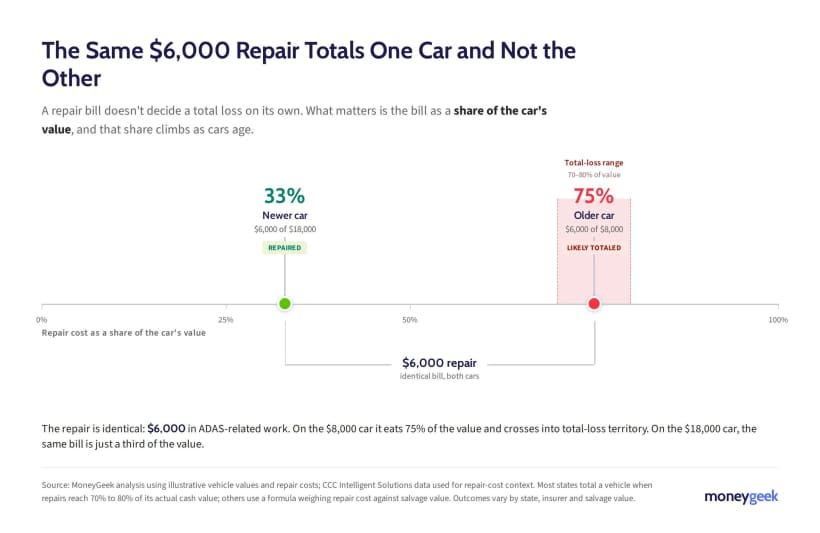
Chart showing the same $6,000 repair totals an $8,000 older car (75% of its value) but is repaired on an $18,000 newer car (33%).

Older, lower-value vehicles have less cushion before repair costs exceed the total-loss threshold. A lower-value vehicle can still carry expensive cameras, radar units or sensor systems, and once calibration costs are added, a borderline repair can tip over the threshold that a higher-ACV vehicle would clear. CCC Intelligent Solutions found that average total repair costs reached $4,818 in 2025, a 1.7% year-over-year increase and the smallest percentage rise since 2017. Repair inflation has slowed. ADAS calibration costs have not.

How ADAS Safety Tech Is Raising Repair Bills

ADAS calibrations appear on 28.3% of all repairable estimates in 2025, up from 21.8% in 2024, a 30% relative increase in a single year, per CCC Intelligent Solutions. At direct repair program (DRP) shops, which process higher claim volumes, that share reached 35.6% by Q3 2025. Caliber Insights estimates calibration will be needed on 65% of auto repairs in 2026 and 75% by 2027.

The average calibration fee is $486 per sensor system, with a pre-scan diagnostic averaging $149 on top of that, per actuary.info's analysis of CCC data. The 28.3% penetration figure covers all repairable estimates in CCC's nationwide network; at direct repair program shops, which handle higher claim volumes, calibration appeared on 35.6% of estimates by Q3 2025, also per CCC.

CCC Intelligent Solutions found that fewer than 45% of calibrations appear on the first repair estimate. Most surface as supplements added after the initial quote, which extends repair cycle time and raises costs. That added time increases rental reimbursement costs for insurers and raises the odds a supplement tips a borderline repair into total-loss territory.

How ADAS Lowers Some Insurance Claim Rates

HLDI insurance data shows ADAS-equipped Mazda vehicles had lower claim frequency, even as repairs involving ADAS sensors can cost more when crashes occur. A March 2026 HLDI study of 2015 to 2023 Mazda vehicles found that a basic front AEB bundle cut property damage liability (PDL) claim rates by 13% and bodily injury liability (BIL) claim rates by 9%. A comprehensive bundle adding front AEB with pedestrian detection, rear AEB, lane departure prevention and high-beam assist was linked to a 39% drop in PDL claim rates, per the Highway Loss Data Institute.

Blind spot detection combined with rear cross traffic alert was associated with roughly a 10% reduction in PDL claim frequency and a 13% reduction in BIL claim frequency, per the same HLDI analysis. The HLDI study found that larger ADAS bundles were linked to larger reductions in auto insurance claims, though some individual features did not add measurable benefits.

But fewer crashes do not mean cheaper ones. HLDI found that most ADAS bundles were associated with higher claim severity. Part of that reflects sensor and camera replacement costs after crashes that do happen. Part of it is a math effect: crash avoidance systems primarily eliminate slow-speed, low-dollar incidents, which removes the cheapest claims from the pool and raises the average cost per remaining claim. "If you're worried about rising repair costs, the smartest thing you can do is get a vehicle with rear AEB and make sure it is turned on," said Matt Moore, chief insurance operations officer at HLDI, in March 2026.

A Federal AEB Rule Is Scheduled for 2029

The National Highway Traffic Safety Administration's (NHTSA) Federal Motor Vehicle Safety Standard No. 127 (FMVSS 127), finalized in 2024, would require all new light vehicles to include AEB by September 1, 2029. NHTSA projects the rule would save at least 360 lives and prevent at least 24,000 injuries each year. FMVSS 127 requires AEB performance across prescribed test scenarios, including lead-vehicle, highway-speed and pedestrian detection scenarios, with that September 2029 compliance date currently still in place.

The rule's timeline is not settled. Following a January 2025 regulatory freeze, FMVSS 127 has been subject to litigation and a government review. The D.C. Circuit appeal remains in abeyance as of mid-2026, and the rule has not been rescinded. The September 2029 compliance date remains in place for now, but its ultimate outcome is uncertain.

For auto insurers, ADAS adoption matters even if the federal rule changes. AEB is already common on new U.S. vehicles, and adoption keeps climbing. Caliber Insights estimates calibration will be needed on 75% of auto repairs by 2027. The repair-cost pressure on total loss rates will persist regardless of what happens to the federal rule.

Why an Aging Fleet Makes the Problem Worse

The average age of a vehicle on U.S. roads hit 12.8 years in 2025 and is projected to reach 13 years in 2026, per CCC's Crash Course 2026 data. There are about 12 million fewer vehicles six years old or younger on the road compared with 2020. COVID-era production slowdowns, rising new car prices and elevated interest rates pushed buyers toward used vehicles, which means the cars getting into accidents today carry lower market values than the ones that crashed five years ago.

Lower ACV makes the total-loss math tip faster. A vehicle worth $8,000 with $6,000 in ADAS-intensive repair costs is a total loss in most states, where insurers apply a total-loss threshold of 70% to 80% of ACV ($6,000 is 75% of $8,000), or a total loss formula that weighs repair cost against salvage value instead of a fixed percentage. The same repair on a vehicle worth $18,000 would be paid out as a repair claim. As the U.S. fleet ages, more crashes fall into this lower-value range where calibration costs become the deciding factor.

How Total Loss Rates Affect Auto Insurance Costs

Total loss rates affect auto insurance premiums in two ways. When a car is totaled, the insurer pays out its ACV rather than a repair bill, which can mean a larger claim payment overall. Higher total loss rates push up claim severity averages across the industry, which flows into comp/collision rate filings with state insurance regulators.

Drivers carrying full coverage car insurance on an older, lower-value vehicle should review whether that coverage still makes financial sense. If your car's ACV is close to your deductible, you may be paying collision and comprehensive premiums for a payout that barely covers the vehicle's replacement.

Those financing or leasing a vehicle should consider gap insurance, which covers the difference between your car's ACV and the amount still owed on your loan if the car is totaled. As total loss rates climb toward 25%, the scenario gap insurance is designed for grows more common. Without it, you'd pay the remaining loan balance out of pocket on a car you no longer have.

How to Check Your Own Exposure

Knowing your car's actual cash value before your next renewal is the first step. If ACV has dropped close to your deductible, review whether collision and comprehensive still make sense for your vehicle's current value.

Comparing auto insurance quotes from multiple carriers can also lower your costs. Total loss rate pressure has led some insurers to reprice comp/collision coverage more aggressively than others in recent rate filings.

Four steps worth taking before your next renewal:

  1. Pull your car's ACV from Kelley Blue Book or the NADA Guides and compare it to your collision deductible.
  2. Ask your insurer how it calculates the total-loss threshold. Most states apply a fixed threshold of 70% to 80% of ACV; others use a total loss formula that factors in salvage value instead.
  3. If you financed your car in the last three years, check whether your loan balance exceeds your car's current ACV. If it does, gap insurance may be worth pricing.
  4. Review your comprehensive coverage deductible. A higher deductible lowers your premium but raises your out-of-pocket exposure if your vehicle is totaled.

Frequently Asked Questions

Total loss decisions come down to your car's value, your state's threshold and the cost of the repair, including ADAS calibration. These answers cover how that math works and what it means for your coverage.

Why Are So Many Crashed Cars Being Totaled?

What Happens When Your Car Is Totaled?

Will ADAS Calibration Costs Keep Rising?

Does a Total Loss Affect Your Insurance Rate?

About Myryah Irby


Myryah Irby, Writer and Data Journalist

Myryah Irby is a writer and data journalist at MoneyGeek. Her work spans original data studies and how-to guides covering auto, home and health insurance, consumer costs, and transportation safety.

Research and Analysis

Since joining MoneyGeek in late 2025, Irby has produced data studies on insurance costs, consumer spending and transportation risk. Her published work includes a 50-state analysis of winter driving danger using fatality and weather severity data; research tracking the relationship between rhodium commodity prices and catalytic converter theft rates, including state-level theft trends and what those rates mean for insurance costs; a state-by-state comparison of winter home heating costs; and an analysis of the full cost of having a baby in America: hospital bills, insurance and out-of-pocket expenses.

Career

Irby has more than 20 years of editorial and writing experience. Since 2005, she has run Irby x Irby, her own editorial and copywriting practice, with clients including The New York Times, The San Francisco Chronicle, OpenAI and the National Park Service. From 2019 to 2023, she served as Senior Managing Editor and then Copywriting Manager at Callisto Media, a nonfiction publisher acquired by Penguin Random House in May 2023, where she led a team of writers and graphic designers.

Before that, she spent nearly 11 years at QuinStreet, a performance marketing company that runs content and comparison sites in insurance and personal finance. She rose from Managing Editor to Senior Managing Editor between 2010 and 2016. Earlier in her career, she edited at Collabrys for nearly four years and tutored doctoral candidates on dissertation writing at the University of San Francisco.


Sources