
Actual Cash Value: How It Works for Car Insurance


Key Takeaways
blueCheck icon

Actual cash value equals your car's replacement cost minus depreciation, which is always less than what you originally paid.

blueCheck icon

When your car is totaled, insurers pay the ACV (minus your deductible), not the original price or remaining loan balance. Insurers consider a car “totaled” when repair costs exceed a certain percentage of the ACV.

blueCheck icon

Understanding ACV helps determine appropriate coverage levels and whether full coverage makes financial sense, especially for older vehicles.

What Is Actual Cash Value?

When your car is declared a total loss, insurance covers its current market value, not what you originally paid. Actual cash value (ACV) is your vehicle's current worth at the time of loss, calculated by subtracting depreciation from the replacement cost.

Insurance companies pay the ACV amount (minus your deductible) when your car is totaled or stolen. They determine your car's ACV using valuation systems and professional services that account for depreciation from age, mileage and wear. Your ACV payout will always be less than your original purchase price.

When Insurance Uses Your Car's Actual Cash Value

Insurance companies use your car's ACV to determine your reimbursement when damage costs exceed your vehicle's value, or when it's stolen and not recovered.

Knowing your car's ACV helps you decide your car insurance coverage needs. If your annual insurance premiums exceed your vehicle's actual cash value, you should reconsider your coverage levels. 

The 10% rule is a useful benchmark: if your annual premium for comprehensive and collision exceeds 10% of your car's ACV, consider dropping that coverage.

Filing an Insurance Claim

After a total loss, your adjuster calculates your car's ACV to set your payout. That figure is the ceiling, which is what your insurer pays minus your deductible. The adjuster reviews your policy, assesses the damage and decides whether to repair the vehicle or declare it a total loss.

If repair costs exceed 70% to 80% of your car's ACV (the threshold varies by state), the insurer totals the vehicle and pays you the ACV instead.

How Does Actual Cash Value Work?

Insurers use ACV to set your reimbursement when damage exceeds your vehicle's value or when the car is stolen and not recovered.

ACV is also the number to know when evaluating your car insurance coverage needs. If your annual premiums exceed the vehicle's actual cash value, the coverage no longer makes financial sense. The 10% rule lets you decide quickly: if your yearly comprehensive and collision cost tops 10% of ACV, reconsider.

ACV Formula
blueCheck icon

Insurers calculate ACV using a consistent formula. Knowing how it works tells you what to expect if your vehicle is totaled.

             ACV = Replacement Cost - Depreciation

Where:

  • Replacement cost: Current market price of a comparable new vehicle
  • Depreciation: Value lost to age, wear and market conditions
  • ACV: What your insurer pays you

Insurers calculate depreciation using the vehicle's age, mileage, condition and market demand, with methods varying by company.

Actual Cash Value Example Computation

You purchased a car for $25,000 three years ago. Today, a similar new car costs $27,000 (replacement cost). Your car has depreciated by $10,000 due to age, mileage and wear.

The $10,000 depreciation breaks down this way over three years: Your car lost 20% ($5,000) in year one, 15% ($3,000) in year two and 10% ($1,700) in year three, with an additional $300 adjustment for condition and mileage.

ACV = $27,000 (current replacement cost) - $10,000 (depreciation) = $17,000

If your car is totaled, your insurance company will pay you $17,000 (minus your deductible).

Actual Cash Value vs. Replacement Cost

Actual cash value pays you what your car was worth before the accident (minus depreciation). Replacement cost coverage pays for a brand-new comparable vehicle, no matter how much your old car had depreciated.

Replacement cost coverage carries a higher premium because the insurer takes on more risk. If your car is totaled, they pay for a new vehicle of the same make and model rather than what your old car was worth at the time of the loss.

Difference Between Actual Cash Value and Replacement Cost

ACV and replacement cost coverage determine how much you get paid when your vehicle is totaled. The gap between the two is often larger than drivers expect.

Coverage Aspect
Actual Cash Value (ACV)
Replacement Cost Coverage

Payout amount

Current market value minus depreciation

Cost of new comparable vehicle

Premium

Lower costs each month

Costs more for you per month (5% more)

Depreciation impact

Yes, reduces your payout

No, depreciation doesn't affect payout

Vehicle age limit

For all vehicles

Only for newer cars (1 to 5 years)

Best for

Older vehicles

New or expensive vehicles

The payout gap by vehicle age:

  • 1-year-old car: ACV is $8,000 to $12,000 below replacement cost
  • 3-year-old car: ACV is $15,000 to $20,000 below replacement cost
  • Car 5 or more years old: ACV is $20,000 or more below replacement cost

If your payout falls short of what you owe, you cover the difference out of pocket. GAP insurance covers that shortfall.

How Insurance Companies Determine Your Car's Actual Cash Value

Insurers calculate your car's pre-accident value from make, model, year, mileage and condition, then compare it against similar vehicles selling in your area. Specialized databases and third-party valuation services supply the real-time market data.

The Valuation Process

Adjusters follow a consistent process to determine your payout. Knowing each step helps you prepare the right documentation and avoid surprises.

  1. 1
    Initial assessment

    The adjuster pulls your car's make, model, year and mileage, then verifies specs through the VIN: trim level, engine size, transmission type and factory options. Discrepancies between what you reported and what the VIN shows can affect the valuation.

  2. 2
    Condition evaluation

    The adjuster documents interior and exterior wear, previous damage and maintenance history. Scratches, dents, upholstery condition, tire tread depth and mechanical issues all go into the record. Carfax or AutoCheck reports flag accident history, flood damage or salvage titles that pull the value down.

  3. 3
    Market research

    The adjuster pulls recent sales of comparable vehicles in your area from CCC, Mitchell or Audatex, like dealer prices, auction results and private party listings from the past 30 to 60 days. Geography matters here because a Honda Accord sells for different prices in California versus Ohio, so comps are limited to your region.

  4. 4
    Final calculation

    The adjuster applies adjustments for aftermarket upgrades, custom features or regional demand shifts, then checks the automated valuation against manual research to catch system errors. The final ACV reflects your specific vehicle and local market, not a national average.

mglogo icon
WHY YOUR PAYOUT DIFFERS FROM ONLINE ESTIMATES

Insurance valuations account for details online tools can't see. Hidden damage discovered during inspection lowers your car's value. Geographic location creates variations, the same vehicle might be worth $2,000 more in California than Ohio based on local demand.

Your car's specific history affects the payout. Complete maintenance records increase value by $1,000 to $3,000, while previous accidents reduce it by $1,000 to $10,000 depending on severity. Aftermarket modifications help or hurt depending on quality and local buyer preferences.

Calculate Your Car's ACV Using Online Tools

You don't need to wait for an insurance adjuster's offer to know your car's worth. Three free online tools give you a solid estimate before filing an insurance claim. Use all three and average the results. This gives you a realistic baseline for negotiations if your insurer lowballs the offer.

    factChecked icon
    Kelley Blue Book (KBB)

    KBB is the name most people recognize when it comes to car values. Dealers and consumers have relied on it for decades, which gives it credibility but also means it tends to run about 5-10% higher than what insurance companies actually pay.

    Visit www.kbb.com and start by entering your car's year, make and model. You'll need to select your specific trim level. this matters more than you'd think since a base model and premium trim of the same car can differ by thousands. Add your mileage, rate your vehicle's condition honestly (excellent, good, fair or poor), then enter your ZIP code since values vary by location.

    KBB works best for getting a private party value baseline. If you're wondering what your car would sell for between two individuals, KBB gives you a solid starting point for your car's ACV.

    factChecked icon
    Edmunds

    Edmunds takes a different approach by showing you all three value types at once: trade-in (what a dealer would pay you), private party (what you'd get selling it yourself) and dealer retail (what a dealer would sell it for). This range helps you see where insurance valuations usually fall, somewhere between trade-in and private party.

    Head to www.edmunds.com and either enter your VIN for automatic specs or select your make and model manually. Input your current mileage and assess your vehicle's condition. The site requires more detailed condition information than KBB, but that extra detail makes the estimate more accurate.

    The catch: you need to be honest about condition. If you overrate your car, you'll get an inflated estimate that doesn't match reality when the adjuster inspects it.

    factChecked icon
    NADA Guides (J.D. Power)

    Insurance companies, banks and dealers actually use NADA behind the scenes. It's the industry-standard resource, which makes it valuable for understanding how professionals value your car. The drawback: it defaults to "clean" condition, so you might see higher numbers than your car's actual state warrants.

    Go to www.nadaguides.com and work through the prompts: select your vehicle's year, make, model, trim and options. Enter your mileage and choose condition. clean, average or rough. You'll see both wholesale (what dealers pay each other) and retail values.

    NADA works best as a wholesale reference point. If your insurance offer comes in near NADA's wholesale value, that's actually reasonable since insurers aren't paying retail prices.

Is Your Total Loss Offer Fair?

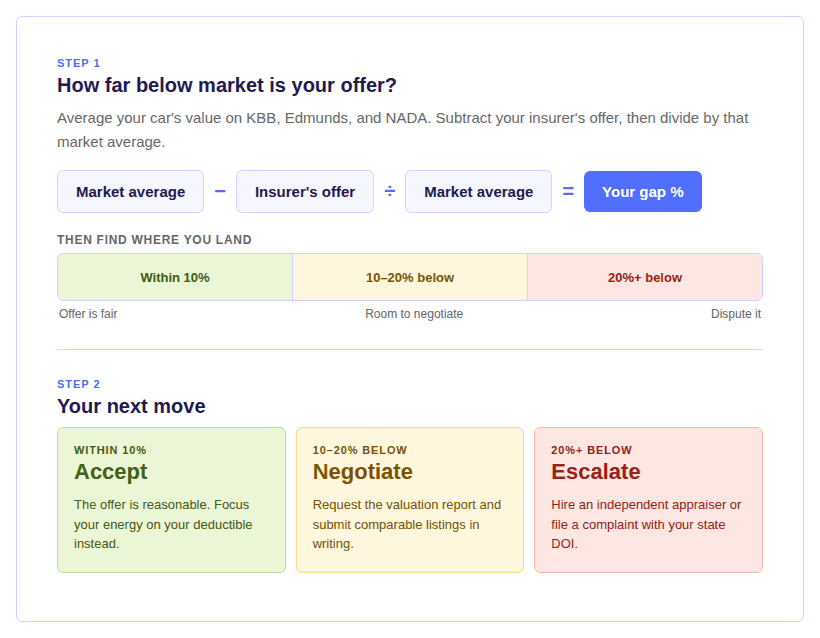
When your insurer totals your car, the payout they offer isn't always the payout you're owed. Before you accept, check whether the number is fair — and know what to do if it isn't.

Your offer should reflect your car's real market value. Factors that work in your favor include complete service records (worth $1,000–3,000 more), low annual mileage, and a clean accident history. Factors that work against you — prior accidents, high mileage, and visible wear — are things the adjuster already knows about, so there's no point disputing those.

If the offer is within 10% of market value, accept it. Negotiating from that position rarely yields much. 

If it's 10–20% below, you have room to push back. Request the adjuster's valuation report, pull five to ten comparable listings, and submit your case in writing. 

If it's more than 20% below, escalate — hire an independent appraiser ($250–500), file a complaint with your state's Department of Insurance, or consider a public adjuster.

Use the tool below to find out which zone you're in.

Image showing how to determine whether your total loss offer is fair.

Actual Cash Value of a Car: FAQ

We answer common questions about actual cash value and how it affects your car insurance:

What is the actual cash value of my car?

How do insurance companies determine the value of my car?

Can I dispute my car's actual cash value?

Does car insurance pay actual cash value or replacement cost?

How much does a car depreciate for insurance purposes?

Actual Cash Value in Auto Insurance: Bottom Line

A total loss payout covers what your car was worth before the accident, not what you paid for it and not what a replacement costs today. Depreciation is the reason that number is often thousands less than you expect.

Replacement cost coverage is worth the extra premium on newer cars. For older vehicles you own outright, ACV coverage is adequate. Your car's current value, your budget and your tolerance for out-of-pocket exposure are the three factors that drive this decision.

Auto Insurance Actual Cash Value: Our Review Methodology

The insurer you choose shapes both your payout and how the claims process unfolds. MoneyGeek's research identifies which companies handle ACV claims fairly, pay promptly and communicate clearly when it matters most.

Total loss claims reveal an insurer's true character. Unlike minor fender-benders where you might repair and move on, ACV payouts involve negotiations over your car's value, potential disputes about depreciation and permanent loss of your vehicle. We focused our methodology on companies that excel at the claims experience, not just offering low premiums that look attractive until you actually need to file a claim.

ACV in Insurance: Related Pages

About Mark Fitzpatrick


Mark Fitzpatrick headshot

Mark Fitzpatrick, a Licensed Property and Casualty (P&C) Insurance Producer in Connecticut, is MoneyGeek's resident insurance expert. He has spent nearly a decade analyzing the market, first at LendingTree and now at MoneyGeek, where he has produced original research on hundreds of carriers and millions of rates across auto, home, renters, health and life insurance.

He writes about economics and insurance on MoneyGeek so people can make coverage decisions with confidence. His insurance insights have been featured in The Washington Post, The New York Times and NPR, among other media outlets.

Like all MoneyGeek analysts, he draws on independent cost and consumer experience data, and no insurance company partnership influences his recommendations.

Fitzpatrick earned his degrees from Johns Hopkins University (M.A. Economics and International Relations) and Boston College (B.A.) and began his career in financial risk management at State Street. He's also a five-time Jeopardy champion!


Sources