Travel Insurance Look-Back Period: How a Routine Checkup Can Get Your Claim Denied

Advertising & Editorial Disclosure

A travel insurance look-back period is the stretch of time before your policy's effective date, often 60 to 180 days, that an insurer reviews to decide whether a health issue counts as pre-existing. A routine checkup, a dosage change or a doctor-ordered test inside that window can result in a denied claim, even with no new diagnosis and no errors on the traveler's part.

Consider a traveler who books a $3,000 trip to Italy and buys comprehensive travel insurance two weeks later, inside the window her plan requires for pre-existing condition protection. About six months (174 days) earlier, her cardiologist adjusted her blood pressure prescription during a routine checkup. There was no new diagnosis and no hospital visit, only a dosage change.

She never thinks about that appointment again until a cardiac episode in Rome lands her in a hospital, and her medical evacuation claim comes back denied. The stated reason: pre-existing condition.

She didn’t book late, and she insured the full cost of her trip. Her policy used a 180-day look-back period, so the review window reached back far enough to catch that dosage change. A plan with a 60-day look-back wouldn't have denied the claim on that basis.

mglogo icon
KEY FINDINGS
  • Travel insurers review your medical history for 60 to 180 days before your policy's effective date, which for comprehensive plans is the purchase date. This window, called the look-back period, decides whether a health issue counts as pre-existing. A dosage change or doctor-ordered test inside it can trigger a denial without any new diagnosis.
  • The CDC says specialized travel coverage is especially important for travelers with pre-existing conditions and those over 65, the same travelers a look-back period is most likely to catch. The agency also says conditions treated in the 90 days before departure are often excluded from coverage.
  • The same medical event, on the same trip, can be paid under one look-back window and denied under another. Nothing about your health or timing has to change for the claim decision to flip.
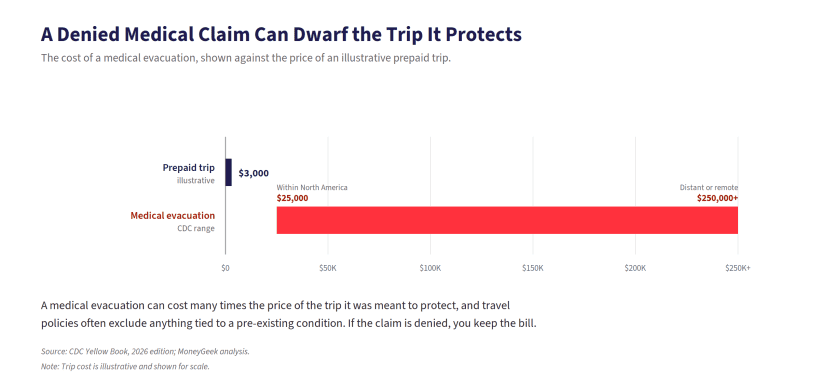
  • A medical emergency abroad is expensive, and a denied claim leaves you paying it. Medical evacuation costs $25,000 for transport within North America and more than $250,000 from distant or remote locations, according to the CDC.
  • Comprehensive travel insurance can cost up to 8% of your trip cost, per the CDC. You get the pre-existing condition waiver only if you buy within your plan's deadline, 14 to 21 days after your first trip deposit.

What Is a Travel Insurance Look-Back Period?

A look-back period is the window an insurer reviews before your policy's effective date, which for comprehensive plans is the same as the purchase date, to judge whether a health issue counts as a pre-existing condition. Experian says the window runs 60 to 180 days, though some plans go a year or more.

The CDC's Yellow Book says conditions requiring hospitalization or direct medical intervention in the 90 days before departure are often excluded. That's a narrower reading than the full look-back definition. Some travel-medical-only policies extend the review to 12 to 36 months.

The exact number lives in the plan’s certificate of insurance, and it varies by carrier. Allianz Travel Insurance, for one, defines a pre-existing condition using a 120-day look-back: a condition counts if, in that window, it led you to seek care or required a prescribed medication, unless the condition stayed controlled on a prescription that didn’t change. Because the wording and the number differ from plan to plan, the certificate, not the marketing page, is what a claims adjuster applies.

The review covers more than new diagnoses. Insurers look for new or worsening symptoms, changes to prescriptions or dosages, new treatments or medical investigations, hospitalizations and any procedure a doctor recommended but you haven't had yet. A traveler with a stable condition unchanged for years clears the check. A traveler who saw a doctor for an unrelated reason and had a medication adjusted inside the window can fail it, even without a new diagnosis.

The length of the window matters as much as its existence. A 60-day look-back reviews one-third as much medical history as a 180-day look-back, so two plans with the same pre-existing benefit can reach opposite conclusions about the same traveler.

Two Policies, Same Trip, Different Claim Result

What decides whether this traveler’s claim gets paid is the length of her policy’s look-back period, not her health and not her timing. The same facts produce two different outcomes.

She pays a $3,000 nonrefundable deposit on January 1 and buys travel insurance on January 15, 14 days later, inside the 14-to-21-day window most comprehensive plans require to qualify for a pre-existing condition waiver. She insures 100% of her prepaid trip cost, so she clears the purchase-timing rule and the trip-cost rule. Whether she also clears the medical stability rule depends on which look-back period her policy uses.

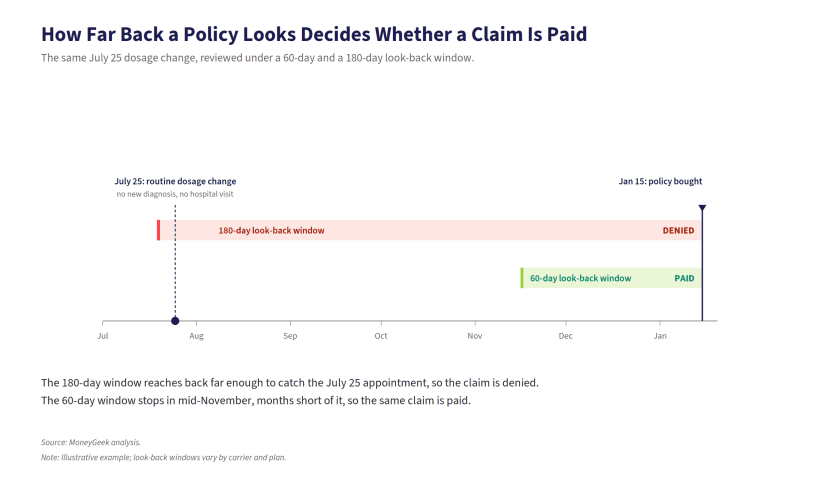
About 174 days, or six months, before her purchase date, on July 25, her doctor adjusted the dosage on a blood pressure prescription she'd taken for years. Again, no new diagnosis and no hospital visit, just a routine dosage change at an annual checkup.

Review window covers
Nov. 16–Jan. 15
July 19–Jan. 15
July 25 dosage change
Outside the window
Inside the window
Medical stability check
Passes
Fails under the plan terms
Claim result
Not denied for a pre-existing condition; standard claims review still applies
Denied as a pre-existing condition

The traveler, the trip and the medical event stay the same under both policies. Only the length of the look-back period changes, and that alone decides whether the claim is covered or denied.

The same July 25 dosage change is denied under a 180-day look-back window and paid under a 60-day one.

A denied medical evacuation claim would be far costlier than the trip itself, an expense the traveler would have to cover out of pocket.

Why the Stakes Are Higher Now

Getting the look-back period wrong costs more today than it did a few years ago, because trips themselves cost more. Air travel prices climbed more than 20% over the year as of spring 2026, per the U.S. Bureau of Labor Statistics, so travelers now have more prepaid, nonrefundable money at risk if a claim is denied.

A medical emergency abroad can erase that investment and then some. Medical evacuation alone runs $25,000 to more than $250,000, per the CDC, and travel health policies often exclude anything tied to a pre-existing condition. Domestic coverage rarely helps: Medicare doesn't pay for care or evacuation outside the United States.

A denied medical evacuation, at $25,000 to more than $250,000, can dwarf the trip it was meant to protect.

Older travelers are most at risk of a denied claim. Federal travel-health guidance flags travelers over 65, and especially over 75, as those who most need specialized coverage and have the hardest time getting underlying conditions covered. They also have the most medical history for an insurer's look-back to catch: 85.2% of U.S. adults saw or talked to a doctor in the past 12 months as of 2024, so a 180-day window can reach six months of recent, unrelated care.

Why Travel Insurance Claims Get Denied

Pre-existing conditions are one of the most common reasons a travel insurance claim fails, and they aren't the only one. The CDC's Yellow Book cites a study of travelers with travel health insurance claims in which insurers fully paid only about two-thirds of claims. The main reasons for refusal were pre-existing illness and poor documentation of expenses.

Both reflect the two mistakes travelers make most: assuming a pre-existing condition is covered when the policy never waived it, and failing to keep the receipts and records an insurer requires. Reading the certificate of insurance before you buy, and keeping documentation after, addresses both.

How to Avoid a Pre-Existing Condition Denial

Ask for the exact number of days in the look-back period before buying, not just whether pre-existing conditions are covered. Comprehensive plans can advertise similar pre-existing condition benefits while using windows that differ by 120 days or more, and that difference shows up only in the certificate of insurance, not the marketing page.

Buy within 14 to 21 days of your initial trip deposit if you want a shot at a pre-existing condition waiver. Eligibility for the waiver ends once you miss that deadline, regardless of how short the look-back period is. You can still buy coverage after that point, but you won't qualify for the waiver.

Insure 100% of your prepaid, nonrefundable trip cost. Partial coverage is one of the fastest ways to lose waiver eligibility even when your medical history and purchase timing are otherwise clean.

Keep a running log of medical care in the months before you buy: doctor visits, medication or dosage changes and any doctor-ordered test or procedure. The medical stability standard covers more than diagnoses, so any change to your symptoms, medications or treatment plan can count. The CDC also recommends carrying letters from your doctors that list your conditions and medications when you travel. Both the log and those letters help if you ever need to prove a claim.

Weigh the cost of coverage against the length of the look-back period, not just the premium. Comprehensive coverage runs up to 8% of your trip cost, per the CDC, so the price difference between a short and long look-back window is small next to a denied five-figure medical bill.

If you're over 65 or manage a chronic condition, weigh the look-back period as seriously as the premium, and compare plans built for older travelers. Federal guidance says travelers over 75 should start shopping early, since coverage for underlying conditions is harder to find. Medicare won't cover care or medical evacuation abroad.

Take Action

  1. 1
    Ask any travel insurance provider for the exact number of days in its look-back period before you compare on price.
  2. 2
    Buy within 14 to 21 days of your initial trip deposit if a pre-existing condition waiver matters to you, since eligibility ends once that deadline passes.
  3. 3
    Log every doctor visit, medication change and doctor-ordered test for six months before you insure a trip, and keep receipts for any care you receive abroad.
  4. 4
    Compare comprehensive plans, and check cancel for any reason coverage if you want protection beyond a standard policy.
  5. 5
    If you’re over 65 or manage a chronic condition, weigh the look-back period as heavily as the price, and start shopping early.

Methodology

MoneyGeek’s explanation of how travel insurance look-back periods and pre-existing condition waivers work reflects standard industry practice and MoneyGeek’s own analysis of travel insurance policies. Regulatory framing and coverage types draw on the National Association of Insurance Commissioners (NAIC), including its Travel Insurance topic page and Travel Insurance Model Act. Full source links appear in the Sources section below.

Medical evacuation costs, pre-existing condition exclusions, claim-refusal reasons and guidance for older travelers come from the CDC Yellow Book chapter on travel insurance (2026 edition). Health care utilization data comes from the CDC’s National Center for Health Statistics. Travel price trends come from the U.S. Bureau of Labor Statistics.

The opening scenario and the two-policy comparison are constructed examples, not real reported claims. The dollar figures, dates and the 174-day window are specific to the scenario, while the rules applied within them (the 60-day and 180-day look-back windows, the 14-to-21-day waiver purchase window, the medical stability standard and the requirement to insure 100% of trip cost) reflect standard travel insurance policy terms. The 60-to-180-day range is the common industry range rather than a surveyed finding; one carrier certificate definition (Allianz Travel Insurance, which uses a 120-day window) is cited as a representative example of how a policy spells this out, and Experian is used as a named secondary source for the general range. This analysis doesn't rely on data from any travel insurance seller or marketplace.

About Myryah Irby


Myryah Irby, Writer and Data Journalist

Myryah Irby is a writer and data journalist at MoneyGeek. Her work spans original data studies and how-to guides covering auto, home and health insurance, consumer costs and transportation safety.

Research and Analysis

Since joining MoneyGeek in late 2025, Irby has produced data studies on insurance costs, consumer spending and transportation risk. Her published work includes a 50-state analysis of winter driving danger using fatality and weather severity data; research tracking the relationship between rhodium commodity prices and catalytic converter theft rates, including state-level theft trends and what those rates mean for insurance costs; a state-by-state comparison of winter home heating costs; and an analysis of the full cost of having a baby in America: hospital bills, insurance and out-of-pocket expenses.

Career

Irby has more than 20 years of editorial and writing experience. Since 2005, she has run Irby x Irby, her own editorial and copywriting practice, with clients including The New York Times, The San Francisco Chronicle, OpenAI and the National Park Service. From 2019 to 2023, she served as Senior Managing Editor and then Copywriting Manager at Callisto Media, a nonfiction publisher acquired by Penguin Random House in May 2023, where she led a team of writers and graphic designers.

Before that, she spent nearly 11 years at QuinStreet, a performance marketing company that runs content and comparison sites in insurance and personal finance. She rose from Managing Editor to Senior Managing Editor between 2010 and 2016. Earlier in her career, she edited at Collabrys for nearly four years and tutored doctoral candidates on dissertation writing at the University of San Francisco.


Sources