


Lemonade leads Oregon's renters insurance market, ranking first in affordability with a MoneyGeek score of 4.9 out of 5. State Farm comes in second with an overall score of 4.8, excelling in customer experience with its reliable network of local agents. American Family, Allstate and Nationwide complete the top five.
Best Renters Insurance in Oregon (2026)
Updated: October 8, 2026
Advertising & Editorial Disclosure
Key Takeaways: Oregon Renters Insurance
Lemonade is Oregon's best overall renters insurance company, earning a 4.9 out of 5 MoneyGeek score for its strong affordability, customer experience and coverage.
At $81 annually, or $7 monthly, Lemonade offers the most affordable renters insurance premiums in Oregon.
Renters insurance quotes range from $81 to $256 per year for the same policy. Get quotes from several insurers to find the most competitive rate for your needs.
5 Best Renters Insurance Companies in Oregon
| Lemonade | 4.88 | $81 |
| State Farm | 4.79 | $124 |
| American Family | 4.51 | $170 |
| Allstate | 4.51 | $157 |
| Nationwide | 4.48 | $169 |
*Our ratings consider different combinations of coverage levels and renter details to identify the best overall options. Rankings may differ based on your profile.

Lemonade
Top Choice for Oregon Renters
MoneyGeek Rating
4.9/ 5
5/5Affordability
4.7/5Customer Experience
4.9/5Coverage
Average Annual Premium
$81Based on our methodology's base profile of a policy with $20K in personal property coverage and $100K in liability coverage with a $500 deductibleAverage Monthly Premium
$7Based on our methodology's base profile of a policy with $20K in personal property coverage and $100K in liability coverage with a $500 deductibleJ.D. Power Renters Insurance Customer Satisfaction Score
674/1,000From the J.D. Power 2026 U.S. Home Insurance Study, which examines customer satisfaction based on responses from homeowners and renters nationwide. The average renters insurance score is 682/1,000.
Compare the Cheapest Renters Insurance Companies in Oregon
At $81 annually, Lemonade has Oregon's cheapest renters insurance for $20,000 in personal property coverage, $81 below the state average of $162. Capital Insurance comes in second at $122 per year. State Farm costs $124 and is available statewide. Rates among the eight most affordable insurers range from $81 to $256 per year, with four of the eight falling below the state average.
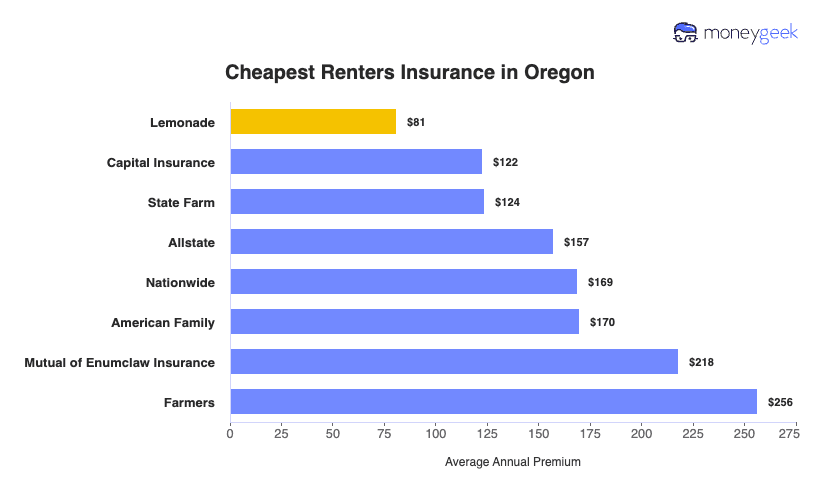
Average Cost of Renters Insurance in Oregon
Oregon renters pay $162 per year on average for renters insurance, $34 below the average cost of renters insurance nationally at $196. This is for a policy with $20,000 in personal property protection, $100,000 in liability limits and a $500 deductible.
Your actual premium varies by your coverage limits, deductible choice and where you're located within the state.
Do You Need Renters Insurance in Oregon?
Many landlords require renters insurance as a lease condition, though Oregon law does not mandate coverage. Property managers often mandate policies to protect themselves from liability claims, sometimes requiring $100,000 or more in liability protection. While the landlord can require coverage, it varies by property. The lease should be reviewed before moving in to confirm whether a policy is required.

HOW TO DETERMINE YOUR RENTERS INSURANCE COVERAGE NEEDS
Typical personal property coverage ranges from $20,000 to $50,000 for most renters' belongings. Go through your unit and add up replacement values for electronics, furniture, clothing and other items to calculate your personal property coverage. You'll also want liability limits of $100,000 or more to protect yourself if someone gets injured in your apartment.
How to Find the Best Cheap Renters Insurance in Oregon
Shop around before you pick a homeowners policy in Oregon. Think about what you can afford, what coverage you need and how much service you expect, and weigh the three together.
- 1Compare quotes from at least three companies
Premiums differ by $175 annually across companies for identical coverage. Make sure you get quotes from both national insurers and regional providers when comparing your options. Getting quotes from at least three providers helps you find the best rate.
- 2Check customer satisfaction ratings and reviews
Low prices are not worth much when the insurer has poor claims handling or customer service. J.D. Power ratings and customer complaints filed with the Oregon Department of Consumer and Business Services should be reviewed before purchasing. How quickly insurers process claims and respond to customer inquiries in Oregon markets is a key consideration.
- 3Bundle renters and auto insurance
Insurers offer 10% to 25% off when policies are bundled together. State Farm and Allstate offer some of Oregon's largest bundling discounts. Bundling helps you reduce total insurance costs while simplifying coverage management with one provider.
- 4Ask about available discounts
Discounts are available for alarm systems, smoke detectors and maintaining a claims-free record for multiple years. Many insurers also offer reductions for good credit scores, non-smoker status or completing safety courses. Reach out to an insurance agent to find out which discounts you might qualify for.
Best Cheap Renters Insurance in Oregon: Bottom Line
Lemonade, State Farm, American Family, Allstate and Nationwide are Oregon's best renters insurance companies. Get quotes from several companies to find rates matching your needs. Try the calculator below for personalized quotes depending on your coverage, deductible and credit.
Personalized Oregon Renters Insurance Rates
Get free renters insurance rate estimates for Oregon based on your coverage needs. Rates reflect a profile of renters aged 21 to 64 with no prior claims.
Select Coverage Level
Select Deductible
Select Credit Score
Average Annual Premium—
Select Coverage Level
Average Annual Premium—
Select Deductible
Select Credit Score
Renters Insurance in Oregon: FAQ
Renters insurance covers only the policyholder and their relatives living in the unit. Your roommate needs their own policy to protect their belongings and get liability coverage. Each roommate should buy separate renters insurance with at least $20,000 in personal property coverage.
Most Oregon renters need $20,000 to $50,000 in personal property coverage and $100,000 in liability protection. Add up replacement costs for your furniture, electronics, clothing and other belongings to calculate your needs. Your landlord may require specific coverage amounts, so check your lease before buying a policy.
Contact your insurer immediately after damage occurs or items get stolen. Document the damage with photos and videos before cleaning up. Provide a list of damaged or stolen items with purchase dates and estimated values. Your insurer will assign a claims adjuster to review your case. Most claims get processed within two to four weeks.
Renters insurance covers temporary housing costs through loss of use coverage if covered damage like fire makes your apartment unlivable. This pays for hotel rooms and restaurant meals while repairs happen. Most policies limit loss of use to 20% to 30% of your personal property coverage amount. Floods and earthquakes aren't covered.
How We Found the Best Cheap Renters Insurance Companies in Oregon
We analyzed Oregon renters insurance companies to identify insurers with low rates and reliable service.
We collected quotes for renters aged 26 to 64 with good credit and no claims history. The profile included $20,000 in personal property coverage, $100,000 in liability protection and a $500 deductible.
Affordability determined 50% of each company's score. Customer satisfaction from industry research made up 40%. Add-on coverage options contributed 10%. Companies with the highest combined scores across all factors made our list of Oregon's best renters insurance providers.
About Mark Fitzpatrick

Mark Fitzpatrick is a licensed Property and Casualty (P&C) Insurance Producer and MoneyGeek's resident expert in insurance and economics. In nearly a decade covering the insurance market at LendingTree and MoneyGeek, he's analyzed hundreds of carriers and millions of rates across auto, home, renters, health and life insurance.
His work has appeared in The Washington Post, The New York Times and NPR. He draws on independent cost and consumer experience data, and no insurance company partnerships affect his recommendations.
Mark studied at Boston College and later earned a master's in economics and international relations from Johns Hopkins University. He worked in financial risk management at State Street before joining MoneyGeek. He's also a five-time “Jeopardy!” champion.