
Best Pet Insurance for Puppies


No single pet insurance provider is best for every puppy under 1 year old. A Labrador Retriever puppy may benefit from a base plan that covers hereditary conditions and have short waiting periods for orthopedic issues, while a French Bulldog puppy may need more comprehensive coverage for breed-specific respiratory conditions.

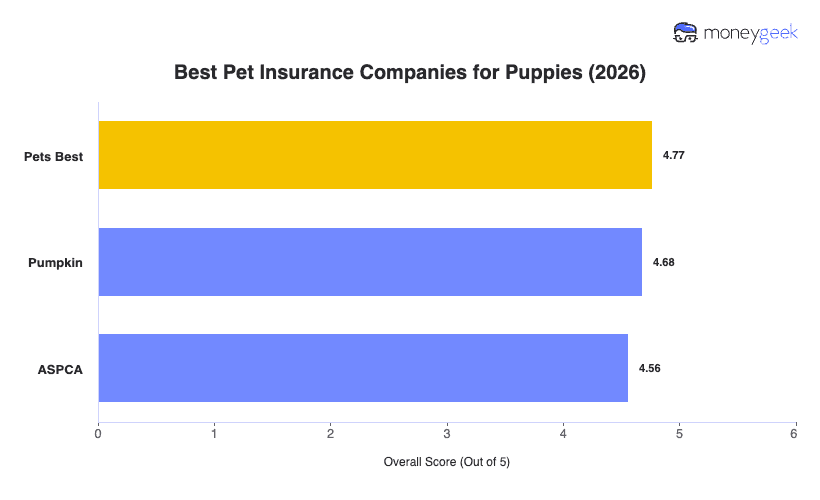
According to my analysis, the best pet insurance for puppies are:  

  • Choose If You Want the Best Value With Direct Vet Pay: Pets Best
  • Choose If You Want Excellent Claims Service and Expedited Reimbursements: Pumpkin
  • Choose If You Want to Save on Puppy Insurance Costs: ASPCA

For our best puppy insurance ratings, we evaluated affordability, customer experience and coverage across 18 major pet insurers using over 67,000 dog profiles representing mixed breeds and purebreds in all 50 states and Washington, D.C. Our analysis used a base profile of a Labrador Retriever under 1 year old with a $5,000 annual limit, $500 deductible and 80% reimbursement rate to ensure consistent comparisons across providers.

We analyzed pricing competitiveness across different breeds and locations, measured customer experience throughout the policy lifecycle from enrollment to claims and assessed coverage quality for puppy-specific health risks. Each insurer received a composite score based on affordability (50% of overall score), customer experience (30% of overall score) and coverage options and terms (20% of overall score).

For a detailed breakdown of the metrics, scoring methodology and analysis approach, see our full methodology.

Pets Best

Pets Best: Best Pet Insurance for Puppies Overall

COMPANY HIGHLIGHTS

Pets Best is my pick for the best puppy insurance overall, offering the best coverage at the lowest average rate of $19 monthly, which is 58% lower than the national average. It covers hereditary conditions without requiring you to purchase an add-on like some insurers do, with coverage starting between zero and three days for accidents and 30 days to six months for orthopedic conditions, based on state. This makes Pets Best well suited to puppies that are highly energetic, frequently explore outdoors or tend to jump, chew and get into things they shouldn't, as well as breeds predisposed to orthopedic issues, such as Labrador Retrievers and Great Danes.

Pets Best also offers to pay licensed vets directly through Vet Direct Pay, which helps reduce your out-of-pocket expenses for your puppy’s covered conditions. However, the company's claims service tend to encounter issues when additional documents are required, which can create extra administrative work and prolong the claims process for puppy owners dealing with unexpected veterinary care.

Read our review: Pets Best Pet Insurance Review

Pumpkin

Pumpkin: Best Puppy Insurance Customer Experience

COMPANY HIGHLIGHTS

Pumpkin is another top recommendation for puppy insurance. It offers excellent customer service at every stage of the policyholder experience, helping puppy owners understand their coverage before enrolling, manage their policy as their puppy grows and navigate the claims process when seeking reimbursement for eligible vet care. Pumpkin also has an urgent pay service, Pumpkin Now, that expedites approvals for claims submitted at the vet, depositing reimbursements to eligible bank accounts within 20 minutes and making it easier to manage unexpected treatment costs at checkout.

However, Pumpkin only offers two reimbursement rates, four deductibles and four annual limits, so you don’t have as much flexibility in tailoring your policy to your puppy’s specific health risks, expected veterinary costs and budget. It also imposes a 14-day waiting period for accident coverage, so highly active or accident-prone puppies have a longer period without coverage for injuries that can occur shortly after enrollment.  

Read our review: Pumpkin Pet Insurance Review

ASPCA

ASPCA: Best Cheap Puppy Insurance

COMPANY HIGHLIGHTS

ASPCA rounds out my best puppy insurance picks, with the second-lowest average rate of $27 per month. Puppy owners can save about 40% against the national benchmark without having to give up comprehensive coverage. ASPCA’s base plan covers hereditary conditions, exam fees, physical rehabilitation and alternative therapies that some insurers exclude or require add-ons for, giving puppies broader financial protection for breed-related health risks while helping cover the diagnostic, rehabilitative and supportive treatments they may need as they grow.

However, ASPCA falters in customer experience, with a service that isn’t as fast or efficient as other competitors, particularly around mobile experience, billing and renewals, as well as claim submission ease. This can make it harder for owners to manage their policy conveniently, submit and track claims efficiently, or get timely support when their puppy needs veterinary care.  

Read our review: ASPCA Pet Insurance Review

What to Assess When Deciding Your Best Puppy Insurance Fit

Pet insurance companies for puppies vary in their coverage terms. Differences in waiting periods, pre-existing condition rules, hereditary condition coverage and routine-care benefits can affect whether your puppy's treatment is covered and how much you'll pay out of pocket. Evaluate the terms below before enrolling to make sure the policy fits your puppy's potential health needs and provides enough financial protection when you need it.

Pre-existing condition rules
Establishes whether an illness or injury that occurred before enrollment or during the waiting periods can be covered.
A narrow definition that distinguishes a previous condition from unrelated future illnesses or injuries.
Broad definitions that can link minor prior symptoms to future unrelated conditions and result in exclusions.
Curable condition terms
Decides whether a condition considered pre-existing can become eligible for coverage after a period without symptoms or treatment.
Curable pre-existing conditions can become eligible for coverage after 180 days without symptoms or treatment.
Permanent exclusions for all curable conditions with no opportunity for coverage to be restored.
How long after enrollment your puppy must wait before different types of coverage take effect.

Waiting periods of 0 to 3 days for accidents, 14 days for illnesses and less than six months for orthopedic conditions.

Accident and illness waiting periods longer than 14 days or orthopedic waiting period of six months or more without the option to waive it.
Hereditary condition coverage
Determines whether conditions inherited through a puppy's breed or genetics can be covered.
Hereditary and congenital conditions included in the base plan without breed-specific exclusions.
Broad exclusions for hereditary or congenital conditions or exclusions targeting conditions your puppy's breed is predisposed to developing.
Prescriptions, exams and diagnostics
Determines whether the policy reimburses the cost of veterinary exam fees, diagnostic tests and medications used to treat covered conditions.
Exam fees, bloodwork, imaging and prescription medications included in the base plan.
Requires multiple expensive add-ons for exams, diagnostics and prescriptions needed for covered conditions.
Coverage for microchipping
Determines whether the policy covers microchipping your puppy.
Coverage for microchipping included in the base plan or offered through an optional wellness plan.
No microchipping benefit included in the base plan or optional wellness add-ons.
Determines whether routine puppy vaccinations are reimbursed.
Offers an optional wellness plan that covers core puppy vaccines such as DHPP (distemper, hepatitis/adenovirus, parainfluenza and parvovirus), rabies and bordetella, with a high annual limit.
Excludes vaccinations permanently from coverage or doesn’t offer wellness add-ons that include them.
Determines whether the policy covers the cost of sterilizing your puppy.
Coverage for spaying/neutering is offered through an optional wellness plan with high annual limits.
Excludes spaying and neutering without an optional wellness add-on.

Claims and record review process

Describes how the insurer evaluates your puppy's medical records and claims to establish whether treatment is eligible for coverage.
Clear medical-record requirements, transparent pre-existing-condition review and a straightforward claims process with clear explanations for decisions.
Unclear record-review standards, inconsistent claim decisions or a process that makes it difficult to determine why your puppy's treatment was excluded.

Is Puppy Insurance Worth It?

Puppy insurance is worth it when you can enroll before your puppy develops a condition that could be excluded as pre-existing and the policy offers coverage that fits your budget and expected needs. Enrolling early while your puppy is young and healthy can help financially protect against the costs of accidents, illnesses and emergency care while giving you an opportunity to secure coverage before health issues arise.

Puppy insurance is more likely to be worth it if you:

  • Recently adopted or purchased a puppy and can enroll before symptoms or health conditions appear in its veterinary records.
  • Have a breed with known hereditary health risks, such as a German Shepherd or Labrador Retriever, and want coverage for conditions that could develop as your puppy matures.
  • Own an active or large-breed puppy that may face a higher risk of accidents, injuries or orthopedic problems as it grows.
  • Would have difficulty paying a large, unexpected veterinary bill for emergency treatment, surgery, hospitalization or other costly care.
  • Want long-term financial protection that can continue from puppyhood into adulthood while helping cover unrelated conditions that develop later.

Best Puppy Insurance Buying Checklist

I've prepared a checklist you can use while getting puppy insurance quotes or speaking with insurers, with an accompanying downloadable PDF to guide you throughout the whole process. Work through each step in order to identify your puppy's likely health needs, determine the coverage that fits your budget, research providers and compare quotes using the same policy terms.

Download: Best Puppy Insurance Buying Checklist

  • blueCheck icon

    Identify your puppy's specific health risks

    Schedule a veterinary visit and ask your veterinarian which health conditions your puppy may be more likely to develop based on its breed, age, expected adult size, lifestyle and family history. Also ask which treatments, procedures and preventive care your puppy is likely to need, including recommended vaccines such as DHPP and rabies, microchipping, deworming and spaying or neutering. Having this information can help you identify coverage terms worth prioritizing, such as hereditary and congenital conditions, orthopedic care, prescription medications and wellness benefits.

  • blueCheck icon

    Determine how much coverage you need

    Decide whether your puppy's needs and your budget are better suited to an accident-only plan, an accident-and-illness policy or an accident-and-illness policy with an optional wellness plan for routine expenses such as vaccinations and spaying or neutering. Then choose an annual limit that could cover the costly treatments your puppy may need, a reimbursement rate based on how much of each eligible veterinary bill you want the insurer to pay after you meet your deductible, and a deductible that reflects how much you can comfortably pay out of pocket each policy year before coverage kicks in. 

    If you're unsure how much coverage your puppy needs, use MoneyGeek's pet insurance coverage needs calculator to get a baseline recommendation, then adjust it, if needed.

  • blueCheck icon

    Research pet insurance providers

    Create a shortlist of pet insurers that offer coverage for puppies and review each company's online sample policy. Check specifically for puppy-relevant terms such as minimum enrollment age, hereditary and congenital condition coverage, accident and orthopedic waiting periods, pre-existing condition rules, coverage for veterinary exams and prescriptions, and wellness benefits for routine puppy care. Record any exclusions, waiting periods or breed-specific restrictions that could affect your puppy so you can compare providers based on coverage rather than premiums alone.

  • blueCheck icon

    Read customer reviews

    Read recent customer reviews with particular attention to how insurers handle claims, explain coverage decisions and support policyholders when a puppy needs unexpected or ongoing veterinary care. Compare feedback across sources such as Trustpilot, the Better Business Bureau and Reddit, looking for recurring patterns rather than relying on a few individual reviews. Use these reviews to identify potential problems with claim approvals, reimbursement delays and communication or record reviews for each insurer you're considering.

  • blueCheck icon

    Get quotes

    Get quotes from every provider in your shortlist using the same deductible, annual limit and reimbursement rate so you can make a fair price comparison. Check whether each provider includes important puppy coverage in its base plan or charges extra for benefits that another insurer includes automatically, such as exam fees, prescription medications, hereditary conditions or other relevant treatments. Record each quote and its coverage terms so you can compare the total cost and financial protection side by side before deciding on a provider.

Best Puppy Insurance: Bottom Line

Pets Best, Pumpkin and ASPCA are my top picks for the best puppy insurance. The best choice for your puppy depends on its breed, health risks and coverage needs, as well as how much you're comfortable spending out of pocket. Before enrolling, compare each provider's puppy-specific coverage terms, including waiting periods, hereditary condition coverage and exclusions, along with affordability, customer experience and overall coverage to determine the best option for your pet and your budget.

Best Puppy Insurance Chart

Best Pet Insurance for Puppies: Next Steps

Once you've researched your options, select one to three providers to compare and get quotes based on your puppy's specific breed, age and location. Use the same annual limit, deductible and reimbursement rate so you can make accurate price comparisons and determine which policy provides the strongest value for your puppy's expected health risks.

If cost is still your main concern

If you're unsure what kind of coverage you need

If you're ready to get quotes

Compare Puppy Insurance Rates

Ensure you are getting the best rate for your puppy insurance. Compare quotes from the top puppy insurance companies.

About Ritchel Mendiola


Ritchel Mendiola, Pet Insurance Writer

Ritchel Mendiola is a Pet Insurance Content Writer at MoneyGeek. She produces coverage guides, provider comparisons and cost analyses so pet owners can understand their options and avoid overpaying.

Ritchel spent over four years as a News and Feature Writer at Asian Journal Publications, where she reported for the Asian Journal newspaper and Balikbayan Magazine, conducted interviews and covered media events. At MoneyGeek, she covers policy terms, exclusions, waiting periods and reimbursement structures the way she treated news facts. They're sourced, verified and reported accurately rather than summarized from marketing copy.

She joined MoneyGeek in late 2021 in the loans vertical and moved to pet insurance content, which she now leads. Her published work includes provider comparisons, breed-specific cost guides, age-specific coverage analyses and state-level pricing studies, all from the vertical's 5 million pet insurance profiles across 18 major providers and all U.S. states.

LinkedIn: https://www.linkedin.com/in/rianmendi/

Contact Email: ritchel.mendiola@moneygeek.com