
Best Pet Insurance for Kittens


The best pet insurance for kittens under 1 year old won’t be the same for every pet owner. A Maine Coon kitten may benefit from a policy that covers hereditary conditions as standard with high annual limits, whereas a Domestic Shorthair kitten with no known breed-specific health risks may be well served by a more affordable policy with flexible reimbursement options.

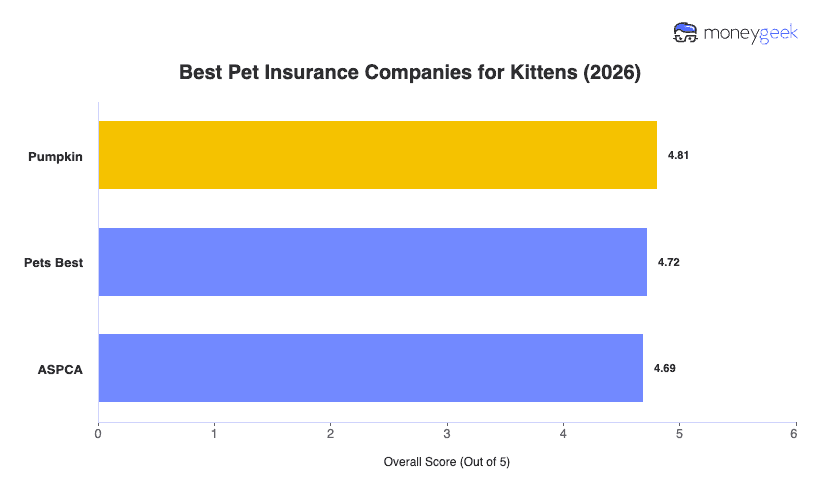
Based on my analysis of MoneyGeek’s kitten data, the best kitten insurance companies are:

  • Choose If You Want the Best Value and Excellent Claims Service: Pumpkin
  • Choose If You Want Broad Coverage With Direct Vet Payment: Pets Best
  • Choose If You Want to Save on Kitten Insurance Costs: ASPCA

For our best kitten insurance ratings, we evaluated affordability, customer experience and coverage across 18 major pet insurers using over 67,000 cat profiles representing mixed breeds and purebreds in all 50 states and Washington, D.C. Our analysis used a base profile of a Ragdoll under 1 year old with a $5,000 annual limit, $500 deductible and 80% reimbursement rate to ensure consistent comparisons across providers.

We analyzed pricing competitiveness across different breeds and locations, measured customer experience throughout the policy lifecycle from enrollment to claims and assessed coverage quality for kitten-specific health risks. Each insurer received a composite score based on affordability (50% of overall score), customer experience (30% of overall score) and coverage options and terms (20% of overall score).

For a detailed breakdown of the metrics, scoring methodology and analysis approach, see our full methodology.

Pumpkin

Pumpkin: Best Pet Insurance for Kittens Overall

COMPANY HIGHLIGHTS

Pumpkin ranks as the best pet insurance for kittens in my analysis. It offers top-tier customer service whether you’re buying coverage for your kitten, managing your policy and submitting a claim after a vet visit. The company also has an urgent pay service, Pumpkin Now, which expedites approvals for claims over $500 submitted at the vet, depositing reimbursements within 20 minutes to eligible bank accounts so you can use the funds to pay at checkout. This feature is valuable for kitten owners, as young cats are more likely to need emergency care or diagnostics during their first year, allowing eligible claims to be reimbursed quickly.

Pumpkin also imposes a 14-day waiting period for ligament and knee conditions, shorter than the industry average of six months, which is ideal for breeds such as Maine Coons and Norwegian Forest Cats that are predisposed to orthopedic conditions like hip dysplasia. However, it doesn’t provide a lot of flexibility for customizing your policy, so you won’t have as many options to adjust your deductible, reimbursement rate or annual limit to better match your budget or anticipated vet expenses as your kitten grows.  

Learn more: Pumpkin Pet Insurance Review

Pets Best

Pets Best: Best Kitten Insurance for Direct Vet Payment

COMPANY HIGHLIGHTS

Pets Best is my top pick if you want the best kitten insurance with direct vet payment. With its Vet Direct Pay feature, the company can send payment for eligible claims directly to licensed veterinarians instead of reimbursing you after the visit, reducing the amount you may need to pay upfront for unexpected treatments, diagnostics or emergency care during your kitten's first years. It also has the shortest accident waiting period among my recommendations, at zero to three days based on state, which allows owners of adventurous kittens that frequently climb, jump or explore new environments to access coverage much sooner.

However, Pets Best falls behind for customer experience, with a claim submission process that runs into issues more frequently, which can make it more stressful to manage claims after an unexpected illness or injury when you're already focused on your kitten's recovery.

Learn more: Pets Best Pet Insurance Review

ASPCA

ASPCA: Best Cheap Pet Insurance for Kittens

COMPANY HIGHLIGHTS

ASPCA leads as the best cheap pet insurance for kittens, averaging $11 per month and providing 51% savings against the national average. It also offers a comprehensive base plan that includes exam fees, prescription medications, hereditary conditions, prescription pet food and alternative treatments, so you’ll have robust coverage for many of the treatments and therapies your kitten may need throughout its life without having to purchase additional coverage for those benefits.

That said, ASPCA’s customer service lands in the bottom half of my analysis, particularly for policy management. Combined with its relatively poor mobile app experience and billing and renewals, this can make routine tasks like viewing policy information, updating account details and changing or renewing coverage for your kitten less smooth and efficient.  

Learn more: ASPCA Pet Insurance Review

What to Assess When Deciding Your Best Kitten Insurance Fit

Pet insurance providers for kittens can differ in their coverage terms, particularly on how they define pre-existing conditions, apply waiting periods or cover hereditary conditions. These differences can determine whether future veterinary expenses for your kitten are reimbursed, making these policy details just as important as the monthly premium. Before choosing a provider, compare each one’s coverage terms to avoid unexpected claim denials after your kitten develops a medical condition.

Pre-existing condition rules
Defines whether illnesses or injuries that showed symptoms before coverage began or during waiting periods are covered.
A narrow definition that limits pre-existing conditions to diagnosed illnesses or documented symptoms.
A broad definition that allows the insurer to classify vague symptoms, related conditions or undiagnosed issues as pre-existing.
Curable condition terms
Defines whether previously resolved conditions may become eligible for coverage after a specified waiting period.
A symptom- and treatment-free waiting period of 180 days or less, with fewer conditions permanently excluded from reconsideration.
Permanently excludes curable conditions from coverage.
The time between enrollment and when different types of coverage become effective.
Accident waiting periods of 0 to 3 days, illness waiting periods of 14 days or less, and orthopedic waiting periods that can be waived or are six months or less.
Long waiting periods for accidents and illnesses or extended wait for orthopedic conditions without a waiver option.
Hereditary condition coverage
Determines whether inherited diseases common to certain breeds are eligible for coverage.
Hereditary and congenital conditions with no breed-specific exclusions are covered in the base plan, after waiting periods are met.
Excludes hereditary conditions entirely or requires a costly optional add-on.
Prescriptions, exams and diagnostics
Determines whether common treatment-related expenses are included with covered claims.
Prescription medications, exam fees and diagnostic testing are included in the base plan.
Requires multiple add-ons to become eligible for coverage or excludes them altogether.
Coverage for microchipping
Determines whether microchipping is covered under the policy.
Coverage for microchipping included in the base plan or offered through an optional wellness plan.
Excludes microchipping permanently from coverage.

Determines whether routine kitten vaccines, such as FVRCP, rabies and FeLV (when recommended), are reimbursed.

Coverage for core kitten vaccinations, including FVRCP, rabies and FeLV, are included through an optional wellness plan with sufficient annual limits.

Excludes vaccinations permanently from coverage or doesn’t offer wellness add-ons that include them.
Determines whether routine sterilization procedures are eligible for reimbursement.

Coverage for spaying/neutering are covered through an optional wellness plan with high annual limits.

Excludes spaying and neutering entirely without an optional wellness add-on.
Describes how claims are reviewed and what medical records are used to determine eligibility.
Straightforward claims submission, transparent medical record reviews and consistently fast reimbursement timelines.
Requires excessive documentation, lacks transparency when evaluating medical history or has consistently slow claims processing.

Is Kitten Insurance Worth it?

Kitten insurance is worth it when you enroll before your kitten develops health conditions that could be considered pre-existing and when the policy provides coverage that matches your budget and long-term expectations. Enrolling early gives your kitten the best chance of qualifying for broader coverage throughout its life while helping reduce the financial impact of accidents, illnesses and emergency veterinary care.  

Kitten insurance is more likely to be worth it if you:

  • Recently adopted or purchased a kitten and can enroll before medical conditions are documented in its veterinary records.
  • Have a breed with known hereditary health risks, such as a Maine Coon or Persian, and want coverage for conditions that may develop later in life.
  • Own an adventurous or outdoor-access kitten that may have a higher risk of injuries or exposure to infectious diseases.
  • Would have difficulty paying a large, unexpected veterinary bill out of pocket.
  • Want long-term financial protection that can continue from kittenhood into adulthood without losing coverage for newly developed conditions.

Best Kitten Insurance Buying Checklist

Use this checklist before getting kitten insurance quotes, and complete the accompanying downloadable PDF as you compare providers or speak with their representatives. Working through each step in order helps you evaluate every insurer using the same criteria, making it easier to identify the policy that offers the most appropriate coverage for your kitten.

Download: Best Kitten Insurance Buying Checklist

  • blueCheck icon

    Identify your kitten's specific health risks

    Schedule a veterinary visit and ask your veterinarian which health conditions your kitten is most likely to develop based on its breed, age, family history and whether it will live primarily indoors or outdoors. Also ask which preventive services your kitten should receive during its first year, including core vaccinations (such as FVRCP and rabies), FeLV vaccination if appropriate, microchipping, spaying or neutering, parasite prevention and any recommended screening tests. 

    Having this information with you when comparing insurers will help you determine whether you need a standard accident and illness policy alone or additional coverage for routine preventive care through an optional wellness plan.

  • blueCheck icon

    Determine how much coverage you need

    Decide whether your budget and risk tolerance are better suited to an accident-only plan, an accident and illness policy or an accident and illness policy paired with an optional wellness plan. Then, choose an annual limit that could cover your kitten's most expensive expected treatments, a reimbursement rate that reflects how much of each eligible vet bill you want the insurer to pay back and a deductible that represents the amount you're comfortable paying yourself each policy year before reimbursement begins. 

    If you're unsure, use MoneyGeek's pet insurance coverage needs calculator to get a baseline recommendation, then use the same coverage settings when comparing providers so you're evaluating comparable policies.

  • blueCheck icon

    Research pet insurance providers

    Create a shortlist of insurers that specifically offer comprehensive accident and illness coverage for kittens, then download and read each company's sample policy before requesting a quote. Pay particular attention to coverage terms that affect kittens, including pre-existing condition definitions, curable condition rules, waiting periods, hereditary and congenital condition coverage, prescription medications, exam fees, diagnostics and available wellness benefits for vaccinations, microchipping and spaying or neutering. 

    Eliminate providers whose policy language contains broad exclusions or restrictive coverage terms before spending time comparing quotes.

  • blueCheck icon

    Read customer reviews

    Read customer reviews on Trustpilot, the Better Business Bureau (BBB) and Reddit, focusing on comments that describe firsthand claims experiences. Look for recurring feedback about reimbursement speed, communication during claims, handling of medical records and whether customers encountered unexpected coverage denials for conditions that developed after enrollment. Reviews can help identify patterns that aren't obvious from policy documents alone, particularly if multiple customers report similar experiences with claims involving kittens.

  • blueCheck icon

    Get quotes

    Request quotes using the same deductible, annual limit and reimbursement rate from every insurer so that premium differences reflect pricing rather than different levels of coverage. As you compare quotes, note whether benefits such as exam fees, prescription medications, rehabilitation or hereditary condition coverage are included in the base policy or require additional add-ons, since a lower premium may become more expensive once optional coverage is added.

Best Kitten Insurance: Bottom Line

Pumpkin, Pets Best and ASPCA are my recommendations for the best kitten insurance, but the right choice depends on your kitten's anticipated health needs, your preferred level of coverage and what fits comfortably within your budget. Before enrolling, compare each insurer's pre-existing condition rules, waiting periods, hereditary condition coverage and other policy terms alongside affordability, customer experience and coverage to find the best long-term fit for your kitten.

Best Kitten Insurance Chart

Best Pet Insurance for Kittens: Next Steps

At this stage, you can narrow your options to one or two providers and confirm pricing and availability using the same coverage assumptions for your kitten's breed, age and location. Comparing quotes on identical terms prevents misleading price differences and helps you validate which insurer offers the right balance of affordable premiums, reliable service and policy features for your kitten's specific health risks.

If cost is still your main concern

If you're still figuring out how much coverage you need

If you're ready to get quotes

Compare Kitten Insurance Rates

Ensure you are getting the best rate for your kitten insurance. Compare quotes from the top kitten insurance companies.

About Ritchel Mendiola


Ritchel Mendiola, Pet Insurance Writer

Ritchel Mendiola is a Pet Insurance Content Writer at MoneyGeek. She produces coverage guides, provider comparisons and cost analyses so pet owners can understand their options and avoid overpaying.

Ritchel spent over four years as a News and Feature Writer at Asian Journal Publications, where she reported for the Asian Journal newspaper and Balikbayan Magazine, conducted interviews and covered media events. At MoneyGeek, she covers policy terms, exclusions, waiting periods and reimbursement structures the way she treated news facts. They're sourced, verified and reported accurately rather than summarized from marketing copy.

She joined MoneyGeek in late 2021 in the loans vertical and moved to pet insurance content, which she now leads. Her published work includes provider comparisons, breed-specific cost guides, age-specific coverage analyses and state-level pricing studies, all from the vertical's 5 million pet insurance profiles across 18 major providers and all U.S. states.

LinkedIn: https://www.linkedin.com/in/rianmendi/

Contact Email: ritchel.mendiola@moneygeek.com